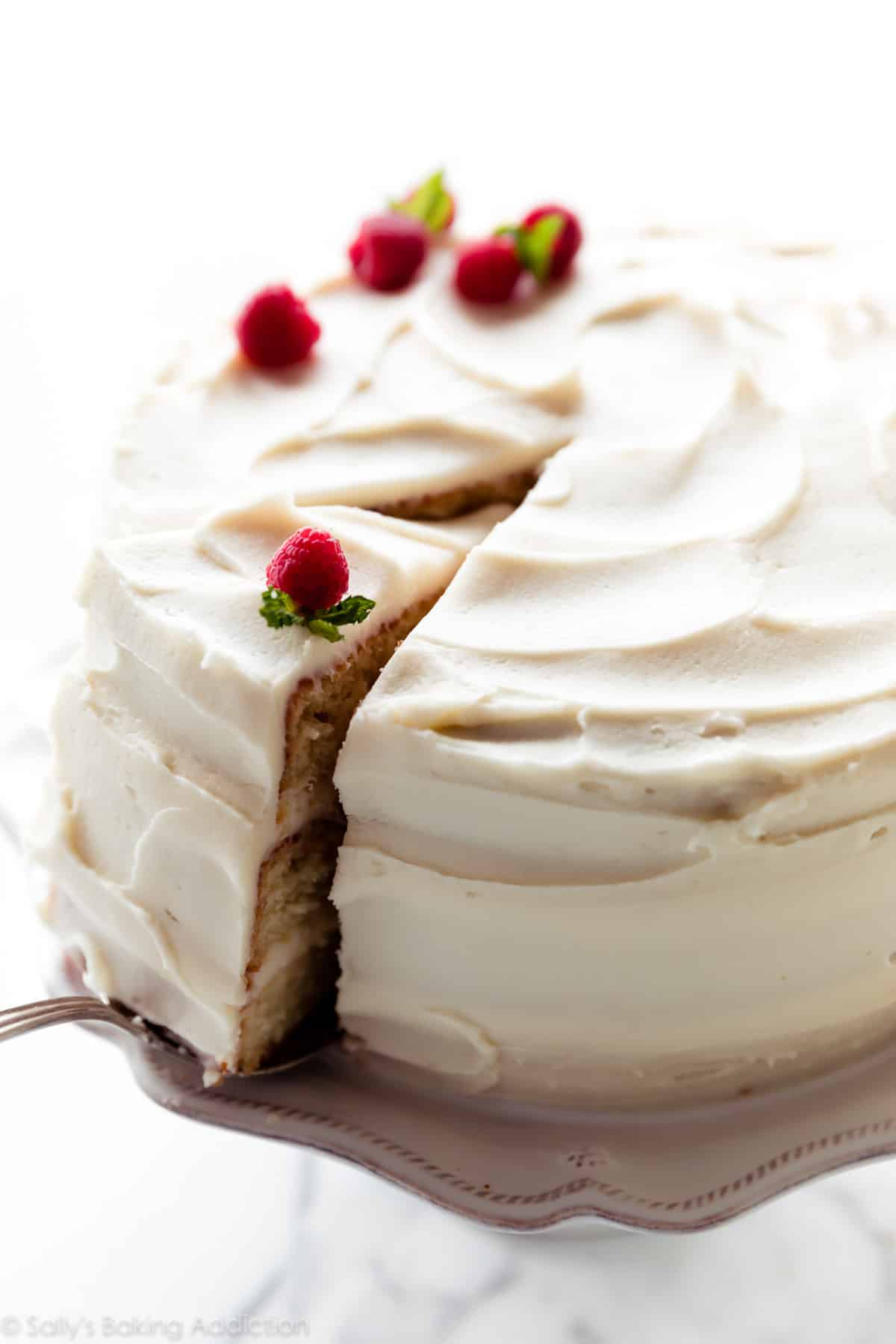
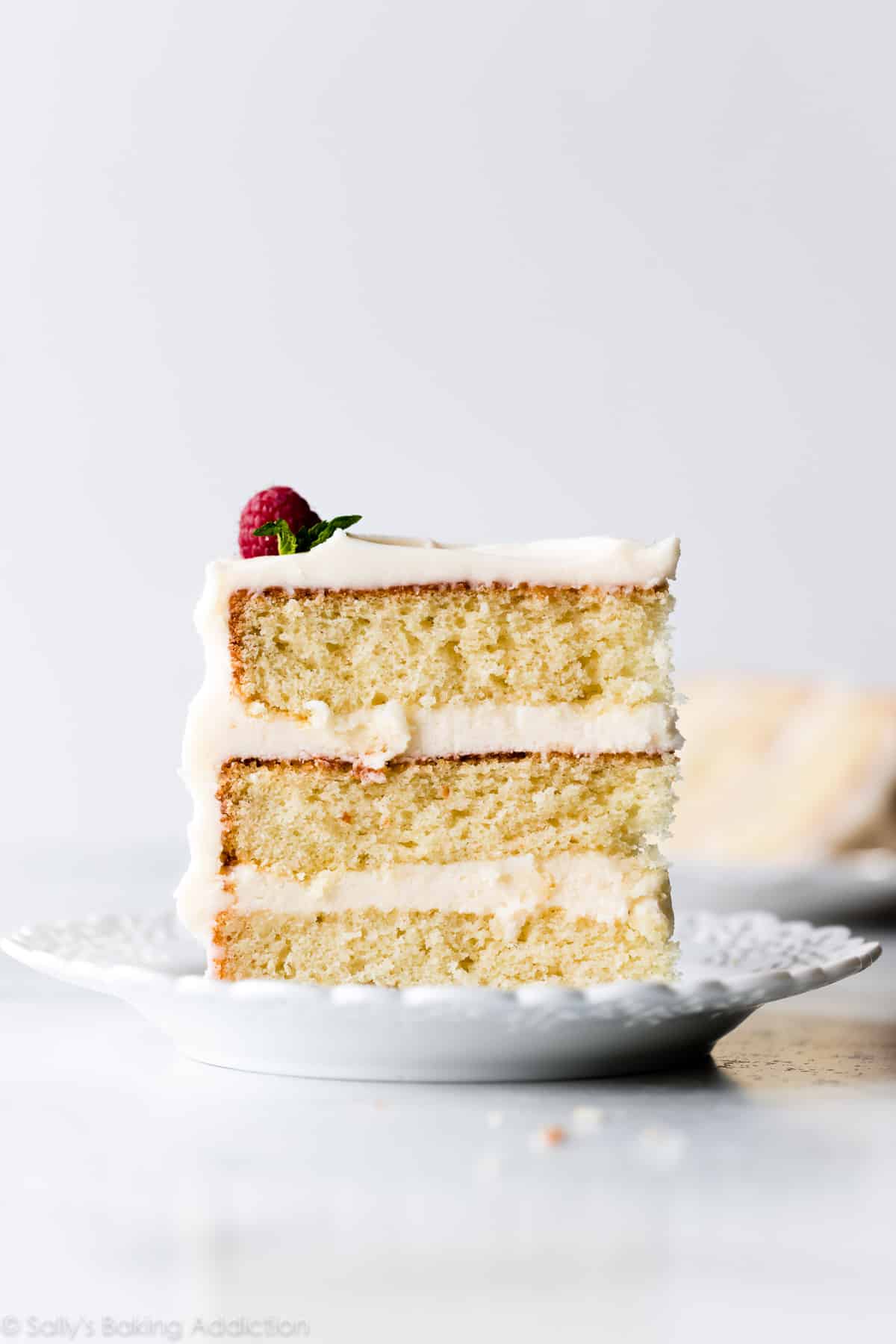
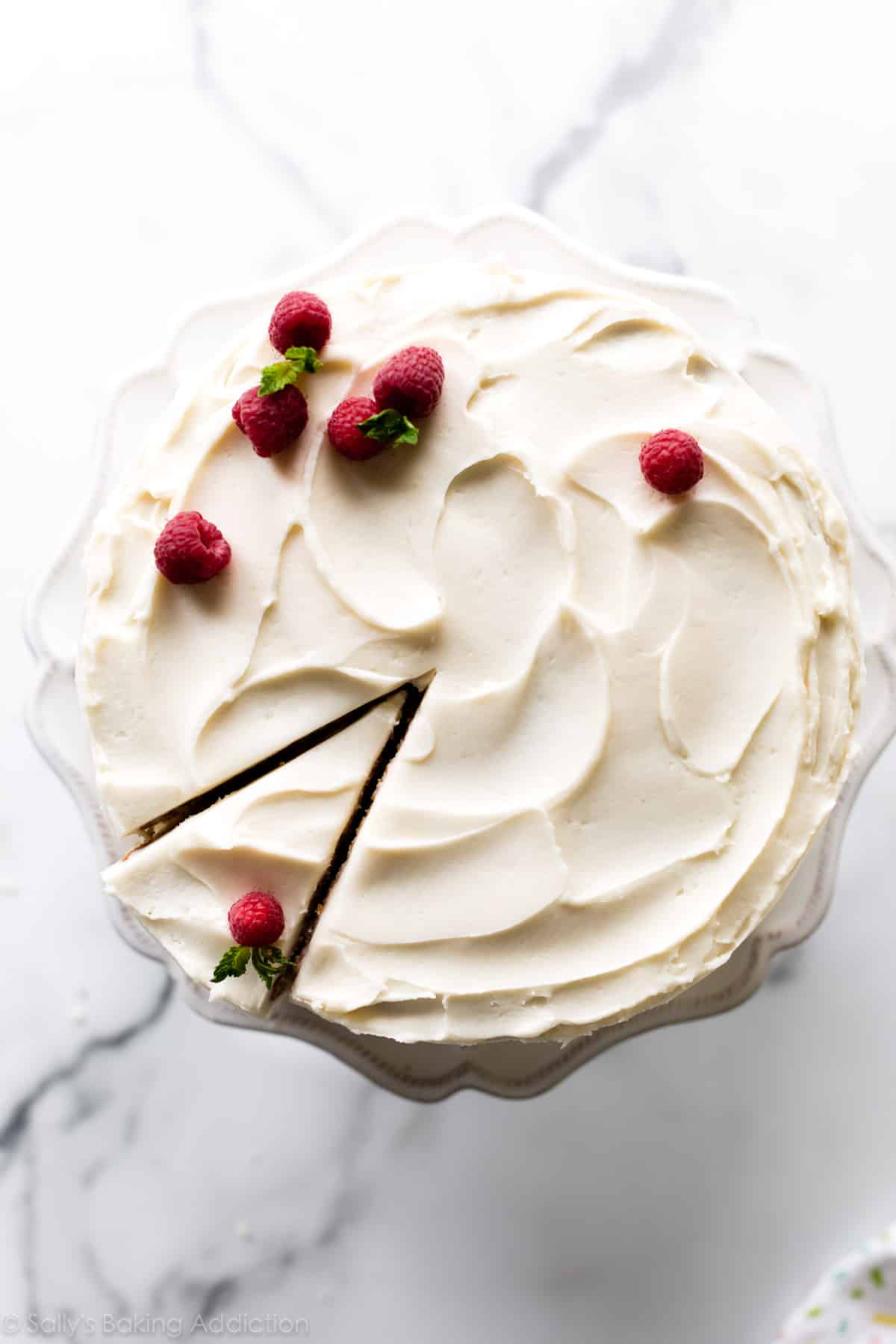
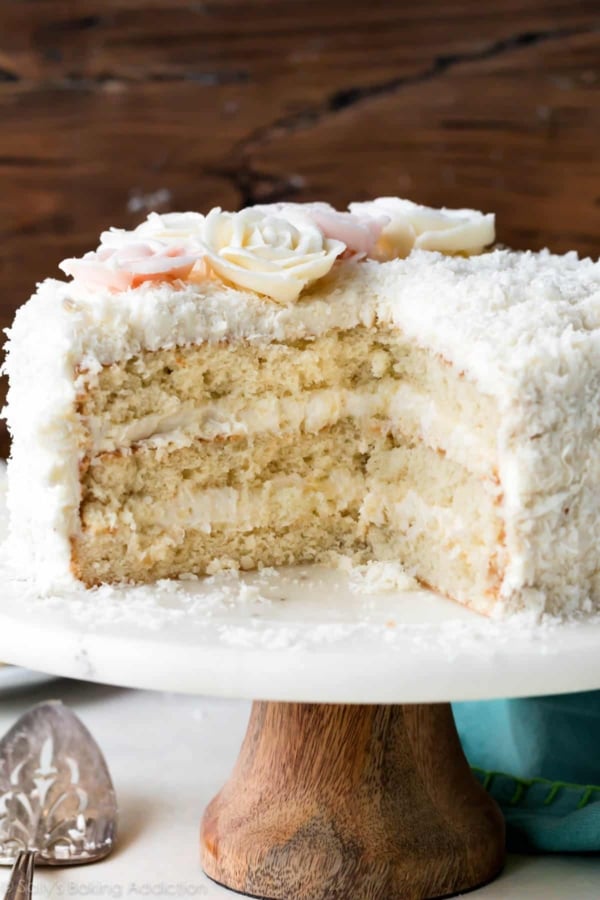
With its outstanding vanilla flavor, pillowy soft crumb, and creamy vanilla buttercream, this is truly the best vanilla cake I’ve ever had. And after 1 bite, I guarantee you’ll agree.
One reader, Sarah, commented: “This cake is elite. Texture, flavor, sturdiness for frosting and decorating, freezes well… It was a beautiful centerpiece and dessert for a baby shower. Thank you! ★★★★★“
One reader, Candice, commented: “This is truly the best vanilla cake I have ever tasted! It is among the best cakes I have made in my 20+ years of baking… ★★★★★“
One reader, Rary, commented: “Off. The. Charts. Absolutely scrumptious! ★★★★★“
Out of all the cake recipes on my website, there’s a glaring absence. There’s white cake with a pristine soft crumb, vanilla naked cake with a flavorful tight crumb, and checkerboard cake with a whimsical design.
What about a classic vanilla layer cake draped in vanilla buttercream? I already have homemade vanilla cupcakes and a vanilla 6 inch cake covered and now in all its crowning glory (and after plenty recipe testing catastrophes), I present you with cake perfection:
This is the best vanilla cake I’ve ever had.
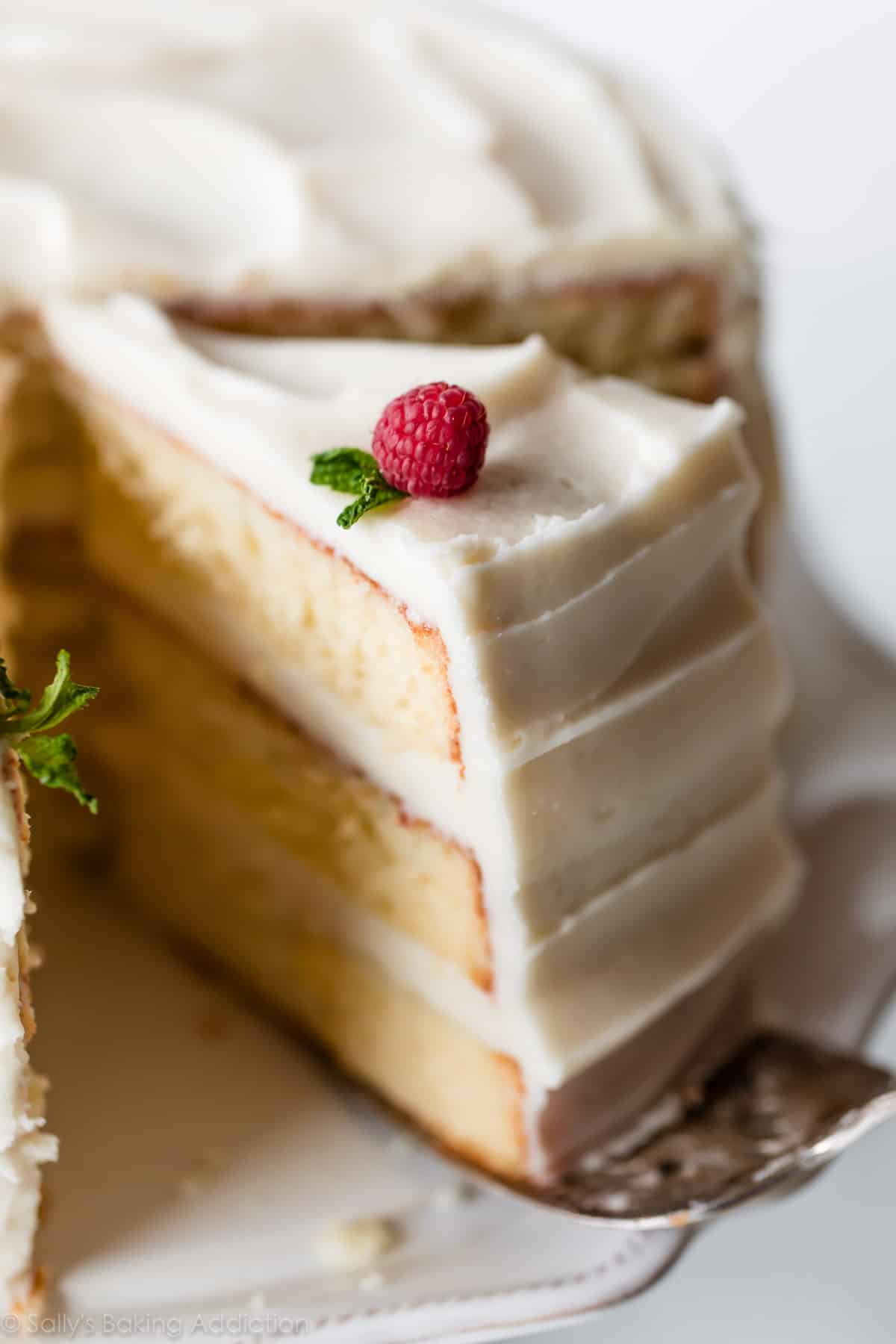
What Makes it the Best Vanilla Cake?
Let’s count the ways!
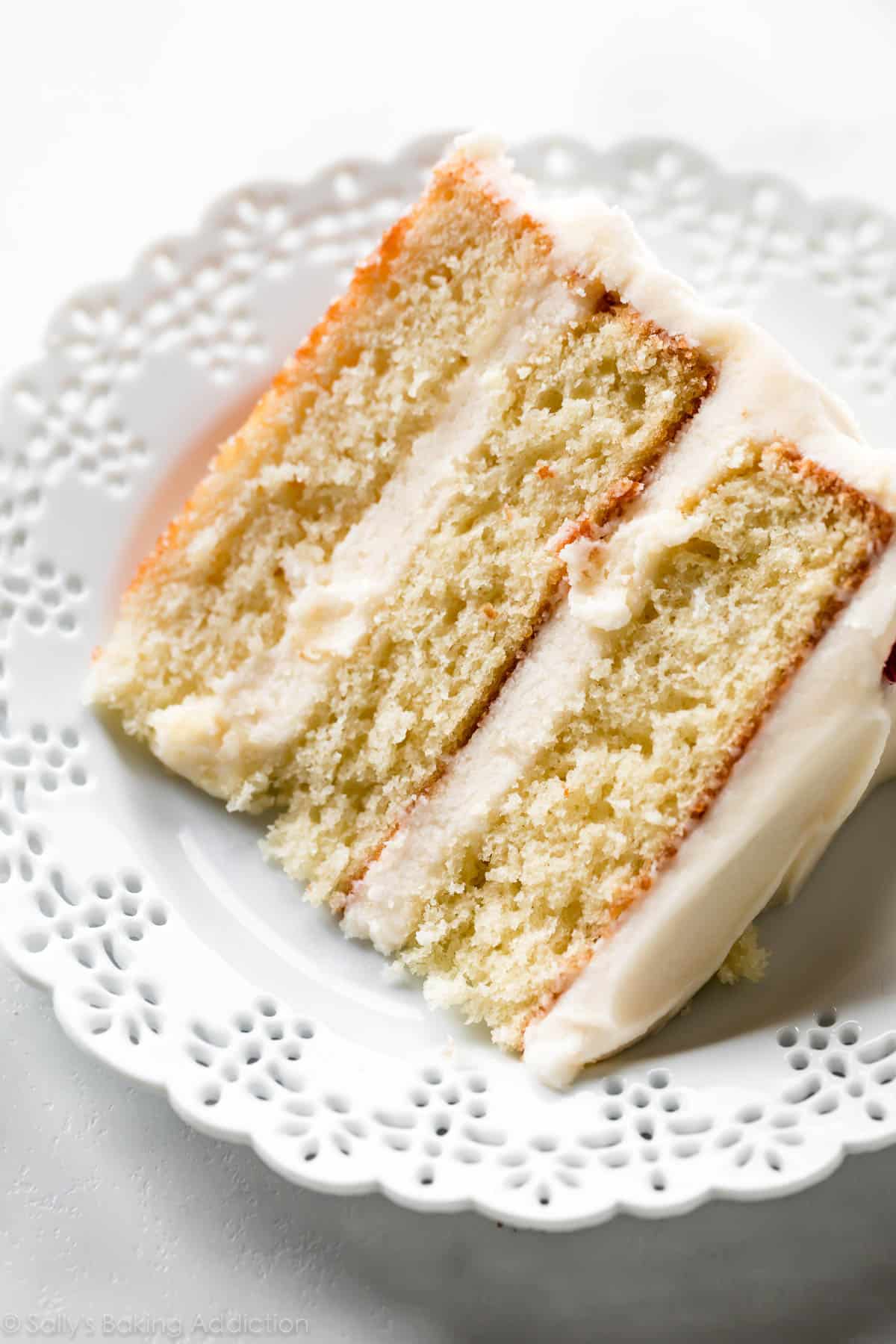
- Soft, light crumb from cake flour
- Fluffy from extra egg whites
- Buttery and cakey from creamed butter
- Stick-to-your-fork moist from eggs & buttermilk
- Extra flavor from pure vanilla extract
Not to mention its versatility: This vanilla cake batter is strong enough for shaped cakes, tiered cakes (see the slight variation in my homemade wedding cake recipe), and holds up beautifully under fondant. Use this batter for vanilla cupcakes, Bundt cake, or even piñata cake. It’s classy enough for a wedding celebration, but unassuming enough for a big family dinner.
Behind the Vanilla Cake Recipe
After years of cake successes and flops, I’m confident in this homemade vanilla cake. During my recipe testing, I combined my white cake recipe and naked cake recipe. These are two reader favorites and I knew they’d be the best starting point. At first there were too many eggs and I quickly learned sifting cake flour was NOT doing any favors.
You need the following power ingredients:
- Cake Flour: If you want a fluffy and soft bakery-style vanilla cake, cake flour is the secret. The cake will be denser and heavier using all-purpose flour.
- Eggs & 2 additional egg whites: 3 whole eggs provide structure, moisture, and richness. 2 extra egg whites keep the cake light and airy. I don’t recommend using 4 whole eggs; stick to the 3 egg & 2 egg white combination.
- Baking Powder & Baking Soda: Remember the differences in baking powder vs baking soda and why we use both in some recipes? Using enough baking powder to give these layers height gave the cake a bitter aftertaste. Baking soda allows us to use less baking powder.
- Buttermilk: Buttermilk is an acidic ingredient and baking soda requires an acid to work. Plus buttermilk yields an EXTRA moist cake crumb. See recipe note about using a DIY buttermilk substitute.
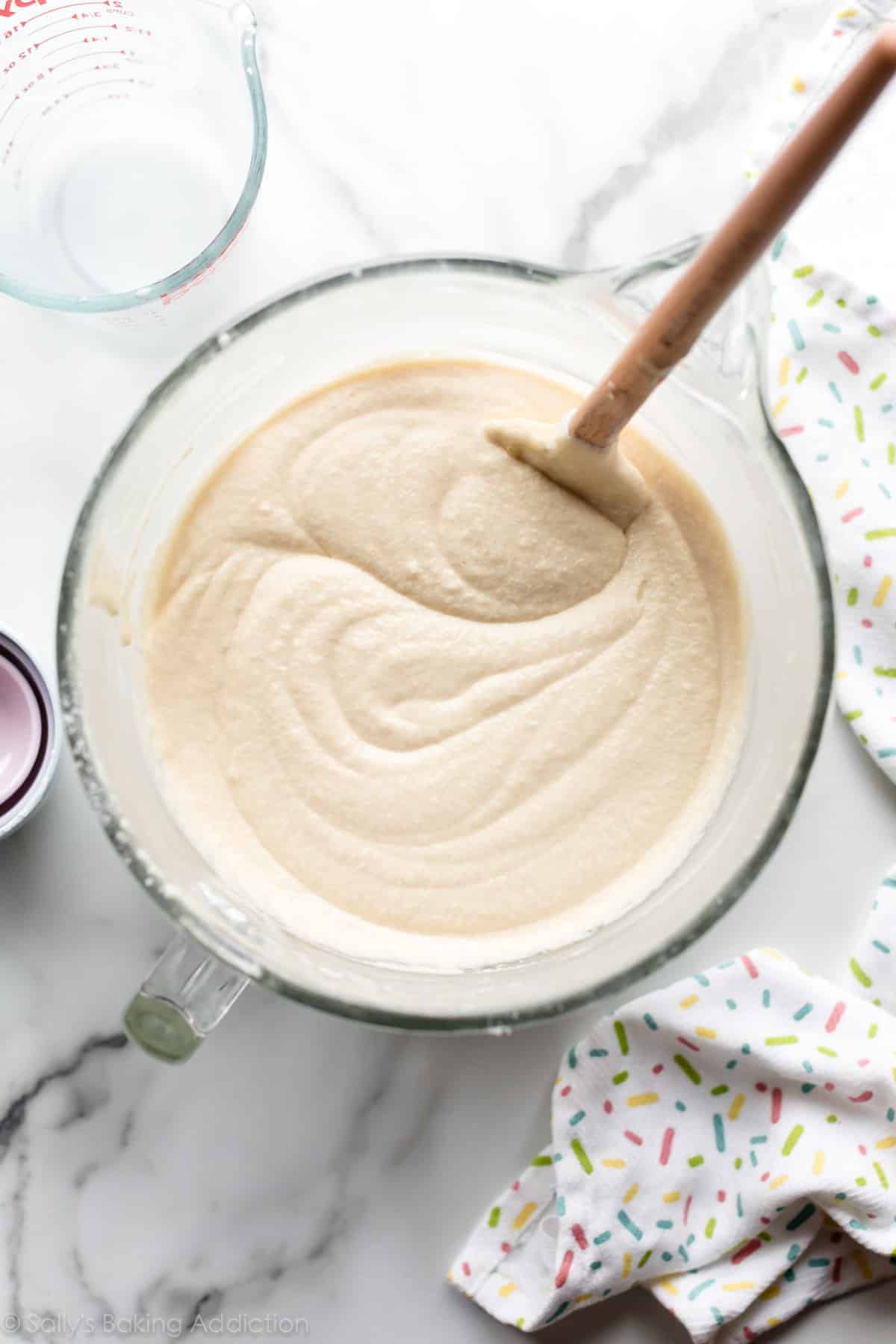
For more prominent vanilla flavor, use homemade vanilla extract. (What a fun DIY gift!) This vanilla cake batter is moderately thick and fits perfectly in 3 9-inch cake pans. We actually use the same exact batter to make snickerdoodle cake.
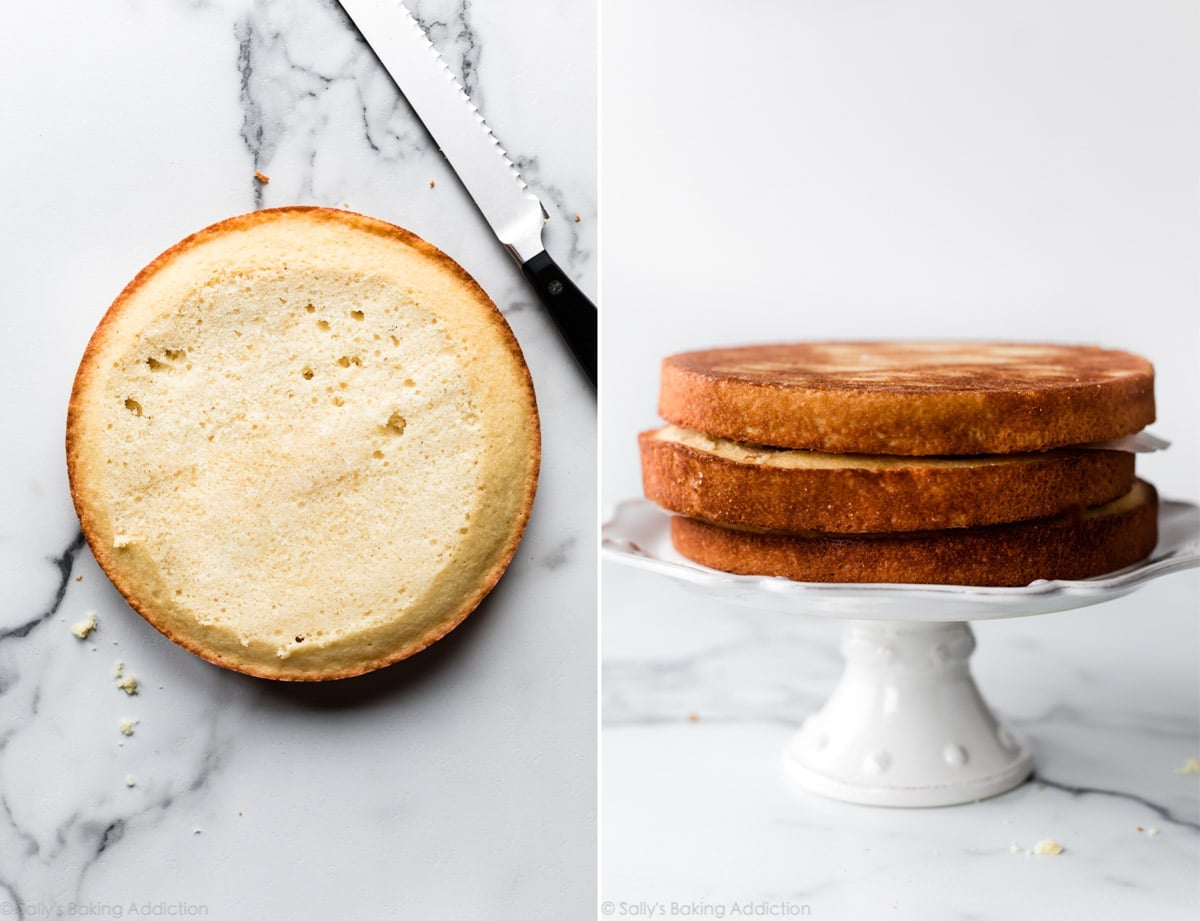
Do you know how to level a cake? Let me help. It’s really easy. You can use a fancy cake leveler, but I use a serrated knife. Carefully slice off the tippy top of the cooled cake layers, creating a flat surface. Leveling cakes doesn’t require a ruler, talent, or any mathematical equations. Instead, just use your eyes, hands, and a knife.
Leveling the cake layers promises a straight and sturdy layer cake.
How Much Frosting Between Cake Layers?
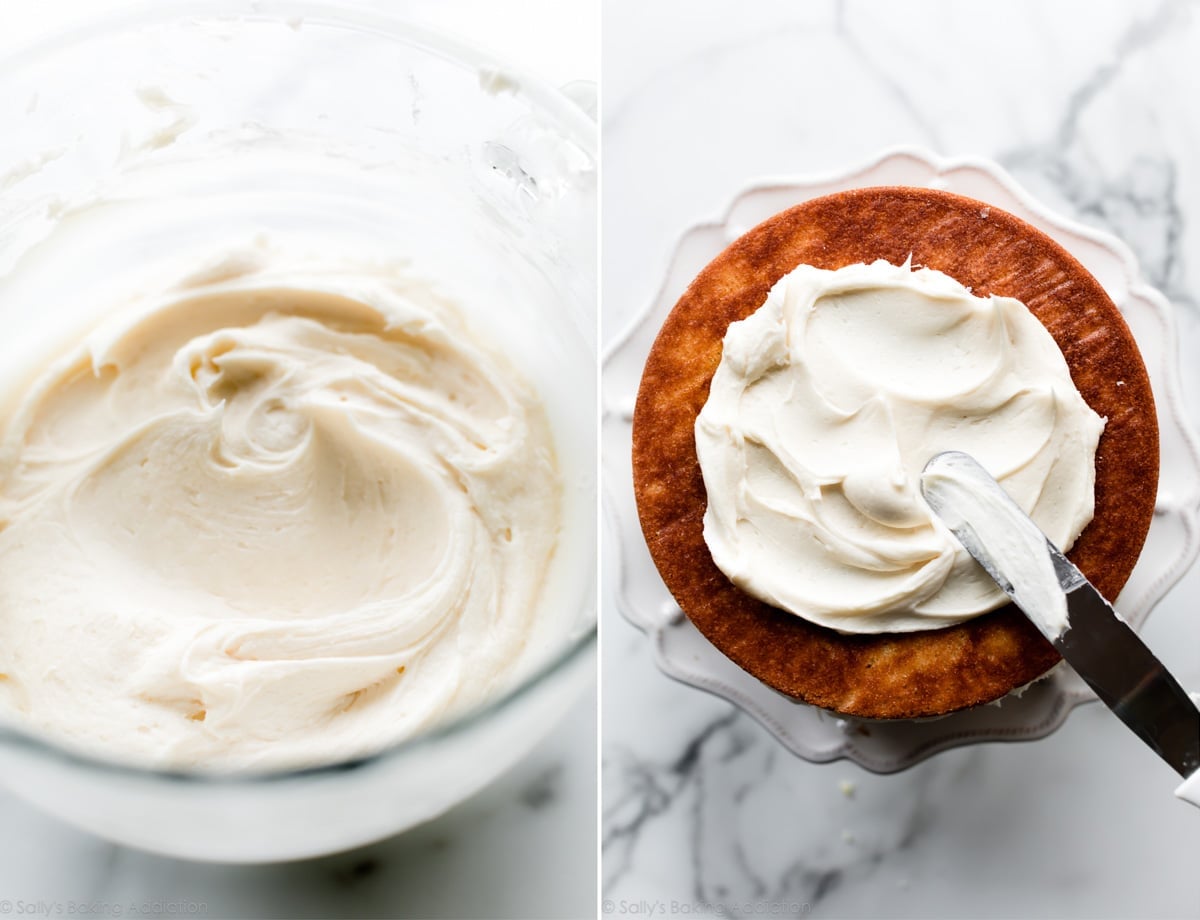
I always eyeball the amount of frosting between cake layers, but I measured when I decorated the pictured cake. The vanilla buttercream recipe below yields about 6 cups of frosting. I recommend you use about 1.5 heaping cups of buttercream between each cake layer and reserve the last 3 cups for outside the cake. If you are going to add a filling such as raspberry cake filling, you’ll use less frosting between the layers. You can use this detailed how to assemble and decorate a layer cake post as a guide!
Cake Decoration Inspiration: For a simple look, stick with vanilla buttercream, fresh berries, and mint sprigs. You can also decorate with chocolate buttercream (I recommend the same amount from this piñata cake), rainbow sprinkles, a chocolate ganache drip like on this chocolate chip cake, or even beautiful buttercream flowers.
Homemade Vanilla Cake Success Tips
Learn from my mistakes and bake the best cake on the 1st try!
- Follow the recipe closely. Use each power ingredient listed.
- Use room temperature ingredients. The batter mixes together evenly when all the cake ingredients are roughly the same temperature. This also reduces the risk of over-mixing and over-baking. Set out your ingredients 1 hour before beginning. Read more about why room temperature ingredients are important.
- Line your cake pans with parchment. Place your cake pans on a large sheet of parchment paper. Trace the bottom of the cake pan with a pencil. Cut parchment paper into rounds. Grease the pan and the parchment paper. Parchment paper rounds guarantee seamless removal from the pan because the cake slides right out.
- Cool cake layers completely. I’ve tried taking shortcuts by assembling a layer cake with semi-warm cake layers. Well, the frosting completely melts and causes the entire cake to collapse. Make sure each layer is cool– refrigerate or freeze the layers if you need to!
- Refrigerate decorated cake. After frosting the cake, place it in the refrigerator for at least 1 hour. This is optional, but it sets the frosting and cake layers. You’ll get beautifully clean slices because the crumbs are cool and tight.
Great read: Check out Tessa’s Top 10 Best Layer Cake Tips.
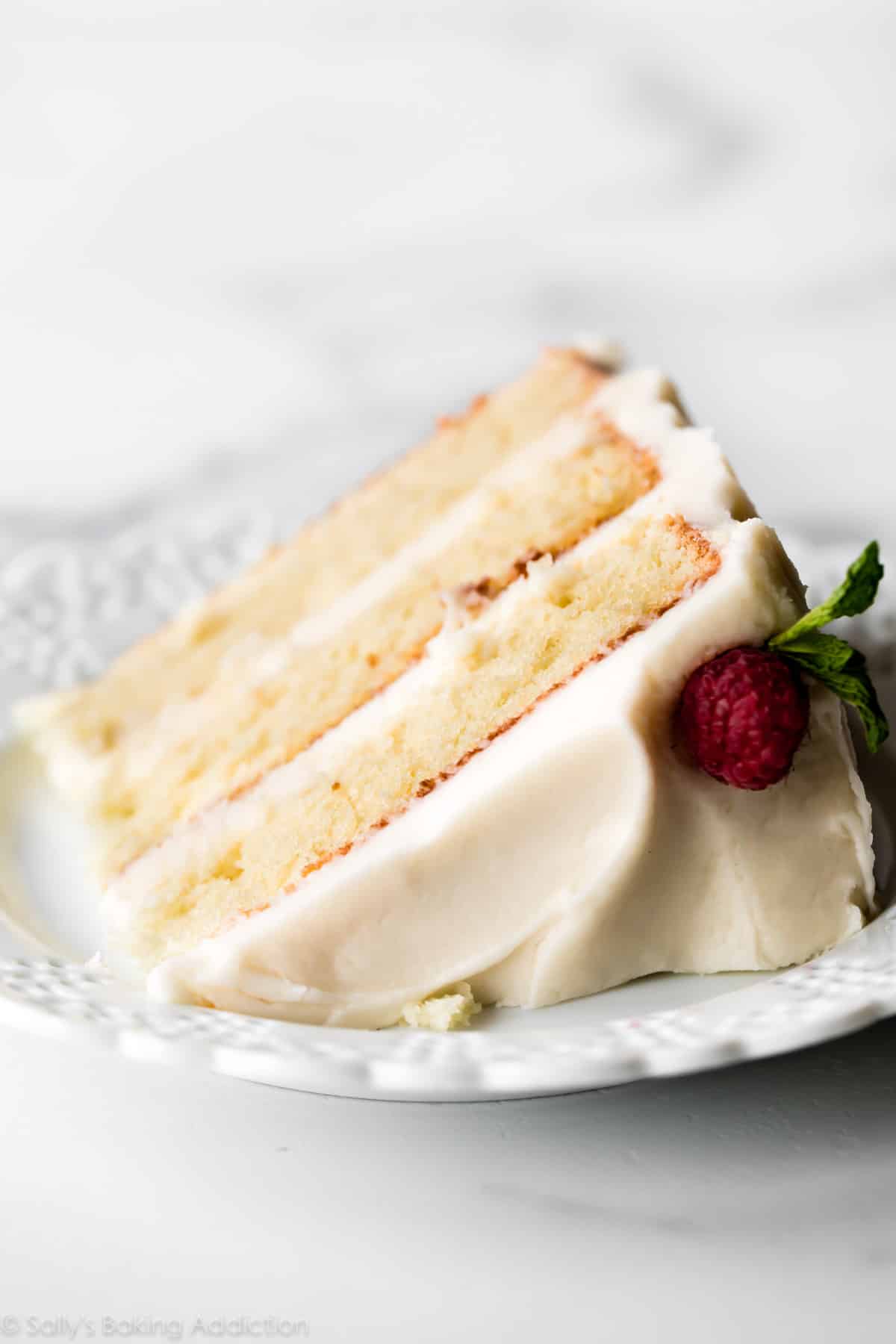
Finding the perfect vanilla cake recipe requires a celebration. Luckily we have cake!!!
More Classic Cake Recipes
And here is my perfected vanilla cupcakes recipe.
Print
Best Vanilla Cake
- Prep Time: 35 minutes
- Cook Time: 25 minutes
- Total Time: 4 hours (includes cooling)
- Yield: 12-14 servings
- Category: Dessert
- Method: Baking
- Cuisine: American
Description
With its outstanding vanilla flavor, pillowy soft crumb, and creamy vanilla buttercream, this is truly the best vanilla cake I’ve ever had. Make sure you read through the recipe and recipe notes before beginning. This recipe yields approximately 8 cups of batter which is helpful if you need this batter for different cake pan sizes and conversions.
Ingredients
- 3 and 2/3 cups (433g) cake flour (spooned & leveled)
- 1 teaspoon salt
- 2 teaspoons baking powder
- 3/4 teaspoon baking soda
- 1 and 1/2 cups (340g) unsalted butter, softened to room temperature
- 2 cups (400g) granulated sugar
- 3 large eggs + 2 additional egg whites, at room temperature*
- 1 Tablespoon pure vanilla extract (yes, a Tablespoon!)
- 1 and 1/2 cups (360ml) buttermilk, at room temperature*
Vanilla Buttercream
- 1 and 1/2 cups (340g) unsalted butter, softened to room temperature
- 5 and 1/2 cups (650g) confectioners’ sugar
- 1/3 cup (80ml) whole milk or heavy cream
- 1 and 1/2 teaspoons pure vanilla extract
- 1/8 teaspoon salt
Instructions
- Preheat oven to 350°F (177°C). Grease three 9-inch cake pans, line with parchment paper rounds, then grease the parchment paper. Parchment paper helps the cakes seamlessly release from the pans. (If it’s helpful, see this parchment paper rounds for cakes video & post.)
- Make the cake: Whisk the cake flour, salt, baking powder, and baking soda together. Set aside.
- Using a handheld or stand mixer fitted with a paddle or whisk attachment, beat the butter and sugar together on high speed until smooth and creamy, about 3 minutes. Scrape down the sides and up the bottom of the bowl with a silicone spatula as needed. Beat in the 3 eggs, 2 egg whites, and vanilla extract on high speed until combined, about 2 minutes. (Mixture will look curdled as a result of the egg liquid and solid butter combining.) Scrape down the sides and up the bottom of the bowl as needed. With the mixer on low speed, add the dry ingredients just until combined. With the mixer still running on low, pour in the buttermilk and mix just until combined. You may need to whisk it all by hand to make sure there are no lumps at the bottom of the bowl. The batter will be slightly thick.
- Pour batter evenly into cake pans. Weigh them to ensure accuracy, if desired. Bake for around 23-26 minutes or until the cakes are baked through. To test for doneness, insert a toothpick into the center of the cake. If it comes out clean, it’s done. Allow cakes to cool completely in the pans set on a wire cooling rack. The cakes must be completely cool before frosting and assembling.
- Make the frosting: In a large bowl using a handheld mixer or stand mixer fitted with a whisk or paddle attachment, beat the butter on medium speed until creamy, about 2 minutes. Add confectioners’ sugar, milk, vanilla extract, and salt with the mixer running on low. Increase to high speed and beat for 2 minutes. Add more confectioners’ sugar if frosting is too thin, more milk if frosting is too thick, or an extra pinch of salt if frosting is too sweet.
- Assemble and decorate: Using a large serrated knife, slice a thin layer off the tops of the cakes to create a flat surface. Discard (or crumble over ice cream!). Place 1 cake layer on your cake stand, cake turntable, or serving plate. Evenly cover the top with about 1 and 1/2 cups of frosting. Top with 2nd cake layer and evenly cover the top with about 1 and 1/2 cups of frosting. Top with the third cake layer. Spread the remaining frosting all over the top and sides. I use and recommend an icing spatula to apply the frosting.
- Refrigerate cake for at least 1 hour before slicing. This helps the cake hold its shape when cutting.
- Cover leftover cake tightly and store in the refrigerator for up to 5 days.
Notes
- Make Ahead & Freezing Instructions: The cake layers can be baked, cooled, and covered tightly at room temperature overnight. Likewise, the frosting can be prepared then covered and refrigerated overnight. Let the frosting sit at room temperature to slightly soften for 10 minutes before assembling and frosting. Frosted cake or unfrosted cake layers can be frozen up to 2-3 months. Thaw overnight in the refrigerator and bring to room temperature before decorating/serving. See how to freeze cakes for detailed instructions.
- Special Tools (affiliate links): 9-inch Round Cake Pans | Glass Mixing Bowl | Whisk | Electric Mixer (Handheld or Stand) | Silicone Spatula | Kitchen Scale (optional) | Cooling Rack | Large Icing Spatula | Cake Turntable | Bench Scraper | Cake Carrier (for storing and transporting)
- 9×13-inch Cake: I recommend using my white cake batter instead. Both use similar ingredients and produce a deliciously light vanilla cake. See recipe notes for the 9×13 inch version.
- 2 Layer Cake: I recommend using my 2 layer white cake batter instead. Both use similar ingredients and produce a deliciously light vanilla cake.
- Bundt Cake: This vanilla cake batter will fit into a 10-12 cup or larger Bundt pan. I’m unsure of the exact bake time (likely around an hour), but use a toothpick to test for doneness. Same oven temperature.
- Cupcakes: Fill cupcake liners 2/3 full. Bake at 350°F (177°C) for 19-21 minutes. Yields about 3 dozen. Or try my vanilla cupcakes recipe.
- Cake Flour: To prevent a dry-tasting cake, make sure you are spooning and leveling the flour or weighing it. For the best results, I strongly recommend cake flour. You can find it in the baking aisle and I have many more recipes using it. Usually a homemade cake flour substitute works, but this recipe uses far too much cake flour and the homemade substitute is not ideal.
- Eggs: 3 whole eggs provide structure, moisture, and richness. 2 extra egg whites keep the cake light and airy. I don’t recommend using 4 whole eggs; stick to the 3 egg & 2 egg white combination. Here are recipes using leftover egg yolks.
- Buttermilk: If you don’t have buttermilk, you can make a DIY buttermilk substitute. Add 2 teaspoons of white vinegar or lemon juice to a liquid measuring cup. Then add enough whole milk to the same measuring cup until it reaches 1 and 1/2 cups. (In a pinch, lower fat or nondairy milks work for this soured milk, but the cake won’t taste as moist or rich.) Stir it around and let sit for 5 minutes. The homemade “buttermilk” will be somewhat curdled and ready to use in the recipe.
- Why is everything at room temperature? All refrigerated items should be at room temperature so the batter mixes together easily and evenly. Read more about why room temperature ingredients are important.
- Want chocolate frosting instead? I recommend the recipe/amount of chocolate frosting I use for Piñata Cake.
- Sprinkle Cake: To make a sprinkle cake, fold about 3/4 cup (135g) of sprinkles into the cake batter. Avoid nonpareils (the little balls), which tend to bleed their color. Or try this confetti birthday cake, which is quite similar to this recipe.







Reader Comments and Reviews
Hi Sally
I love your receipe. I have baked a few times and the cakes were well received.
However, each time the top centre part of the cake will crack. And the centre of the cake will still be wet while rest of the cake are already cooked. Can you please share some tips on how to improve on this. Tks alot.
Your Fan 😀
Alice
Thank you for creating and posting this recipe – definitely lives up to its name! Everyone loved it.
Hi Sally,
I would like to try this cake with 12 inch pans. I realize I may have extra batter left over. I don’t see a conversion for 12 inch pans. Please help!
I followed the recipe exactly and had excellent results! It is the very best vanilla cake and frosting I’ve ever made. , Very moist, not too sweet but sweet enough. Absolutely perfect!
Hi! I was wondering if it is ok to use some drops of liquid food coloring into the frosting to make it pinkish for my daughter’s birthday, for decoratinge the outside. Thanks
Absolutely! We do it all the time!
Hi Sally, I just love your recipes and find them all to be fool proof and delicious, so thank you.
Just wondering, I always find a big discrepancy between a measured cup (leveled) and its equivalent mgs. Which do you believe is better? To measure ingredients in cups or mgs? Thanks
Hi Sonia, Using a kitchen scale to measure is the most accurate. We love to say “A cup isn’t always a cup, but a gram or ounce is always a gram or ounce.” We wrote a whole post about measuring you may find helpful: How to Properly Measure Baking Ingredients
Hi Sally, I wanted to thank you for your vanilla and triple chocolate cake recipes.. I made a two tiered hogwarts theme cake for my son’s birthday last week.. it was awsome!! My son loved it!!! It was a huge cake but not even a crumb was left as my guests wanted to take some home with them as well!! I would like to share pictures with you but couldn’t figure out how. Thanks a million once again!!
We’re so happy those cakes were such a hit for you! Thank you for your kind review. We’re always happy to see baker’s photos – shoot us an email at sally@sallysbakingaddiction.com
Hello!
I love using this recipe for my vanilla cakes! It is a definite go to as it is always moist and has a great vanilla flavor! Just wondering how you would recommend halving this recipe?? I looked at your other similar recipes but like this one, it just makes a bit too much sometimes!!
Hi Stephanie! You can halve this recipe for a smaller cake, or you might follow our 6 inch vanilla cake recipe instead. Equally delicious!
Hi Sally,
How could I make this recipe work for a 3-layer cake using 6” baking pans?
Hi Alicia, for a 3 layer, 6 inch cake we recommend following the vanilla cake recipe in our 6 inch cakes post. Enjoy!
Amazing cake! Made it for my husbands birthday using 3x8in square pans instead of rounds and it worked great but I needed about 27-29 min to bake. It was super moist and very fluffy. My husband said it was the best cake he has ever had. This was my first attempt of making a cake from scratch in over a decade and I couldn’t be more happy that I chose this recipe.
Do you recommend sifting the cake flour?
It doesn’t hurt, but we don’t find it necessary for this cake. Happy baking!
Wonderful recipe- always love buttermilk cakes
One question: do you have any suggestion for salvaging a vanilla cake you think you’ve over baked a bit? Any type of soak to brush on to add moisture? Thanks!
Hi Patti, you’re correct — our best recommendation would be adding a simple syrup to try giving the cake a little extra moisture. Hope this helps!
Hi Sally! Would you recommend swapping the vanilla extract for real vanilla bean? Or no?
Hi Erica! You can definitely use vanilla beans. We recommend scraping the seeds from 1/2 or 1 whole vanilla bean, then using 1 or 1 and 1/2 teaspoons of pure vanilla extract. We still recommend using some vanilla extract even if you add vanilla bean.
I used the cake flour substitute as described under the “power ingredients” section and the cake was quite dense and not at all fluffy as expected. Now that the cake has already been made and served, I read in the notes that, “ Usually a homemade cake flour substitute works, but this recipe uses far too much cake flour and the homemade substitute is not ideal.” The discrepancy between the two areas of guidance led to a disappointing experience and cake.
Thanks so much for your feedback on this cake, Ashley. I’ll look into that conflicting information.
Hey sally i love this cake but i need to make it in a 9×13inch pan how long would i need to bake it for and do you think its sturdy enough to carve it a bit to look like half a soda can? Im making a cake for my mom and trying to get creative
Hi Alexis! We recommend using our white cake batter instead. Both use similar ingredients and produce a deliciously light vanilla cake. See recipe notes for the 9×13 inch version — it should be plenty sturdy to carve as you mention. Hope it’s a hit!
Hi!
I have a question…
I can’t fit three pans in my oven at one time (smaller oven with only two racks). Only two will fit, one on each rack. Will the quality of the third layer be affected by waiting for the first two pans to bake? or should I just go with the two layer recipe?
Does the answer for this apply to other cakes as well? because I want to try the Dark Chocolate Mousse Cake and it has four layers so I’ll run into the same issue.
Thanks!!
Hi Brian! You have two options – bake two pans first and let the other(s) sit at room temperature until there’s room in the oven (it will be fine sitting for a bit) or bake all three at the same time and be very deliberate about rotating the pans part way through baking. All ovens are different so you may need to experiment to find what works best for you. Hope this helps!
I love this cake! I made it exactly as directed with 3 9” round pans and it really was the best vanilla cake I’ve ever had. Now my granddaughter wants me to bake a giant donut for her birthday. I tried this recipe in a tube pan and it had to bake 50 minutes. It just didn’t have the same fluffy texture either. Sally do you have any suggestions to make a giant vanilla donut?
Thank you so much!
Hi Rose, A sturdier cake like this cream cheese pound cake would be perfect for a giant donut cake! Let us know if you give it a try
I want to substitute oil for the butter in this recipe, do you think it will work? If so, what will be the amount of oil to be used?
Hi Rita! We don’t recommend that swap for this cake.
Sally, I made this cake for Mother’s Day for our daughter in law. It was the best vanilla cake I have eaten. It was light, moist and not to sweet. We added a little strawberry jam in between the layers and it was delicious!
Your site is my go to for recipes. I have never been disappointed!
Winning recipe! I was searching for a way to use up my surplus of cake flour. I appreciate the explanations about why the recipe is the way it is.
I made this recipe 3 times. Each time it was on the dry side. I kept thinking it was something I did but by this last time making it I realized I just have to use a different recipe. I like moist cake. This one just didn’t work.
While this is a fine cake, I prefer the Classic White Cake Recipe from Cook’s Illustrated. That recipes uses the reverse creaming method (AKA two-stage method) which produces a more tender crumb. By mixing the flour with the butter at the beginning, there’s no chance for the flour to become overglutenized. The result is pure velvet.
Hi Sally, Can I half this recipe and make it into 2 layers of 6″ cake? I don’t know how to reduce 1/3 in your 6″ 3 layer vanilla cake.
Hi Ran! We recommend using our 6-inch vanilla cake recipe – make 2 layers and use any extra batter for cupcakes. Happy baking!
Hi there, I’d love to do this white cake with chocolate instead of vanilla frosting. Should I double your choc frosting recipe from your yellow cake to do this and will it be enough to frost this 3 tiered white cake?
Hi Sheila! We recommend following these ratios to cover this 3 layer vanilla cake. Enjoy!
I made this cake and it tasted good but the vanilla flavor wasn’t very strong and it had a similar taste to cornbread. what do you suggest i do?
Hi Mackenzie! Sally wrote this post which I know you’ll find helpful if you have time to review it: Latest Recipe Testing. There’s information on how cakes can sometimes taste like cornbread there!
Dear Sally
Thank you for sharing the receipe and the various tips. I have baked 3 times using your receipe, its tasty and moist.
The only challenge is each time the centre of the cake is wet whereas other part of the cake is cooked. I used toothpick to test the cake. The top also cracked when I baked longer for the centre to be cooked through.
Apppreciate to please advise how to
rectify it. Thank you.
Best Regards
Fion
Hi Fion, we’re so happy you enjoy this cake recipe! Next time, try covering the top of your pans with aluminum foil part way through the bake time if you notice the tops browning before the center is finished baking.
I am dying to try this recipe but I want to do a two layer using 8 inch pans. How can I adjust it in order to make sure that works out?
Hi Bianca! For a two layer cake, we suggest following this white cake recipe instead (same great vanilla flavor!). Or you could reference this cake pans and conversions guide to scale down this vanilla cake recipe.
This cake was absolutely amazing. I’ve struggled in the past making cakes and have been avoiding using any buttercream because my frosting would come out overly sweet and too buttery. The frosting was a nice thick consistency and after I froze my cakes for an hour it glided right over the whole thing. Recipe yielded more than enough frosting, I added around 600 grams of powdered sugar and it was enough. The cake was a nice vanilla and perfect sweetness. Thank you!
This is my second rating on this – still the best cake! Even easier to make the second time!
I want to use this recipe for my daughter’s next birthday. I’ve read through your conversion tips and I think it should work for the number pan I got (link below). The pan instructions say that a box of cake mix works for it, so I assume your recipe should fit and then have some left overs. I hope so b/c my kids and I really love the flavor of this cake!
Hi! Thanks for this recipe! I’d love to try it out for my daughter’s first birthday and was wondering if I can make this cake a few days in advance and keep it in the fridge. I don’t have time to thaw it overnight if I freeze it. Would the cake still taste good if it was made 3 days in advance?
Hi Karen, It would likely be ok if covered very well in the refrigerator, but it really will taste the best/freshest if made 24 hours ahead of time. You can also make the individual layers and wrap them very well, refrigerate, and then assemble the day of if that is an option for you.
I love the recipe and follow it to every gram.
But my cakes always fall apart/crumple when I assemble them. I bet I still do something wrong…
When they finished baking, I wrap them in cellophan (double layer) and store them in my fridge.
Today I did as well and assembling and frosting were a mess!
Do you have any tips for that?
Best wishes,
Shonela
Hi Shonela! Usually when cakes crumble, they’re too dry. We don’t recommend storing cake layers in the fridge as it will dry them out. Here’s our tips for making cakes ahead of time if you’re interested in an alternate method. And here’s some tips for preventing dry cakes that may help as well. Crumb coating your cakes before fully frosting will help to seal in crumbs when you’re decorating. You can read more about that in our naked vanilla cake (a half-naked cake is similar to a crumb coat). Hope this helps!