With its outstanding vanilla flavor, pillowy soft crumb, and creamy vanilla buttercream, this is truly the best vanilla cake I’ve ever had. And after 1 bite, I guarantee you’ll agree.
One reader, Sarah, commented: “This cake is elite. Texture, flavor, sturdiness for frosting and decorating, freezes well… It was a beautiful centerpiece and dessert for a baby shower. Thank you! ★★★★★“
One reader, Candice, commented: “This is truly the best vanilla cake I have ever tasted! It is among the best cakes I have made in my 20+ years of baking… ★★★★★“
One reader, Rary, commented: “Off. The. Charts. Absolutely scrumptious! ★★★★★“
Out of all the cake recipes on my website, there’s a glaring absence. There’s white cake with a pristine soft crumb, vanilla naked cake with a flavorful tight crumb, and checkerboard cake with a whimsical design.
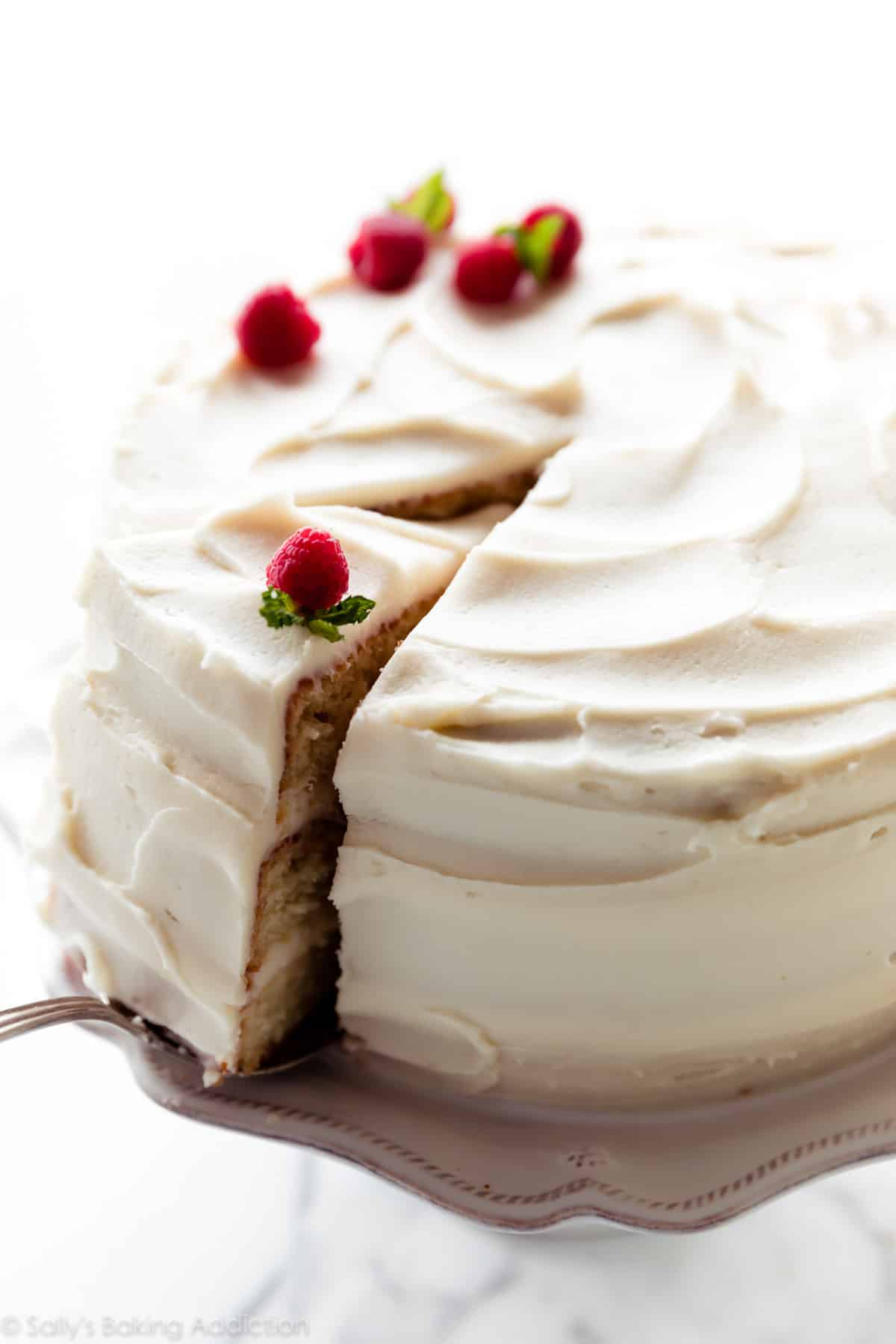
What about a classic vanilla layer cake draped in vanilla buttercream? I already have homemade vanilla cupcakes and a vanilla 6 inch cake covered and now in all its crowning glory (and after plenty recipe testing catastrophes), I present you with cake perfection:
This is the best vanilla cake I’ve ever had.
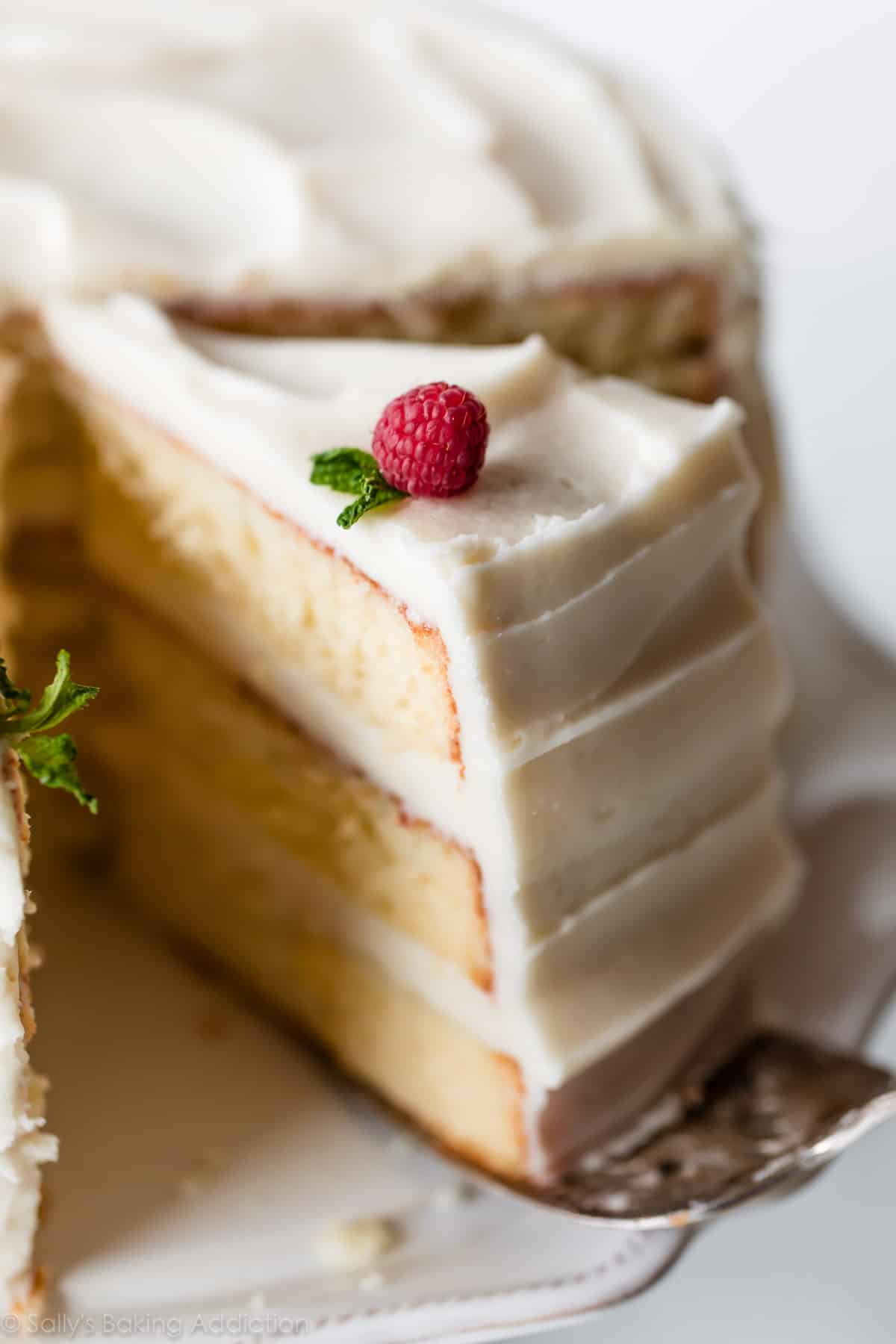
What Makes it the Best Vanilla Cake?
Let’s count the ways!
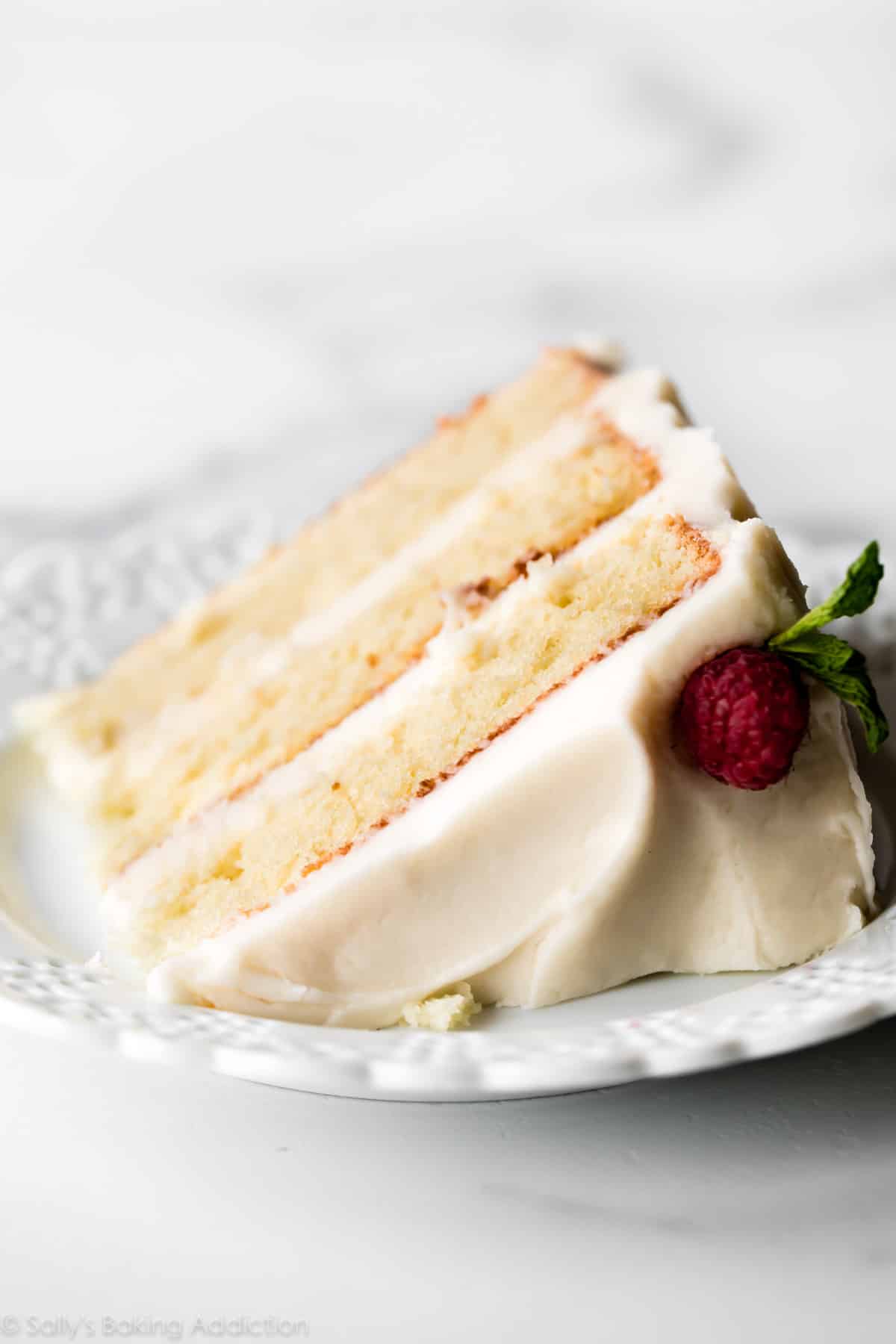
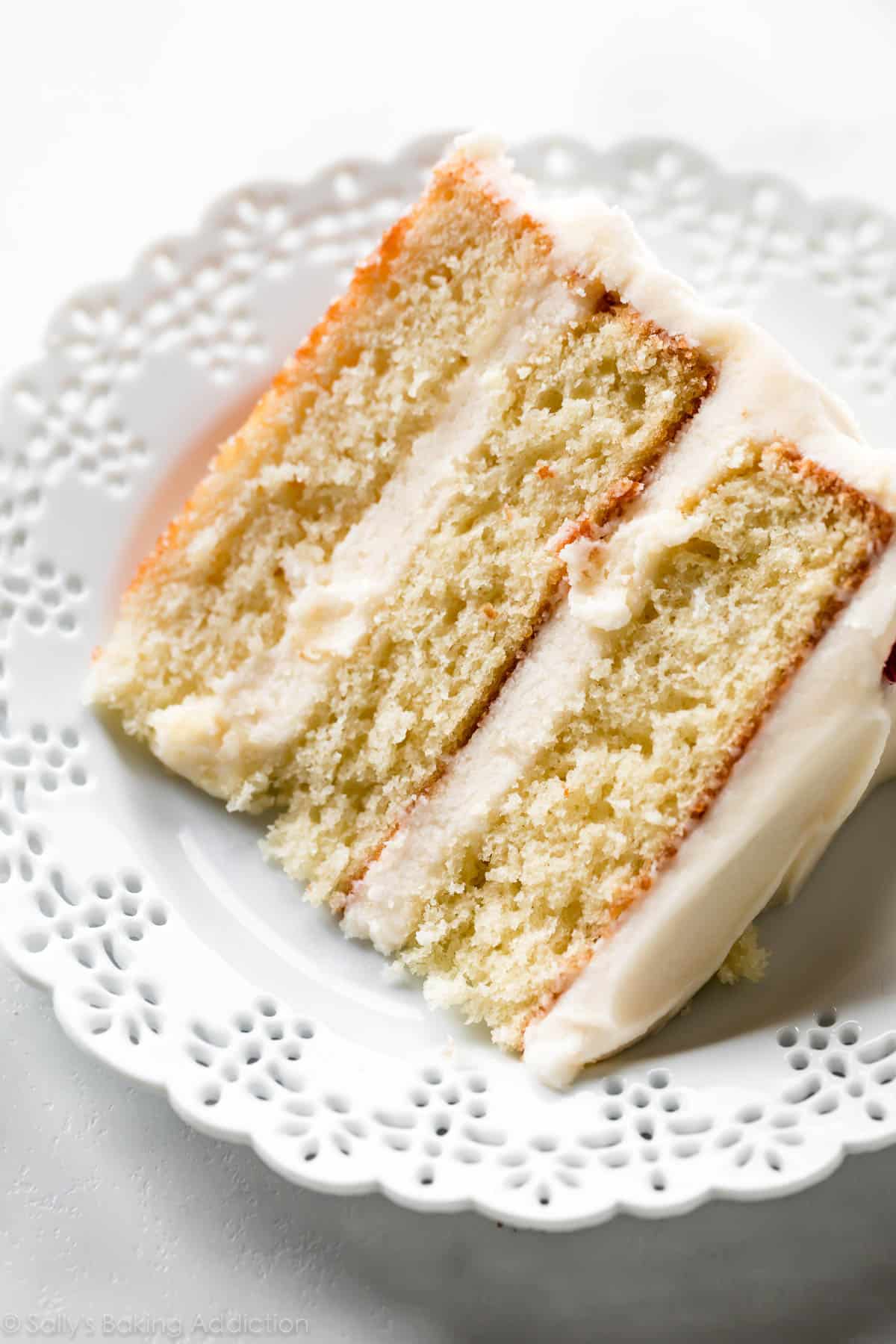
- Soft, light crumb from cake flour
- Fluffy from extra egg whites
- Buttery and cakey from creamed butter
- Stick-to-your-fork moist from eggs & buttermilk
- Extra flavor from pure vanilla extract
Not to mention its versatility: This vanilla cake batter is strong enough for shaped cakes, tiered cakes (see the slight variation in my homemade wedding cake recipe), and holds up beautifully under fondant. Use this batter for vanilla cupcakes, Bundt cake, or even piñata cake. It’s classy enough for a wedding celebration, but unassuming enough for a big family dinner.
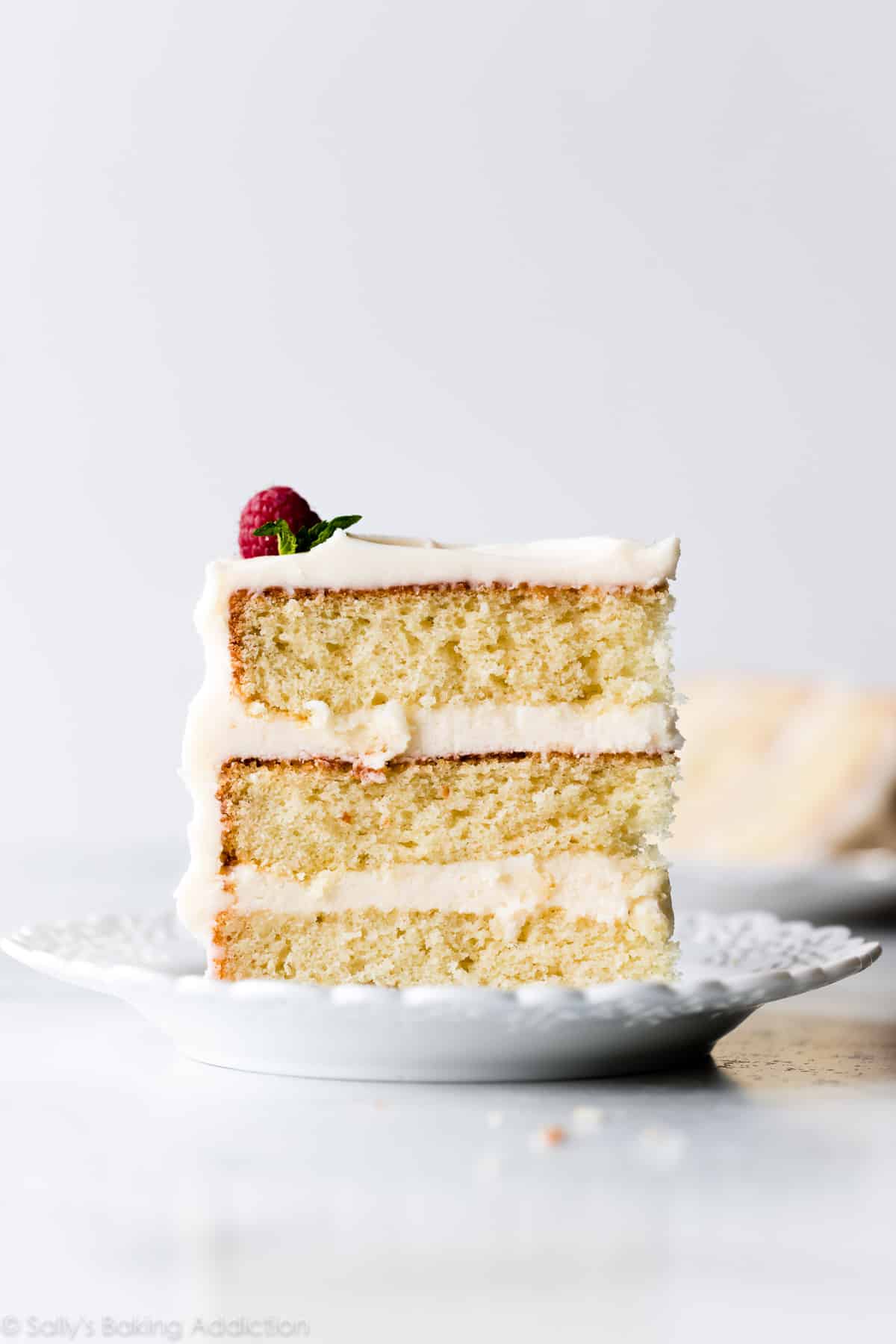
Behind the Vanilla Cake Recipe
After years of cake successes and flops, I’m confident in this homemade vanilla cake. During my recipe testing, I combined my white cake recipe and naked cake recipe. These are two reader favorites and I knew they’d be the best starting point. At first there were too many eggs and I quickly learned sifting cake flour was NOT doing any favors.
You need the following power ingredients:
- Cake Flour: If you want a fluffy and soft bakery-style vanilla cake, cake flour is the secret. The cake will be denser and heavier using all-purpose flour.
- Eggs & 2 additional egg whites: 3 whole eggs provide structure, moisture, and richness. 2 extra egg whites keep the cake light and airy. I don’t recommend using 4 whole eggs; stick to the 3 egg & 2 egg white combination.
- Baking Powder & Baking Soda: Remember the differences in baking powder vs baking soda and why we use both in some recipes? Using enough baking powder to give these layers height gave the cake a bitter aftertaste. Baking soda allows us to use less baking powder.
- Buttermilk: Buttermilk is an acidic ingredient and baking soda requires an acid to work. Plus buttermilk yields an EXTRA moist cake crumb. See recipe note about using a DIY buttermilk substitute.
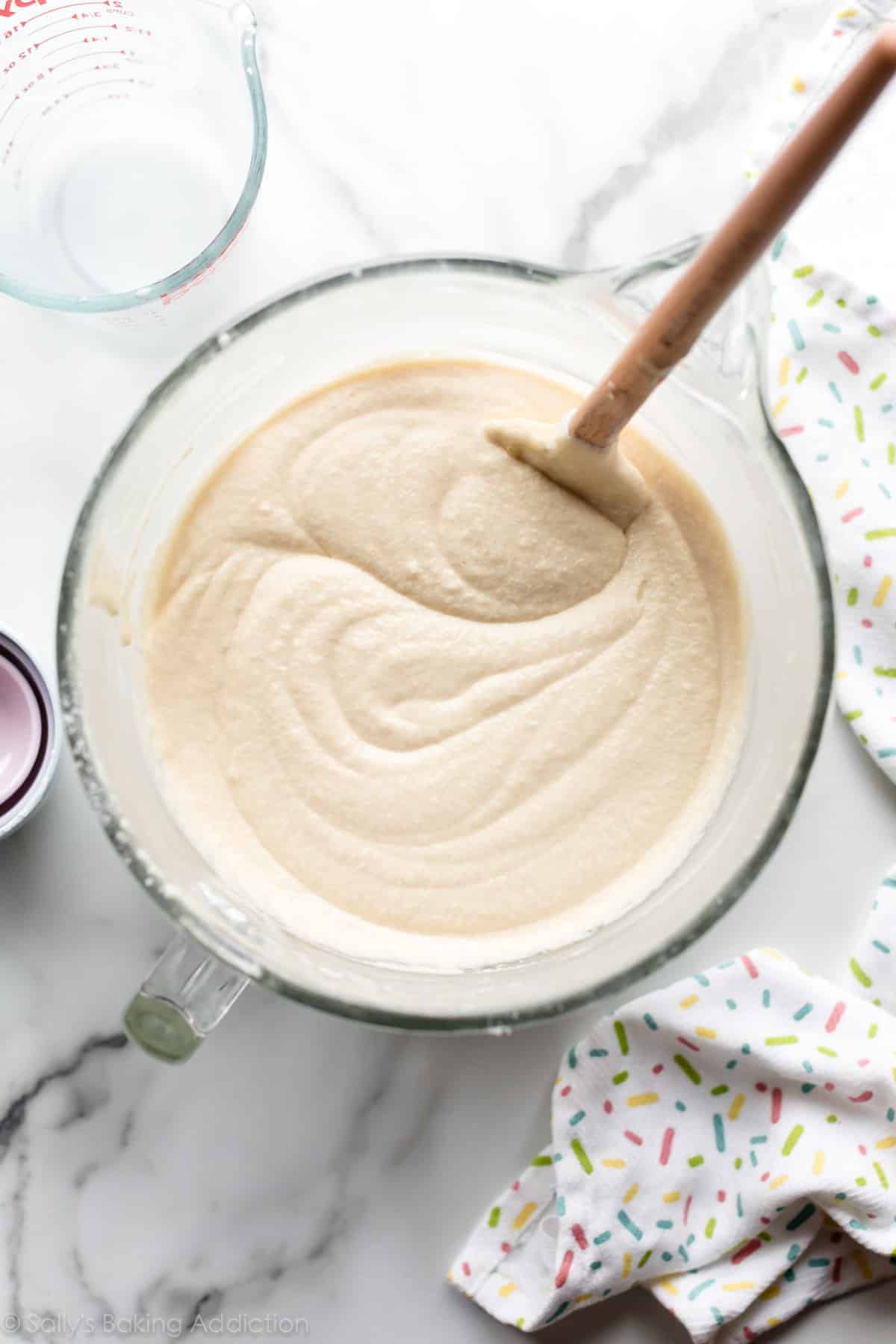
For more prominent vanilla flavor, use homemade vanilla extract. (What a fun DIY gift!) This vanilla cake batter is moderately thick and fits perfectly in 3 9-inch cake pans. We actually use the same exact batter to make snickerdoodle cake.
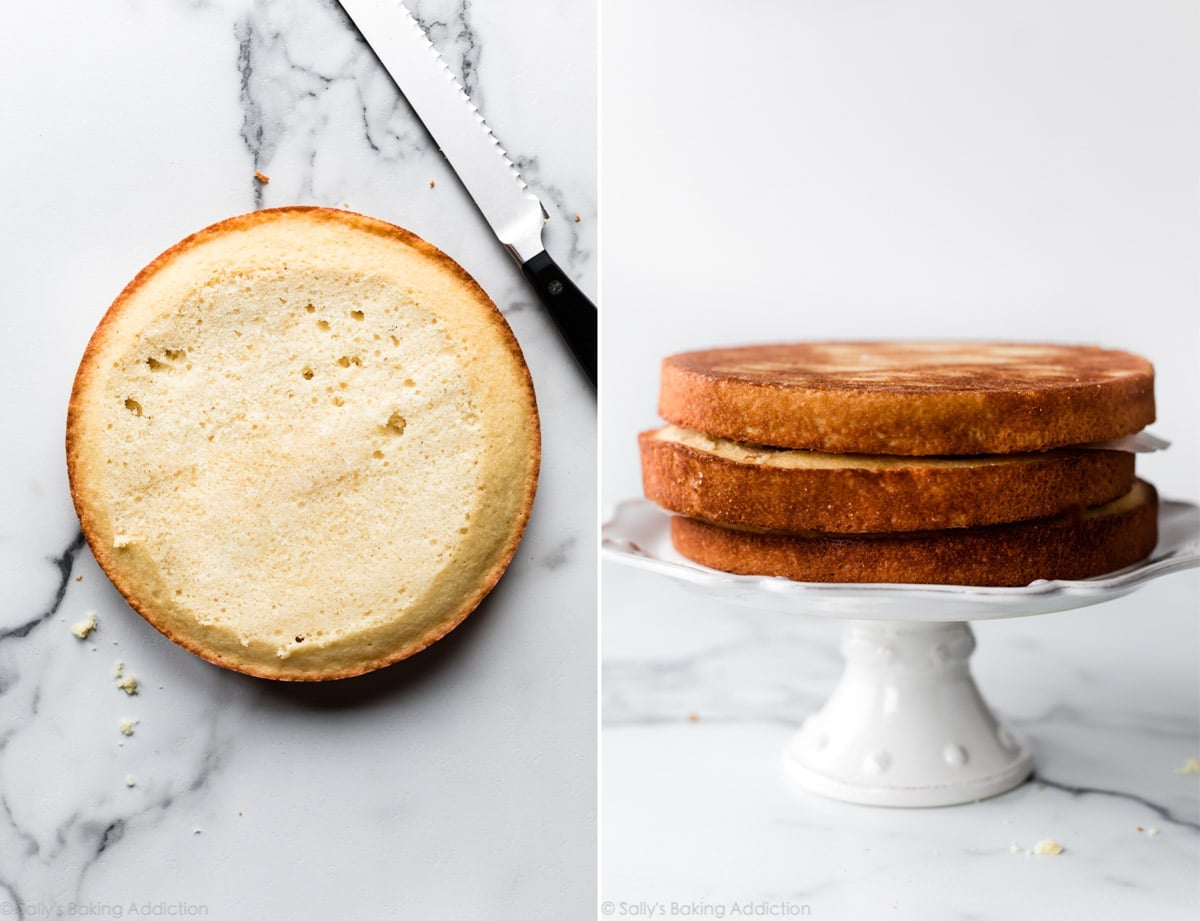
Do you know how to level a cake? Let me help. It’s really easy. You can use a fancy cake leveler, but I use a serrated knife. Carefully slice off the tippy top of the cooled cake layers, creating a flat surface. Leveling cakes doesn’t require a ruler, talent, or any mathematical equations. Instead, just use your eyes, hands, and a knife.
Leveling the cake layers promises a straight and sturdy layer cake.
How Much Frosting Between Cake Layers?
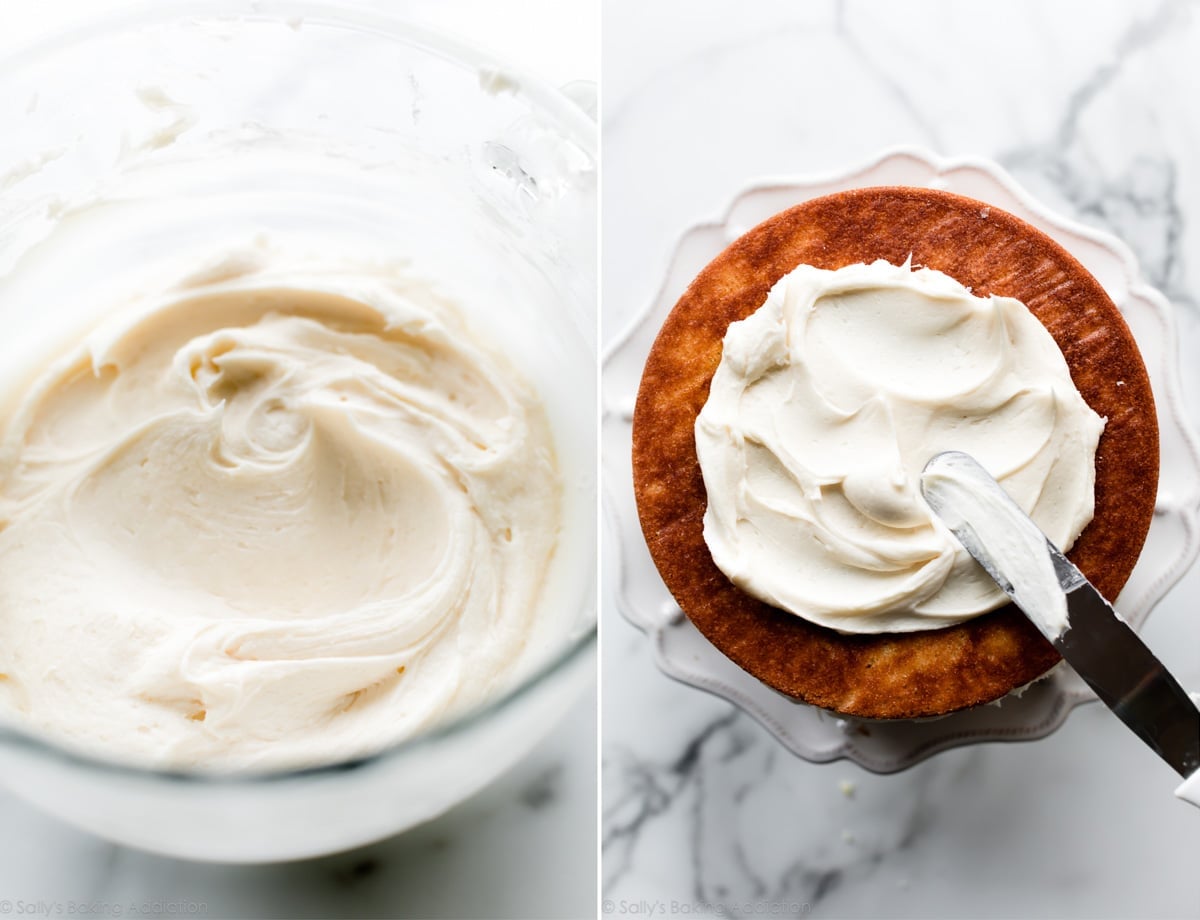
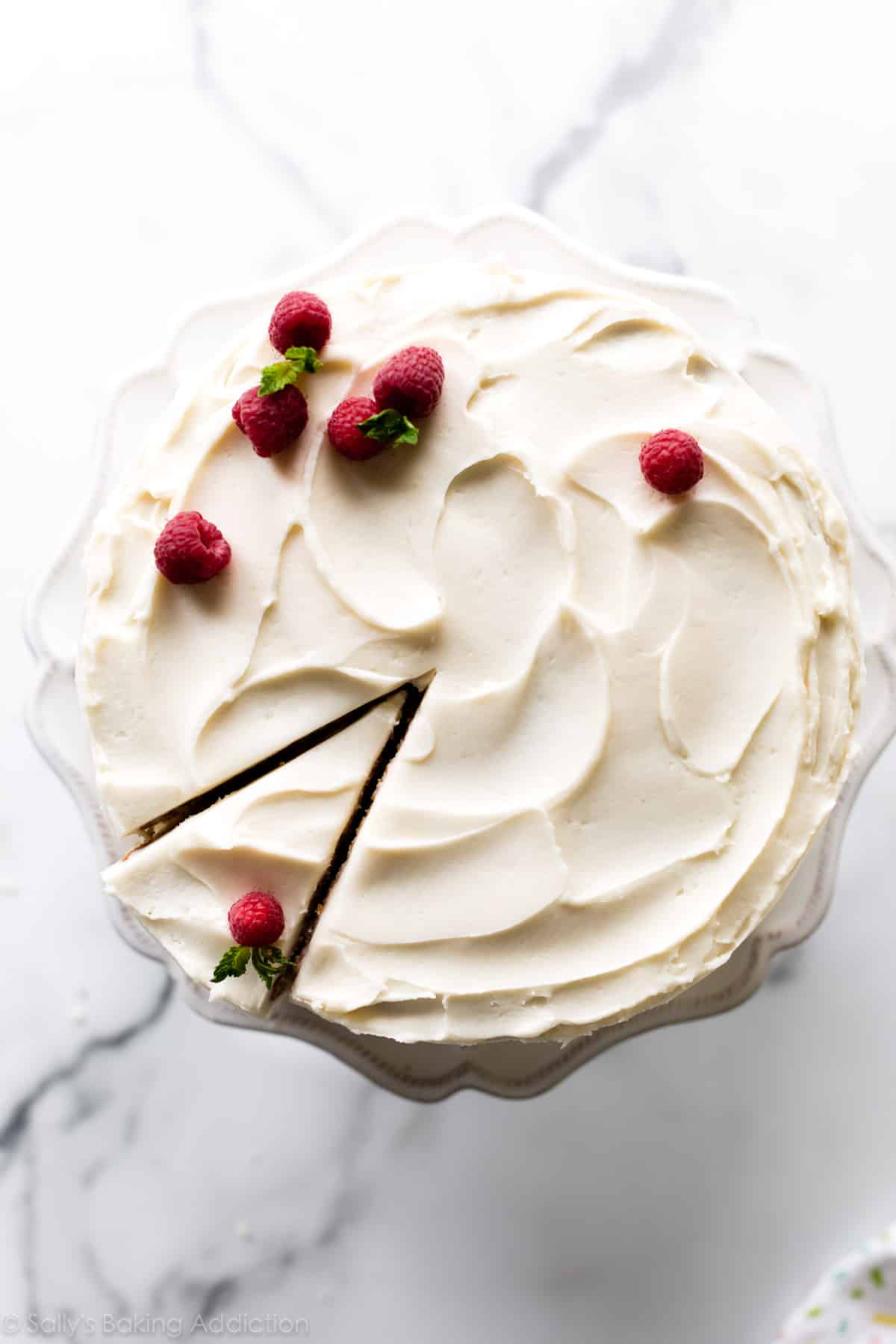
I always eyeball the amount of frosting between cake layers, but I measured when I decorated the pictured cake. The vanilla buttercream recipe below yields about 6 cups of frosting. I recommend you use about 1.5 heaping cups of buttercream between each cake layer and reserve the last 3 cups for outside the cake. If you are going to add a filling such as raspberry cake filling, you’ll use less frosting between the layers. You can use this detailed how to assemble and decorate a layer cake post as a guide!
Cake Decoration Inspiration: For a simple look, stick with vanilla buttercream, fresh berries, and mint sprigs. You can also decorate with chocolate buttercream (I recommend the same amount from this piñata cake), rainbow sprinkles, a chocolate ganache drip like on this chocolate chip cake, or even beautiful buttercream flowers.
Homemade Vanilla Cake Success Tips
Learn from my mistakes and bake the best cake on the 1st try!
- Follow the recipe closely. Use each power ingredient listed.
- Use room temperature ingredients. The batter mixes together evenly when all the cake ingredients are roughly the same temperature. This also reduces the risk of over-mixing and over-baking. Set out your ingredients 1 hour before beginning. Read more about why room temperature ingredients are important.
- Line your cake pans with parchment. Place your cake pans on a large sheet of parchment paper. Trace the bottom of the cake pan with a pencil. Cut parchment paper into rounds. Grease the pan and the parchment paper. Parchment paper rounds guarantee seamless removal from the pan because the cake slides right out.
- Cool cake layers completely. I’ve tried taking shortcuts by assembling a layer cake with semi-warm cake layers. Well, the frosting completely melts and causes the entire cake to collapse. Make sure each layer is cool– refrigerate or freeze the layers if you need to!
- Refrigerate decorated cake. After frosting the cake, place it in the refrigerator for at least 1 hour. This is optional, but it sets the frosting and cake layers. You’ll get beautifully clean slices because the crumbs are cool and tight.
Great read: Check out Tessa’s Top 10 Best Layer Cake Tips.
Finding the perfect vanilla cake recipe requires a celebration. Luckily we have cake!!!
More Classic Cake Recipes
And here is my perfected vanilla cupcakes recipe.
Print
Best Vanilla Cake
- Prep Time: 35 minutes
- Cook Time: 25 minutes
- Total Time: 4 hours (includes cooling)
- Yield: 12-14 servings
- Category: Dessert
- Method: Baking
- Cuisine: American
Description
With its outstanding vanilla flavor, pillowy soft crumb, and creamy vanilla buttercream, this is truly the best vanilla cake I’ve ever had. Make sure you read through the recipe and recipe notes before beginning. This recipe yields approximately 8 cups of batter which is helpful if you need this batter for different cake pan sizes and conversions.
Ingredients
- 3 and 2/3 cups (433g) cake flour (spooned & leveled)
- 1 teaspoon salt
- 2 teaspoons baking powder
- 3/4 teaspoon baking soda
- 1 and 1/2 cups (340g) unsalted butter, softened to room temperature
- 2 cups (400g) granulated sugar
- 3 large eggs + 2 additional egg whites, at room temperature*
- 1 Tablespoon pure vanilla extract (yes, a Tablespoon!)
- 1 and 1/2 cups (360ml) buttermilk, at room temperature*
Vanilla Buttercream
- 1 and 1/2 cups (340g) unsalted butter, softened to room temperature
- 5 and 1/2 cups (650g) confectioners’ sugar
- 1/3 cup (80ml) whole milk or heavy cream
- 1 and 1/2 teaspoons pure vanilla extract
- 1/8 teaspoon salt
Instructions
- Preheat oven to 350°F (177°C). Grease three 9-inch cake pans, line with parchment paper rounds, then grease the parchment paper. Parchment paper helps the cakes seamlessly release from the pans. (If it’s helpful, see this parchment paper rounds for cakes video & post.)
- Make the cake: Whisk the cake flour, salt, baking powder, and baking soda together. Set aside.
- Using a handheld or stand mixer fitted with a paddle or whisk attachment, beat the butter and sugar together on high speed until smooth and creamy, about 3 minutes. Scrape down the sides and up the bottom of the bowl with a silicone spatula as needed. Beat in the 3 eggs, 2 egg whites, and vanilla extract on high speed until combined, about 2 minutes. (Mixture will look curdled as a result of the egg liquid and solid butter combining.) Scrape down the sides and up the bottom of the bowl as needed. With the mixer on low speed, add the dry ingredients just until combined. With the mixer still running on low, pour in the buttermilk and mix just until combined. You may need to whisk it all by hand to make sure there are no lumps at the bottom of the bowl. The batter will be slightly thick.
- Pour batter evenly into cake pans. Weigh them to ensure accuracy, if desired. Bake for around 23-26 minutes or until the cakes are baked through. To test for doneness, insert a toothpick into the center of the cake. If it comes out clean, it’s done. Allow cakes to cool completely in the pans set on a wire cooling rack. The cakes must be completely cool before frosting and assembling.
- Make the frosting: In a large bowl using a handheld mixer or stand mixer fitted with a whisk or paddle attachment, beat the butter on medium speed until creamy, about 2 minutes. Add confectioners’ sugar, milk, vanilla extract, and salt with the mixer running on low. Increase to high speed and beat for 2 minutes. Add more confectioners’ sugar if frosting is too thin, more milk if frosting is too thick, or an extra pinch of salt if frosting is too sweet.
- Assemble and decorate: Using a large serrated knife, slice a thin layer off the tops of the cakes to create a flat surface. Discard (or crumble over ice cream!). Place 1 cake layer on your cake stand, cake turntable, or serving plate. Evenly cover the top with about 1 and 1/2 cups of frosting. Top with 2nd cake layer and evenly cover the top with about 1 and 1/2 cups of frosting. Top with the third cake layer. Spread the remaining frosting all over the top and sides. I use and recommend an icing spatula to apply the frosting.
- Refrigerate cake for at least 1 hour before slicing. This helps the cake hold its shape when cutting.
- Cover leftover cake tightly and store in the refrigerator for up to 5 days.
Notes
- Make Ahead & Freezing Instructions: The cake layers can be baked, cooled, and covered tightly at room temperature overnight. Likewise, the frosting can be prepared then covered and refrigerated overnight. Let the frosting sit at room temperature to slightly soften for 10 minutes before assembling and frosting. Frosted cake or unfrosted cake layers can be frozen up to 2-3 months. Thaw overnight in the refrigerator and bring to room temperature before decorating/serving. See how to freeze cakes for detailed instructions.
- Special Tools (affiliate links): 9-inch Round Cake Pans | Glass Mixing Bowl | Whisk | Electric Mixer (Handheld or Stand) | Silicone Spatula | Kitchen Scale (optional) | Cooling Rack | Large Icing Spatula | Cake Turntable | Bench Scraper | Cake Carrier (for storing and transporting)
- 9×13-inch Cake: I recommend using my white cake batter instead. Both use similar ingredients and produce a deliciously light vanilla cake. See recipe notes for the 9×13 inch version.
- 2 Layer Cake: I recommend using my 2 layer white cake batter instead. Both use similar ingredients and produce a deliciously light vanilla cake.
- Bundt Cake: This vanilla cake batter will fit into a 10-12 cup or larger Bundt pan. I’m unsure of the exact bake time (likely around an hour), but use a toothpick to test for doneness. Same oven temperature.
- Cupcakes: Fill cupcake liners 2/3 full. Bake at 350°F (177°C) for 19-21 minutes. Yields about 3 dozen. Or try my vanilla cupcakes recipe.
- Cake Flour: To prevent a dry-tasting cake, make sure you are spooning and leveling the flour or weighing it. For the best results, I strongly recommend cake flour. You can find it in the baking aisle and I have many more recipes using it. Usually a homemade cake flour substitute works, but this recipe uses far too much cake flour and the homemade substitute is not ideal.
- Eggs: 3 whole eggs provide structure, moisture, and richness. 2 extra egg whites keep the cake light and airy. I don’t recommend using 4 whole eggs; stick to the 3 egg & 2 egg white combination. Here are recipes using leftover egg yolks.
- Buttermilk: If you don’t have buttermilk, you can make a DIY buttermilk substitute. Add 2 teaspoons of white vinegar or lemon juice to a liquid measuring cup. Then add enough whole milk to the same measuring cup until it reaches 1 and 1/2 cups. (In a pinch, lower fat or nondairy milks work for this soured milk, but the cake won’t taste as moist or rich.) Stir it around and let sit for 5 minutes. The homemade “buttermilk” will be somewhat curdled and ready to use in the recipe.
- Why is everything at room temperature? All refrigerated items should be at room temperature so the batter mixes together easily and evenly. Read more about why room temperature ingredients are important.
- Want chocolate frosting instead? I recommend the recipe/amount of chocolate frosting I use for Piñata Cake.
- Sprinkle Cake: To make a sprinkle cake, fold about 3/4 cup (135g) of sprinkles into the cake batter. Avoid nonpareils (the little balls), which tend to bleed their color. Or try this confetti birthday cake, which is quite similar to this recipe.







Reader Comments and Reviews
I made this for my mom’s birthday, and she LOVED IT! The cake was easy to get out of the pans (such a blessing!) and was super nice to work with! Loved the buttercream as well! Will def be trying this again!!! <33
Hello, the only cake flour I can seem to find is self raising cake flour. Will this flour work? Is there anything I should omit if using? Thank you!
Hi Erin, we don’t recommend it. Self-raising flour contains differing amounts of leaveners, and it’s best to use a plain cake flour and add in the baking powder and baking soda separately.
Love this cake. Could you tort the layers if it was cold enough?
We haven’t tested it, but let us know if you try, Amanda!
I’m really not sure where I messed up on this one. I made the triple chocolate cake recently and the buttercream was perfection, but this one was so thin, even with extra powdered sugar. I just could not get the texture right. I’m so disappointed and my end result is hideous, but atleast it tastes good 🙁
Hi Hannah, we’re so sorry to hear you had troubles with this one. Was the heavy cream/milk over measured by chance? Or did you use a lower fat milk? That could make the frosting less creamy. Or was your butter a bit too soft? Here’s more about what room temperature butter really means. If it starts out too warm, it will be difficult to get the frosting to a thick, creamy consistency. Hope this helps for your next batch!
Thank you for replying! I used heavy cream, and I don’t think my butter was too warm, but I’m willing to bet that’s what it is. The cake itself was still delightful and I’m going to reattempt this again! 🙂
I made your vanilla cake with your raspberry filling for my mom’s 80th birthday party. Everyone loved it! I’m a big fan of your recipes. This truly was the best vanilla cake I have ever had! Thank you Sally for all you share with us.
I love almond flavored cake and have been looking for a recipe. Could I use almond extract and if so how much would produce an almond flavored cake. Or do you recommend a different recipe?
Hi Jeannie, we don’t have an almond cake recipe, but you could use half vanilla extract and half almond, or even 3/4 vanilla and 1/4 almond depending on how strong you would like the flavor here.
Sally, what kind of filling (other than lemon curd) would be good for this cake?
Hi Nicole, we love this raspberry cake filling!
How do I substitute buttermilk
Hi Victoria, buttermilk (or the DIY version in the recipe Notes) is really best here. It’s necessary to help activate the baking soda and it helps create an extra moist cake crumb. You could try a combination of sour cream and regular milk (like we do for the bottom layer of our homemade wedding cake), but the crumb will be denser. Hope this helps!
I haven’t tried to make this cake yet but can you reduce the sugar to make it less sweet for kids?
Hi Truongy, Sugar is used for moisture and texture in baked goods as well as taste. You can certainly try reducing the sugar, but the resulting texture will be different than intended.
Batter is too thick. Really disappointed with this recipe. Took me 1 whole hour and a bit just to make something too thick
Hi Maryanne, we’re sorry you had troubles with this recipe. If the batter was too thick, was there too much flour by chance? Be sure to spoon and level (or use a kitchen scale) to measure the flour to ensure it isn’t over measured. Room temperature ingredients are important, too, so that the batter will come together smoothly. Let us know if we can help troubleshoot further.
If I have a fan oven, what changes should I make in the baking temperature and/or time?
Hi Anna, we always recommend and write for conventional settings for baking (not convection/fan). The flow of air from convection heat can cause baked goods to rise and bake unevenly and it also pulls moisture out of the oven. If you do use convection/fan settings for baking, lower your temperature by 25 degrees F and keep in mind that things may still take less time to bake.
Can you use salted butter instead of unsalted?
Hi Amie, if using salted butter in the cake, reduce the added salt down to 1/2 teaspoon. You can use it in the frosting too, then just salt it to taste.
This vanilla cake is the best! I have been baking your recipes for a long time and they never disappoint me. The vanilla cake was moist and fluffy and so delicious! I am making your chocolate cupcakes the weekend. Thank you so much for sharing your wonderful recipes!
Thank you so much for making and trusting our recipes, Mary!
Could melted coconut oil be a substitute for butter in the cake portion of this recipe?
Hi Jay, butter is key to this cake’s intended taste and texture, so we don’t recommend swapping it. If needed, you could try swapping with solid coconut oil (not melted), as you’ll need a solid to cream together with the sugars. Hope you enjoy!
Thanks for the quick reply. I will try the original recipe first, as it seems like a good excuse to make two cakes! Made your Black Forest Cake last weekend and it was amazing. Love your recipes!
Can this be used for an 8” and for how long should I bake the cakes to prevent over baking or drying? Thank you in advance.
Hi Heidi, you can use this recipe with 8 inch cake pans for slightly thicker layers in a three layer cake. You may need an extra minute or two of bake time since they layers will be thicker – use a toothpick to test for doneness. Or, you can fill the 8 inch pans a little less and use the leftover batter for some cupcakes.
Sally, when I was measuring my flour out I was weighing it as well and when I got to 2 cups, levelled, it already weighed 434 gms. The whole 3 and 2/3rds would weigh a lot over the 433g that the recipe states. I dont know if I should go by cups or grams.
Hi Sharon, We test all of our recipes multiple times using both metric weights and cups (since that’s standard where we live). While spooning and leveling our flour does get us 125 grams per cup, we always say that “A cup isn’t always a cup, but a gram or ounce is always a gram or ounce!” Basically, when in doubt go by the weight!
Can the egg whites be from a carton?
Hi Laura, you can use carton egg whites for the two additional egg whites.
What measurements should I use (tbsp or cups) for the carton egg whites?
Hi Rafaela, the side of the carton should have a conversion chart.
This recipe is great, the cake is packed with So much flavour and moisture will be replacing my standard vanilla recipe with this 🙂
Ps. For those in the uk, although the recipe says cake flour and includes leavening agents, use self-raising flour. I used plain and my cake was very dense and did not bake thoroughly.
This is my go to cake for every occasion and always have consistent results . Easy and delicious!! My question is if it would be possible to make this recipe ( or your 6 inch) in a 5 inch pan. My daughter wants me to make a 3-4 layer 5 inch smash cake for her 1 year olds birthday. I thought about just using the 5 inch recipe and not using as much batter by decided to reach out for advice. Thanks so much.
Hi Cathie! We would use the batter from our 6 inch cake recipe for a 3 or 4 layer 5 inch smash cake.
Hi! I just wanted to ask, what is cake flour? Is it the same as the pre-mixed box from the store?
Hi Sarah, cake flour is a low protein flour that’s milled into a fine consistency. It contains about 7-9% protein, while all-purpose flour, a harder flour, has anywhere between 10-12%. It gives cakes a softer, fluffier texture. You can usually find it in the store next to the other flours, often packaged in boxes.
First time making this cake , I was so happy it turned out out , although I thought it was alittle on the dry side . Not sure why or what I did wrong .
We’re happy to help troubleshoot. How did you measure your flour? Be sure to spoon and level (or use a kitchen scale) to ensure the flour isn’t over measured. Too much flour can significantly dry out cakes, as can over baking for even a few minutes. Hope this helps for next time, and we’re glad you enjoyed the cake!
This is the most delicious cake i have ever had! It melts in your mouth like a dream. Perfection!!!
I love this recipe! Can I add raisins or sultanas? Do I need to amend the recipe in any way to do so? Thanks so much
Hi Charley, we haven’t tried, but other readers have added raisins with success. Enjoy!
I love to bake and especially enjoy your recipes. I make a lot of cupcakes and cookies, and I’ve decided to give cake decorating a try this year. I’m going to start with this cake and try doing a border around the top. I read that beginners should make extra frosting in case of mess ups. I’m wondering if I should use the recipe here or your other vanilla buttercream recipe. I’m confused as this one says it makes 6 cups, but the other one says 2.5 cups. If I was to double that one, I would have way more frosting, according to the measurements for butter and powdered sugar. I’m wondering if you could tell me which I should do. I don’t want to make way too much, but I also don’t want to be short as the whole reason I’m doing this is to learn/practice making a border. Thanks in advance for your help!
Hi Cassie, We are sorry we are just getting to your question. If you haven’t tried it yet, you can certainly make 1.5 times this frosting recipe. We typically use 1.5 cups of frosting between each layer and find that there is enough left to lightly frost the sides of the cake as well. If you make 1.5x the frosting recipe you should have enough left to pipe a border around the top as well. And if you happen to have extra frosting left over, it does freeze well!
This is my “go to” recipe for Vanilla Cake.
My family and anyone who has ever had, raves about it…
It’s the only cake my granddaughters want for their shared birthdays!
It’s versatile. It made 40 cupcake for a Celebration of Life.
Tonight, I made two layers and a dozen cupcakes!
Is it possible to make this dairy free?
Hi JJ, we recommend searching for a dairy free vanilla cake recipe instead of trying to adapt this one, since it may not turn out properly. Thanks!
This is my Granddaughter’s and my favorite cake recipe we bake together!
Moist and flavorful! Can’t find recipe in your cookbooks.
Which one includes it?
Hi Barbara! This cake recipe isn’t in any of my cookbooks; it is only available on my website!
I was planning on halfing this recipe in order to do that what size and how many cake pans should i use
Hi Hadley, Here is everything you need to know about converting recipes to different Cake Pan Sizes.
Why do you recommend a different recipe if the cake needs to be a 9×13?
Hi Amanda, see the recipe notes (below the recipe) for our suggestions on making a 9×13 cake. Enjoy!
I read the entire page again and still didn’t see anything that mentions why you wouldn’t want to use this cake recipe for a 9×13 cake. I’m thinking about doing it anyway, which is why I’m asking. Will it mess up the cake? Is it because it only makes 8 cup of batter and I’d have to double it?
I have the same question as Amanda: WHY is the recommendation to use a different recipe for a 9×13″ cake? Does it have to do with an assumption that if baking in a 9×13″ pan we are going for a single-layer cake (sheet cake) and the other recipe makes a fluffier, less sturdy crumb? Or batter volume? Those were the only reasons I could think of. I’m wanting to make a small rectangular layer cake and I was thinking about baking the whole cake in a 9×13″ pan then cutting in half horizontally and vertically to make 4 layers…. Any reason why that wouldn’t be appropriate for this recipe? (Batter volume maybe?)
Hi Laura, the white cake makes the right amount of batter for a 9×13 cake. This batter in a 9×13 would be a little thick and difficult to bake through properly.
I was planning on using lemon curd between the layers, could I possibly do a cream cheese frosting for the outside?
Hi Hadley, cream cheese frosting would be delicious here!