
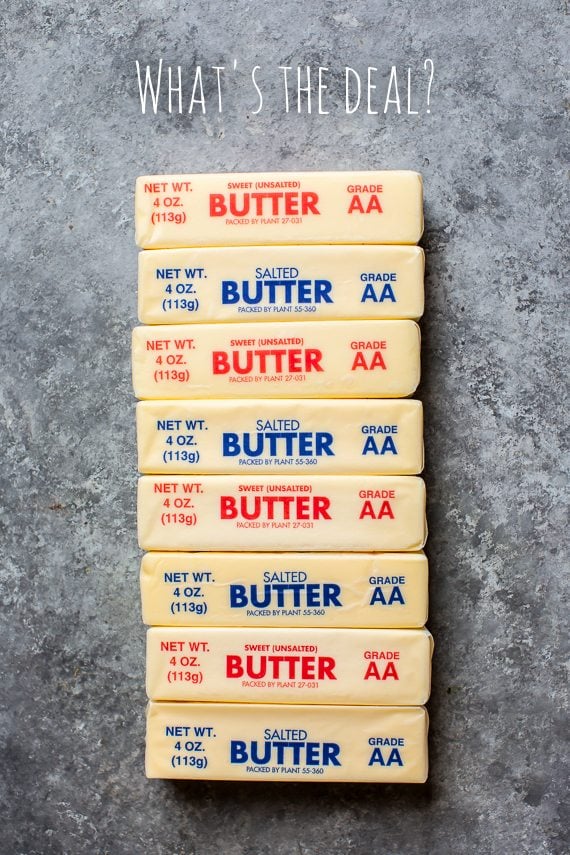
Here’s a common question in the kitchen. What’s the deal with salted and unsalted butter in baking? Does it really make a difference? Or is the recipe just being annoyingly picky? Ugh, baking.
Yes and yes I’m sorry.
Butter is our best friend in the kitchen, especially when it comes to pie crusts and cookies and cakes and cupcakes and poundcake and oh yeah, every other thing we have ever baked! Butter’s so common in our recipes that we often take this simple ingredient for granted. But the truth is that butter is just as fussy as the next baking ingredient. If your butter is too warm, forget about creaming it and your “fluffy cake” will end up dense, lifeless, and flat. Too cold and you’ll wind up with harsh chunks of butter in your otherwise pristine cake batter. Not only with regards to temperature, butter is a massive question mark when it comes to salt content. And that’s exactly what we’re going to discuss today.
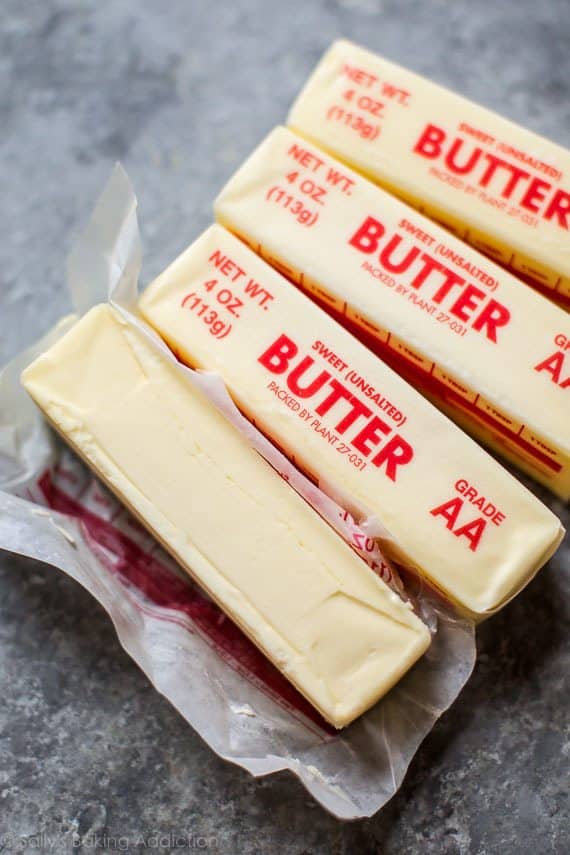
It’s quite ironic that a recipe can call for both unsalted (sweet) butter and salt. Why not just use salted butter? 2 or 3 reasons, actually.
1. The amount of salt in salted butter varies between brands.
You know baking is all about science, but it’s all about control as well. When you use unsalted butter in a recipe, you can control the exact amount of salt in your baked good. When you use salted butter, you have no idea how much salt you’re using because it varies between each brand you see at the store. Chowhound tells us the exact amount of salt in popular brands and some are double the amount of others! It would take quite a lot of salted butter to really produce a huge taste difference in baked goods, but it’s still good to be able to fully control the amount of salt.
2. Unsalted butter is fresher.
Salt is a preservative and therefore, salted butter has a longer shelf life than unsalted butter. We’re talking 3-4 months of shelf time. This doesn’t necessarily mean that salted butter has been on the shelf longer; it simply has a longer shelf life. For the freshest butter, reach for the unsalted variety. (Or heck! Make your own!) However, some brands add “natural flavor” to unsalted butter, which extends its shelf life (not quite as long as salt). This is usually lactic acid, which also helps regulate its pH.
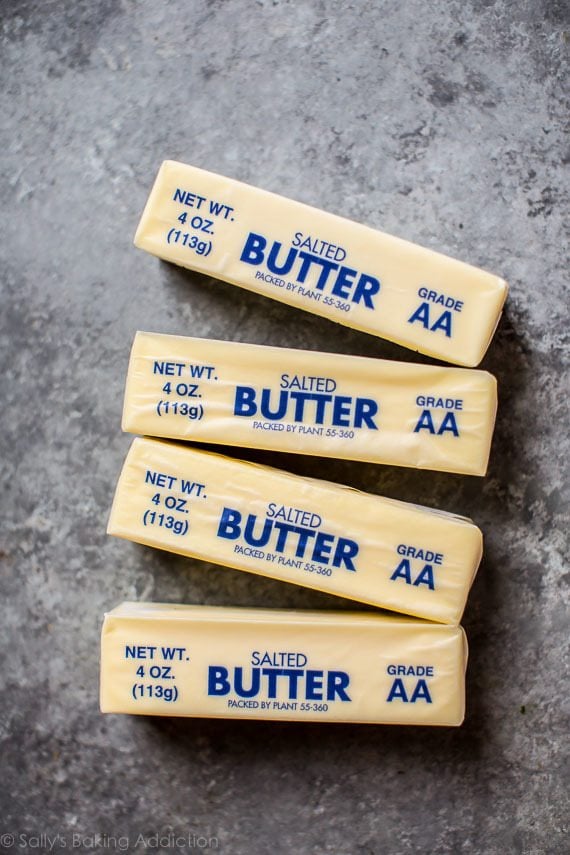
How to Substitute Salted Butter and Unsalted Butter
It’s best to use the type of butter called for in a recipe. But here’s a general rule: reduce or add 1/4 teaspoon of salt per 1/2 cup (1/4 lb; 8 Tbsp; 113g) of butter.
Explained: If you come across a recipe that calls for salted butter and all you have is unsalted butter, use unsalted butter and increase the salt in the recipe by 1/4 teaspoon for every 1/2 cup of butter. So if a recipe calls for 1 cup of salted butter and 1/4 teaspoon of salt, you will use 1 cup of unsalted butter and 3/4 teaspoon of salt. And if you come across a recipe that calls for unsalted butter and all you have is salted butter, simply decrease the salt in the recipe by the same ratio above—1/4 teaspoon of salt per 1/2 cup of butter. If you’re making a recipe that calls for 1/2 cup of unsalted butter and 1/2 teaspoon of salt, you can use 1/2 cup of salted butter and 1/4 teaspoon of salt. Get it?
Further reading:
- My Best Baking Tips
- Baking Powder vs Baking Soda
- Dutch-process vs Natural Cocoa Powder
- 10 Best Cupcake Baking Tips & How to Fill Cupcakes
- Why Room Temperature Ingredients Make a Difference
- 14 Best Baking Tools That Every Baker Needs
- How to Cream Butter & Sugar








Reader Comments and Reviews
Thanks for all the great recipes and tips, you make baking super easy and fun
The recipe I’m using for cinnamon rolls says use 4 tablespoons of salted butter and 3/4 teaspoons of salt. I only have unsalted butter, how do I know how much salt to use since that’s under half a cup? Or do I just use the same amount of salt as directed?
Hi Ava, here’s a general rule: reduce or add 1/4 teaspoon of salt per 1/2 cup (1/4 lb; 115g; 1 stick) of butter. Hope this helps!
4tbsp = 1/4 cup. So you would use unsalted butter and 1tsp salt
Thank you for the suggestions on how to get butter to room temperature, and how to compensate for unsalted butter if you only have salted butter.
Thank you so much for explaining the difference between using unsalted or salted butter in our recipes. However could you explain how I can print off your baking tips? I know how to print out the recipes but I’m having trouble with the other information. Thanks!
Hi Donna, yes, I see what you mean–there isn’t an easy Print button like the recipes have. Unfortunately, at this time we don’t have a quick fix for this, so I think the best thing to do would be to copy and paste the text content you want to print out into a word document and print from there. Sorry for the inconvenience!
That’s what I’ve been doing. But Thank you very much for the quick response Love your recipes and helpful hints!
Does it REALLY matter if I use butter or margarine?
Hi Michele, We don’t recommend swapping butter with margarine. Margarine and shortening have a higher water content than butter and make baked goods spread more. You’ll also miss the buttery taste. Best to stick with butter according to a particular recipe.
Do you use European butter with higher fat content or butter from usa
Hi Sue! We usually advise against it as the extra fat can change results of baking recipes (make cookies spread more, etc.).
Thank you.
You explained salted v unsalted beautifully.
So what if the recipe calls for 3/4 unsalted butter but all I have is salted. How much would I need for chocolate chip cookies?