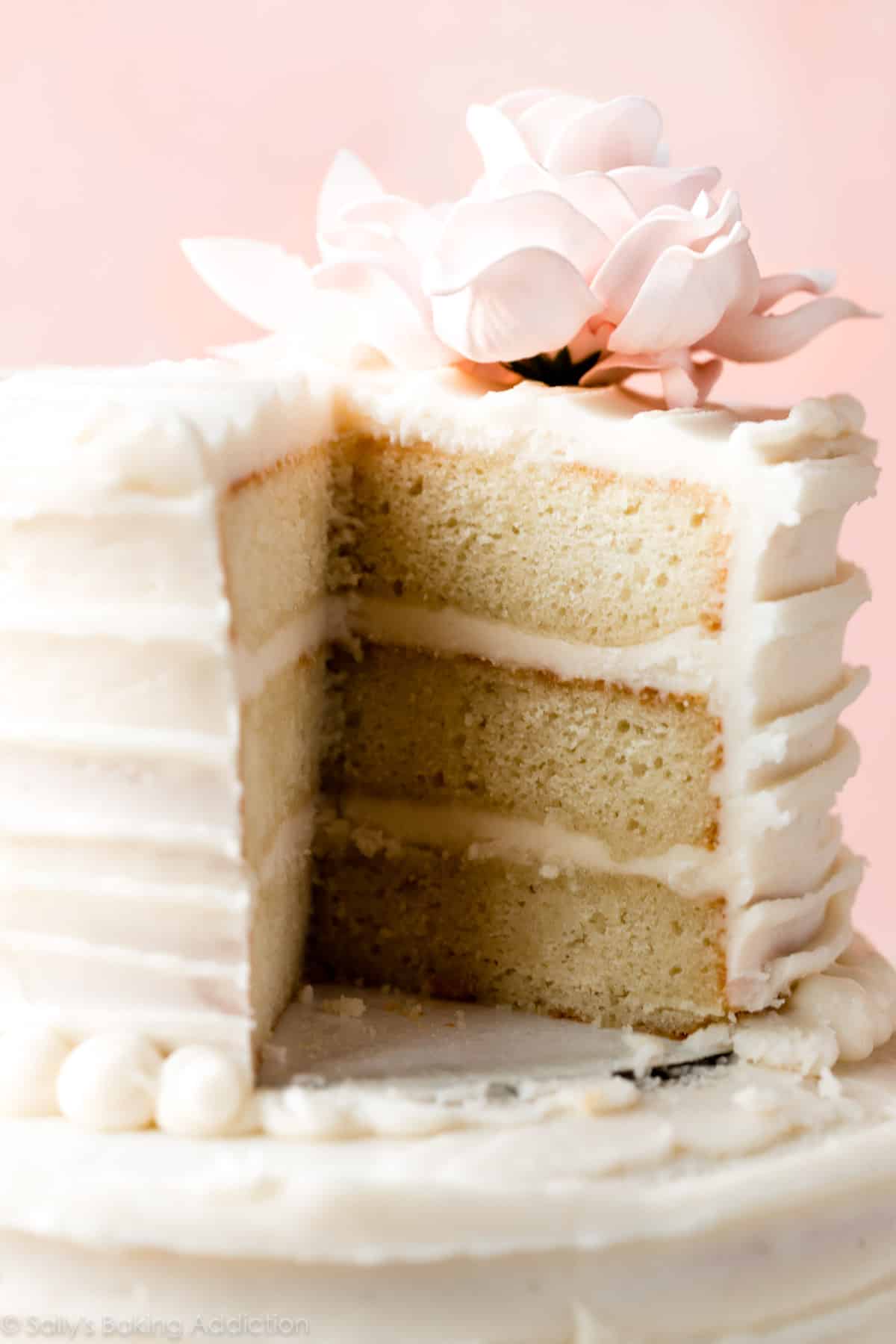
Here you’ll find a full recipe and cake decorating video tutorial for a DIY homemade wedding cake. This simply decorated and elegant vanilla wedding cake has 2 tiers and comes with full assembly instructions. With the help of this carefully detailed post, this wedding cake recipe is perfectly manageable for any home baker.
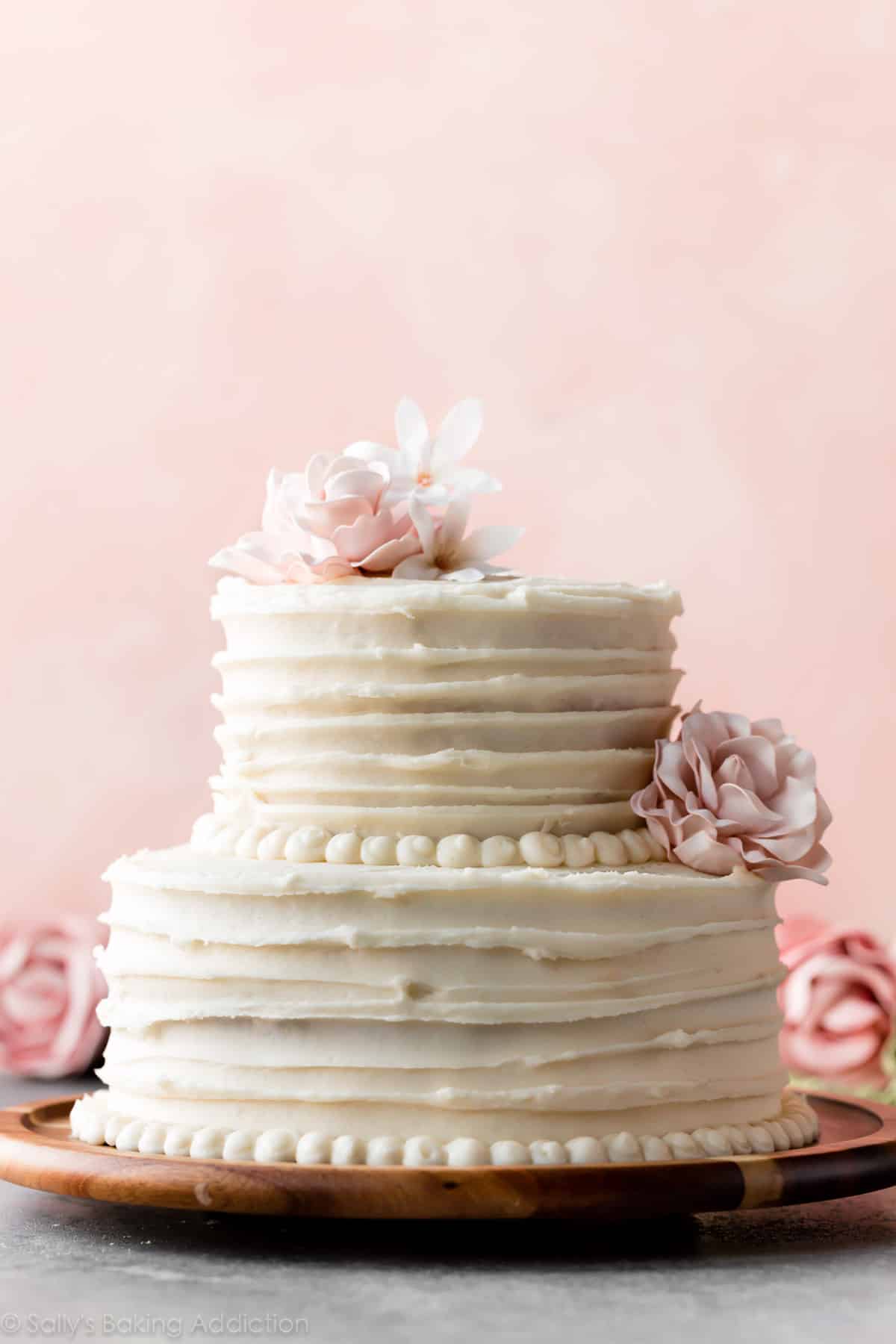
By the request of many readers, let me present you with a homemade 2 tier wedding cake recipe. Adapted from my trusted vanilla cake and 6 inch cake recipes, this from-scratch wedding dessert is not only beautiful—it tastes remarkable, too.
(Isn’t that what counts?)
Fully equipped with complete details and recipe instructions to make this one-of-a-kind dessert, you will wow the happy couple and wedding guests alike. This post has it all.
This DIY Homemade Wedding Cake Is:
- Completely from-scratch
- Manageable for any home baker
- Simple, yet elegant—rustic chic meets traditional
- Complete with a full list of helpful kitchen tools
- Perfect for a small wedding (approximately 30-35 people)
- Wonderful for a larger wedding if other dessert options are available
How to Make a DIY Homemade Wedding Cake
This is a 2 tier wedding cake. Both tiers are buttery, soft, and moist. In lieu of traditional fondant, this homemade wedding cake recipe uses my vanilla buttercream, but in a higher quantity. To avoid (1) overwhelming your mixer with excess cake batter and (2) over-mixing or under-mixing the batter, make each cake separately.
- Make each batch of frosting separately too.
Unless you have extra oven(s) or oven space, prepare the cake batters and bake the layer cakes one at a time. Cool the cakes completely before assembling and decorating, which I cover in a separate section below.
Same Ingredients for Both Tiers
Both cakes use the same exact ingredients and each has a special job, so I do not recommend substitutions. Use sugar, cake flour, egg(s), extra egg whites, sour cream, whole milk, and proper room temperature butter. (Among a few other ingredients.) If needed, use this cake flour substitute. Here are recipes that use leftover egg yolks.
- 2-3 batches of lemon curd, which uses egg yolks, would be fantastic as a filling between these cake layers.
The bottom cake is my vanilla cake recipe, but I swap buttermilk for whole milk and sour cream. I do this so you don’t need any varying ingredients for both tiers. (Because the top tier uses whole milk and sour cream.) Sure, you could use buttermilk to replace both the whole milk and sour cream in the 6 inch cake, but whole milk and sour cream are more readily available to most than buttermilk.
Other Flavor Options
This is vanilla flavored, which is a classic choice to please a variety of wedding guests. You can have fun with frostings, fillings, and flavorings. Here are 5 other cake flavor options:
- Carrot Cake: Use my carrot cake recipe for the bottom tier and make a half batch of the batter for the top tier. Use the same 6 inch cake baking instructions described below.
- Red Velvet Cake: Use my red velvet cake recipe for the bottom tier. You can divide between 3 9-inch cake pans as instructed in the recipe notes. Use my red velvet cupcakes batter for the 6 inch cake. Use the same 6 inch cake baking instructions described below.
- Lemon Cake: Use my lemon cake recipe for the bottom tier. Use my lemon cupcakes batter for the 6 inch cake. Use the same 6 inch cake baking instructions described below.
- Marble Cake: Use my zebra cake for the bottom tier. Use my smaller zebra cake recipe (see this 1st birthday cake) for the 6 inch cake on top.
- Chocolate Chip: After adding the milk in both batters, fold 1 and 1/2 cups (270g) mini chocolate chips into the 9-inch vanilla cake batter and 1 cup (180g) of mini chocolate chips into the 6-inch vanilla cake batter. Regular size chocolate chips would be fine, but mini chocolate chips mean more in each bite.
*These are the only flavors I’ve tested with tiers. At this time, I don’t have a sturdy enough chocolate version to use as the bottom tier.
Want to mix and match flavors? Stick with the vanilla cake on the bottom (or other flavors listed above) and use any cupcake recipes listed in my 6 inch cakes post for the top tier. As explained in that post, cupcake batter yielding between 12-15 cupcakes makes the perfect 3 layer 6 inch cake.
Filling ideas: The filling in my cake is vanilla buttercream, but feel free to use other frosting flavors if desired. You can add extracts to the frosting such as almond, lemon, orange, or coconut. (Start with 1 teaspoon, taste, then add more to taste.) You can even mix a few Tablespoons of raspberry jam into the vanilla buttercream for the filling or use raspberry cake filling.
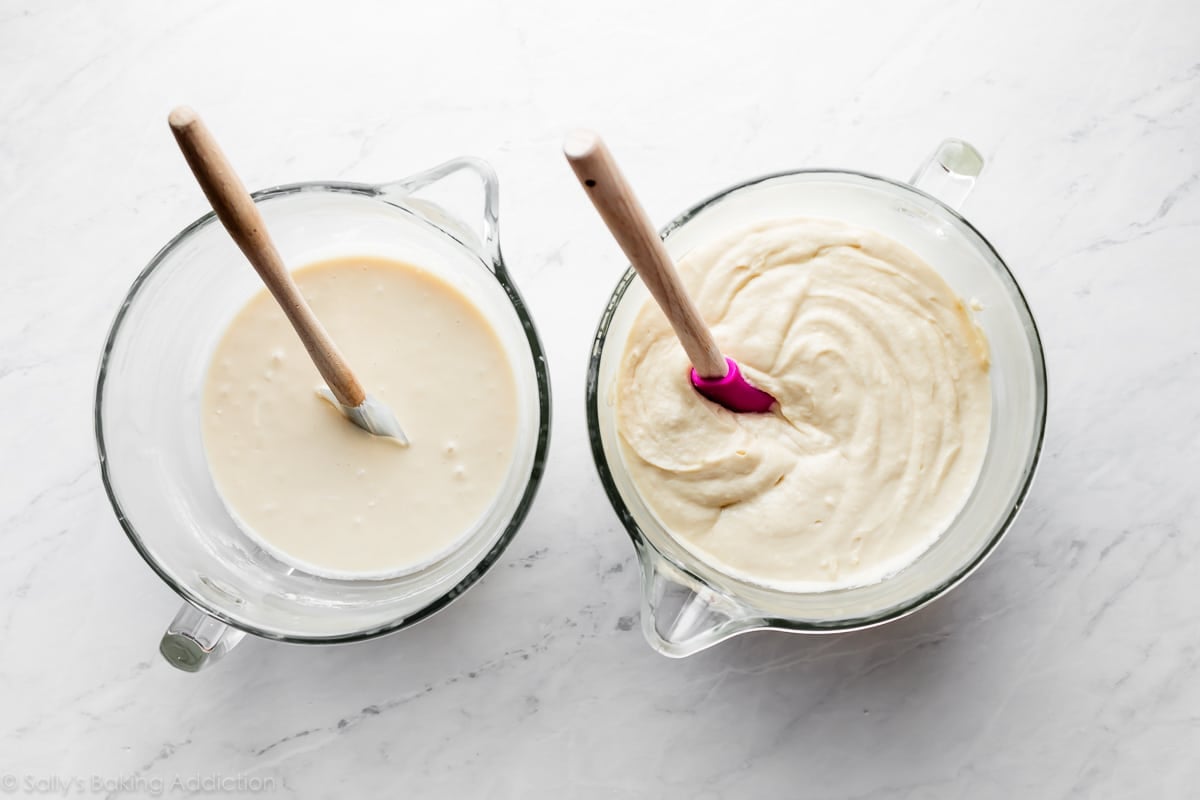
The 6-inch cake batter (left above) is light and creamy. The 9-inch cake batter (right above) is thicker because the bottom tier is a bit denser (for extra support).
Prepare the Wedding Cake Pans
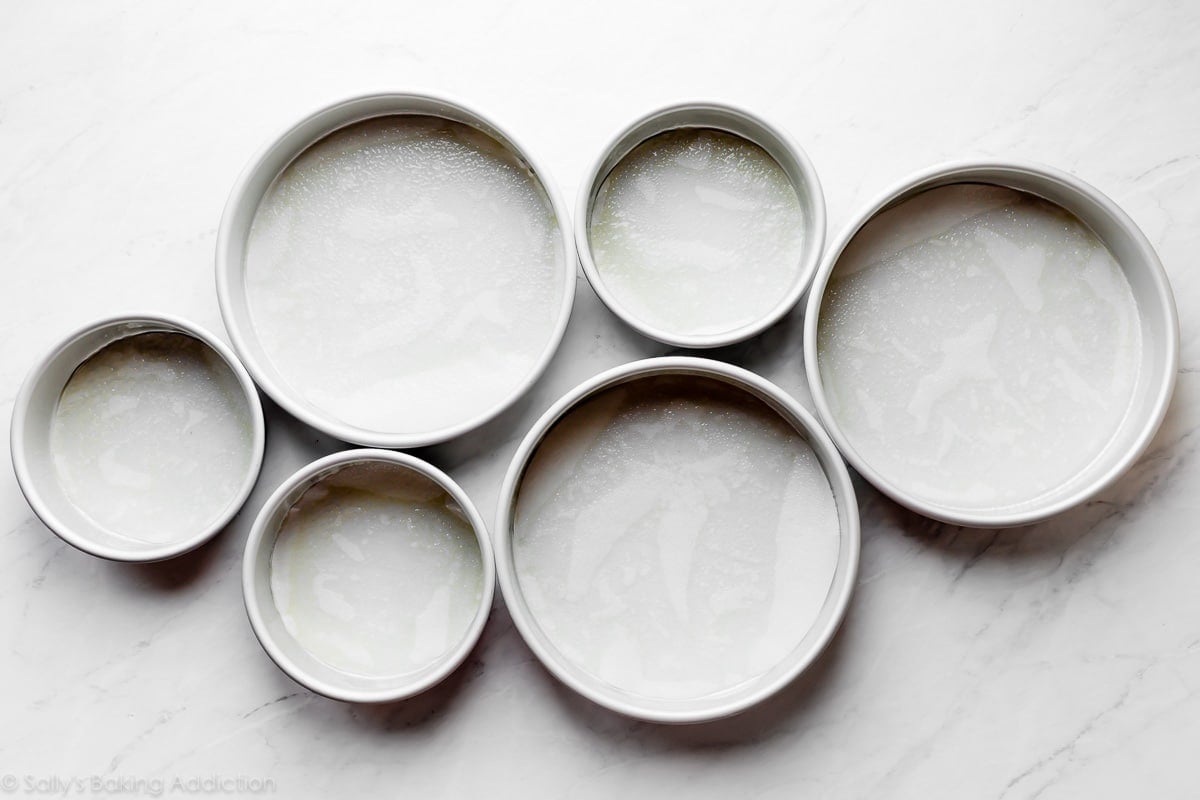
Always line your round pans with parchment paper rounds before adding the batter. Begin by lightly spraying the bottoms and sides of each with nonstick spray or greasing with butter. Add a parchment paper round, then grease the round as well. Parchment paper rounds aren’t something special you need to buy. Simply trace the bottom of your cake pan on regular parchment paper and cut into rounds. Parchment paper rounds guarantee the cooled cakes will seamlessly release from the pans.
See my 10 Cake Baking Tips post for all my advice on baking the BEST cakes.
Other Cake Pan Sizes
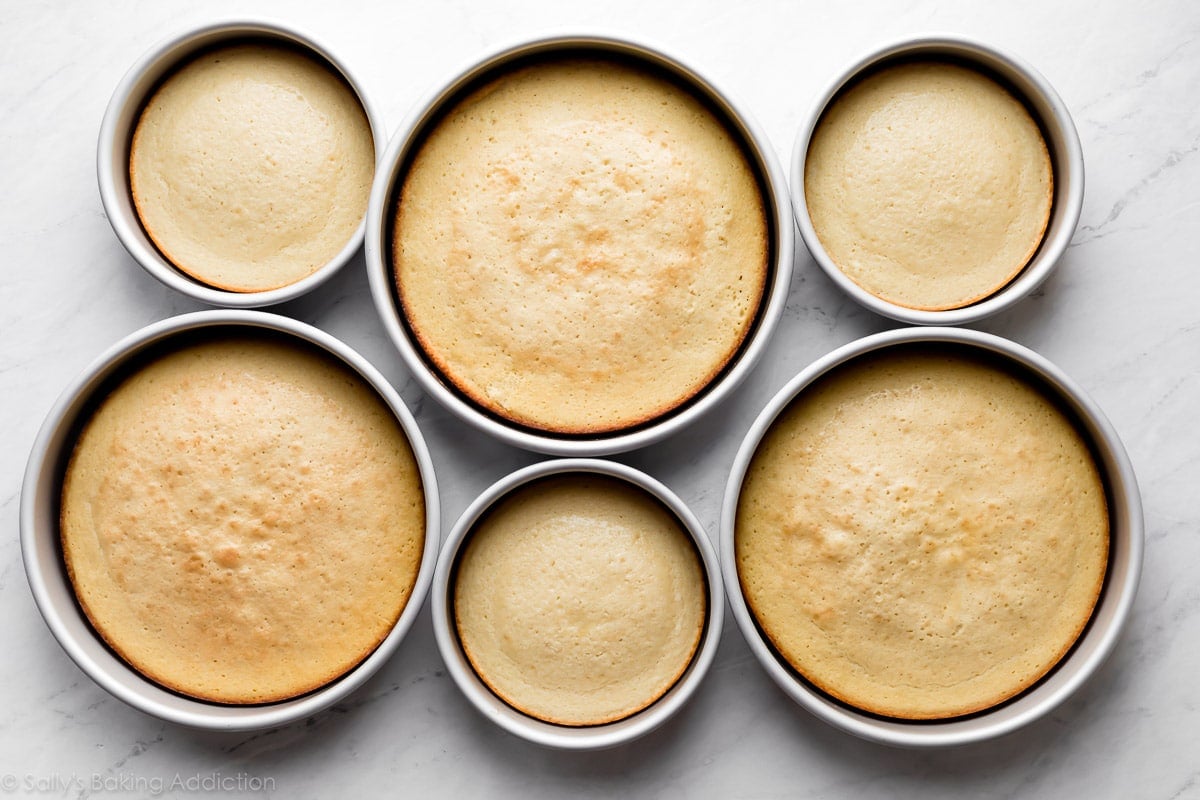
This recipe uses one 9-inch 3 layer cake and one 6-inch 3 layer cake. The 9-inch cake is 8-9 cups of batter and the 6-inch cake is 4 cups of batter. If you need to substitute other size cake pans, see my Cake Pan Sizes & Conversions post to determine the appropriate amount of batter you need for your desired cake pans.
Wedding Cake Video Tutorial (Decorating)
Give the video a few seconds to load right below this text. It’s a faded horizontal image of the cake. Click on the play button in the center to play it. Make sure any ad blockers are temporarily paused on your browser.
How to Assemble & Decorate a Homemade Wedding Cake
Assembling
You are literally making 2 completely separate cakes and placing one on top of the other. For guaranteed support and stability, place 4 cake dowels in the bottom tier. Cake dowels are sticks that will support the top tier. You’ll have to measure and cut the dowels so they are flush with the surface of the bottom cake. Place the small tier on top. A 6-inch cake board, which I describe next, is crucial between the tiers for added support.
*As shown in the video tutorial, crumb coat and decorate both cakes separately before layering the tiers. Decorating instructions are next.
Decorating
Decorate both tiers on cake boards. You can remove the cake board from the bottom tier, if desired, before placing the cake onto a serving platter or cake stand. (This can be tricky!) However, I usually just leave it. A piped frosting border around the bottom of the cake hides it. Do not remove the cake board from the bottom of the top tier. The cake board sits between both tiers for added support and stability and ensures that when you cut into the top tier, the whole cake doesn’t sink down.
A wedding cake is literally the dessert of a lifetime, so it shouldn’t only taste great—it should look stunning, too. To reduce the possibility of flaws or mistakes, stick with simple decorating. A crumb coat on both tiers is necessary to protect the outer layer of frosting from catching any crumbs.
- What is a crumb coat? It’s basically a very thin layer of frosting around the cake before the beautiful exterior frosting is applied. You can see me crumb coating the cakes (as shown in the video tutorial, photos, and described in the recipe below), refrigerate the cakes to help “set” the crumb coat.
As you can see in the video tutorial above, it’s helpful to use a bench scraper to apply the crumb coat and exterior frosting layer. In fact, I use a bench scraper for decorating all layer cakes. I also like to use an icing spatula for the top of the cakes. (I use a small icing spatula for the small cake and a large icing spatula for the large cake.)
After crumb coating the cakes, they must be refrigerated to help “set” the crumb coat. This is another reason why cake boards are necessary—to help transfer/transport the cakes around.
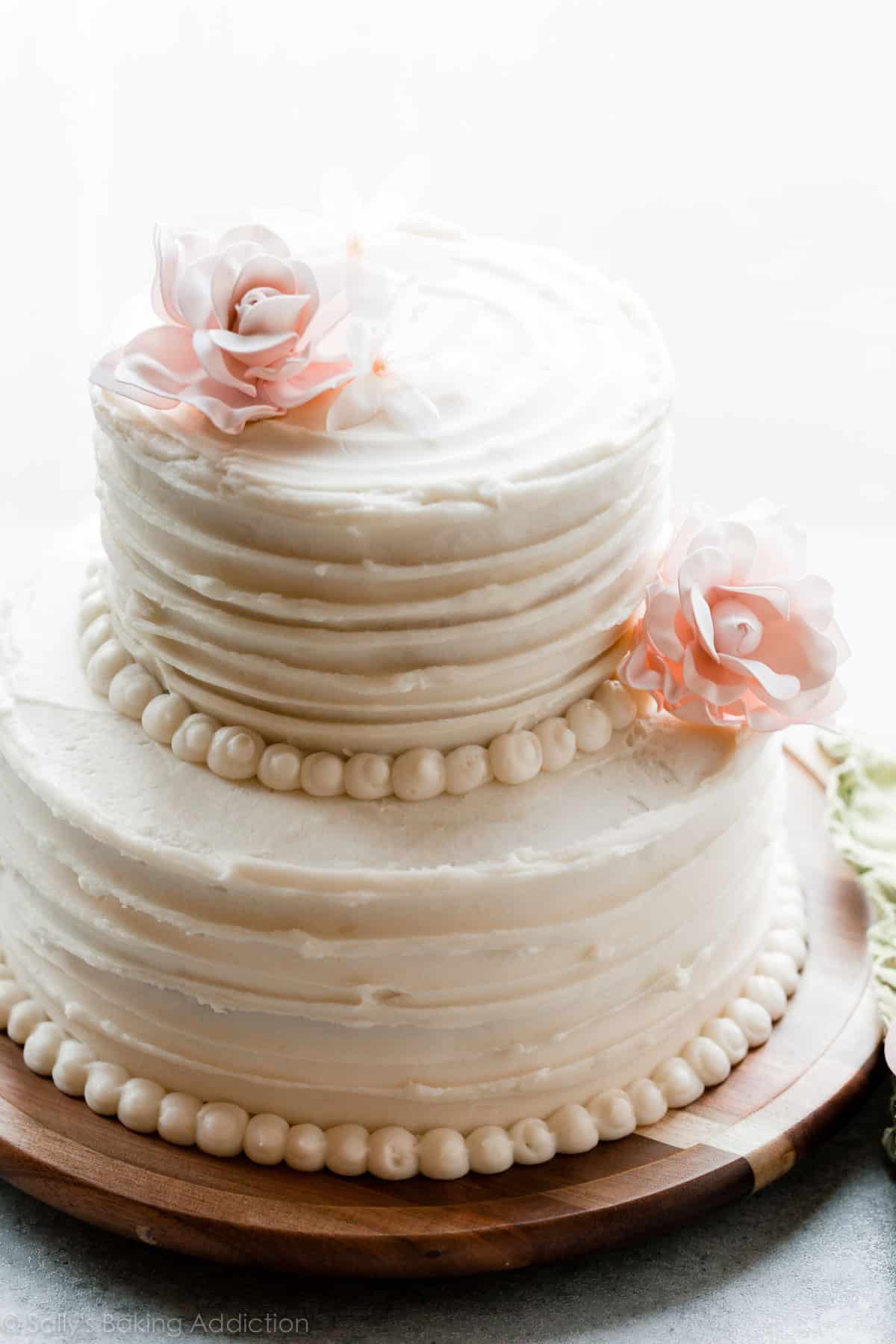
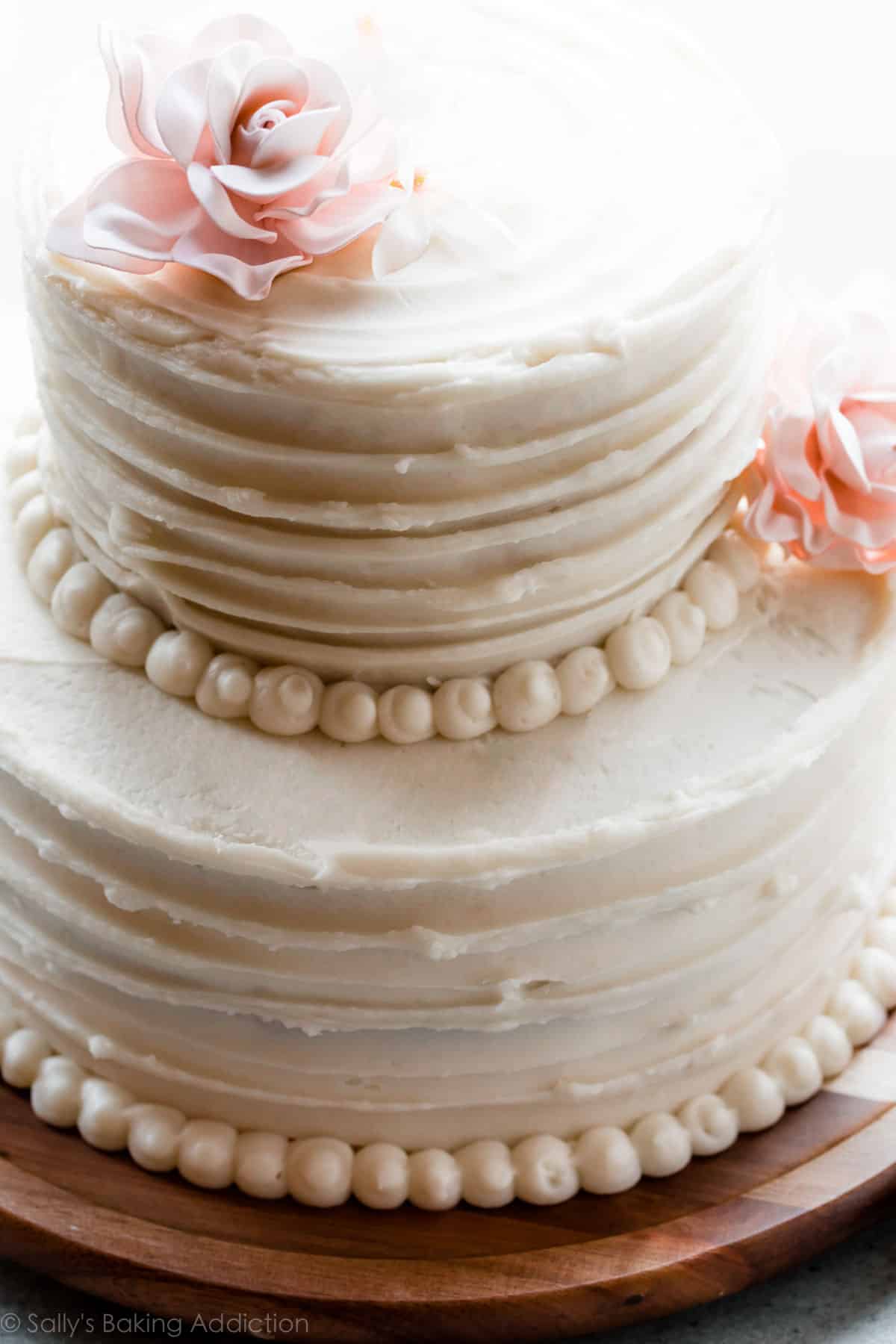
The textured look of the exterior frosting is very easy. (A big shoutout to my assistant, Stephanie, for suggesting this look!) As shown in my video, use a small icing spatula and run it around the cakes while spinning with the cake turner. You will love this look because it’s very easy, but resembles beautiful ruffles.
Piping
After placing the small tier on top, you can pipe frosting around the bottom of it. This covers up any spaces or smears that may have appeared when arranging the top tier. I pipe dots of frosting with a round piping tip between the tiers as well as around the bottom of the whole cake. They resemble pretty pearls. To smooth any peaks on these “pearls,” moisten your fingertip with water and gently press down on the peak.
More Decorating Inspiration
- Naked Cake style with flowers and berries
- Buttercream Flowers
- Two-Toned Frosting Roses
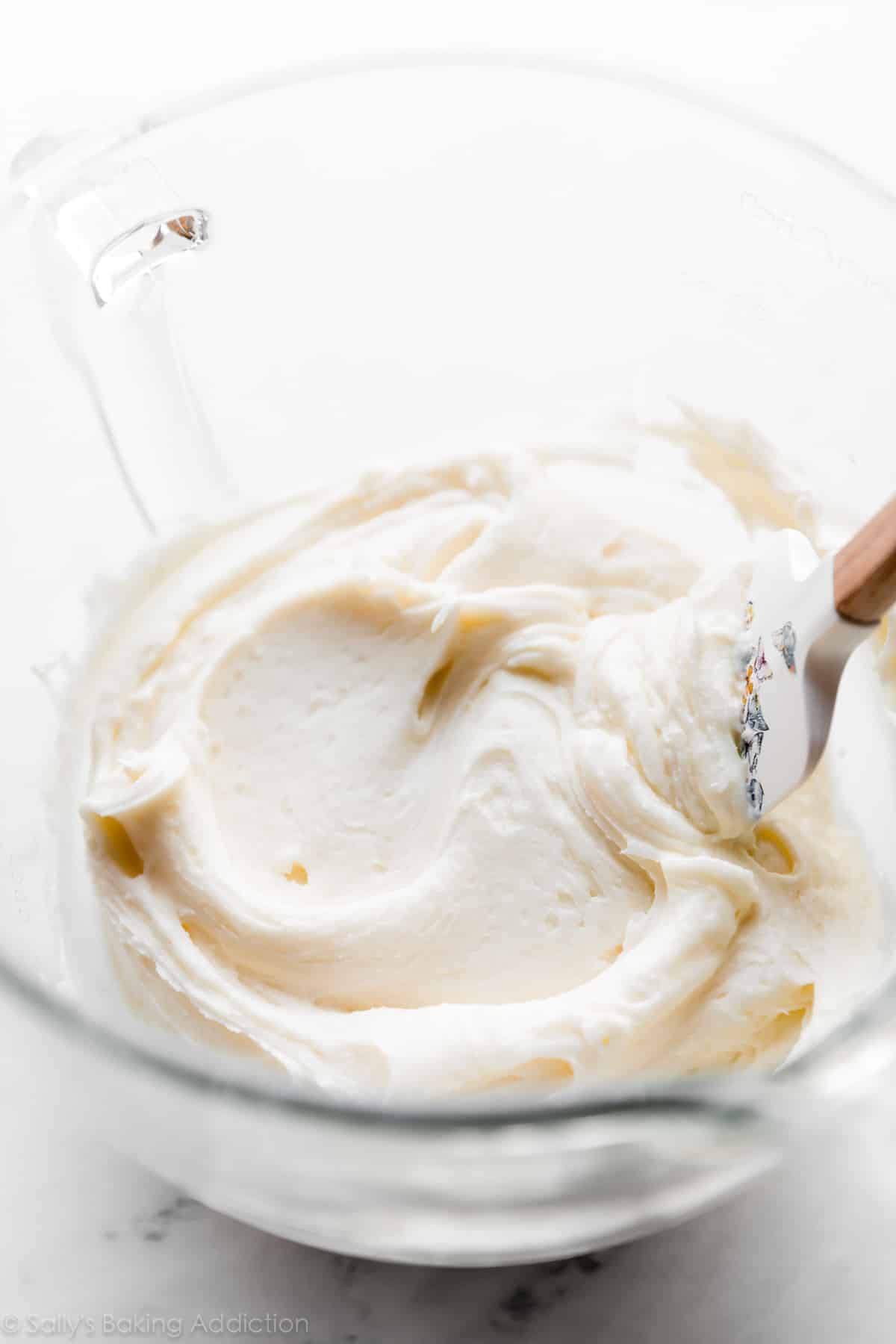
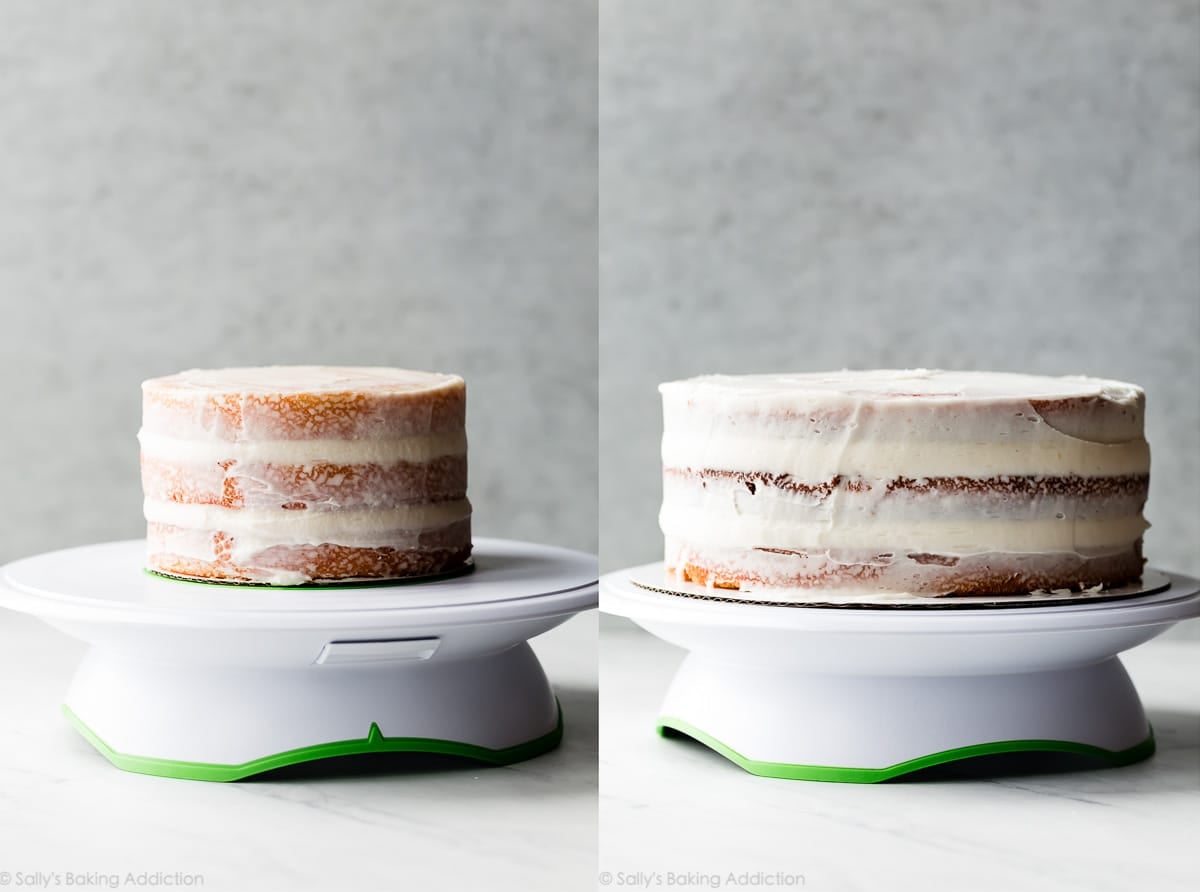
We’ll use my vanilla buttercream recipe (an increased amount, of course) for the decoration. Make two separate batches of frosting, 1 batch for each tier. There’s too much frosting for 1 batch—it will overwhelm your mixer.
You need at least 8-9 cups of frosting total which includes the filling, crumb coat, exterior ruffled frosting, and piping. If you desire other flavors of frosting, be sure to find a recipe that yields or adjust to yield 8-9 cups.
How to Keep Air Bubbles Out of Your Buttercream
Over-whipping vanilla buttercream creates air bubbles. The taste is no different, but the buttercream is no longer smooth and velvety.
Here’s how to get rid of air bubbles in your frosting: Ditch the mixer. Grab a wooden or metal spoon and begin stirring the buttercream by hand. Mash the frosting up against the side of the bowl to “pop” the bubbles. Do this until most of the air bubbles pop, about 1-2 minutes. This trick requires a lot of arm muscle!
Recommended Special Tools
(Affiliate links)
- Mixer (Handheld or Stand Mixer)
- Egg Separator
- 3 9×2 inch Round Cake Pans
- 3 6×2 inch Round Cake Pans
- Cake Boards (I use 1 6 inch and 1 10 inch. A 9 inch board works for the bottom cake, too. Or purchase this set which also includes cake dowels.)
- Cake Dowels (You need 4. You can use plastic cake dowels too. Plastic dowels are easier to cut.)
- Large Icing Spatula (for large cake)
- Small Icing Spatula (for small cake and for ruffled edge)
- Bench Scraper
- Cake Turner
- Piping Bag (disposable or reusable)
- Round Piping Tip
- Artificial Flower Decor (I used “Cozy Blush” color. Love these!)
- Large Serving Platter or Cake Stand (Pictured is a wooden cake stand I found at Target last year. You can see some of my other favorite cake stands in my list of Gift Ideas for Bakers.)
Simple Homemade Wedding Cake Recipe
- Prep Time: 5 hours (includes baking, cooling, decorating)
- Cook Time: 45 minutes
- Total Time: 6 hours
- Yield: 30-35 servings
- Category: Dessert
- Method: Baking
- Cuisine: American
Description
This is a recipe for a completely homemade 2 tier wedding cake. For best taste and texture, and to avoid overwhelming your mixer, make each tier (cake) and each batch of frosting separately.
Ingredients
9-Inch Bottom Tier
- 3 and 2/3 cups (433g) cake flour (spooned & leveled)
- 1 teaspoon salt
- 1 teaspoon baking powder
- 3/4 teaspoon baking soda
- 1 and 1/2 cups (340g) unsalted butter, softened to room temperature
- 2 cups (400g) granulated sugar
- 3 large eggs + 2 additional egg whites, at room temperature
- 1 Tablespoon pure vanilla extract (yes, Tbsp!)
- 3/4 cup (180g) full-fat sour cream, at room temperature
- 3/4 cup (180ml) whole milk, at room temperature
6-Inch Top Tier
- 1 and 3/4 cups (207g) cake flour (spooned & leveled)
- 1/4 teaspoon salt
- 3/4 teaspoon baking powder
- 1/4 teaspoon baking soda
- 1/2 cup (8 Tbsp; 113g) unsalted butter, softened to room temperature
- 1 cup (200g) granulated sugar
- 1 large egg + 1 additional egg white, at room temperature
- 2 teaspoons pure vanilla extract
- 1/2 cup (120g) full-fat sour cream, at room temperature
- 1/2 cup (120ml) whole milk, at room temperature
Frosting for 9 inch cake & piping
- 2 cups (452g) unsalted butter, softened to room temperature
- 8 cups (960g) confectioners’ sugar
- 6 Tablespoons (90ml) whole milk or heavy cream
- 1 and 1/2 teaspoons pure vanilla extract
- 1/8 teaspoon salt
Frosting for 6 inch cake
- 1 cup (16 Tbsp; 226g) unsalted butter, softened to room temperature
- 4 – 5 cups (480-600g) confectioners’ sugar
- 1/4 cup (60ml) heavy cream or whole milk
- 1 teaspoon pure vanilla extract
- salt, to taste
Instructions
- Before beginning this recipe, watch the video tutorial above, read the entire blog post, read the recipe instructions, and review the recipe notes. Make sure you’re prepared with the recommended special tools, which are listed right above this recipe and in the recipe Notes section.
- Make each cake separately. Start with the bottom tier (9-inch cake). Preheat oven to 350°F (177°C). Grease three 9×2 inch round cake pans, line with parchment paper rounds, then grease the parchment paper. Parchment paper helps the cakes seamlessly release from the pans. (If it’s helpful, see this parchment paper rounds for cakes video & post.)
- Whisk the cake flour, salt, baking powder, and baking soda together. Set aside. Using a handheld or stand mixer fitted with a paddle or whisk attachment, beat the butter and sugar together on high speed until smooth and creamy, about 3 minutes. (Here’s a helpful tutorial if you need guidance on how to cream butter and sugar.) Scrape down the sides and up the bottom of the bowl with a silicone spatula as needed. Beat in the 3 eggs, 2 egg whites, and vanilla extract on high speed until combined, about 2 minutes. (Mixture will look curdled as a result of the egg liquid and solid butter combining.) Beat in the sour cream. Scrape down the sides and up the bottom of the bowl as needed. With the mixer on low speed, add the dry ingredients until just incorporated. With the mixer still running on low, slowly pour in the milk until combined. Do not over-mix. Whisk it all by hand a few times to make sure there are no lumps at the bottom of the bowl. The batter will be slightly thick. You’ll have 8-9 cups of cake batter. Pour batter evenly into cake pans. Weigh them to ensure accuracy, if desired. Bake for around 23-26 minutes or until the cakes are baked through. To test for doneness, insert a toothpick into the center of the cake. If it comes out clean, it’s done. Allow cakes to cool completely in the pans set on a wire cooling rack. The cakes must be completely cool before frosting and assembling.
- Keep the oven on.
- For the top tier (6-inch cake) prepare three 6×2 inch round cake pans just as you did with the 9-inch cake pans in step 2. (Greasing with parchment paper rounds.)
- Prepare the 6-inch cake batter the same exact way as the bottom tier. You’ll have about 4 cups of cake batter. The batter will be thinner than the bottom tier’s cake batter. Pour batter evenly into cake pans. Weigh them to ensure accuracy, if desired. Bake for around 18-22 minutes or until the cakes are baked through. To test for doneness, insert a toothpick into the center of the cake. If it comes out clean, it’s done. Allow cakes to cool completely in the pans set on a wire rack. The cakes must be completely cool before frosting and assembling.
- Using a large serrated knife, slice a thin layer off the tops of all the cakes to create a flat surface. This is called leveling off the cakes. Discard the leveled off piece (or crumble over ice cream!).
- Make the frosting for the 9-inch cake (which is enough for the piping detail, too): In a large bowl using a handheld mixer or stand mixer fitted with a paddle attachment, beat the butter on medium speed until creamy, about 2 minutes. Add confectioners’ sugar, milk, vanilla extract, and salt with the mixer running on low. Increase to high speed and beat for 2 minutes. Add more confectioners’ sugar if frosting is too thin, more milk if frosting is too thick, or an extra pinch of salt if frosting is too sweet.
- You can prepare the rest of the frosting now (step 11), if desired, or begin decorating the 9-inch tier. Place your 9-10 inch cake board on your cake turner. Place 1 cake layer on your cake board. Using a large icing spatula, evenly cover the top with a scant 1 and 1/2 cups of frosting. Top with 2nd cake layer and evenly cover the top with a scant 1 and 1/2 cups of frosting. Top with the third cake layer. Using about 1-1 and 1/4 cups of frosting, spread it all over the top and sides in a thin layer, also called a crumb coat. A large icing spatula and bench scraper are helpful for applying the crumb coat. Set leftover frosting aside at room temperature. If you are decorating this cake in stages over 1-2 days, cover and refrigerate this leftover frosting.
- Using the cake board to pick up the cake (be careful, it’s heavy), place the cake in the refrigerator to help set the crumb coat as you work on the top tier.
- Make the frosting for the 6-inch cake, just as you prepared the 1st batch of frosting. (Step 8.) Before adding any salt, taste the frosting, then add a pinch if desired. I always add a small pinch.
- Place your 6-inch cake board on your cake turner. Place 1 6-inch cake layer on your cake board. Using a small icing spatula, evenly cover the top with a scant 3/4 cup of frosting. Top with 2nd cake layer and evenly cover the top with a scant 3/4 cup of frosting. Top with the third cake layer. Using about 3/4 cup of frosting, spread it all over the top and sides in a thin layer, also called a crumb coat. A small icing spatula and bench scraper are helpful for applying the crumb coat. Set leftover frosting aside at room temperature. If you are decorating this cake in stages over 1-2 days, cover and refrigerate this leftover frosting.
- Using the cake board to pick up the 6-inch cake, carefully place the cake in the refrigerator to help set the crumb coat as you work on the exterior frosting on the top tier.
- Remove the bottom tier from the refrigerator (along with the cake board) and place on the cake turner. Apply the remaining frosting for the bottom tier on the cake, reserving about 6-8 Tablespoons for piping detail. I recommend a large icing spatula and bench scraper to apply the outer layer of frosting. For the decorative textured frosting as pictured, see my video above. As shown in the video, use a small icing spatula and run it around the cake while spinning with the cake turner. You will love this look because it’s very easy, but resembles beautiful ruffles. Carefully lift the cake (with the cake board) and place on your serving platter or cake stand.
- Wash and dry 4 cake dowels. Measure the height of the bottom cake. Measure and cut the cake dowels to match. Staying within a 6 inch circle diameter (you can use another 6 inch cake board to “imprint” a 6-inch circle in the very center of the top of the 9-inch cake), insert the dowels into the cake, spacing them about 2 inches apart to form 4 corners of a square. Push the dowels straight down until each touches the bottom cake board. Set aside.
- Remove the top tier from the refrigerator (along with the cake board) and place on the cake turner. Decorate just as you did the bottom tier, including the ruffled textured frosting. I also turn the cake on the cake turner and apply this ruffled look on top of the 6-inch cake, too. This is optional. Along with the cake board, carefully lift the small cake and gently place it in the very center of the bottom tier.
- Piping: After placing the small tier on top, you can pipe leftover frosting around the bottom of it. This covers up any spaces or smears that may have appeared when arranging the top tier. I pipe dots of frosting with Wilton piping tip #12 between the tiers as well as around the bottom of the whole cake. They resemble pretty pearls. To smooth down pointy peaks on these “pearls,” moisten your fingertip with water and gently press down on the peak.
- Add any decorative pieces, such as artificial flowers.
- Cake is best enjoyed within 3 days. Refrigerate cake until ready to serve. After a few hours, the frosting will “set” and you can lightly cover with plastic wrap.
- Cover any leftover cake tightly and refrigerate for up to 1 week.
Notes
- Make Ahead & Freezing Instructions: Assembled cake is best enjoyed within 3 days. Refrigerate assembled cake until ready to serve. After a few hours, the frosting will “set” and you can lightly cover with plastic wrap until ready to display and serve. You can make the cake ahead of time before assembling it, too. The cake layers can be baked, cooled, and covered tightly at room temperature overnight. Likewise, the frosting can be prepared then covered and refrigerated overnight. Let the frosting sit at room temperature to slightly soften for 20 minutes before assembling and frosting. (You may need to beat the refrigerated frosting in the mixer for 1-2 minutes if it’s particularly solid. Feel free to add a Tablespoon of milk or heavy cream to soften it up as it mixes, too.) Crumb-coated cakes can be frozen up to 2-3 months. Cover with 2 layers of plastic wrap and 1 layer of aluminum foil. Freeze. When ready, thaw overnight in the refrigerator. Unfrosted cake layers can also be frozen up to 2-3 months. Thaw overnight in the refrigerator and bring to room temperature before decorating/serving. See how to freeze cakes for detailed instructions on freezing cake layers.
- Special Tools (affiliate links): 9-inch Round Cake Pans | 6-inch Round Cake Pans | Glass Mixing Bowls | Whisk | Electric Mixer (Handheld or Stand) | Silicone Spatula | Egg Separator | Kitchen Scale (optional) | Cooling Rack | Cake Boards (1 6 inch and 1 10 inch, or this set which also includes cake dowels) | Wooden Cake Dowels or Plastic Cake Dowels | Cake Turner | Large Icing Spatula | Small Icing Spatula | Bench Scraper | Piping Bag (Disposable or Reusable) | Wilton #12 Round Piping Tip | Artificial Flower Decor
- Cake Flour: If you can’t get your hands on cake flour, use this cake flour substitute.
- More flavors, fillings, sizes, decoration ideas, and special tools: See blog post above.
- Why is everything at room temperature? All refrigerated items should be at room temperature so the batters mix together easily and evenly. Read here for more information about the importance of room temperature ingredients.







Reader Comments and Reviews
Hi! I just made a trial with this recipe and it came out a little like cornbread. I’m not sure… so I did beat the flour into the wet ingredients on slow, then I finished until just combined by hand. I then added the milk and combined that by hand. I’m not sure where I went wrong, but a light cornbread flavor is definitely there. The texture seems fine…do you have any insight? I used King Arther unbleached cake flour.
Thank you, from a novice baker!
Hi Cass! I think you’ll find this post helpful if you have time to review it: Latest Recipe Testing. There’s information on how cakes can sometimes taste like cornbread there!
Hi, sorry my question about the two tins wasn’t clear. I have full size cake tins, not 2” tins, so the batter would fit comfortably. I mainly wanted to check whether the batter would cook well when made into two larger layers? Thanks for the quick reply and sorry for not being clear the first time! ☺️
Hi Kelly, so sorry for misunderstanding your original question! Even with large enough pans it can be difficult to bake thick cakes through properly without burning the edges. We suggest sticking with 3 cake layers.
Hi Sally! First time making a wedding cake. Been researching and reading all of your instructions. Made many a cake over my years but my concern is that this cake will be too dense. In reading questions asked from other readers regarding this I see you tell them to avoid overmixing. My question is – is it better to use a hand mixer that doesn’t have as much power as a stand mixer to achieve not over mixing? There is a huge difference in mixing for 2 or 3 minutes in your steps with a hand mixer vs a stand mixer. Going to attempt a pre trial of this cake this week before the wedding in 2 weeks. Help!
Hi Tara! We usually make cake batter with a stand mixer. Here’s some tips to avoid dense cake you may like to read as well!
Hi Sally: I’ve cooked/baked my whole life, but never tried to do a wedding cake till now. I did a practice yesterday with this recipe (the bottom tier), followed the instructions to the letter. Had several smallish vertical tunnels, the top & bottom of layers was sticky. Each layer 7/8″ deep on the edges & centers which were nicely domed fell to almost a level cake as they cooled. I haven’t iced yet. Does this sound normal? Thank you.
Hi Rebecca, Tunnels and holes in cakes are typically formed due to over-mixing. Too much air makes its way into the batter and it’s trapped inside. Cakes that are over-mixed also don’t rise as high due the gluten being over developed. If you decide to try the recipe again, avoid over-mixing if you can!
I would really love the see the height of the layer as well as the pan size. I know some people prefer one-inch high layers while I prefer two, but I rarely see that mentioned. One can’t assume that pan height for a recipe equals layer height in my experience. I really want two-inch layers so I only have to bake two of each pan size rather than three to get a 4-inch tall piece of cake. Do your recipes (and especially this one) default to the height of the pan? Just wondering before I attempt this. Thank you.
Hi Ann, We divide our batter between three pans as we find the slightly thinner layers bake more evenly and rise the best (no matter what the pan height). You could try dividing it between 2 pans instead for thicker layers, but the texture of your cakes will be more dense.
Hi,
I usually find cake recipes quite sweet. Would it be ok if I use less sugar in the cakes? Would that affect the baking?
Thanks! You have an awesome website and great instructions!
Hi Toto, thank you for making our recipes! You can certainly give it a try, but keep in mind that sugar makes up part of the structure of the cake and reducing it will alter how it comes out.
Would a 10″ and 8″ be big enough to fed roughly 60 at as a wedding cake (a grooms cake there as well). So if I baked 3 (10″) and 3 (8″) with a ruffle design 🙂 do you feel this would be plenty. This is my first time making a wedding cake (for my son) and I am SO NERVOUS!
Hi Karla! We recommend checking out this helpful Cake Portion Guide (https://chelsweets.com/cake-portion-guide/) from Chelsweets for some help with cake servings. It looks like an 8 inch round cake stacked on a 10 inch round cake may be just about perfect for 50 people. That, plus the groom’s cake, seems like it should be plenty for your group. Or, you can bake a few batches of cupcakes just to have some extras, too. Best of luck!
One more quick question…I do think this recipe is going to work out GREAT for layers (tiers) even doing the ruffle design the bride wants BUT she also wants fresh flowers (which I have researched on how to add), guess my question is IS this cake sturdy enough to hold the small cake board on top tier WITH more buttercream and flowers. I do plan on having the top tier on its own cake board atop the bottom tier AND with that in mind do I need dowels on the bottom tier?
Hi Karla, that should be fine (assuming your top cake board with flowers and buttercream will not be super heavy). Correct, we recommend using both the cake boards and dowels for extra support. Hope this helps!
Hello,
I have been given the opportunity to make a wedding cake for a friend. The cake consists of 12 inch, 9 inch, and 6 inch tiers. Would I be able to use the denser cake for both the 9 inch and 12 inch? If so how much batter would I need to do the 12 inch?
Hi Alexia, yes you can use the same batter for the two bottom tiers. Here is everything you need to know about converting recipes to different Cake Pan Sizes. Hope this helps!
Hi Sally,
This recipe is FANTASTIC! I am practicing for my upcoming wedding. The only concern I have is that it was too dense… To be honest I used corn starch + all purpose flour instead of cake, and may have taken the cakes out of the oven a smidge too early. They also went frosted into the fridge and sat for 24 hours prior to consuming (as this will be the case for the wedding). Any thoughts on ways to get a fluffier, lighter cake? Thanks so much!
P.S. Substituted half of the vanilla for almond extract, and it was DELICIOUS!
Hi Sarah! Using true cake flour should help with yield a fluffier cake. Here’s more tips for preventing dense cake as well – we include lots of helpful tips in that post. So glad you love it!
Hello! I am wanting to make your wedding cake recipe for my grandparents anniversary but the thing is they dont like the taste of sour cream in anything so is there any way I can substitute the milk and sour cream with buttermilk? Will that change the cake drastically and will it still be able to hold up as a bottom tier?
Hi Alexis, Yes, you can replace the milk and sour cream with buttermilk. Hope it’s a hit for your grandparent’s anniversary!
Hi Sally,
My cakes, especially the 6 inch ones, have so many holes in them. I think I overbeat the first batch I made. Followed the recipe to the letter on second batch and still had holes in the cake. Any idea what I might be doing wrong?
Thanks!
Hi Michele! Small bubbles in cakes are normal, but if you have larger bubbles or holes in your cupcakes it could be from any number of reasons. Some common causes of air bubbles are over-mixing the batter, not having all of your ingredients at room temperature, using too much leaveners, or adding the eggs all at once instead of one at a time. Hope this helps for next time!
Hi, I’m making a two-tier cake for a friends birthday but am under a bit of time pressure and only have 2 of each size tin. My tins are cake rather than sandwich (2”) tins so I was thinking of just splitting the batter between 2 rather than 3 tins to save me doing more bakes. I haven’t done this before though so wanted to get your take on whether the batter will cook well in two thicker layers or if it would need adjusting at all? Thanks! Kelly
Hi Kelly! The cake tins we use for this recipe are 2 inches tall as well – I fear yours would overflow or not cook properly through if you try to bake the cakes in 2 pans each. For best results we recommend sticking with three layers per cake. You can let the last third of the batter sit at room temperature while you wait for one of the pans to be free to bake the third. Happy baking!
Hi Ashley! Just baked the 6 inch tier of the white wedding cake. It was really tender and tasted fantastic. I was a bit worried because my daughter wants to use a cake topper and I don’t know if the cake would hold up. Might it work to do the top tier as dense as the 9 inch tier?
Can I stack each tier separately including the cake dowels through the crumb coat stage and freeze? I have to travel with the cake for a day before the wedding.
Thanks!
Hi Patricia, You could. Let the crumb coat set in the refrigerator before wrapping it with plastic wrap to freeze. Then thaw in the refrigerator overnight and bring to room temperature before frosting and serving the cake. Happy baking!
Hi! I am using some deep spring form pans with the same dimensions. First would the batter fit into a 3 in deep pan and 2nd how should I adjust the cooking time?
Hi Ashley, While you could use your 9 inch springform pan, we still recommend baking this as three separate layers (same with the 6 inch cake). Adding all of the cake batter to one pan means the cake won’t bake evenly and it will be too heavy to rise properly.
Ok! Thats what I wondered. I have seen these wire cake cutters and wondered if I could just cook a thick one and the slice it. Thank for clarifying.
Hi Sally,
I truly enjoy your posts as they don’t just tell your reader how to do things… but why. And for me, the WHY is the most valuable information in baking. I find myself reading your posts and forming questions in my mind (the why questions) only to find that as I keep reading, you answer every one of them.
I have learnt so much about baking from your research and your insights and for that I am truly grateful.
Yours sincerely,
Andrea
Hi Andrea, thank you so much for your kind and thoughtful comment. We really appreciate your sweet words and loyal readership — thank you for making and trusting our recipes!
Hi Sally, do you think your spice cake recipe is study enough to hold this? Making a wedding cake for my friend and that is the flavor she requested. Thank you!
Absolutely. It would be great as a tiered cake.
Hi sally i have been asked to make a naked wedding cake ! Which i have never done before , i feel this is a big responsibility even though i have read numerous recipes and blogs which all seem good but am still quite baffled! How may and what sizes for 50 people ? Would appreciate your help thanking you in advance.
Hi Carol! We recommend checking out this helpful Cake Portion Guide from Chelsweets for some help with cake servings. It looks like an 8 inch round cake stacked on a 10 inch round cake may be just about perfect for 50 people. You can use our handy cake pan sizes and conversions guide to find out how much batter you would need for those pans as well. Hope this helps!
Hi Sally, many thanks for your reply regarding the conversions, i have to have two semi naked tiers ready for cutting and serving for a Friday afternoon in August when should i start filling and covering with the buttercream and, do i keep them in the fridge when finished, how do you cover them once they are buttercream coated, they will be on display for a couple of hours at the venue in a warm place
Hi Carol, if possible, it’s always best to frost the cake as close to when you’re planning to serve. You can put them in the fridge when finished until ready to serve — if you have cake boxes or large tupperware containers, that’s best for helping to keep the cake fresh.
Hi, I’m making this cake for Saturday but it’s my first time making a cake like this and I want to start early in case it fails, I have time to order one. I am also using fondant on the outside instead.
Is starting on Tuesday for a Saturday event, too far ahead? Will the cake taste bad?
Hello. I’ve been addicted to your site for all my baking adventures. I especially love your tips and trouble shooting sections. I’ve confirmed, many times, that your Swiss buttercream fixes do indeed work. I’ve been practicing it with brown sugar to ice the cake referenced below…
I am making my daughter’s wedding cake for this October. To keep with the autumn theme I’d like to attempt a caramel cake frosted with brown sugar Swiss buttercream. Do you have a caramel cake recipe that is suitable for stacking? Thank you.
Hi Lori, thank you so much! The burnt sugar cake would be great for stacking, especially if you use cake dowels. It has lovely caramel-like flavor.
Do you know if this recipe is sturdy enough to hold up against fondant instead of buttercream?
Also does buttermilk vs the sourcream/milk mixture offer the same flavour? I want to swap for buttermilk but don’t want to compromise on taste.
Hi Tayb, the sour cream and milk mixture will provide a sturdier crumb that will withstand fondant better. It should hold up just fine.
I always use buttercream under my fondant as many people pull the fondant off (not everyone likes it), and then they are left with a naked cake, but not if I put a little extra on over the crumb coat. Just a thought.
Hi Sally!!! I am planning on making this cake for my own wedding coming up in April and I was wondering if a strawberry jam or fresh strawberries layered with the buttercream would work well on the bottom tier. I plan on doing a test cake first as well. P.S. I love all of your recipes!! Every time I bake something from you everyone is amazed!!!
Hi Alissa, both of those options should work perfectly – let us know how it goes. Congratulations and happy baking!
Very detailed instructions. Cake came out beautifully and everybody loved it. Thank you so much!
Hey Sally! I really want to make this cake for my mom’s birthday, but she’s lactose intolerant. I tried finding alternative recipes that use almond milk, but they’re not as good and detailed as your recipe. Could I replace the milk for almond milk? Thank you so much!
Hi Ana! A lower fat or non dairy milk would work instead, though the cake may not be as light. Unfortunately, we have no tried and true non-dairy substitutes for the butter and sour cream. We would recommend searching for a dairy-free cake for best results.
Thank you so much, Trina! Luckily, it’s just cow’s milk of any kind that she can’t tolerate. I appreciate it!
Hi Sally! I am planning on making this and was hoping to make the traditional “wedding cake” flavor (with some almond). Do you have a recipe you recommend or can you recommend how much extract to add? Do you think vanilla buttercream would still be the best choice? Thanks so much!!
Hi Kate, you could absolutely try adding almond extract to the batters for this tiered cake. We’d recommend starting by replacing half the called for vanilla extract with almond extract. Vanilla buttercream would be delicious, or you can add almond extract to the buttercream for an even more pronounced almond flavor — we’d start with a teaspoon, taste, and then add more to your liking. We’d love to know how it turns out for you!
Hi Sally,
I have recently become very passionate about baking and have done a number of your recipes (the scones being most recent) and I am amazed by how clear you instructions always are. My friend is trying to support my passion and wants me to bake him a cake for his engagement party. Would I be able to do this cake with a red velvet recipe? In addition, would it be enough to use 2 9×2 & 2 6×2 cake tins if I wanted the cake to be a little bit smaller in size? Thank you so much for your help! I’m a huge fan of your work.
Hi Yasmine! See the section of the blog post titled “other flavor options” for red velvet instructions. You can reference this cake pan sizes guide to find out exactly how much batter you’ll need for your cake pans. Hope the cake is a hit!
Hi again,
Just a follow up question. If I am doing it as a red velvet flavoured cake, should I use the same frosting as the red velvet recipe or the frosting for the wedding cake recipe?
Thank you for you patience,
Yasmine
You can use either one! Cream cheese frosting is traditional with red velvet, but buttercream is more sturdy and will hold up for piping and decorating much better.
Hiya,
I’m making a 7 inch wedding cake with 9 inch bottom layer. Would this work and how much extra ingredients would I need from the 6 inch recipe eipe.
Hi Karishma! Here is everything you need to know about converting recipes to different Cake Pan Sizes.
I am hoping to make something like this with a baking set I purchased. The set comes with a 3x2in, a 5x2in and a 7x2in pan. It is marketed to fit one box cake. Would this recipe make too much? Do you think one of your recipes for 6 inch cakes would work?
Hi Maribel! This recipe would be too much batter. Boxed cakes usually make two 8 or 9 inch cake layers. This white cake recipe would be much closer. Hope this helps!
I will be baking today. I don’t know why this recipe has me so anxious. Do you think the white cake recipe will hold up to tiering? I was comparing the two recipes and the main difference I see is that you use egg yolks in the base of the wedding cake but not in the white cake and there is obviously more batter. Do you think the egg yolks add more stability or is the white cake stable enough to handle being tiered?
Hi Maribel! Using cake dowels, the white cake should be just fine as the bottom tier. Happy baking!
Hi sally!
What should I do if I want bigger cake size? Any recommendations for 10” and 12” round cake?
Thank you!!!
Hi Karen! We haven’t tested a larger cake, but you can use this handy guide to find out how much cake batter you’ll need for your pans.
Would I be able to make this with two 9″ pans instead of three?
Hi Jenn, there is too much batter for 2 9-inch cake pans. You can try using this white cake batter instead, which is essentially a vanilla cake but with a softer crumb. Using cake dowels, it should be just fine as the bottom tier.
Hello Sally!
Thank you for another amazing recipe. I have a question: I would like to make the base cake a brown butter cake. Do you have any suggestions on how to adapt the recipe? Would the amount of butter/liquid remain the same or do they need to be adjusted?
I appreciate any feedback and thank you again.
Best,
Elisse
Hi Elisse, you’re welcome! We haven’t tested this (or any cake similar to this) with brown butter. You’ll have to brown the butter, refrigerate it to solidify it, then bring the solidified butter back to room temperature in order to cream it with the sugar. You will likely need more liquid in the batter, but only a few Tbsp. Again, we haven’t tested this so we can’t speak for exact results.
I am getting married this fall, and after seeing what wedding cakes cost, I am happy to attempt to make my own! We are getting married in the Florida keys. Any suggestions on how to add some key lime flavor to this cake? Thank you!
Hi Janet, congratulations! I haven’t tested this recipe with key lime flavor, however, you may want to use this lemon cake as the base then this lemon cupcakes batter as a 6 inch cake. Replace the lemon with key lime juice and zest.