
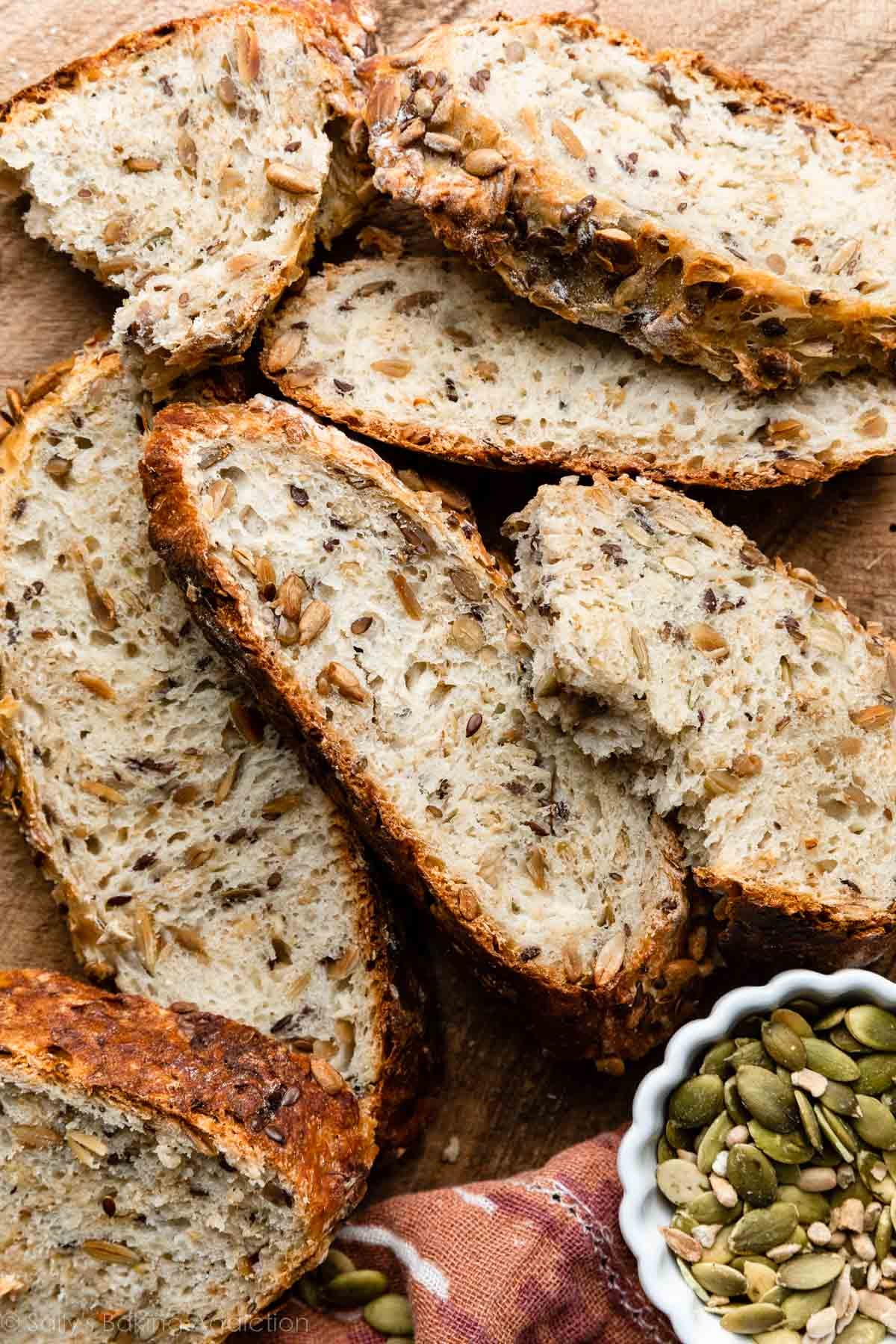
This seeded oat bread is crusty on the outside, chewy on the inside, and has the most delicious crunch in every bite, thanks to all the seeds. This is a hearty loaf that can stand up to any meal, from thick and chunky stews to delicate poached eggs. You’ll use an easy no-knead method to make this yeast bread, which produces a beautiful homemade loaf with minimal hands-on work.
This recipe is brought to you in partnership with Red Star Yeast.
One reader, Rob, commented: “Best bread we’ve had in a long time! Crusty, chewy, flavorful, nutty, and delicious with some good butter. Will definitely be making this again. Thank you. ★★★★★“
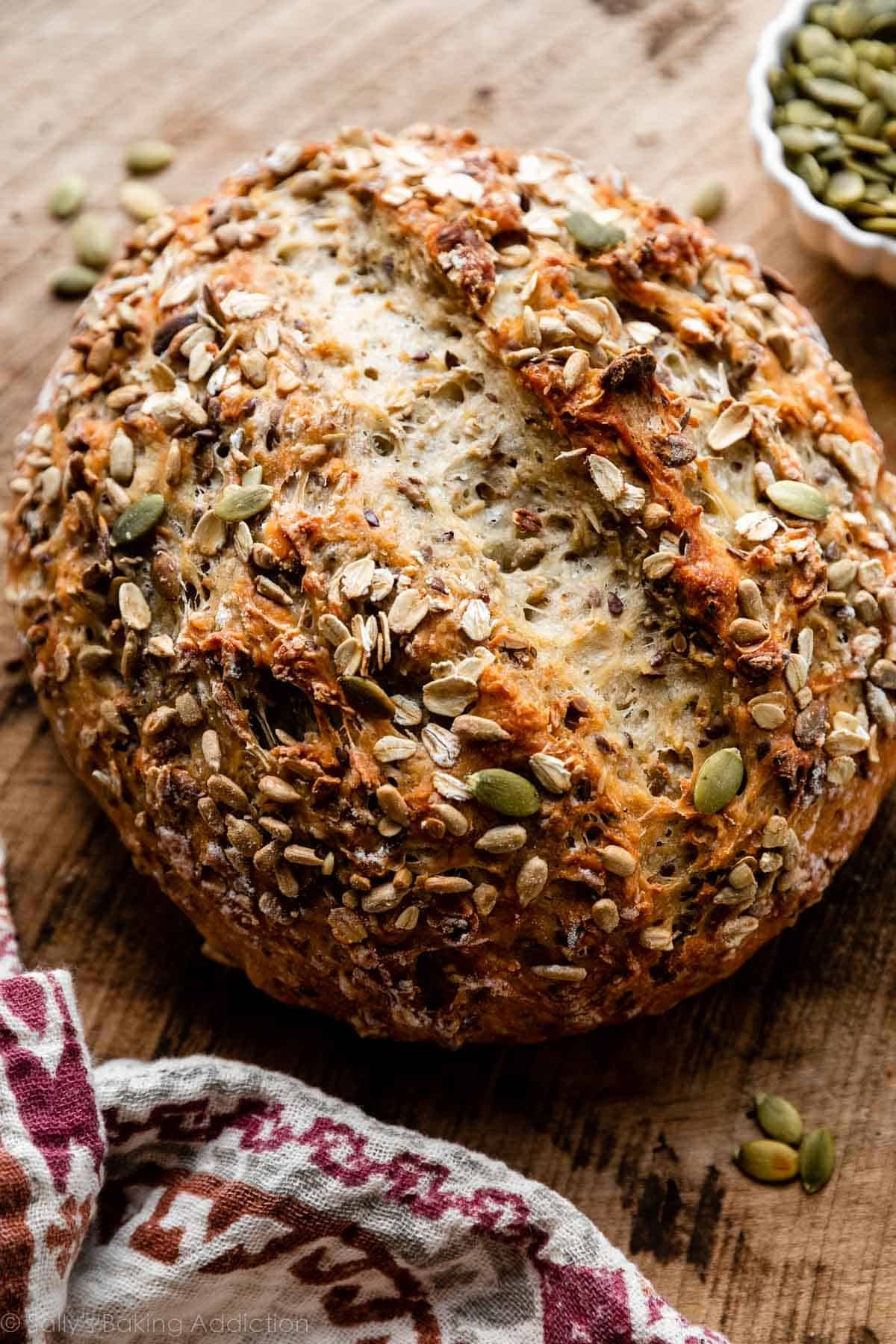
You know those gorgeous seed-encrusted loaves of bread you see in bakery windows?
The kind that look like they took ages to make, and you wonder how much kneading, shaping, and work went into just 1 loaf? Well, you can make those same beautiful seeded loaves right at home, with hardly any work involved. No kneading, no complex shaping, no mixer needed.
Yes, this crusty, chewy, golden-brown, seed-speckled oat bread doesn’t require any complicated work.
This bread, like my homemade cranberry nut no-knead bread, asiago-crusted skillet bread, pizza bread, and olive bread, will convince anyone that you either bought it from a bakery or spent all day in the kitchen making it—which, of course, you didn’t. Don’t feel like you have to let them in on our little secret. 😉
Hearty Homemade Bread for Beginners
This texture-lover’s seeded oat bread recipe is based off of my homemade artisan bread, a wonderfully easy and widely popular no-knead bread that’s used by both beginners and experts.
If you’re nervous to try homemade bread, this recipe is a great introduction. Even though the recipe is easy, the bread does NOT skimp on flavor. It’s just a simple way of baking homemade bread inspired by the no-knead technique originating from bread expert Jim Lahey.
Here’s why it’s so simple:
- Absolutely no kneading (just like homemade English muffins)
- Zero complicated shaping
- No mixer required
- 90% of the time is totally hands off
- Dough can rest in the refrigerator for up to 3 days—a great make-ahead recipe
- Can bake in a dutch oven or on a baking sheet
The trick is giving the risen dough a rest in the refrigerator. The cool air slows the fermentation process and helps develop better flavor.
Grab These Ingredients:
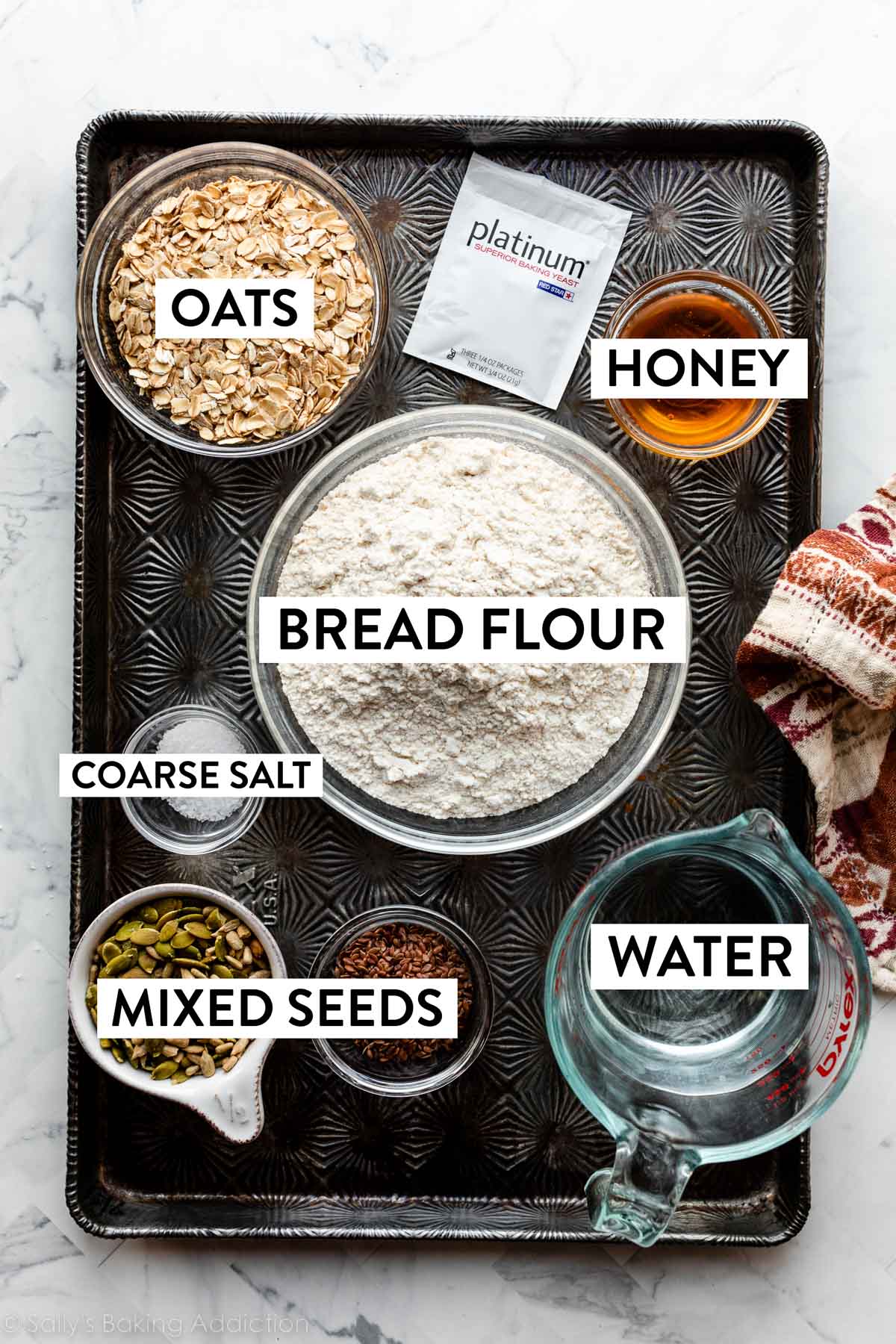
Here’s why each ingredient is so important:
- Bread Flour: While you could use all-purpose flour in this recipe, I strongly recommend using bread flour. Bread flour produces a stronger, chewier bread, and that makes a big difference in an artisan-style loaf like this oat bread.
- Oats: Oats provide a little wholesome texture. As the dough rises, the oats soak up some moisture and expand. Whole rolled oats are best, but you can use quick oats if needed.
- Salt: I recommend using coarse sea salt because I find the bread’s flavor lacking with regular table salt.
- Instant Yeast: I always use Platinum Yeast by Red Star, which is an instant yeast (aka “quick rise” yeast). 2 teaspoons is a little less than 1 standard packet. (If using active dry yeast, there are no changes needed to the recipe. The rise time may just take slightly longer.) I use more yeast in this recipe compared to my cranberry nut no-knead bread and jalapeño cheddar bread. Why? Those doughs rest and rise at room temperature. However, for more flavor and just as much rise, I use more yeast and let this dough rest in the refrigerator.
- Seeds: Pumpkin, sunflower, and flax seeds are all highly nutritious—they’re pretty much superfoods. I love that these 3 types of seeds vary so much in size and texture, but if you’d like to change up the types of seeds in this mixture, go for it. I use a medley of seeds in this multigrain bread, too. (And even these quinoa snack bars!)
- Honey: Honey helps give this bread a springy, spongey texture. It also adds a little sweetness, but we’re using half as much honey here than in my honey oat bread recipe, so the bread isn’t super sweet.
- Water: You’ll also need a little warm water to bring all the ingredients together. I use cool, room temperature water in olive bread and artisan homemade bread, two other no-knead doughs, but with the addition of oats today, the yeast has to work harder, and warm water helps it work quicker.
Let Me Show You How to Make This Seeded Bread
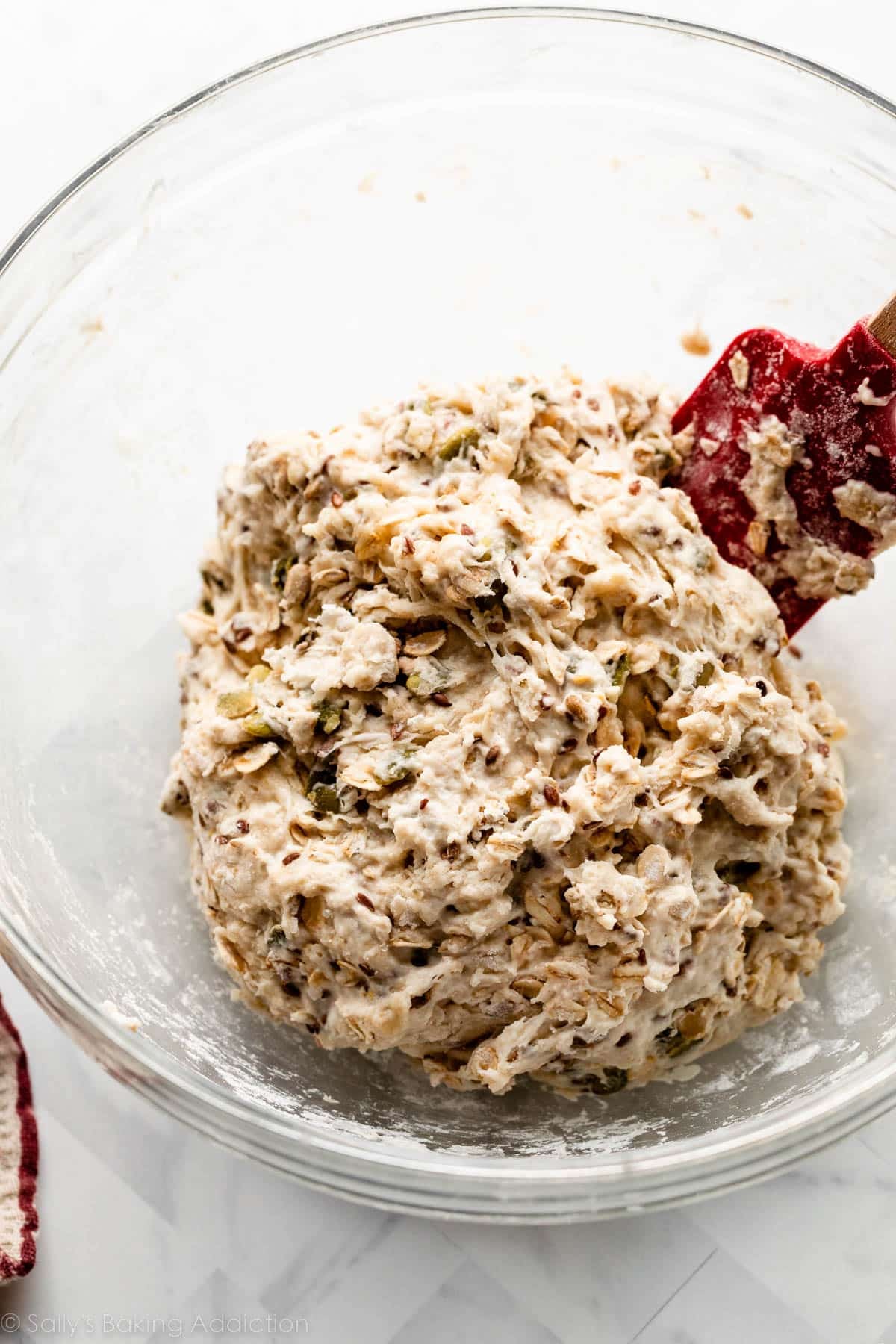
The full written recipe is below, but use the following explanations and step photos to help you get started. Bring the dough ingredients together as instructed in the recipe. At first the dough will seem very dry and shaggy and you’ll question if it will even come together. It will. In fact, the dough is a little sticky after it has been thoroughly mixed:
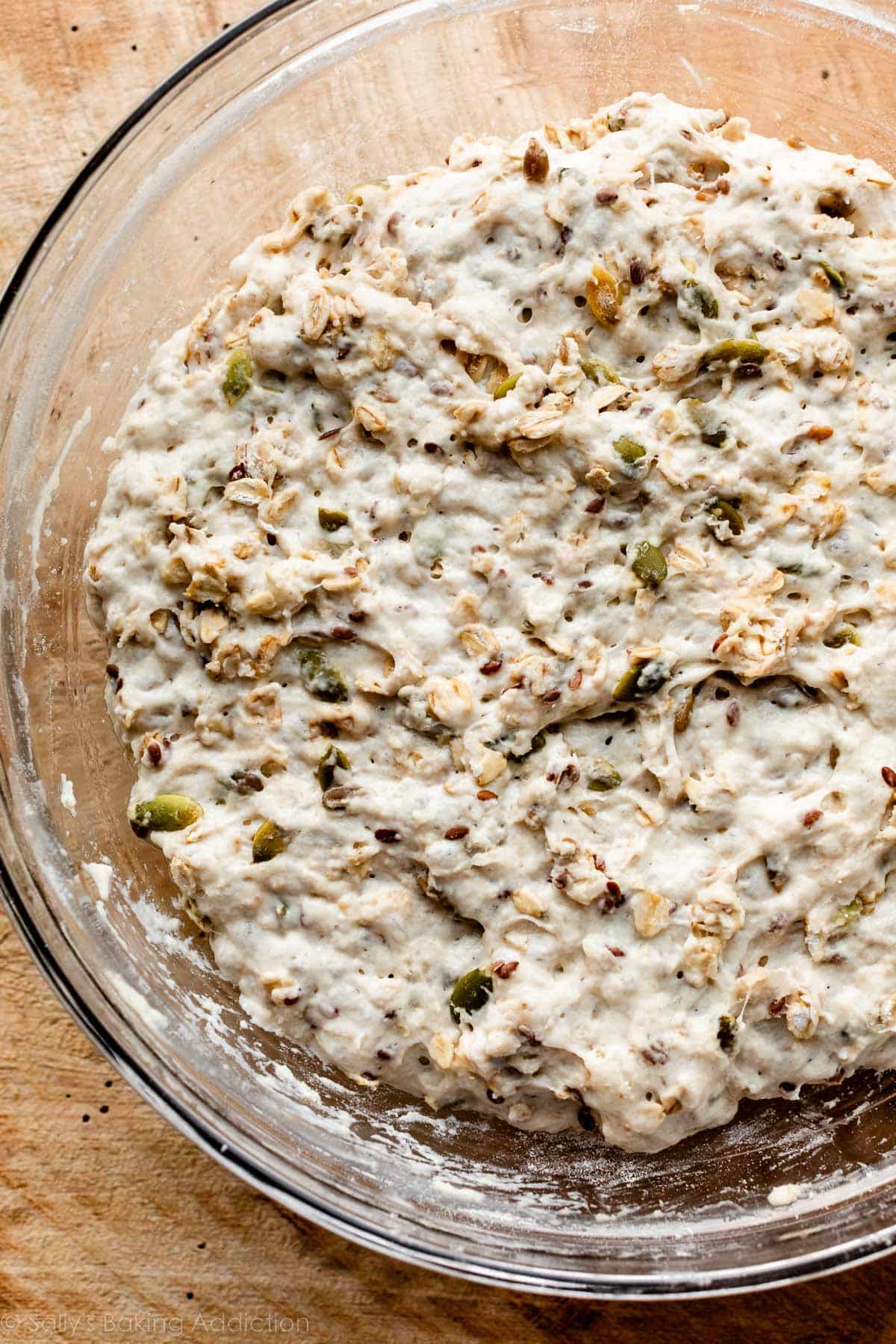
Let it rise. Cover the dough and let it rise at room temperature for about 3 hours. Notice that the dough rises OUT more than it rises UP. That’s ok.
You can move on to shaping and baking the dough, but for best flavor, I strongly recommend refrigerating the risen dough, even if it’s just for a couple hours. I usually refrigerate it for 12 hours.
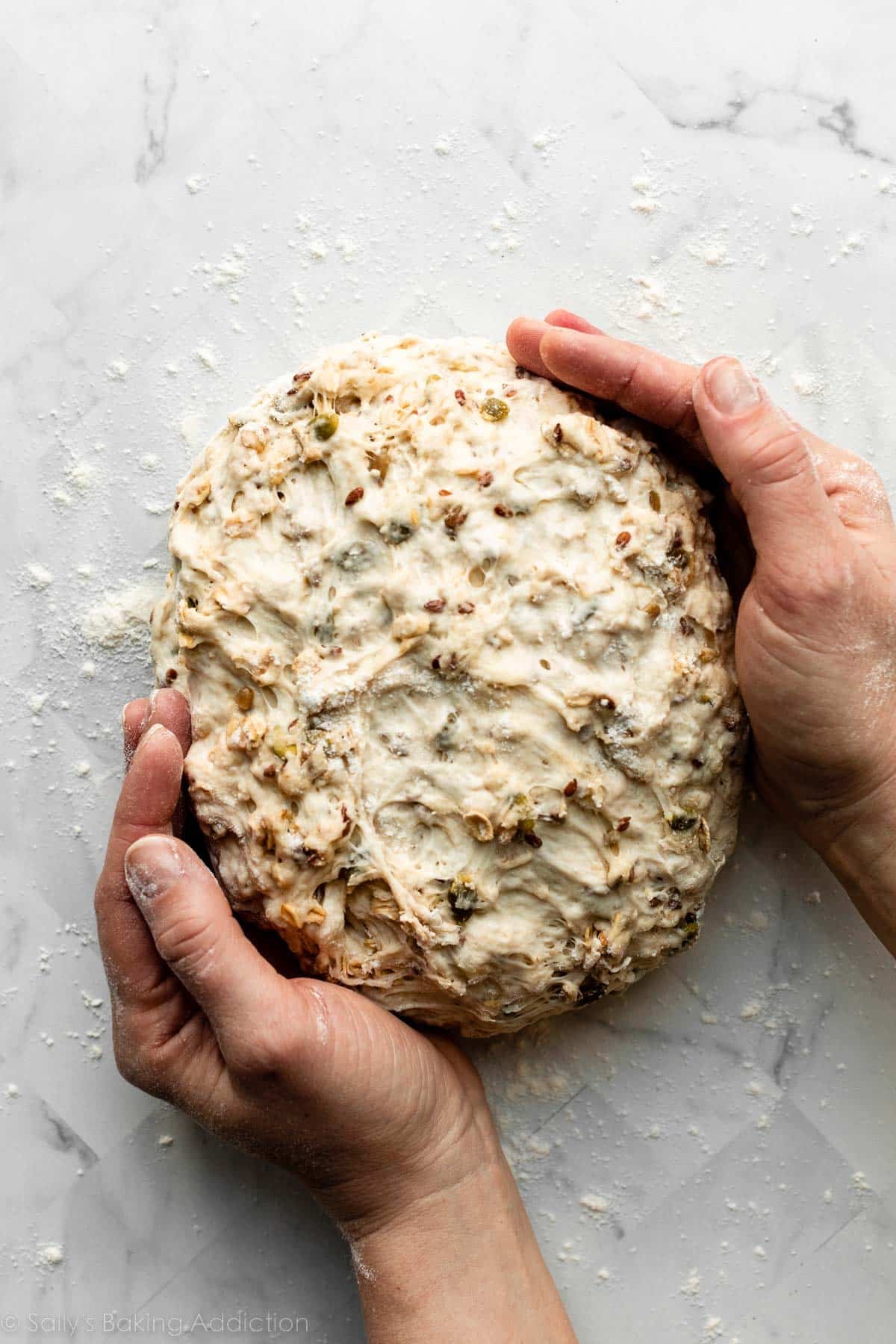
After the dough rises and rests in the refrigerator, use generously floured hands to shape the dough into a round boule or ball-like shape.
Use a Baking Sheet or Dutch Oven
Baking the seeded oat bread in a covered dutch oven traps steam inside the pot, creating that perfect crispy crust. If you plan to bake a lot of bread in the future, you won’t regret buying a dutch oven. If you don’t have a dutch oven, a nonstick baking sheet is best. (I use a baking sheet in the video tutorial below. And even have a trick for creating a steamy oven!)
- Baking Sheet: If you’re using a baking sheet, dust the pan with cornmeal and/or a little flour. Place the dough on top, cover it, and let it rest as the oven preheats. You will find these detailed instructions in the recipe below, along with my optional steamy oven trick for a crispy crust in step 10. (Adding boiled water to a pan beneath the baking bread. Works great!)
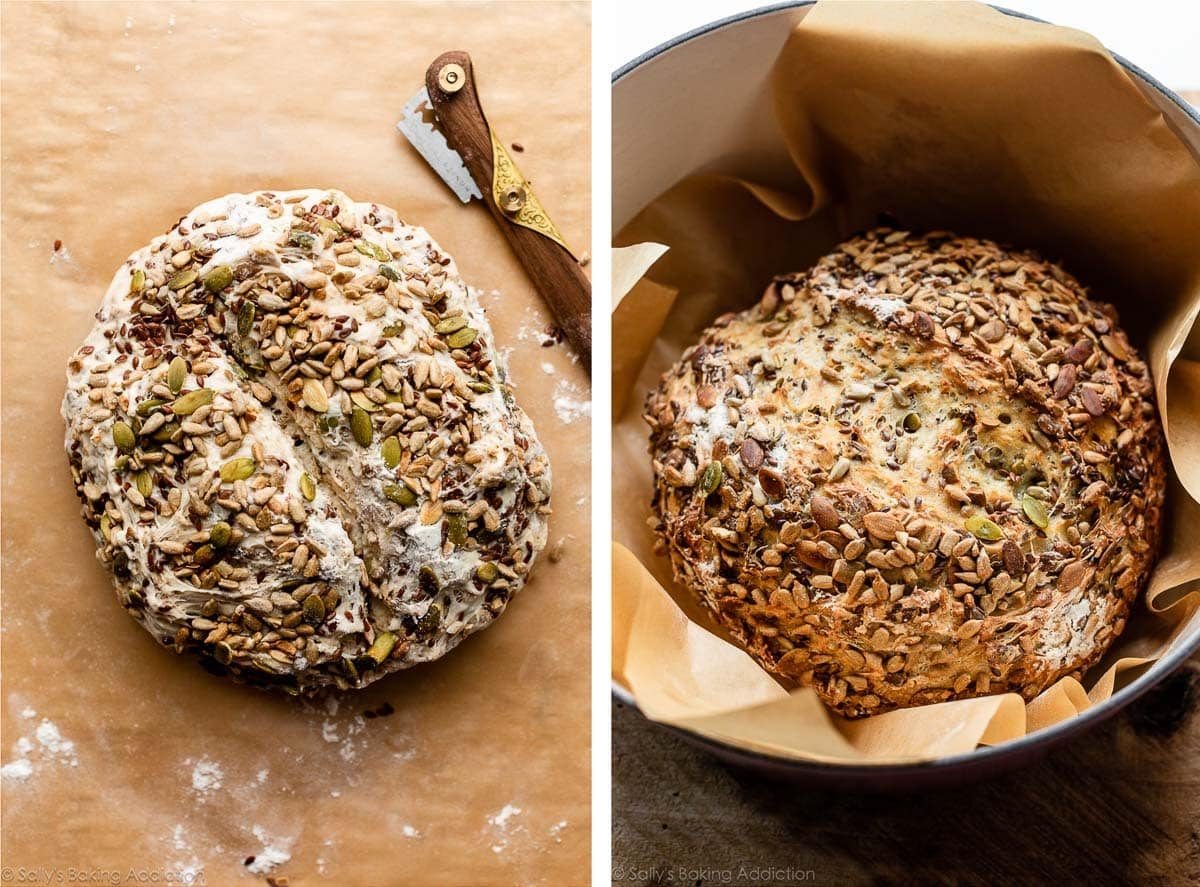
- Dutch Oven: Place the empty dutch oven with lid in the oven as it preheats. Place the ball of dough on high-heat-resistant parchment paper (I use this parchment paper), and then fit it inside a bowl. Cover and let the dough rest as the oven preheats, then place it (with the parchment) in the hot dutch oven before baking. You will find these detailed instructions in the recipe Note below.
Whichever baking method you use, don’t forget to add seeds/oats to the exterior of the dough (I usually just press them on). And make sure you score the dough with a bread lame or sharp knife before baking. Scoring allows the wet, airy dough to “breathe” as it expands and bakes.
Baking sheet method:
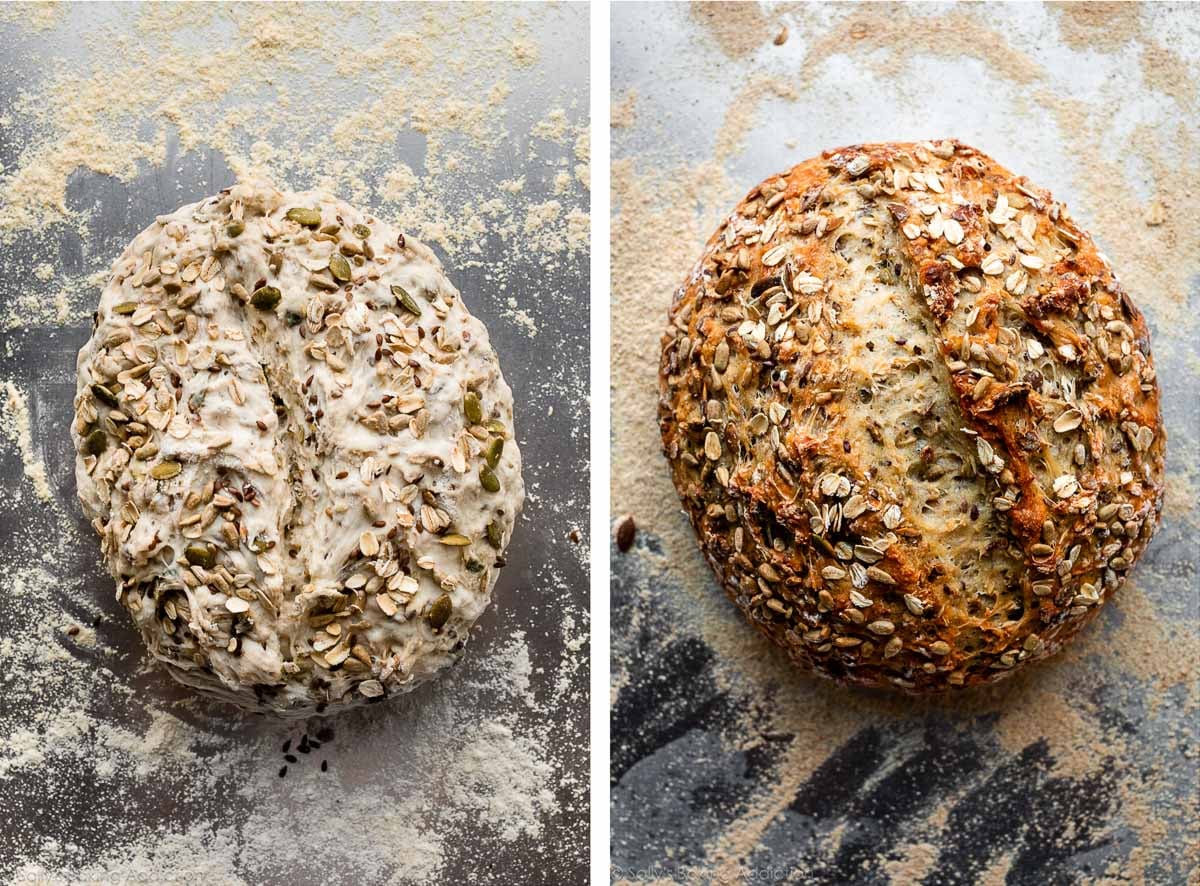
Dutch oven method:
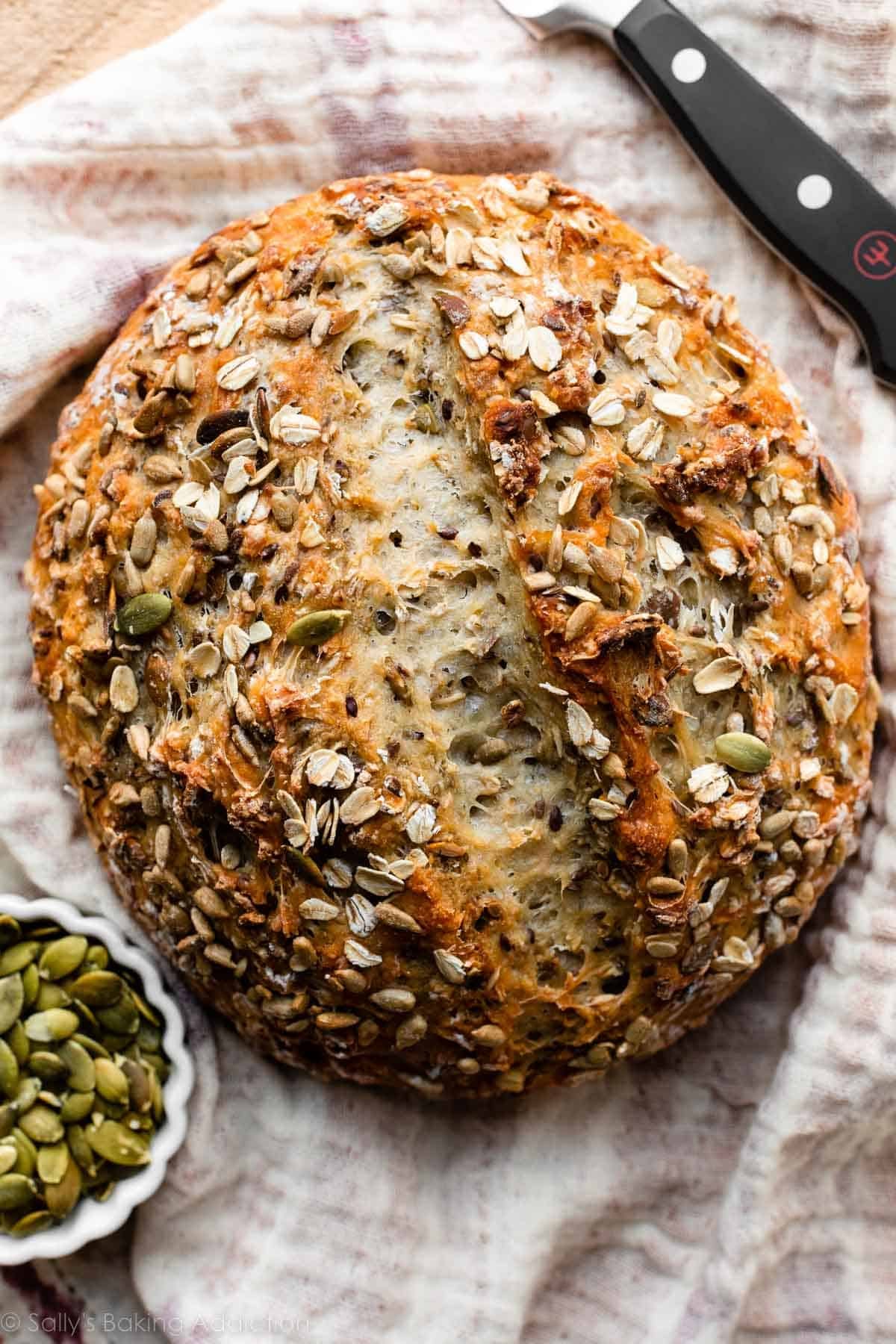
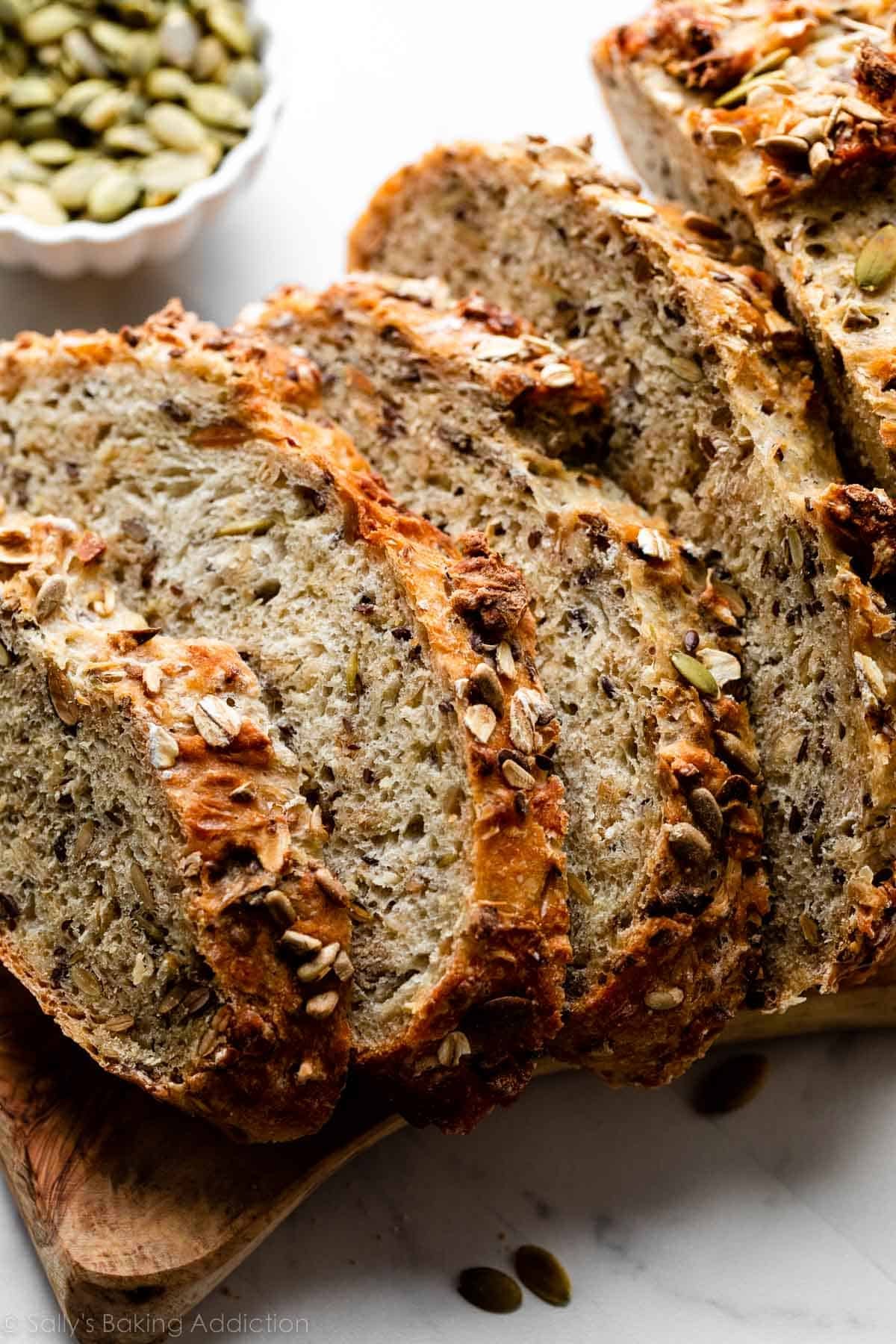
The bread is unbelievable when it’s fresh from the oven—warm, crispy, crusty, soft, and loaded with texture inside and out!
What Do I Serve With Seeded Bread?
Honestly, it’s fantastic plain, with a swipe of butter or a dip-dish of olive oil. The bread would also be delicious paired with homemade pesto or homemade honey butter.
But I especially love serving this seeded oat bread alongside a soup, like this creamy chicken noodle soup or homemade alphabet soup. It also gives phenomenal texture to grilled cheese sandwiches, and makes a hearty base for creamy smashed avocado and soft eggs.
If you manage to have any leftover, make use of the stale bread in this easy breakfast casserole!
Yeast Bread Success Tips
If you’re a bread beginner, reference this Baking with Yeast Guide for helpful, easy-to-understand answers to many yeast FAQs.
No Knead Seeded Oat Bread
- Prep Time: 4 hours
- Cook Time: 40 minutes
- Total Time: 5 hours (includes slight cooling)
- Yield: 1 loaf; 10-12 servings
- Category: Bread
- Method: Baking
- Cuisine: American
Description
Follow this easy no-knead recipe for a hearty loaf of homemade seeded oat bread. Review Notes before beginning. If you’re new to working with yeast, reference my Baking with Yeast Guide for answers to common yeast FAQs.
Ingredients
- 3 cups (390g) bread flour (spooned & leveled), plus more as needed for shaping and pan
- 2 teaspoons (about 6g) Platinum Yeast from Red Star instant yeast
- 1 cup (85g) old-fashioned whole rolled oats
- 1/4 cup (30g) unsalted pumpkin seeds (pepitas)
- 1/4 cup (30g) salted or unsalted sunflower seeds
- 2 Tablespoons (18g) flax seeds or sesame seeds
- 2 teaspoons coarse salt
- 2 Tablespoons (43g) honey
- 1 and 1/2 cups (360ml) warm water (about 95°F (35°C))
- optional: cornmeal for dusting pan
Topping
- 1 Tablespoon (5g) old-fashioned whole rolled oats
- 1 Tablespoon (8g) pumpkin seeds (pepitas)
- 1 Tablespoon (8g) sunflower seeds
- 1 teaspoon flax seeds or sesame seeds
Instructions
- Watch the video below before you begin, and let that be your visual guide for this recipe.
- In a large un-greased mixing bowl, whisk the flour and yeast together. Add the oats, pumpkin seeds, sunflower seeds, flax seeds, and salt and whisk to combine. Mix the honey and water together, and then pour over the dry ingredients. Using a silicone spatula or wooden spoon, gently mix together. The dough will seem dry and shaggy, but keep working it until all the flour is moistened. If needed, use your hands to work the dough ingredients together. The dough will be very sticky. Shape into a ball in the bowl as best you can. (Tip: Stir dough by hand. Dough is too sticky for a mixer.)
- Keeping the dough in the bowl, cover the dough tightly with plastic wrap or aluminum foil and set on the counter at room temperature (honestly any normal room temperature is fine). Allow to rise for 3 hours. The dough will just about double in size, stick to the sides of the bowl, and have a lot of air bubbles.
- You can continue with step 5 immediately, but for absolute best flavor and texture, I strongly recommend letting this risen dough rest in the refrigerator for at least 12 hours and up to 3 days. (Even just a couple hours is good!) Place covered dough in the refrigerator for up to 3 days. The dough will puff up during this time, but may begin to deflate after 2 days. That’s normal and nothing to worry about.
- Lightly dust a large nonstick baking sheet (with or without rims, and make sure it’s nonstick) with a little flour and/or cornmeal. Using generously floured hands and gentle pressure so as to not deflate the dough too much, shape the risen dough into a ball. (I just do this right inside the bowl it’s in, or you can do this on a lightly floured work surface.) Dough is very sticky.
- Transfer ball to prepared baking sheet. Mix topping ingredients together. Sprinkle on top of dough, and if the seeds aren’t sticking, press them into the dough as best you can. Loosely cover and allow dough to rest for 45 minutes. You will bake the dough on this prepared baking sheet. See recipe note if you want to use a pizza stone or dutch oven.
- During this 45 minutes, preheat the oven to 425°F (218°C).
- When ready to bake, using a very sharp knife or bread lame (you could even use kitchen shears), score the dough with a slash or X about 1/2 inch deep. (“Score” = shallow cut.) If the shaped loaf flattened out during the 45 minutes, use floured hands to reshape.
- Place the shaped and scored dough (on the flour/cornmeal-dusted pan) in the preheated oven on the center rack.
- Optional for a slightly crispier crust: Place a shallow metal or cast iron baking pan or skillet (I usually use a metal 9×13-inch baking pan) on the bottom oven rack. Carefully and quickly pour 3–4 cups of boiling water into the shallow pan. Quickly shut the oven to trap as much steam inside. The steam helps create a crispier crust.
- Bake for 40 minutes or until the crust is golden brown. If you notice the exterior browning too quickly, tent the bread with aluminum foil. How to test for doneness: Give the warm bread a light tap. If it sounds hollow, it’s done. For a more accurate test, the bread is done when an instant read thermometer reads the center of the loaf as 195°F (90°C).
- Remove the bread from the oven and allow to cool for at least 10–20 minutes before slicing and serving.
- Store leftovers loosely covered at room temperature for up to 3 days or in the refrigerator for up to 10 days.
Notes
- Make Ahead & Freezing Instructions: The dough can sit in the refrigerator for up to 3 days (step 4), so this is a wonderful recipe to begin ahead of time. You can also bake the bread, allow it to cool, and freeze for up to 3 months. Thaw in the refrigerator and allow to come to room temperature before serving. You can also freeze the dough. Complete the recipe through step 5. Wrap in plastic wrap and place in a freezer-friendly container. Freeze up to 3 months. To bake, allow dough to thaw overnight in the refrigerator, or for 2–3 hours at room temperature. Continue with step 6, including allowing dough to rest for 45 minutes before baking. Keep in mind that the bread tastes a little heavier after freezing/thawing the dough and then baking it.
- Special Tools (affiliate links): Glass Mixing Bowls | Silicone Spatula or Wooden Spoon | Baking Sheet | 2-cup Measuring Cup | Bread Lame | Instant-Read Thermometer | Coarse Salt
- Flour: For absolute best flavor and chewy texture, I strongly recommend using bread flour. You can use a 1:1 substitution of all-purpose flour in a pinch with no other changes to the recipe. I recommend avoiding whole wheat flour in this dough; however, if necessary, you can replace up to 1 cup (about 130g) of the bread flour with whole wheat flour. The bread will taste a bit heavy.
- Yeast: I always use Platinum Yeast from Red Star, an instant yeast. You can use any instant yeast in this dough. If using active dry yeast, the 1st rise time is usually slightly longer, about 3.5–4 hours. Reference my Baking with Yeast Guide for answers to common yeast FAQs.
- Salt: Use a coarse salt, such as coarse sea salt, in this bread. I find the flavor slightly lacking when using regular table salt. If you only have table or fine salt, reduce to 1 and 1/2 teaspoons.
- Seeds: Feel free to use more/less of a particular seed you love, or skip any seeds if you wish. Around 1/2 cup of larger seeds and 2 Tablespoons of smaller seeds is ideal. I usually use unsalted pepitas and salted sunflower seeds. Salted or unsalted are fine, but I don’t recommend 1/2 cup of salted seeds, so if you want to use salted, use 1/4 cup of salted and 1/4 cup unsalted. If you want to add poppy seeds, replace 1 Tablespoon of flax seeds/sesame seeds with poppy seeds. Or just use 1 Tablespoon poppy seeds and skip the flax/sesame.
- Using a Dutch Oven: You need a 6-quart or larger dutch oven or any large oven-safe pot with a lid. Prepare dough recipe above through step 4, including refrigerating the risen dough for at least 12 hours. After refrigerating, turn the dough out onto a lightly floured work surface and, using lightly floured hands, shape into a ball as best you can. Doesn’t have to be perfect. Transfer dough to a large piece of parchment paper. (Large enough to fit inside your pot and one that is safe under such high heat. I use this parchment and it’s never been an issue.) Lift the parchment paper and dough up and place it all into a large mixing bowl. Cover dough lightly with plastic wrap and leave alone for 30 minutes. During this 30 minutes, preheat the oven to 425°F (218°C). Place your dutch oven (with the lid) inside for 30 minutes so that it’s extremely hot before the dough is placed inside. After 30 minutes, sprinkle seed topping all over dough. Using a bread lame or sharp knife, gently score a 1/2-inch-deep slash or X into the top. Remove the dutch oven from the oven and carefully place the dough inside by lifting it up with the parchment paper and placing it all—parchment paper included—inside the pot. Cover with the lid. Bake for 30 minutes with the lid on. Carefully remove the lid and continue baking for 10 more minutes or until the bread is golden brown. You can test for doneness exactly how you would in step 11 above. Remove pot from the oven, carefully remove the bread from the pot, and allow to cool on a wire rack for 10–20 minutes before slicing/serving.
- Using a Pizza Stone: If you want to bake your bread on a pizza stone, place pizza stone in the preheating oven. Remove hot pizza stone, dust with cornmeal or a little flour, and then transfer shaped and scored dough to hot pizza stone and bake as directed.
- No Nonstick Pan? If you don’t have a nonstick baking sheet, line it with parchment paper instead. Coat with a dusting of flour and/or cornmeal before placing the dough on top. Parchment paper can burn, so it’s best to check the box to see how much heat yours can tolerate. Lower your oven heat if necessary, and bake the bread for longer until it’s golden brown and sounds hollow when tapped.















Reader Comments and Reviews
Do you have any of the nutrition facts breakdown for this recipe?
We don’t usually include nutrition information as it can vary between different brands of the same ingredients. Plus, many recipes have ingredient substitutions or optional ingredients listed. However, there are many handy online calculators where you can plug in and customize your exact ingredients/brands. Readers have found this one especially helpful: https://www.verywellfit.com/recipe-nutrition-analyzer-4157076
Can I use whole wheat flour with this recipe? Do I need any adjustments? Also, what happens if you make it in the KitchenAid mixer? So, in essence, it will be somewhat kneaded.
Hi Julia, We really recommend avoiding whole wheat flour in this dough; however, if necessary, you can replace up to 1 cup (about 130g) of the bread flour with whole wheat flour. The bread will taste a bit heavy. This recipe does not rely on kneading—so while you could use your mixer to incorporate the ingredients, we don’t recommend mixing it much longer. A bowl and spoon are best.
Hearty, delicious, and easy to make. Thank you.
That looks amazing! Is there a DIY gluten-free bread flour recipe that I could make myself? Thank you
Hi Alina, we aren’t experts in gluten free baking, but let us know if you give anything a try.
I love seeds and can’t wait to bake this up. Are you using raw or roasted seeds? Thanks!
We typically use raw, but you can use roasted seeds if desired.
This bread is so delicious! I used the Dutch oven with parchment paper because that’s how I always bake bread. The loaf was a little heavy and not as airy as I would have liked, but I think that’s due to my handling it a little too roughly when forming the ball out of the fridge. I realize in your video that you’re shaping it soooo gently. I’ll try that next time. I took Jenn’s suggestion and topped it with Everything Bagel seasoning. Out of this world good and so much flavor! I will definitely make this one again and be a little more gentle when shaping the boule. Thanks!
I really wish you’d include nutritional information with all your recipes. Please
Hi Kathleen, We don’t usually include nutrition information as it can vary between different brands of the same ingredients. Plus, many recipes have ingredient substitutions or optional ingredients listed. However, there are many handy online calculators where you can plug in and customize your exact ingredients/brands. Readers have found this one especially helpful: https://www.verywellfit.com/recipe-nutrition-analyzer-4157076
I was wondering if this recipe could make rolls instead of a loaf and if so, how would that affect baking time? Also, would they be ok on a baking sheet or would another type of pan be better? I’ve only ever made your soft dinner buns, which are a hit but I’m looking for a seeded dinner roll recipe and was excited to see this bread recipe
Hi Brenda, You can make smaller rolls. Bake time and yield will depend on the size you make them. Bake until the crust is golden brown and when you tap the loaves, they will sound hollow when done. For a more accurate test, the bread is done when an instant read thermometer reads the center of the rolls as 195°F (90°C).
I would like to make smaller loaves how would I adjust the baking time
Hi Kathy, You can make smaller rolls. Bake time and yield will depend on the size you make them. Bake until the crust is golden brown and when you tap the loaves, they will sound hollow when done. For a more accurate test, the bread is done when an instant read thermometer reads the center of the rolls as 195°F (90°C).
This bread is fantastic! I fermented for about 24 hours. Adding some sourdough discard for a little punch. Mix/rise/ferment/bake in my LeKue. Thank you Sally!
hi sally! is it possible to switch out the instant yeast for the instant sourdough yeast (red platinum) in your bread recipes that call for regular instant yeast? my husband loves sourdough so wanted to make the switch BUT wasn’t sure if it would compromise the end result. ty 😉
Hi Sonny, I haven’t specifically tested that swap with this bread, but you can certainly try it. Let me know how it turns out.
Could you bake this on a teflon sheet or silpat instead of a nonstick pan?
I have made this bread several times and everyone who tries it absolutely loves it. Thanks for the recipe.
I followed your recipe almost to the letter and the result has exceeded my expectations!
This was so fun to make!! Thank you!! I added Everything Bagel Seasoning! It’s delicious!!
You call this OAT seeded bread, which is deceiving since the amount of oats, not even oat flour but whole oats, is one cup, 1/3 of the total amount of “flours” The bulk being “bread flour” so a regular wheat flour. For people like me who avoids wheat is, as I said, totally deceiving. Sure your bread looks good but …. I would be impressed if you developed a bread using the numerous flours WITHOUT WHEAT’
Very disappointed at your lack of clarity.
Thank you for your feedback; I appreciate it. I suppose it was clear it’s not a gluten free bread because it isn’t named or described as such. I am not an expert at gluten free breads, so I would be impressed if I could do that too!
Bianca, thanks for showing us that Karens exist in the world of baking as well as the real world! Do you want to speak to the manager too?
Dear Bianca, I hope you find more happiness in your life so that you don’t find yourself so disappointed, especially by the title of a recipe. This is a free site and nobody owes you anything.
Thankful – spot on! I can’t believe someone goes through the trouble of commenting something so negative because of a recipe title… uff….
Sally – you are amazing! Everything I try from your website turns out wonderful! Love this bread.
This bread is amazing. It is a little more dense than some other recipes, but that is what I love. I make these and baguettes. Now all my baguette lovers want this one too. Thanks for the time and effort you put into making this accessible for us all.
After refrigerating the dough overnight, should it be brought up to room temp before baking? Getting the internal temp up to 195F is taking a really, REALLY long time directly out of the fridge. I made it previously w/o the refrigerating step and it turned out great, so I’m curious to see how this one turns out.
Hi Mizz P, the dough will sit at room temperature for 45 minutes as you pre-heat your oven (step 6), so it’s not going directly from the refrigerator to the oven. Hope this helps and that you enjoyed the bread using this method, too!
I’m so sorry to report that this is a bread that yes, and sadly, turned out dense and lacked flavor. On goes my search.
I and now proofing 2 so to make two loaves. One is a gift. I ran out of bread flour at 285g and subbed out the balance with APF. Do you think it will make any notable difference in the loaf?
Hi Karen, it shouldn’t make much of a difference. Happy baking!
Mine turned out a super tasty but dense brick- didn’t rise much and took almost an hour to bake. I followed the recipe meticulously and used all new/fresh/room temp dry ingredients and yeast, warm (not hot) water, and replaced only 1/2 cup of the bread flour with whole wheat. Other no-knead recipes I’ve tried call for the dough to rise at room temp for several hours so I’m going to guess 3 hours wasn’t enough in the cooler winter room temps of my kitchen? I used fleischmann’s instant yeast also, like another reviewer who had a flat loaf, but have used this yeast with success in other recipes so I can’t imagine it was that. I’d definitely try this recipe again with a longer rise (and maybe in a sunny spot) as the flavor was incredible!
Hi RB! Did the dough double in size? The photos above should be helpful. It can take longer on cold days.
Could the 1/2 cup of whole wheat played a role too? The dough rose some but I don’t think it doubled, and it lost some volume in the fridge. It seemed a bit deflated and firm after chilling and was hard to shape. I’m going to attempt it again for thanksgiving but give it a longer rise in a sunny corner and temp my warm water. Again the flavor is spot-on, especially with my added touch of whole wheat, and the salt/honey ratio is perfect for me (I don’t like my savory breads too sweet). I’m gonna keep trying til I get it right!
I am a beginner with bread making. Can I divide this recipe in half and bake 2 loaves? They will bake faster of course
Hi Deb, absolutely!
and I am guessing you can do this with most breads…
I have a 5.5 quart dutch oven. Will it be OK to bake this bread in it?
We recommend a 6-quart or larger Dutch oven, but it would probably still work in a 5.5-qt. Dutch oven, as that’s pretty close. You can also bake it on a baking sheet instead.
Sorry if I’ve missed it but I was wondering if you knew what the nutritional value was? I’m on a low card/high fiber diet and I’m looking for alternative bread ideas.
Hi Stephanie, We don’t usually include nutrition information as it can vary between different brands of the same ingredients. Plus, many recipes have ingredient substitutions or optional ingredients listed. However, there are many handy online calculators where you can plug in and customize your exact ingredients/brands. Readers have found this one especially helpful: https://www.verywellfit.com/recipe-nutrition-analyzer-4157076
Amazingly easy and delish. My daughter-in-law, who is a very good baker mentioned that she’s never been able to make yeast breads. I gave her a Dutch oven and this recipe (and the cranberry bread recipe) for her birthday and now she can make yeast breads!
What a lovely gift!
I am wondering if this could be baked in a loaf pan, or if it would not turn out as well
You can certainly try a loaf pan. You may want to try this honey oat bread instead, and you can add seeds to that dough.
Hello Sally! Can the salt in this recipe be reduced or removed altogether? I’m Always baking your incredible recipes for my family, but my mom is on dailysis and needs to be on a low sodium diet. I would love to know if baking this bread is still possible with some adjustments to the salt content. >.< Thank you so much in advance for your reply!
Hi Riley, you can certainly reduce the salt, but understand that the bread won’t be as flavorful. I don’t recommend leaving it out completely.
When you put the dough in the fridge for the prolonged rise, perhaps you should add how much longer it will take to come to room temp and then rise again as your did in the video
Love the bread, question tho, when you take the dough out of the refrigerator after 12 hours, shape it into a ball and rest for 45 min, are 45 min enough the dough is still cold ? Or does it have to come to room temperature , before baking?
Hi Daniela, We’re so glad you love this bread! It does not have to come to room temperature first.
Followed recipe exactly minus using 50% 50% all purpose and hard whole flour (all I had) and used Dutch oven method. It turned out perfect!
Question…maybe I missed it, but when I arrive at step 5 with 12+ hr refrigerated dough, not immediately, is the rest period still 45 minutes?
Hi JDMoss, yes, the rest time is still 45 minutes. Enjoy!