
Yeasted bread has never been easier. This simple method produces the most beautiful and crusty cranberry nut no-knead bread with very little hands-on work! If you’re new to working with yeast, reference my Baking with Yeast Guide for answers to common yeast FAQs.
I originally published this recipe in 2017 and have since added new photos and a few more success tips.
“Homemade bread” and “easy” are terms that don’t typically go hand-in-hand. When you think of homemade bread, you think difficult, right? This recipe, however, will completely change that thought. I realize that’s a pretty big promise, but I’m confident your perception of homemade bread will switch from “nope! too much work” to “wow, I CAN do this.”
One reader, Kris, commented: “This is an excellent recipe—bread made easy. Delicious bites full of flavor from the cranberries and walnuts. Will keep this forever. ★★★★★”
Another reader, Linda, commented: “This recipe is fantastic. The bread had a wonderful crust and great flavor. The instructions were super thorough at explaining everything for a novice bread maker. ★★★★★”
Why You’ll Love This Cranberry Nut No-Knead Bread:
- Just 7 simple ingredients
- Hardly any hands-on time
- Variety of textures: crispy crusty exterior, soft and chewy interior, and plenty of dried cranberries and nuts in every slice
- An egg-free baking recipe and dairy-free recipe
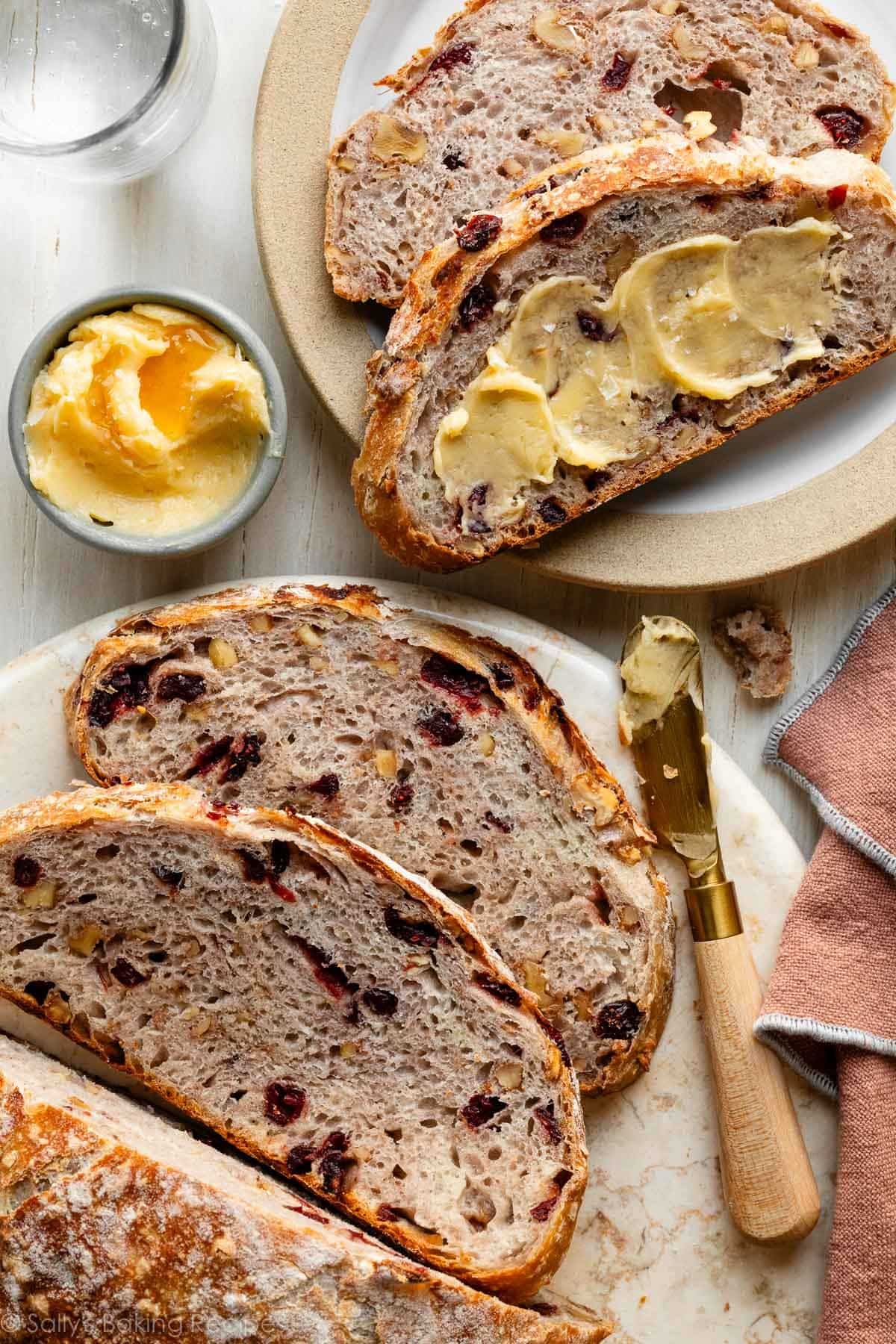
- Tastes incredible warm with a swipe of honey butter.
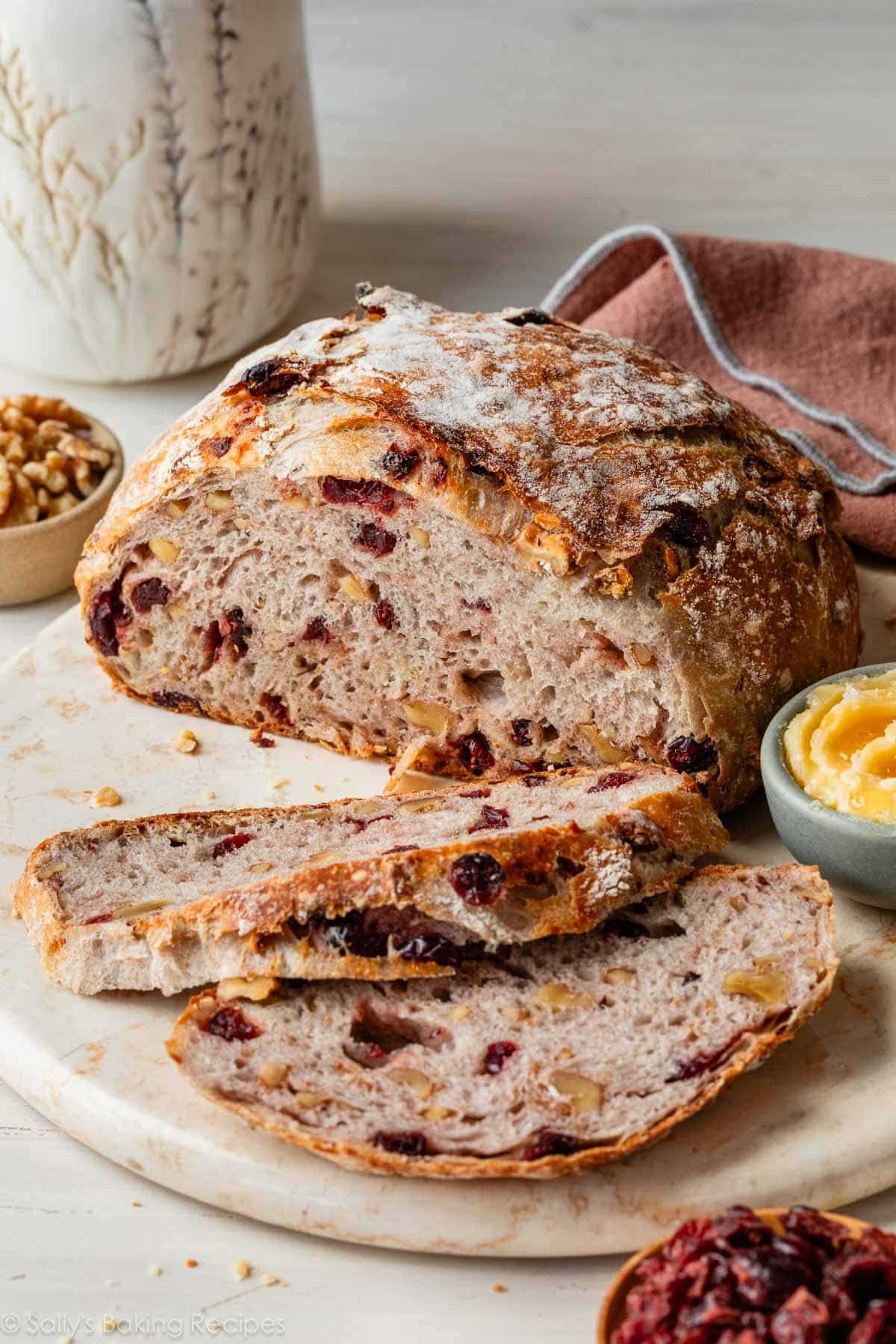
This bread, like my homemade artisan bread, seeded oat bread, pizza bread, asiago-crusted skillet bread, and olive bread, has all the bells and whistles of a fresh-from-the-bakery cranberry nut bread, and takes very little effort. If you are new to working with yeast, or simply feeling a little lazy, this recipe is for you.
Making this loaf will leave you plenty of time to loaf around. 😉
Just 7 Ingredients for This Cranberry Nut Bread
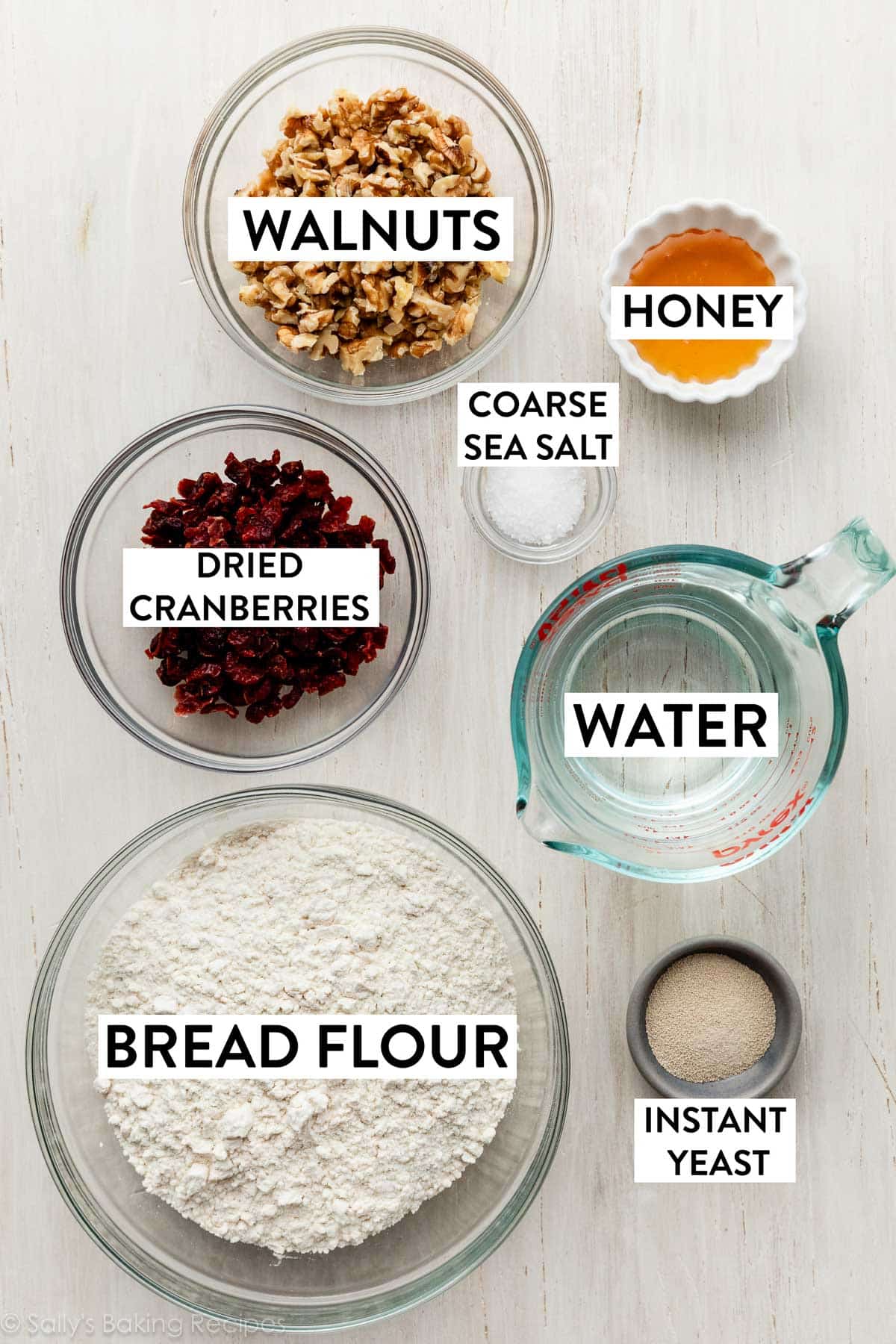
You don’t need a lot of ingredients to make homemade bread, and you might already know that if you’ve tried this sandwich bread recipe. You only need 7 ingredients to make this bread:
- Flour: Flour gives the bread its structure. You can use all-purpose or bread flour. I typically reach for bread flour because it yields a slightly chewier bread.
- Salt: Pick up some coarse sea salt; I find the flavor is lacking with regular table salt.
- Yeast: You can use instant or active dry yeast, but I highly recommend an instant (aka “rapid rise” or “quick rise” yeast). I always use Platinum Yeast by Red Star, which is an instant yeast with dough improvers. You don’t need much here—only 1/2 teaspoon—because of the long rise time.
- Nuts: Walnuts or pecans—baker’s choice!
- Dried Cranberries: I love the chewy texture of dried cranberries here. Don’t use fresh or frozen cranberries, because this dough is too wet. Raisins would work too, or try chopping up dried apricots or dates.
- Water: I normally encourage you to use warm liquid with yeast because it helps the yeast work faster. For this recipe, you want the water to be about 95ºF (35ºC), because we’re encouraging a nice slow rise to build flavor. An instant-read thermometer takes the guesswork out of this.
- Honey: Honey adds flavor and helps give the bread its springy, sponge-like texture.
By the way, if you enjoy honey in your homemade bread, you’ll love this no-knead honey oat bread because the flavor really stands out. The process is also very similar to today’s easy bread recipe. And both breads are delicious warm or toasted and topped with this easy homemade honey butter.
Overview: 5 Steps to Make No-Knead Bread
This no-work, no-knead, professional-bread-at-home concept originated with Jim Lahey of Sullivan Street Bakery in NYC. It’s all very basic ingredients, but his method is unique, which includes an 18-hour rise time. 18 hours?! Yes! Don’t be nervous, this 18 hours gives the dough a chance to ferment. And the fermentation time requires absolutely nothing from you. Just set it on your counter and forget about it until the next day. We use this same method for homemade English muffins. In both recipes, the magic happens when you’re not looking!
Step 1: Stir ingredients together. Don’t even break out your mixer.
This will be a super sticky dough. Remember, do NOT be tempted to add more flour. It will stick to your hands. That’s nothing a quick wash can’t fix!
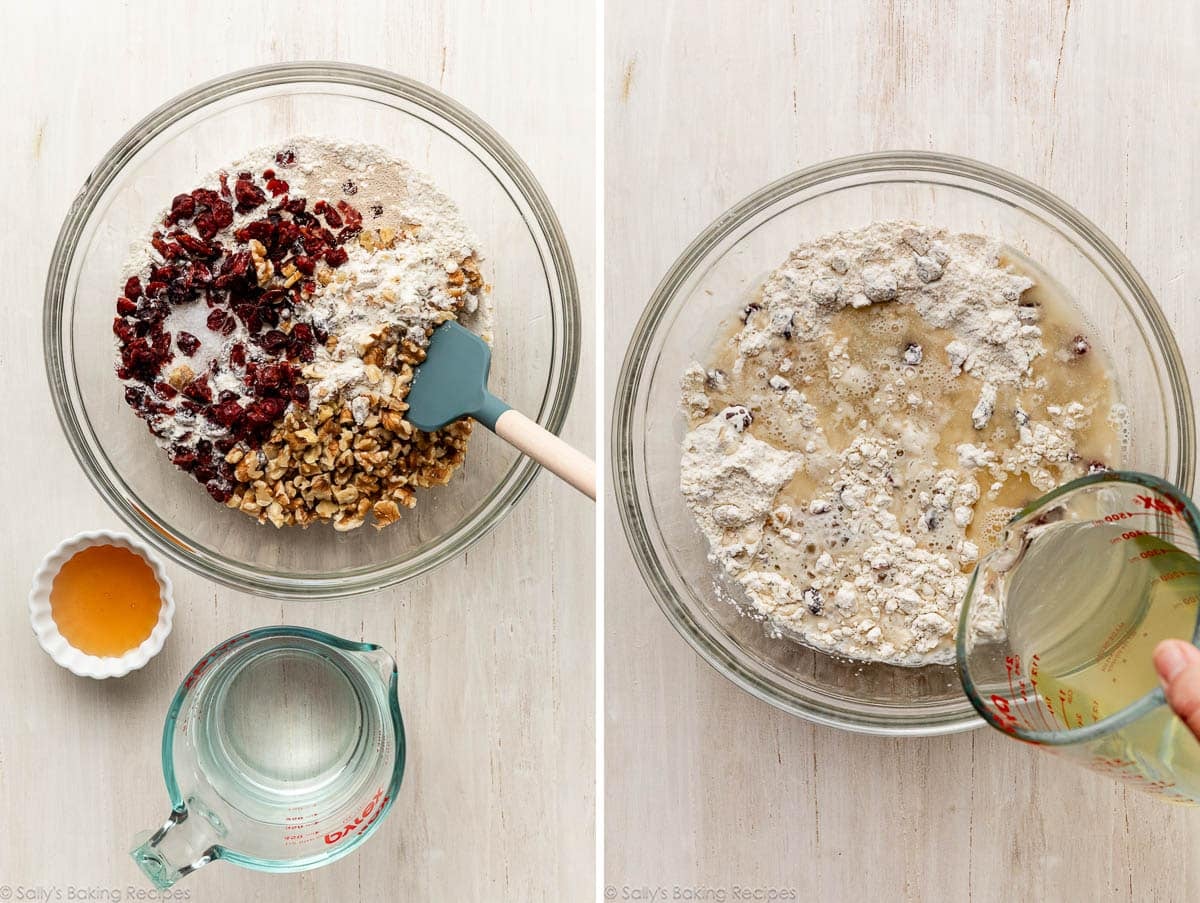
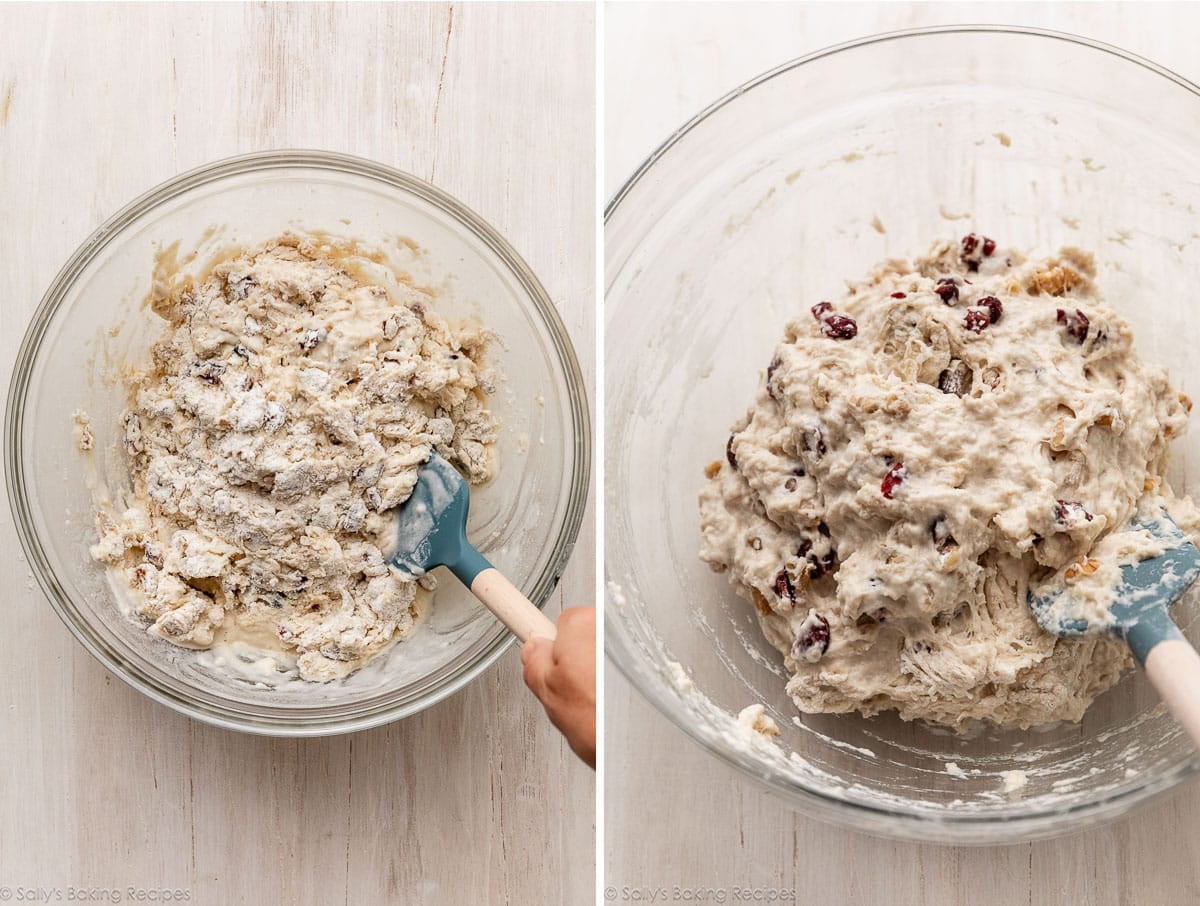
Step 2: Cover the dough and ignore it.
Let the dough rise at room temperature for 12–18 hours. This recipe is very forgiving. Any normal-ish room temperature is fine. You’ll know that the dough is finished rising when it has about doubled in size and air bubbles have formed on top. Like this:
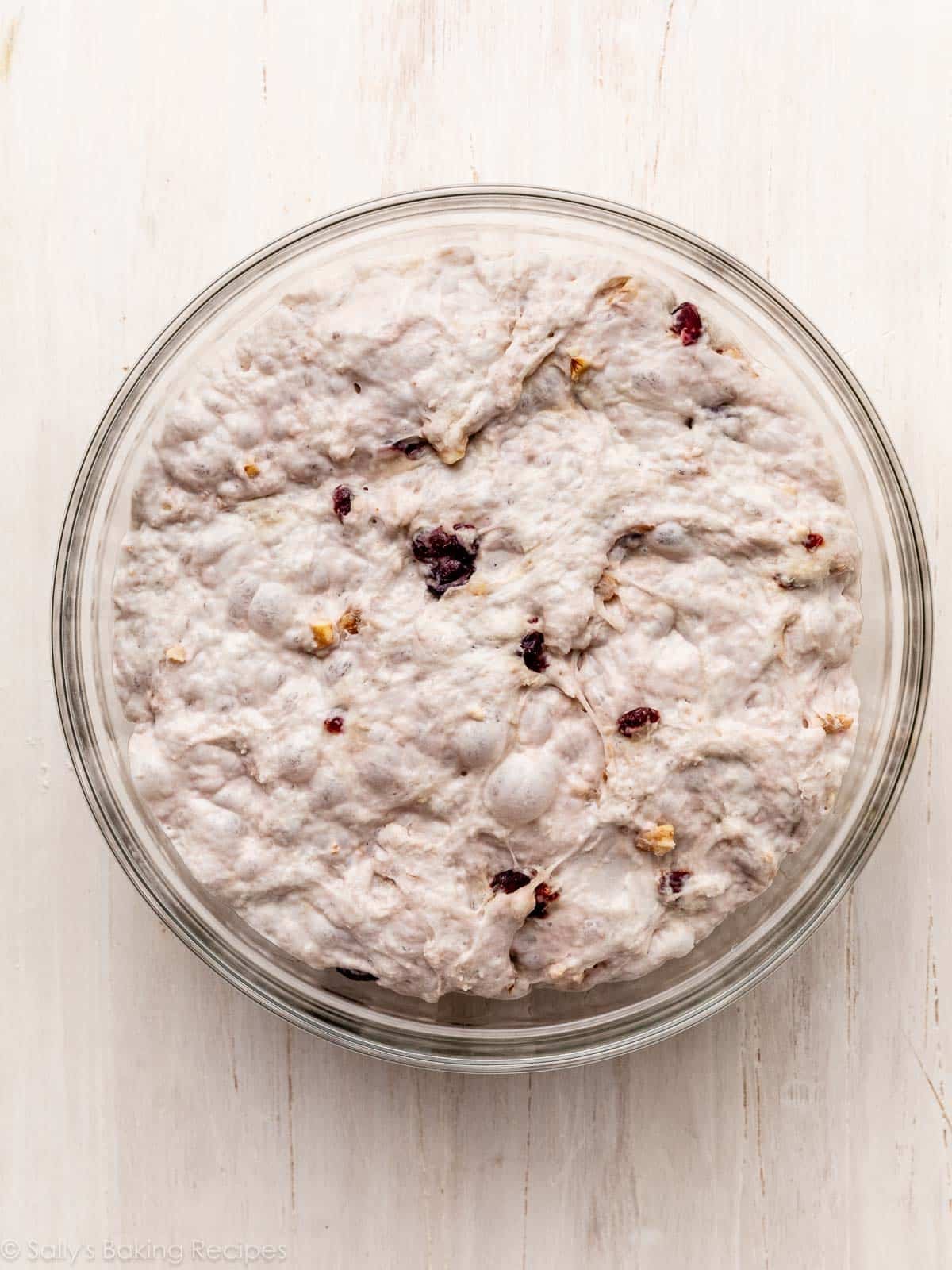
Step 3: The dough will still be super sticky after rising. That’s ok! Using lightly floured hands, form the sticky dough into a ball and place on a large piece of parchment paper. Score the top with a sharp knife, kitchen shears, or bread lame, then allow to rest for 30 minutes.
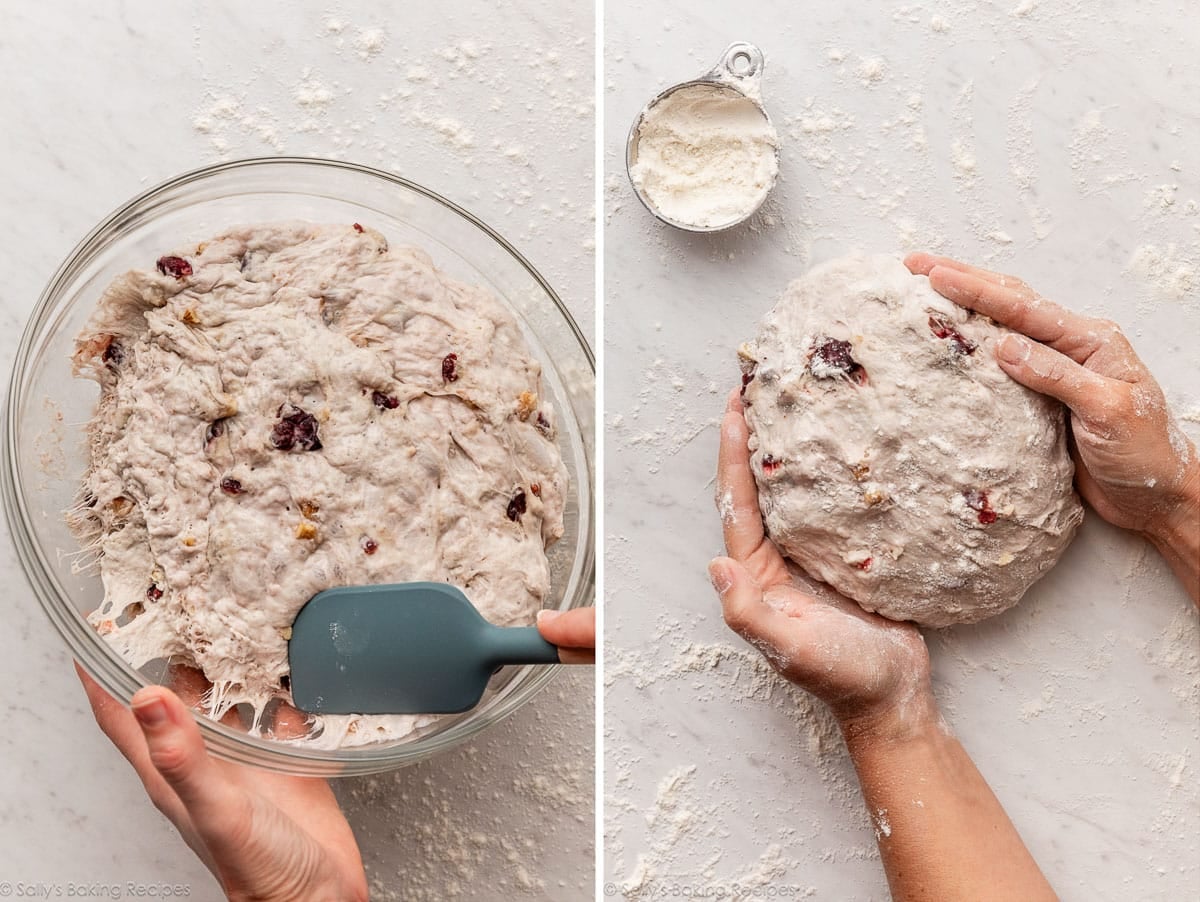
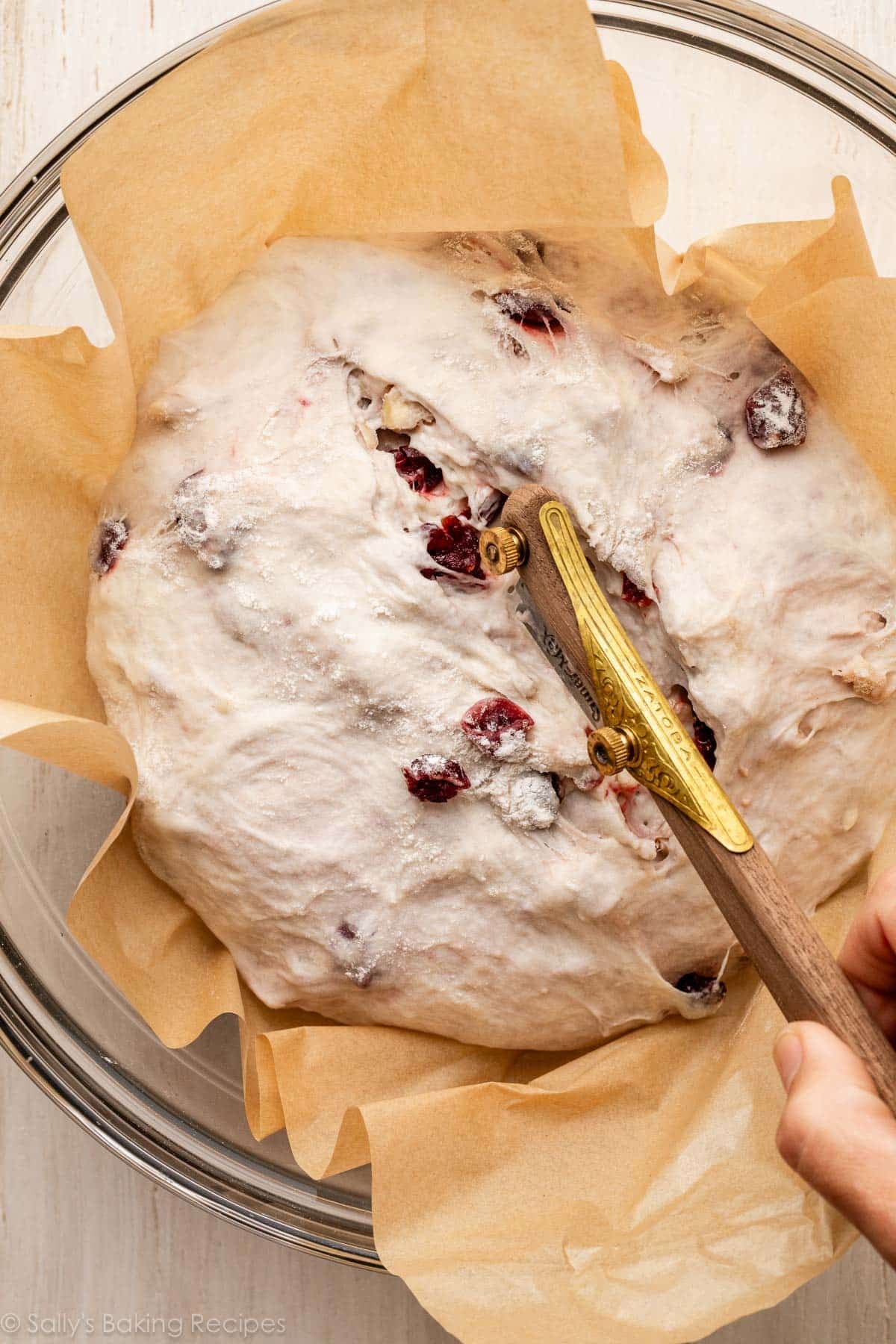
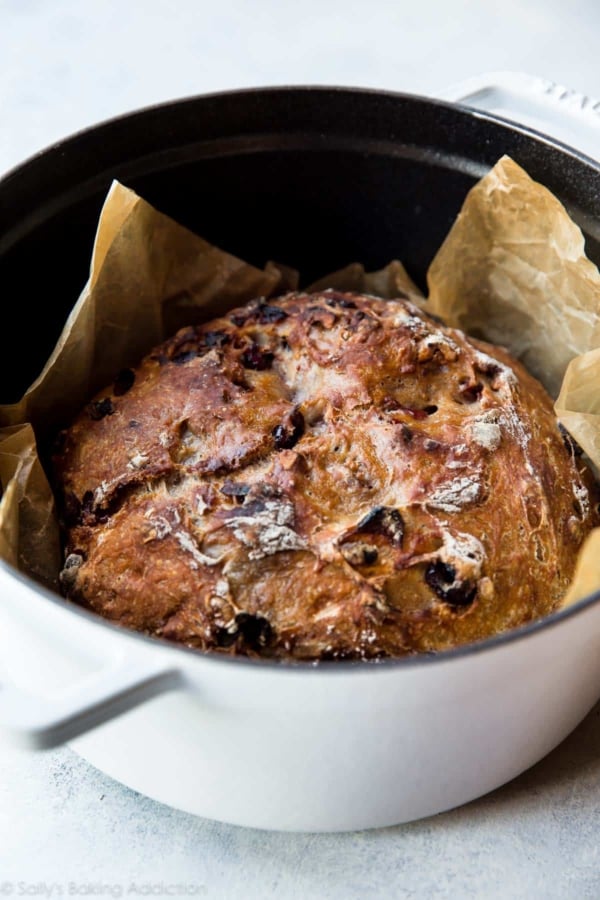
Step 4: Preheat a 5- to 6-quart Dutch oven. You’ll bake the bread in a pre-heated (super-hot!) Dutch oven, which helps form a crusty exterior. If you don’t have a Dutch oven, you can use any oven-safe heavy-duty pot with a lid.
Step 5: Bake for about 35 minutes. For an accurate doneness test, the bread is done when an instant-read thermometer reads the center of the loaf as 195°F (90°C).
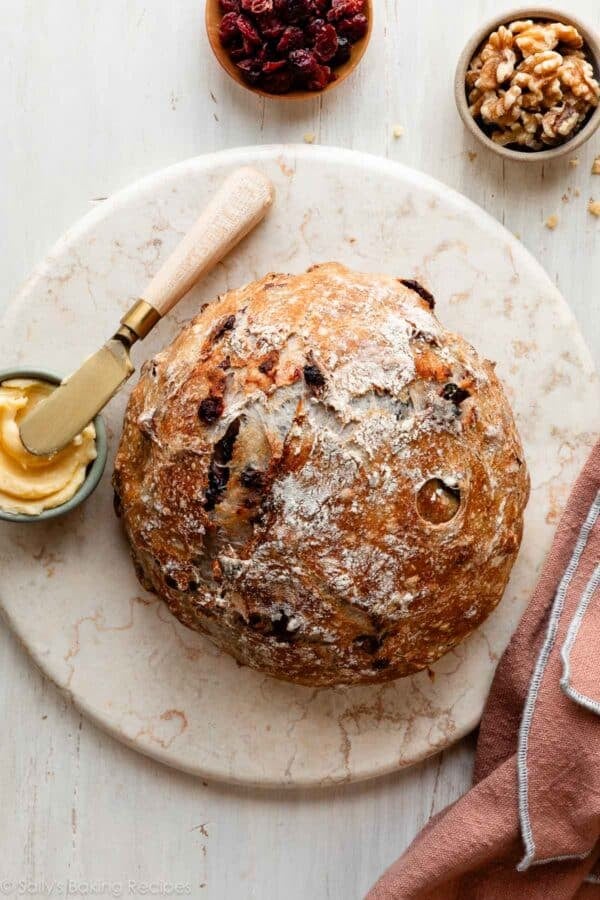
FAQ: Why Bake No-Knead Bread in a Dutch Oven?
Baking the bread with the lid on traps steam inside the pot, creating that perfectly crisp crust. A lid is the secret to this bread recipe’s success! You won’t regret picking up a Dutch oven.
No Dutch oven? No problem.
While baking the bread in a Dutch oven is key to this bread’s texture, you can get around it. Instead, place the rounded dough on a parchment paper-lined or generously floured nonstick baking pan. No need to pre-heat the pan like you do the Dutch oven. While the oven preheats and the scored loaf is resting, boil a kettle of water. After the oven is preheated, place scored dough/baking pan on the center rack. Then place a shallow metal baking/roasting pan or cast-iron skillet (I usually use a metal 9×13-inch baking pan; do not use glass) on the bottom oven rack. Carefully and quickly pour 3–4 cups of boiling water into it, and then quickly shut the oven door to trap the steam inside. The steam helps create a crispier crust. This is exactly how I bake 4-ingredient artisan bread.
Step 6: Enjoy a slice of warm, fresh bread you won’t believe you made from scratch.
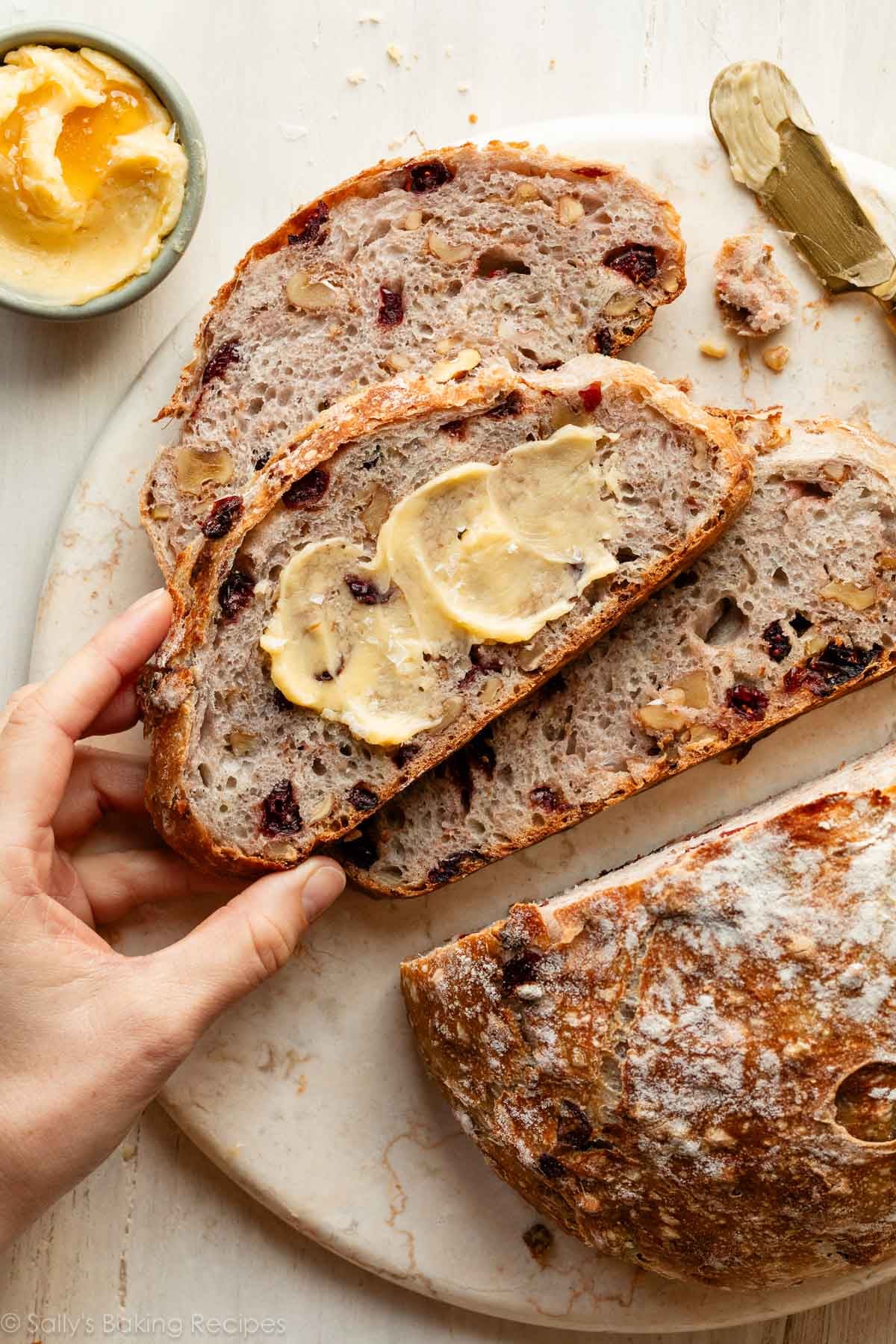
This lightly honey-sweetened cranberry nut bread is fabulous for breakfast, toasted with butter or honey butter. Or serve it alongside a charcuterie board with a soft cheese like brie or goat cheese, or this white cheddar cranberry pecan cheese ball (yum!).
This recipe is brought to you in partnership with Red Star Yeast.
Print
Crusty Cranberry Nut No Knead Bread
- Prep Time: 30 minutes
- Cook Time: 35 minutes
- Total Time: 20 hours
- Yield: 1 loaf; 10-12 servings
- Category: Bread
- Method: Baking
- Cuisine: American
Description
Yeasted bread has never been easier. This simple mixing method produces the most beautiful and crusty cranberry nut no-knead bread with very little hands-on work! If you’re new to working with yeast, reference my Baking with Yeast Guide for answers to common yeast FAQs.
Ingredients
- 3 cups + 2 Tablespoons (390g) bread flour or all-purpose flour (spooned & leveled), plus more as needed
- 2 teaspoons coarse sea salt (I find the flavor lacking with regular table salt)
- 1/2 teaspoon Platinum Yeast from Red Star instant yeast
- 3/4 cup (95g) chopped walnuts or pecans
- 3/4 cup (105g) dried cranberries*
- 1 Tablespoon (21g) honey
- 1 and 1/2 cups (360ml) warm water (about 95°F (35°C))
Instructions
- *No need to grease the bowl, and do not use a mixer in this step because the dough is too sticky for a mixer.* In a large bowl using a silicone spatula, stir the first 5 ingredients together. Mix the honey and water together, then pour on top. Mix to combine. (Note that in the video below, I add the honey to the dry ingredients instead of mixing first with water, but you can do it either way.) The dough will be very sticky; don’t be tempted to add more flour, you want a sticky dough. Gently shape into a ball as best you can.
- Cover tightly. Set on the counter at room temperature (honestly any normal room temperature is fine) and allow to rise for 12–18 hours. The dough will double in size, stick to the sides of the bowl, and may have air bubbles on the surface.
- Turn the dough out onto a lightly floured work surface and, using lightly floured hands, shape into a ball as best you can. It doesn’t have to be perfect. Transfer the dough to a large piece of parchment paper. (Large enough to fit inside your pot and one that is safe for high heat. I use this parchment and it’s never been an issue.) Using a very sharp knife, kitchen shears, or a bread lame, gently score an X into the top. Place the ball of dough + parchment inside a bowl so the dough doesn’t spread out as it rests. Cover dough lightly with plastic wrap or a clean kitchen towel and let it rest for 30 minutes.
- During this rest, preheat the oven to 475°F (246°C). (Yes, very hot!) Place your Dutch oven (with the lid) or heavy-duty pot in the oven for 30 minutes so that it’s extremely hot before the dough is placed inside. After 30 minutes, remove the Dutch oven and carefully place the dough inside by lifting it up with the parchment paper and placing it all—the parchment paper included—inside the pot. Cover with the lid.
- Bake for 25 minutes with the lid on. Carefully remove the lid and continue baking for 8–10 more minutes until the bread is golden brown. How to test for doneness: Give the warm bread a light tap. If it sounds hollow, it’s done. For a more accurate test, the bread is done when an instant-read thermometer reads the center of the loaf as 195°F (90°C).
- Remove pot from the oven, carefully remove the bread from the pot, and allow to cool on a wire rack for at least 20 minutes before slicing.
- Cover and store leftover bread at room temperature for up to 1 week.
Notes
- Make Ahead & Freezing Instructions: The dough takes up to 18 hours to rise, so this is a wonderful recipe to begin 1 day ahead of time. To freeze, bake and cool the bread, wrap in a layer of plastic wrap, then a layer of aluminum foil, and freeze for up to 3 months. Thaw in the refrigerator, and then allow to come to room temperature before serving. You can also freeze the dough. Mix the dough together as instructed in step 1. Wrap the sticky dough in lightly oiled plastic wrap and place in a freezer-friendly container. Thaw at room temperature, then let it rest/rise as instructed in step 2. Proceed with step 3 and the rest of the recipe.
- Special Tools (affiliate links): Glass Mixing Bowl | Lodge Cast Iron Dutch Oven or Le Creuset Dutch Oven | Parchment Paper | Bread Lame | Instant-Read Thermometer | Cooling Rack
- Dutch Oven: Use a 5- to 6-quart (or larger) Dutch oven or any large oven-safe pot with an oven-safe lid. If your Dutch oven is smaller than 5 quarts, you can halve the recipe (instructions remain the same, just halve each ingredient) or make the dough as instructed in step 1, shape the dough into 2 balls instead of 1 ball, and bake them one at a time in your smaller Dutch oven. While the 2nd dough waits, lightly cover and keep at room temperature. The bake times in the recipe above (25 mins and then 8–10 mins) will both be a little shorter for the smaller loaves.
- No Dutch oven? See post above for alternative.
- Flour: You can use either bread flour or all-purpose flour here. Bread flour will produce a slightly chewier bread. Feel free to substitute up to 1 cup (around 130g) of the flour for whole-wheat flour. Do not use all whole-wheat flour, as the bread will taste quite dense and heavy.
- Yeast: If you don’t have instant yeast, you can use active dry. I’ve never had a problem using active dry yeast in this recipe, and with no other changes needed. Works wonderfully!
- Cranberries: Dried cranberries (or raisins) are best for this wet dough. I do not recommend frozen or fresh cranberries.
- Parchment Paper: If your parchment paper has a maximum temperature that’s lower than the temperature called for in the recipe, bake the bread at that temperature. Bake the bread a little longer to compensate for the lower temperature.
- Reference my Baking with Yeast Guide for answers to common yeast FAQs.
- Recipe adapted from Red Star Yeast, method originally from Jim Lahey.










Reader Comments and Reviews
I followed the recipe exactly as written and this bread is absolutely delicious!! My daughter said it’s right up there with “Papa’s” bread (her grandfather) which is the highest of compliments!! I baked it in my Le Creuset Dutch oven & it turned out exactly like your photo. Thank you for another excellent ⭐️⭐️⭐️⭐️⭐️ recipe, Sally!!
Hi! I want to try this recipe this weekend, but I had a question. I do not have a Dutch oven, but I do have a tri-ply stainless steel 5 qt pot that can be placed in the oven at 350 with the lid or 450 without the lid. If the lid has a steam hole, do you think it’s okay to use it or should I just stick to your suggestion on what to do if a Dutch oven isn’t available?
Hi Kellie, I wish we could help, but we don’t have experience with baking in that type of pan. Because this bread bakes at a very high temperature, 475F, which is higher than recommended for your pot, it would be better to be safe and follow the instructions for using a baking sheet instead. Hope the bread turns out great!
I made the recipe with your suggestion on how to cook it without a Dutch oven. It came out great!
Thx for the recipe. Wondering how the water only has to be 95 degrees. I thought it needed to be 110 for instant yeast? Feel like it did not rise as well.
Hi J, We usually use a warm liquid with yeast because it helps the yeast work faster. For this recipe, you want the water to be about 95ºF (35ºC), because we’re encouraging a nice slow rise to build flavor
I love your recipes! Can this dough be refrigerated vs leaving out on counter? I am not able to bake until tomorrow.
Hi Kelley, This dough requires 18 hours to rise at room temperature, so you can prepare it in the evening and leave it at room temperature overnight before baking in the morning. Or, if you plan on letting it rise for 18 hours throughout the day, you can then place it in the refrigerator overnight and bake in the morning, no need to bring to room temperature first.
Can you make this with fresh cranberries?
Hi Valerie, we highly recommend using dried cranberries in this recipe. Fresh will likely add too much moisture.
If you have an enameled dutch oven, DO NOT USE this recipe. Today I learned the hard way that the maximum temperature for an enameled dutch oven is 400-450°F. Heating it to 475°F, as per this recipe’s instructions, caused the binding agent to ooze out of the rim creating a black drippy mess and ruining my dutch oven. Apart from that, the dough came out so sticky that scoring it and forming it in any capacity was impossible. I’m usually a fan of Sally’s recipes, so this was a massive let down.
Hi Lily, I’m sorry you experienced trouble with this. The dough is supposed to be sticky, and you can use flour on your hands to help shape it. Many enamel-coated dutch ovens and brands have temperature thresholds up to 500°F, but of course it depends on the brand. May I ask what brand you were using so I can look into it and make adjustments to the recipe as needed? Again, sorry you had trouble.
This was a terrific recipe and absolutely delicious with a morning cup of coffee. Literally every recipe from Sally is a winner!
This is a foolproof, easy, and DEELISH bread recipe! I make all kinds of bread, sourdough, you name it, and this is the most requested bread by my friends
What happens if it stays out longer than 18 hours?
Hi Aiden, the flavor of the bread may be sour, and the gluten structure will begin to break down. When that happens, the interior of the baked bread will be quite dense.
Recipe and video are different
Hi, the difference I see is mixing the honey with the water, which is a note I added to the instructions. Are you seeing any other differences? They match to me!
The bread came out great but I found it is very wet dough because this reason I wasn’t cut wet dough, Otherwise it came good & delicious.
I made this recipe yesterday and followed the instructions to a tea, but my dough has not risen at all, and it’s now been 13 hours! What the heck can I do? I was hoping to serve it to company today.
Hi Lee, We are sorry you are having trouble with this recipe. Did you leave your dough to rise at room temperature? And did you check to make sure that your yeast was fresh?
Didn’t do it for me. Had to cook for 20 plus extra minutes and still didn’t hit 190 degrees. Followed recipe exactly.
Could I use orange juice for some or all of the water?
Hi Kathleen, you could add orange zest to the dough. And perhaps replace 1 Tablespoon of the water with fresh orange juice. We have not tested this, but that is what we would try first.
I made this for be first time yesterday and it came out ok. It was very crusty on the outside but pretty dense on the inside. It tastes even more dense the next day. Could that be from too much flour? Too much water? I don’t have a food scale, I was just using a measuring cup. I know this is a denser bread but this pretty pretty dense. I would like to try this again but I don’t want to make the same mistake. I left it for 18 hours, does the room temperature have to be warmer, I usually leave my place on the cooler side.
Hi Sarah, this bread is a bit denser than a kneaded bread, but how have you been measuring your flour? Make sure to spoon and level instead of scooping to prevent too much flour in your dough. This could result in dense bread that doesn’t rise. Referencing this Baking with Yeast Guide may be helpful in the future as well. Hope this helps!
I tried making this but since my parchment paper only handles 425 i kept the temp there, did it 27 minutes covered as one of the comments suggested but i think i might need to make it 30 minutes then uncovered for 10. Just because when i checked the temp at 27 and 9, itwas only 165°F and a little wet inside, i ended up having to add up to 8 more minutes uncovered. The crust got a little too hard but the inside was very soft, a bit dense but still tasted really good!
I made this and it was really good and easy. I just wonder if I’m doing something wrong as I’m not using the Dutch method. The bread was starting to burnt on top so I put a baking sheet over it after 30 min of baking but the thermometer only read 104 so I left it another 20 min and still only read 150 it ended up being about an hour and a half to reach 190 whit j I finally just took it out. The crust was definitely crispy and the inside a little chewy and so delicious. I will be making this again but any suggestions on cooking time would be grateful
my parchment paper only goes up to 425 degrees. Is it ok to use tin foil instead?
Hi Diane! We don’t recommend using foil here. You could bake your bread at the lower temperature for slightly longer, instead. We’ve never had issues with out parchment burning.
Simply delicious!! Thanks for the easy to follow instructions! I have made this bread twice in the past week– making a third time for my husband’s work potluck Christmas lunch. Would it work to increase the cranberries and walnuts to 1 cup each and the honey to 2 tablespoons?
Hi Diane! We would keep the amount of add-ins the same, but you can increase the honey a bit. So glad it’s a hit for you!
How do I use a pizza stone to bake the bread?
Hi Jan, a few readers have reported back saying they successfully used a pizza stone for this bread, though our team has not personally tested it. We would add the water in a pan beneath it. Enjoy!
Hi! Troubleshooting question- I baked as described for the times and it sounded hollow. But when we got to the center it was still raw and doughy. Not sure what happened! Any ideas?
Hi Ceci, it sounds like it was probably a bit underbaked. An extra couple minutes in the oven should help for next time. For a more accurate test for doneness, the bread is done when an instant read thermometer reads the center of the loaf as 195°F (90°C).
Great recipe! I use pecans and raisins, then add a teaspoon of cinnamon. Can this recipe be modified to use gluten free flour?
Hi Pat, we haven’t tested this recipe with gluten-free flour, so we’re unsure of the results. Let us know if you give it a try!
I just had to make this no knead cranberry bread. That being said I left out more than 18hrs. Will it still be ok?
Any suggestions for high altitude? I’m at 5000 ft
Hi Anna, I wish we could help, but have no experience baking at high altitude. Some readers have found this chart helpful: https://www.kingarthurflour.com/learn/high-altitude-baking.html
Could I bake this in 2 8×4 loaf pans?
I have made this recipe several times in my dutch oven & we love it. I wanted to bake smaller loaves to give as Christmas gifts.
Thank you!
Hi Luanne, You could certainly try a loaf pan or two. We are unsure of the exact bake time you would need but let us know if you give it a try.
I like to use whole wheat flour. Has this recipe been made with it? I love this bread!
We don’t recommend using all whole wheat flour, but you can try substituting some of the all-purpose with whole wheat. The bread will be denser. So glad you enjoy this recipe!
This recipe is incredible!!! My family and I loved it completely. There is a similar, seasonal bread in a big box store–this one is better, moister, and delightful. I baked this at 425 for 28 minutes with the lid on, 9 minutes with the lid off.
my dough has not risen after 24 hours of sitting in a covered bowl. I followed the directions and did not leave anything out
Hi Eileen! Could your yeast be expired? We would try again with fresh yeast. Here’s our helpful baking with yeast guide as well.
Hello, I have a bakers bowl but no oven safe lids. Would foil work?
Hi Silvia, If you don’t have a cover, we suggest using the baking sheet method detailed in the seeded oat bread post for your loaf.
will the bread turn out ok if it rises more than double in size?
Hi Diane! If it over-proves, it could turn out more dense.
Do you know what size bowl was used in the video while proofing the dough? Knowing the size will help to determine if my dough has doubled as shown in the video. As you can tell I’m new at bread baking with yeast. Thanks so much.
Hi Diane, we’re unsure of the exact size, but it doesn’t have to be exact!