
This homemade soft multigrain bread is prepared with multigrain hot cereal mix, such as 5 grain, 7 grain or 10 grain cereal. Whole or quick oats are an excellent option, too. It’s soft and fluffy like regular white sandwich bread, but has a hearty and satisfying flavor. Either instant or active-dry yeast work and you can even turn this dough into multigrain rolls.
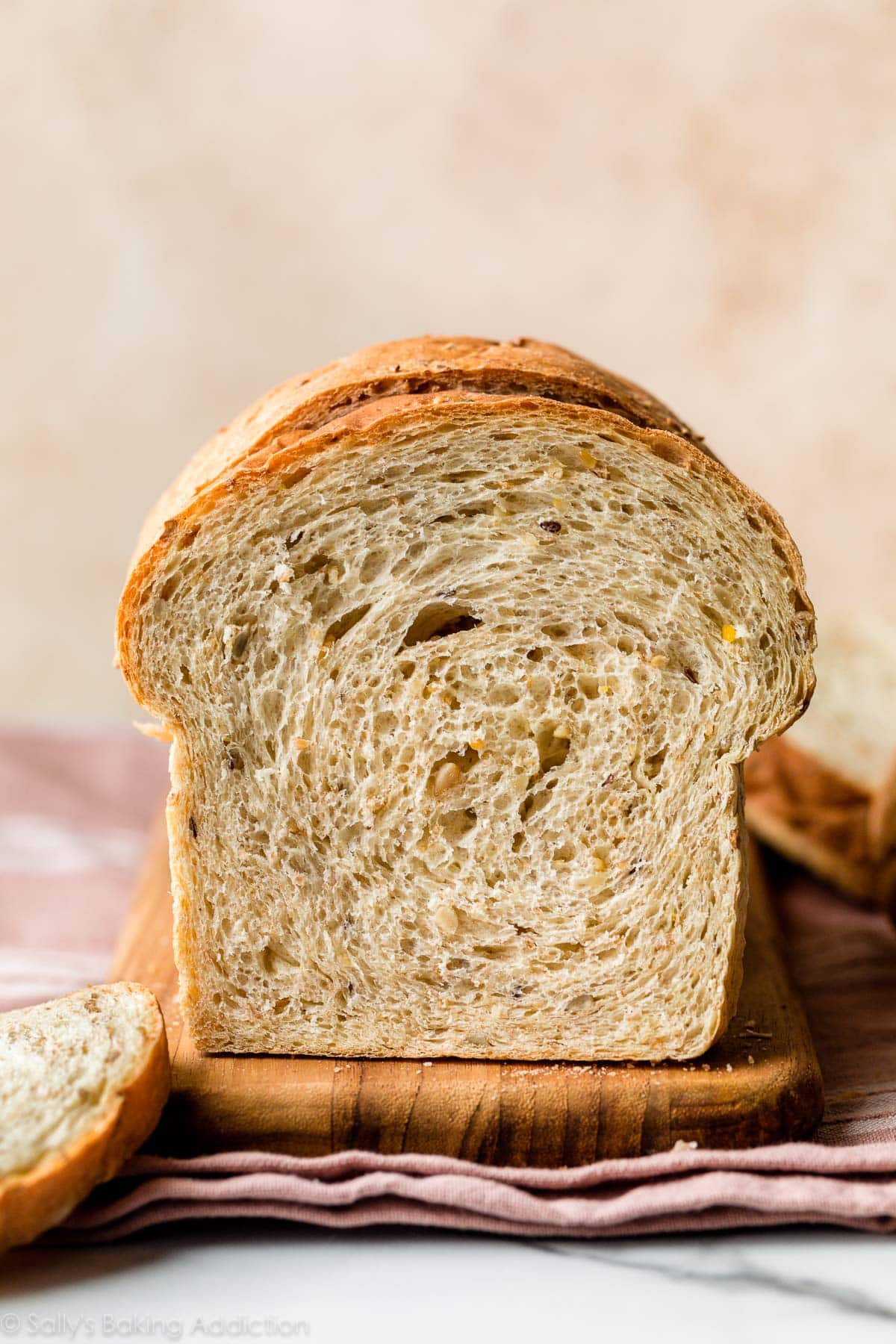
Learn to bake homemade bread. I’ve noticed that’s a common baking goal at the start of each year. Today I’m sharing a new homemade bread recipe, one I’ve been perfecting for months. Using my regular white sandwich bread as the starting point for this new variation, I finally mastered a multigrain bread that’s both soft and sturdy. If you love homemade bread and crave added texture, you’ll enjoy this multigrain loaf. Bonus: You can use this dough for homemade rolls, too!
One reader, Nancy, commented: “I make this recipe all the time. It’s my go-to sandwich bread. In fact, I have a loaf proofing right now on this rare rainy day. Super easy, so it’s a perfect bread for a beginner. Also a blank canvas for whatever you want to add. I bump up the protein and fiber with flax and chia. Give it a try. You won’t regret it. ★★★★★”
Soft Multigrain Bread Details
- Flavor: Slightly nutty with an earthy, satisfying flavor similar to whole wheat bread. A little brown sugar adds mild sweetness.
- Texture: This wholesome bread is wonderfully soft without being flimsy. It’s great for sandwiches, but perfectly satisfying plain or with a spread of butter.
- Ease: I categorize this as an intermediate baking recipe. The dough requires an extra step in the very beginning—soaking those grains in water. If you read the directions before starting, you’ll be set for success. Take your time and if you’re new to baking with yeast, review my Baking with Yeast Guide and How to Knead Dough posts first. Lots of helpful information there.
- Time: Between preparing the dough, both rises, and baking, set aside at least 4-5 hours to complete this recipe. But keep in mind that most of the time is hands off as the dough rises. You can even get started on the dough the night before.
If you love wholesome, hearty homemade bread like this, you’ll enjoy no knead honey oat bread and no knead seeded oat bread recipes too.
Video Tutorial: How to Make Soft Multigrain Bread
We need a careful blend & ratio of ingredients to produce a grain loaf that (1) rises tall, (2) maintains a soft fluffy texture, and (3) has legitimate structure for sturdy slices. The ingredients are practically the same as this sandwich bread, but we’re skipping the milk, using hot boiling water, adding grain cereal mix and seeds, slightly reducing the butter, and swapping regular sugar for brown sugar. Took lots of tweaking to perfect.
Key Ingredients You Need & Why
- Multigrain Hot Cereal Mix or Oats: If you read anything in this post, have it be this. This recipe starts with multigrain cereal, such as 5 grain, 7 grain or 10 grain cereal. You can also use whole or quick oats, but I do not recommend steel cut. There are many variations of hot cereal available in grocery stores—a multigrain version may include rye, barley, oats, whole wheat, and/or more. Honestly any grain cereal you mix with hot water works assuming there’s no flavors or sugars added (for example, don’t use brown sugar cinnamon oatmeal mix). If you can’t find any multigrain hot cereals at the store, you can purchase online—or just use plain oats. I really like this 7 grain + flax seed hot cereal. Multigrain baby cereal works too.
- Boiling Water: Just as you would make the hot cereal to eat, mix it with hot water. Use 1 and 3/4 cups (420ml) boiling water, then let the mixture cool until a digital thermometer reads about 110°F (43°C). This usually takes 20 minutes. If it’s too hot, the heat will kill the yeast.
- Brown Sugar: Sugar feeds the yeast, increases its activity, and tenderizes the dough. You can use regular white granulated sugar, but brown sugar was especially tasty in this loaf.
- Butter: To make a soft bread, you need fat in the dough. Butter promises a soft and flavorful loaf. 3 Tablespoons is plenty.
- Flour: If you have both bread flour and all-purpose flour on hand, I recommend using bread flour. All-purpose flour definitely works, but you get a sturdier and more bread-like texture from bread flour. I love using whole wheat flour when I can, but this dough is not fit for all whole wheat flour. In my recipe testing, I found that similar to homemade English muffins, replacing up to 1 cup of the bread/all-purpose flour with whole wheat flour worked just fine. The bread was a bit denser, but had great flavor. I usually make it with 3 cups of bread flour and 1/3 cup whole wheat flour. If you wish to use all whole wheat flour, follow my recipe for whole wheat bread instead.
Add-In Options
Add-ins are completely optional, but I encourage seeds and/or nuts for a little texture. I usually use sunflower seeds. Other options include chopped pecans or walnuts, pepitas, raisins, dried cranberries, or a blend of these. You could also throw in smaller seeds such as chia, flax, or sesame. See recipe note below before starting.
Step-by-Step Photos
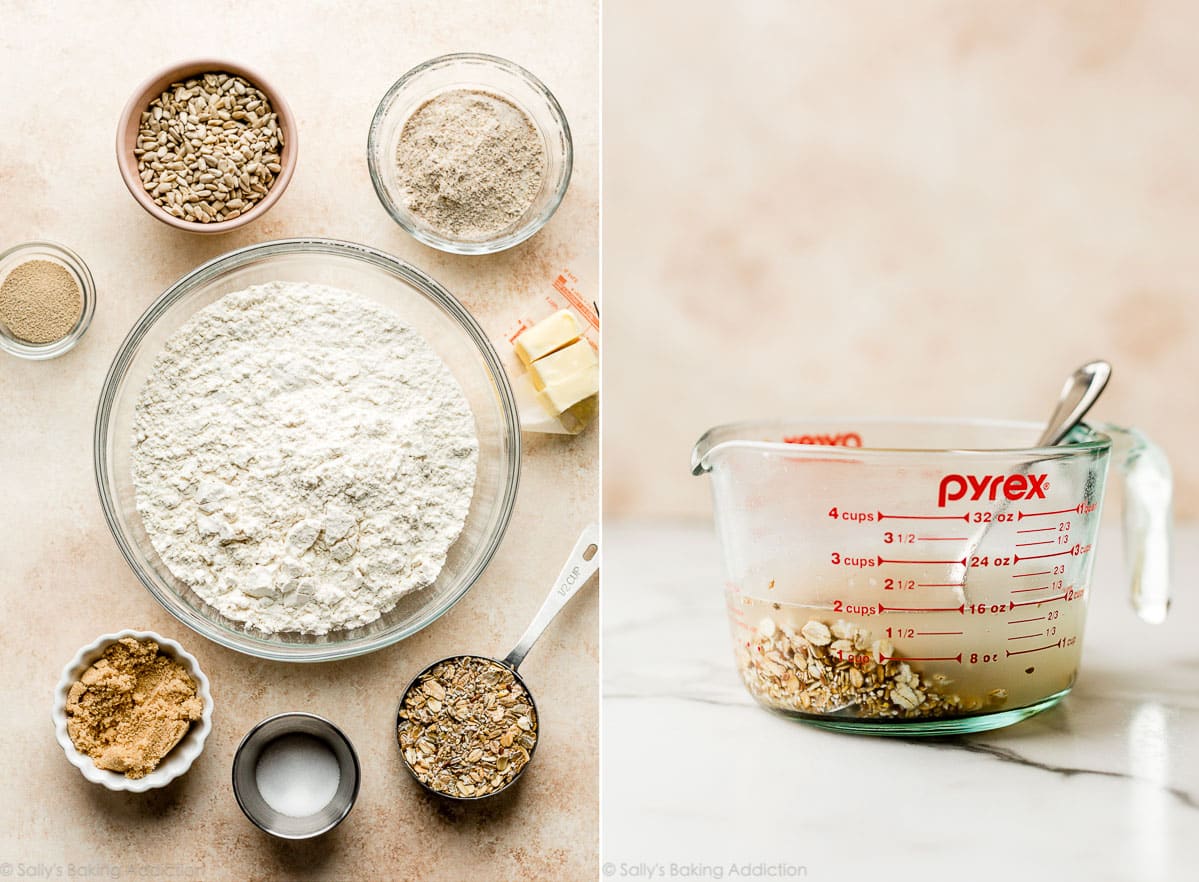
Soak the grain cereal in the boiling water, as pictured above.
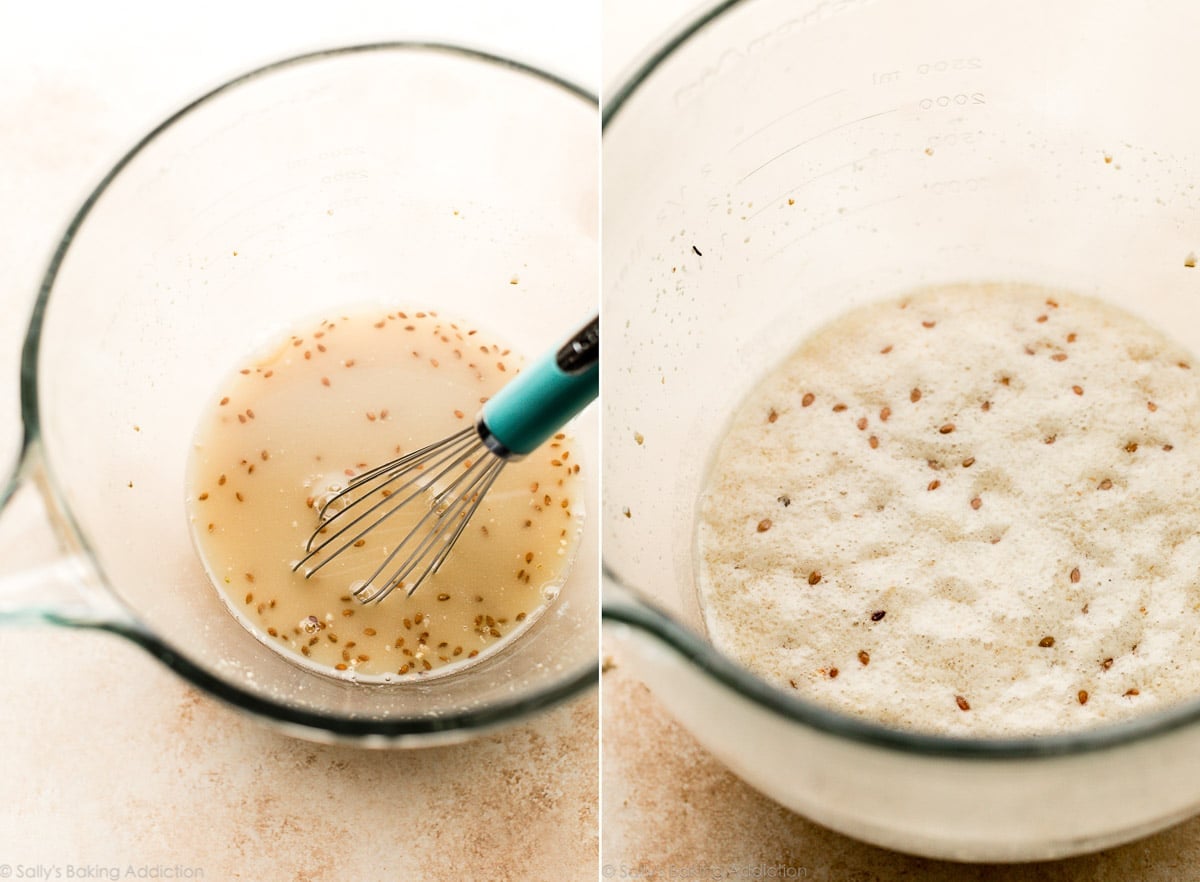
Below left: After it cools down, whisk in the yeast and brown sugar. Below right: After 5-10 minutes, you’ll notice foam or bubbles on the surface. This means the yeast is active and ready. Note that the hot cereal that I use contains flax seeds so that’s what you’re seeing floating on top!
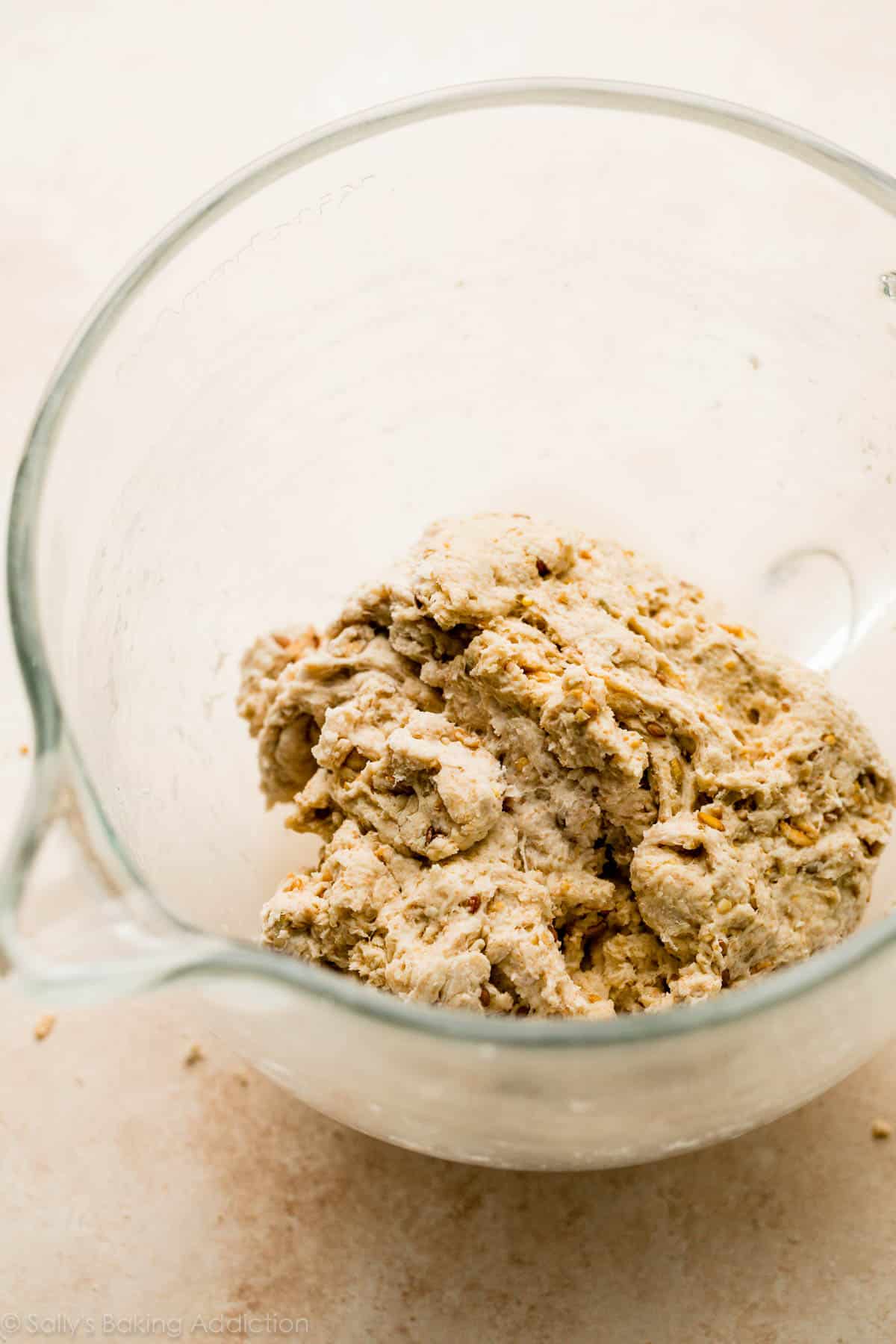
The dough will feel heavy. As instructed in the recipe below, knead it before letting it rise. If you’re new to bread-baking, my How to Knead Dough tutorial will be helpful here.
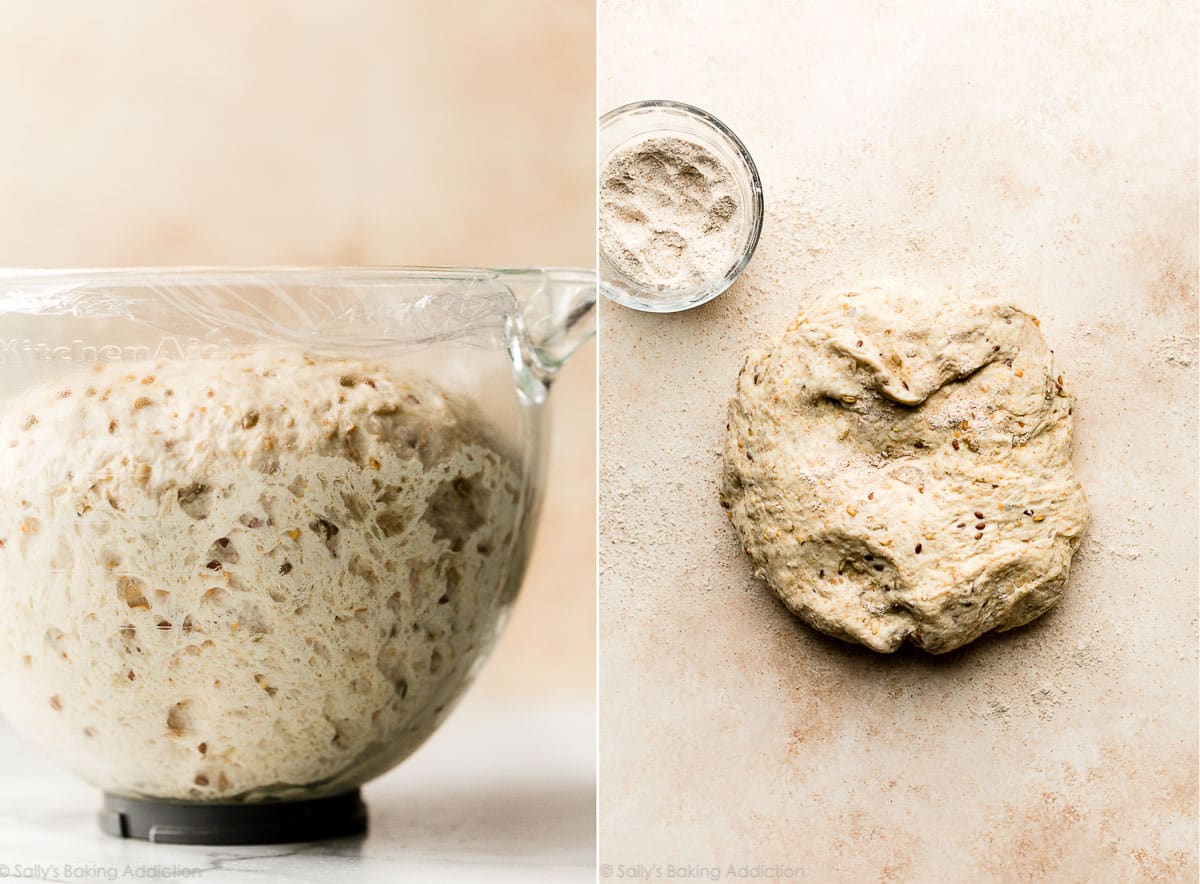
Below left: After you make and knead the dough, let it rise until doubled in size. Below right: Punch it down to release the air, then place on a lightly floured work surface.
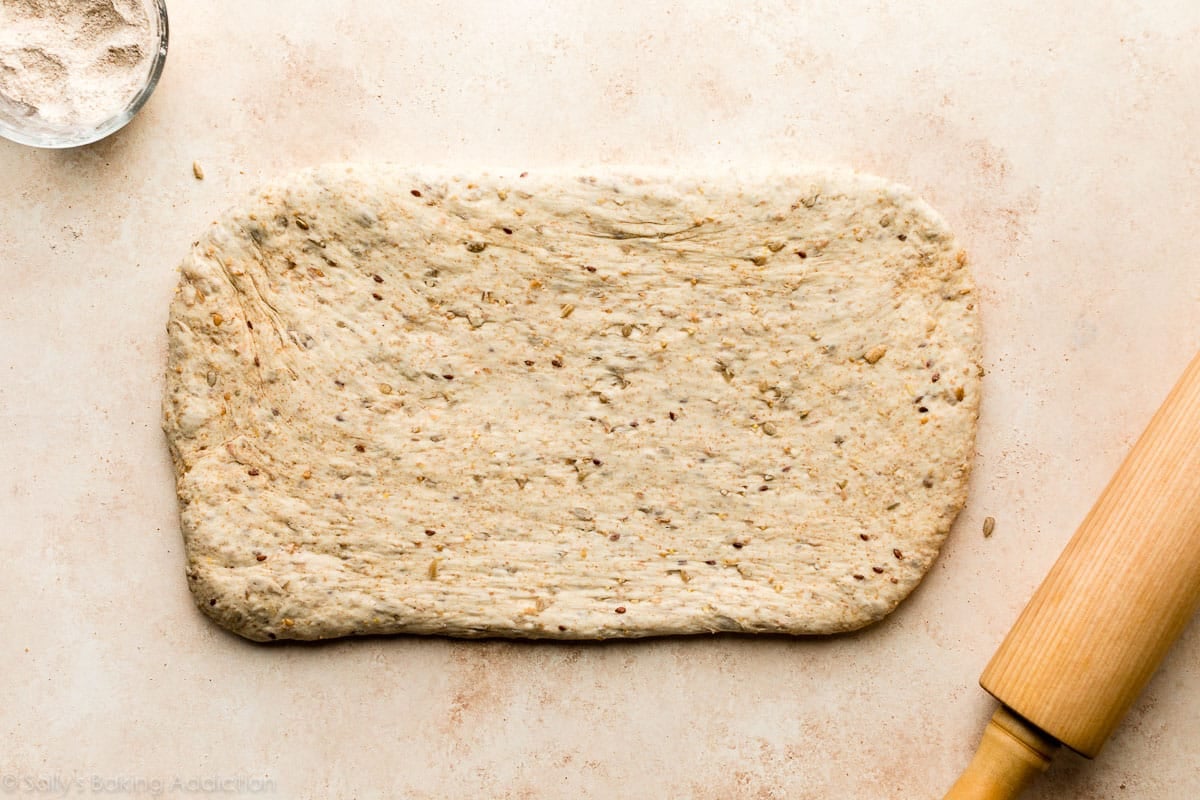
Roll it out into an 8×15-inch rectangle:
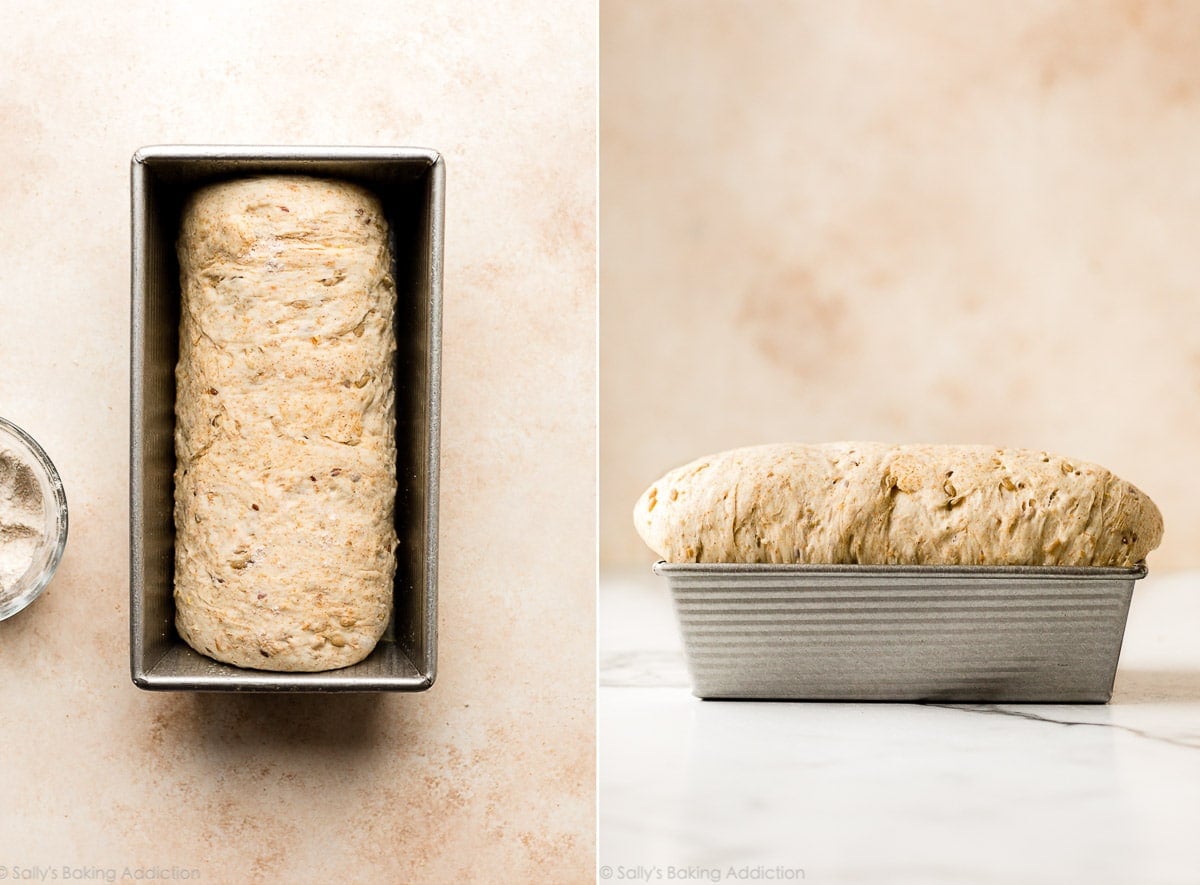
Below left: Roll it up tightly starting with the 8-inch side, so you have an 8-inch roll to fit into your 9×5 inch loaf pan. (Unlike cinnamon rolls where you roll up the dough starting with the larger side.) Below right: Let it rise until it’s 1-2 inches above the rim of the pan.
Look at this height!
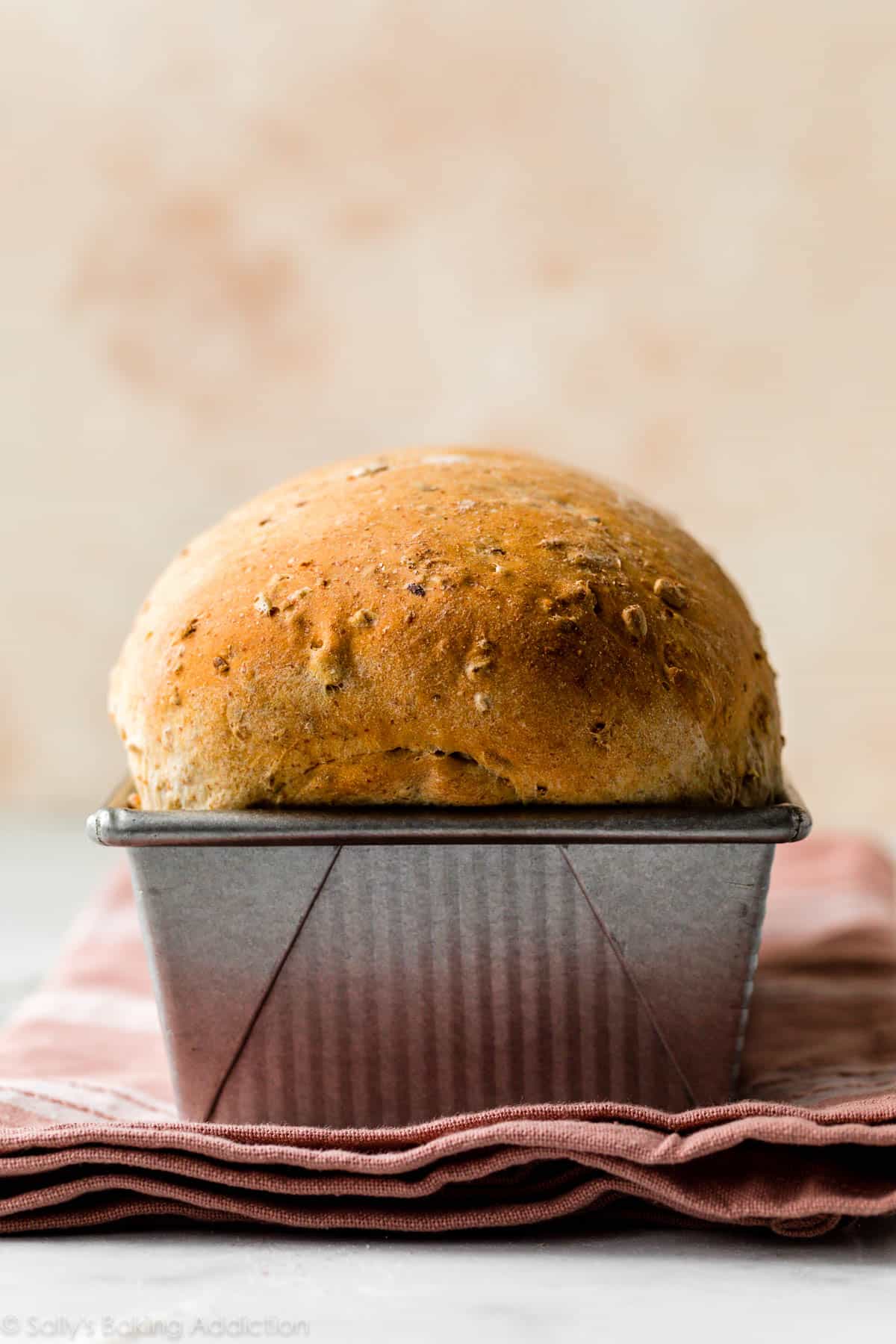
Bake until golden brown:
How do I test for doneness? Give the loaf a light tap. If it sounds hollow, it’s done. For a more accurate test, the bread is done when an instant read thermometer reads the center of the loaf as 195–200°F (90–93°C).
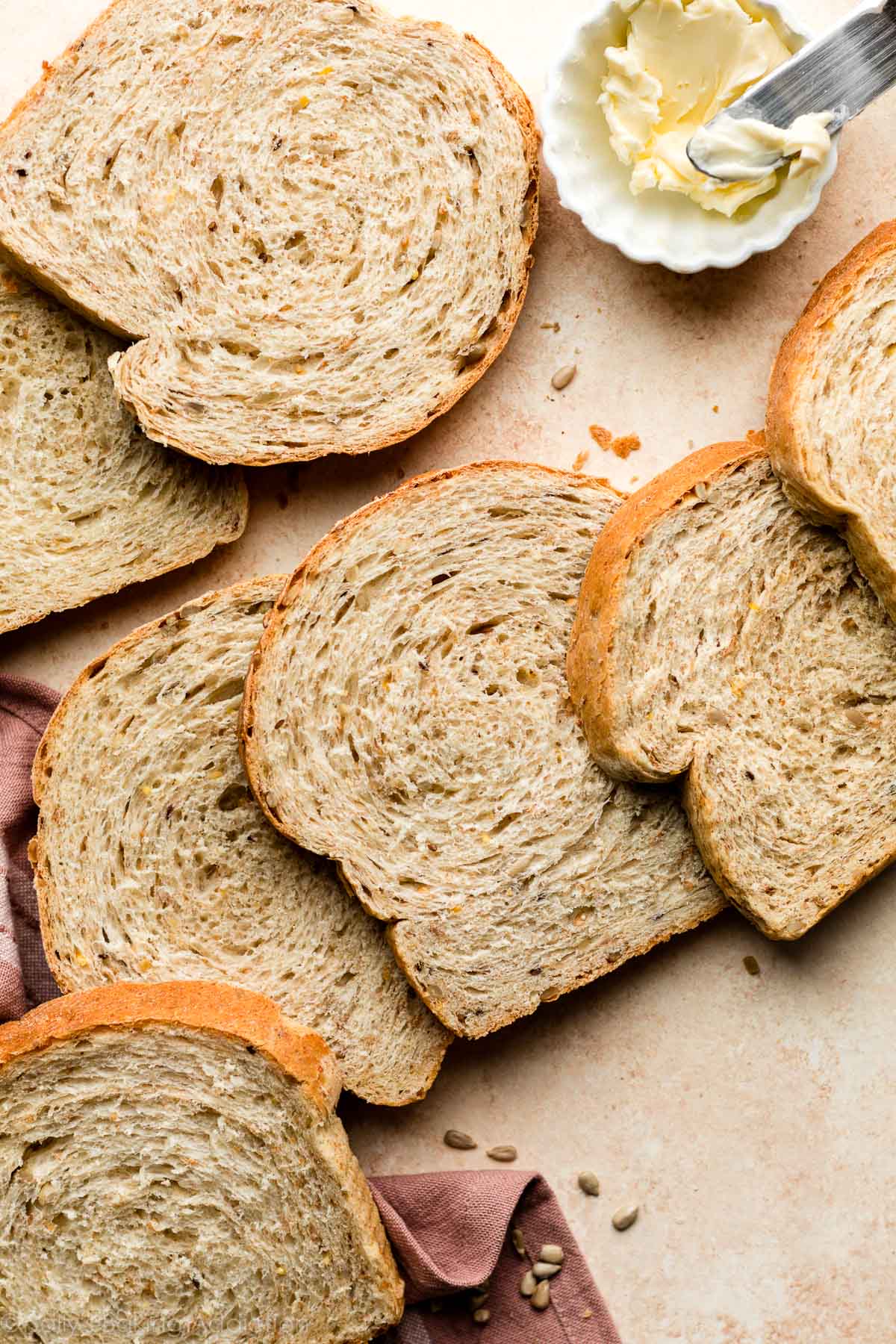
This multigrain bread is phenomenal when sliced and served warm. The exterior is crisp and crusty while cloaking a hearty, yet fluffy crumb inside. The whole slice is just so, so satisfying and cozy. And it’s fabulous with homemade honey butter. This is definitely a homemade bread to try!
If you happen to have any leftovers, day old bread is perfect for soaking up flavors in an easy breakfast casserole.
Can I Make This Into Rolls?
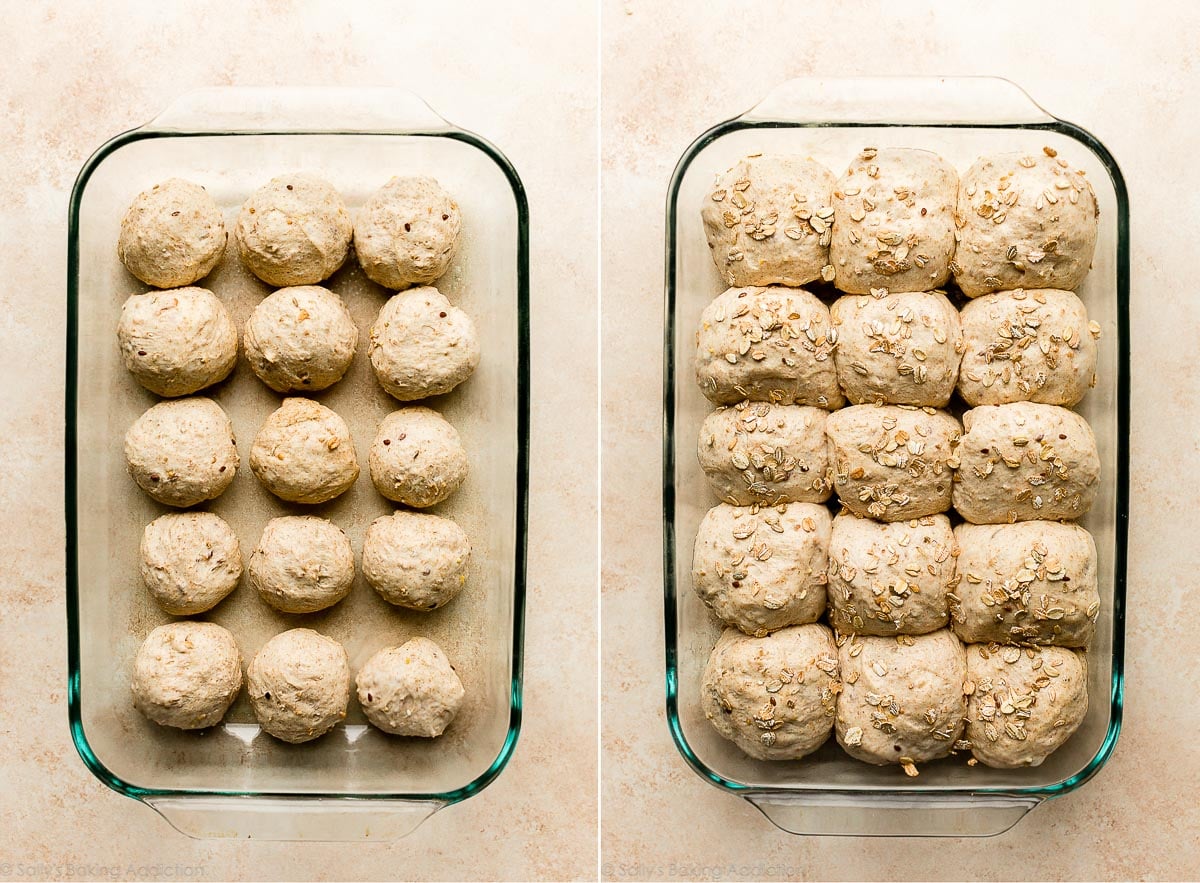
I thought you’d ask! I tested this dough to make multigrain rolls and it worked wonderfully. Not quite as soft as regular dinner rolls and not quite as heavy as whole wheat dinner rolls. I will say that I preferred the multigrain sandwich bread because it had a little more texture from the crust. Served warm with a pat of butter, however, the rolls were fantastic. See recipe note for instructions. Though I haven’t tested it, I imagine you could use this dough to make 3-4 bread bowls, too.
Multigrain AND multipurpose!

More Yeast Bread Recipes
Browse all of my yeast bread recipes.
Print
Soft Multigrain Bread
- Prep Time: 3 hours, 40 minutes
- Cook Time: 34 minutes
- Total Time: 4 hours, 15 minutes
- Yield: 1 loaf
- Category: Bread
- Method: Baking
- Cuisine: American
Description
This is wholesome multigrain bread with an irresistibly soft and fluffy interior. For best success, take the time to review the recipe notes before starting. Though not required, an instant read thermometer is helpful in a few of these steps.
Ingredients
- 1/2 cup (60g) dry multigrain cereal mix or old-fashioned whole rolled oats (see note)
- 1 and 3/4 cups (410ml) boiling water
- 2 and 1/4 teaspoons (7g) instant or active dry yeast (1 standard packet)
- 3 Tablespoons (37g) packed light or dark brown sugar
- 3 Tablespoons (43g) unsalted butter, softened to room temperature
- 1 and 1/2 teaspoons salt
- 3 and 1/3 cups (433g) bread flour (spooned and leveled), plus more as needed and for hands/work surface
- optional: 1/2 cup (60g) sunflower seeds, chopped nuts, pepitas, raisins, or dried cranberries
Instructions
- Prepare the dough: Place cereal mix in a large heatproof bowl (you can also use the bowl of your stand mixer). Pour boiling water on top. Let the mixture cool until a digital thermometer reads about 110°F (43°C). This usually takes 20 minutes. Pay attention to the temperature because if it’s too hot, it will kill the yeast. If it became too cool, however, it’s not a problem—the dough may just take a few extra minutes to rise.
- Whisk the yeast, sugar, and all of the warm water/cereal mixture in the bowl of your stand mixer fitted with a dough hook or paddle attachment. Cover and allow to sit for 5-10 minutes or until foamy and bubbly on the surface.
- Add the butter, salt, and 1 cup (about 130g) flour. Beat on low speed for 30 seconds, scrape down the sides of the bowl with a silicone spatula, then add another cup of flour. Beat on medium speed until relatively incorporated (there may still be chunks of butter). Add all of the remaining flour and the seeds/nuts (if using), then beat on medium speed until the dough comes together and pulls away from the sides of the bowl, about 2 minutes. If it seems too sticky, add more flour, 1 Tablespoon at a time until it begins to pull away from the sides of the bowl. *If you do not own a mixer, you can mix this dough with a large wooden spoon or silicone spatula. It will take a bit of arm muscle!*
- Knead the dough: Keep the dough in the mixer and beat for an additional 3-5 full minutes, or knead by hand on a lightly floured surface for 3-5 full minutes. (If you’re new to bread-baking, my How to Knead Dough video tutorial can help here.) If the dough becomes too sticky during the kneading process, sprinkle 1 teaspoon of flour at a time on the dough or on the work surface/in the bowl to make a soft, slightly tacky dough. Do not add more flour than you need because you do not want a dry dough. After kneading, the dough should still feel a little soft. Poke it with your finger—if it slowly bounces back, your dough is ready to rise. You can also do a “windowpane test” to see if your dough has been kneaded long enough: tear off a small (roughly golfball-size) piece of dough and gently stretch it out until it’s thin enough for light to pass through it. Hold it up to a window or light. Does light pass through the stretched dough without the dough tearing first? If so, your dough has been kneaded long enough and is ready to rise. If not, keep kneading until it passes the windowpane test.
- 1st Rise: Lightly grease a large bowl with olive oil or nonstick spray. Place the dough in the bowl, turning it to coat all sides in the oil. Cover the bowl with aluminum foil, plastic wrap, or a clean kitchen towel. Allow the dough to rise in a relatively warm environment for 1-2 hours or until double in size. (I always let it rise on the counter. Takes about 2 hours. For a tiny reduction in rise time, see my answer to Where Should Dough Rise? in my Baking with Yeast Guide.)
- Grease a 9×5-inch loaf pan.
- Shape the bread: When the dough is ready, punch it down to release the air. Lightly flour a work surface, your hands, and a rolling pin. Roll the dough out into a large rectangle, about 8×15 inches. It does not have to be perfect– in fact, it will probably be rounded on the edges. That’s ok! Roll it up into an 8 inch log and place in the prepared loaf pan.
- 2nd Rise: Cover shaped loaf with aluminum foil, plastic wrap, or a clean kitchen towel. Allow to rise until it’s about 1-2 inches above the top of the loaf pan, about 1 hour. (See photo above for a visual.)
- Adjust oven rack to a lower position and preheat oven to 350°F (177°C). (It’s best to bake the bread towards the bottom of the oven so the top doesn’t burn.)
- Bake the bread: Bake for 35-40 minutes– if you notice the top browning too quickly during bake time, loosely tent the pan with aluminum foil. How to test for doneness– give the loaf a light tap. If it sounds hollow, it’s done. For a more accurate test, the bread is done when an instant read thermometer reads the center of the loaf as 195°F-200°F (90°C-93°C).
- Remove from the oven and allow bread to cool for a few minutes before slicing and serving. Feel free to let it cool completely before slicing, too.
- Cover leftover bread tightly and store at room temperature for 2-3 days or in the refrigerator for up to 10 days.
Notes
- Freezing Instructions: This dough isn’t ideal for freezing. The dough has a hard time rising after thawing. Instead, try the overnight instructions (next) or freeze the baked loaf. To freeze the baked loaf, allow the bread to cool completely, then freeze for up to 3 months. Thaw in the refrigerator or at room temperature, then reheat as desired.
- Overnight Instructions: Prepare the recipe through step 7. Lightly cover the shaped bread and refrigerate for up to about 15 hours. At least 2 hours before you need the bread the next day, remove from the refrigerator, keep covered, and allow to rise on the counter for about 1 hour before baking. Alternatively, you can let the dough have its 1st rise in the refrigerator overnight. Cover the dough tightly and place in the refrigerator for up to 12 hours. Remove from the refrigerator and allow the dough to fully rise for 2 more hours. Continue with step 6.
- Special Tools (affiliate links): Electric Stand Mixer | 9×5-inch Loaf Pan | Rolling Pin | 7 Grain Hot Cereal
- Grain Cereal: Use dry multigrain cereal that you would use to make hot cereal, such as 5 grain, 7 grain, or 10 grain cereal. You can also use quick or whole oats, but I do not recommend steel cut oats. There are many variations of hot cereal available in grocery stores– a multigrain version may include rye, barley, oats, whole wheat, and/or more. Honestly any grain cereal you mix with hot water works assuming there’s no flavors or sugars added (for example, don’t use brown sugar cinnamon oatmeal mix). If you can’t find any multigrain hot cereals at the store, you can purchase online– or just use plain oats. I really like this 7 grain + flax seed hot cereal. Multigrain baby cereal works too.
- Yeast: You can use active-dry or instant yeast. The instructions are the same no matter which you use.
- Flours: If you have both bread flour and all-purpose flour on hand, I recommend using bread flour. All-purpose flour definitely works, but you get a sturdier and more bread-like texture from bread flour. I love using whole wheat flour when I can, but this dough is not fit for all whole wheat flour. In my recipe testing, I found that replacing up to 1 cup (around 130g) of the bread/all-purpose flour with whole wheat flour worked just fine. The bread was a bit denser, but had great flavor. I usually make it with 3 cups of bread flour and 1/3 cup whole wheat flour.
- Seeds/Add-Ins: The pictured loaf was prepared with 1/2 cup (60g) of sunflower seeds. I love extra flavor and texture, so I’ve been increasing that amount to 2/3 cup (80g). Use any of the suggested add-ins like sunflower seeds, pecans, walnuts, pepitas, raisins, dried cranberries, or a blend of these. If you want to use smaller seeds, such as poppy, chia, flax, or sesame, I recommend reducing the amount to 2 or 3 Tablespoons. You could, however, blend these smaller seeds with larger seeds/nuts/dried fruit for a total of 1/2 or 2/3 cup (60 or 80g).
- Multigrain rolls: Make the dough as written above through the first rise (steps 1-5), then follow steps 5-10 in my dinner rolls recipe. Bake time is 25-26 minutes.
- If You Want to Top with Oats or Seeds: If you want to top the dough with oats or seeds prior to baking, carefully brush the dough after the 2nd rise (step 8) with 1 egg white beaten with 1 Tbsp water, then sprinkle 2 Tbsp of oats or seeds on top. Neither will stick without the egg white brushed on first. I did this with the pictured rolls.
- Doubling this recipe: For best results, I recommend making two separate batches of dough. However, if you want to double the recipe all in 1 mixing bowl, double all of the ingredients except for the yeast. Use 2 and 1/4 teaspoons yeast. This amount of dough may overwhelm your stand mixer, so I recommend mixing the dough with a large wooden spoon or silicone spatula instead. It will take a bit of arm muscle.















Reader Comments and Reviews
Hi Sally – I made this bread today and it is delicious! One question though – the bread rose perfectly for both first and then second in the loaf pan, 2in above the top, but as soon as I took it out of the oven where is was rising the top fell to the level of the top of the loaf pan. I let it rest a little longer while I heated the oven to cook it but it only rose maybe 1/2 in. Any tips? (I was gentle with it)
Hi Rachael! This could be from the dough being over-proofed. Try reducing the second rise time a bit to see if that helps, or let it rise somewhere a little less warm. Glad you enjoyed it!
I have made this many times already and never fails. I love this bread so much, so soft and it’s butterly flavor is great <3
Hi, love your site. I have made both the basic white and the multigrain and while both are delicious I am not getting much lift on the second rise. I have been using AP flour and active dry yeast. Do you think instant yeast and/or bread flour will give me more lift?
Hi C.W. We do like bread flour with this recipe! Was the bread in a cold environment during that 2nd rise? Any change of temperature from the 1st rise? If you try the recipe again, see if adding a little more yeast helps, perhaps increase to 2 and 1/2 teaspoons or 2 and 3/4 teaspoons.
Hi! I switched to King Arthur bread flour and instant yeast and got much better results. Came out beautifully and tastes delicious. Thank you so much!
Would gluten benefit this bread or does it not need it?
Hi SY, we don’t find it necessary to add any additional gluten to this recipe.
First multigrain recipe my kids not only tolerate, but devour! The first load is always eaten same day and the second within two days. They LOVE this bread. Hallelujah!
Easy and delicious! It will make it difficult to ever purchase bread again!
Great recipe! I find that it’s better to let the center reach 205-210 degrees F
Who could eat store-bought bread again after trying this?? The recipe produced an INCREDIBLY delicious loaf of bread. I used rolled oats and added flax seed. Also used the suggested 1/3 c whole wheat flour. I did not have bread flour so I used AP flour and it came out well, but I can see how bread flour would make a better sandwich bread. It’s on my grocery list!
Perfect recipe again! Puffed up beautifully, smells heavenly with a great crust! Next loaf I’m going to try that reader submitted edits for brown bread
Can I substitute brown sugar with maple syrup? How much would I use?
Hi Kiki, you can use maple syrup, we would use 2-3 Tbs.
I find I like bread recipes that use some milk in the dough. It just seems to have a softer texture to me. Do you think I could use milk for part of the water in your recipe? Or do you think it would change the texture too much to support the add ins in the dough?
Hi Theresa! This is already a very soft bread. You could use boiling milk instead of water if you’d like but the bread will be much softer and the slices may be pretty flimsy.
We’ve only made this loaf once, and with oatmeal, but it turned out beautifully! I’m curious if it’s possible to use monkfruit sweetener instead of brown sugar?
Hi Katrina, we’re so glad you enjoyed this bread recipe! We’d love to help but we are not trained in baking with sugar substitutes. For best taste and texture (and so you don’t waste your time trying to adapt this recipe since it may not work properly), it may be more useful to find a recipe that is specifically formulated for sugar substitutes like monkfruit sweetener. Thank you!
Hello this is an excellent bread my daycare kids and my family love it. My bread tends to be so flat Im letting it rise like recipe says but it’s very brick looking still taste great but it’s dense.
What should I do to improve it ?
Hi Sav, I’m sorry to hear it’s turning out dense. What kind of yeast are you using?
Love this but why is it coming out crumbling? HeLP!
Hi Jac, How are you measuring your flour? Be sure to spoon and level (or use a kitchen scale) to measure your flours to ensure just the right amount, otherwise any excess flour could dry out your bread and make it crumbly. Crumbly bread can also mean it was just slightly over baked. Was the bread warm when you sliced it? If it’s not fully cooled before slicing, the slices can crumble a bit. Hope these tips help for next time!
Our family LOVES Sally’s recipes, but this might be the best one yet. We have a favorite brown bread from a local bakery, so in order to make this a brown bread I modified this recipe by substituting 1/3c of bread flour for 1c of whole wheat flour (total flour of 3c BF and 1c WWF; used ~2c water total), and substituting the brown sugar for 1/4c honey and 2T molasses. I also added 1T cocoa powder and 1T espresso powder, which along with the molasses gives the bread a beautiful milk chocolate color. IT WAS AMAZING! Truly the best bread I’ve ever made. Sally is our baking MUSE!
I absolute love this bread. I now make this bread instead of buying loaves. My 95 year old mother lives with me and we normally eat 1/2 sandwich each so I split the dough and make this into two smaller loaves and it is perfect. The smaller loaf is easier to slice too.
This was the best bread recipe I have ever made! Absolutely delicious! I took you’re advice on how to add wheat flour. So I did 1/2 cup wheat flour and then changed out the sugar for honey. It was a hit and now I am baking this instead of buying bread. Love it!
This bread is tasty, easy and fun to make! I have just made my second batch.
Unfortunately I’m running into a problem where both times, while the top of the loaf is definitely done and it knocks hollow-sounding etc the bottom of the loaf is still raw when I take it from the pan. I’ve tried putting it back into the oven but it doesn’t really work well. I have checked the temperature of my oven and I don’t know why it isn’t cooking through – should I maybe put the pan closer to the middle than to the bottom of the oven? get a thicker or darker bread pan? Leave it in longer than 45 min? Any suggestions would be appreciated!
Hi Cat, are you using a metal loaf pan? I ask because glass or ceramic loaf pans could have thicker bottoms, and not finish the bottom of the bread when the top finishes. Here’s what I’ve done in the past with this loaf, when the top looks pretty much done and set (close to the end of bake time), I remove it completely from the oven. Give it a few minutes, then invert the bread out of the loaf pan (it’s hot, use oven mitts). Then put the bread, without the pan, back in the oven for a few minutes to finish up. This helps the bottom cook nicely. Or you can simply extend the bake time in the loaf pan, and tent the top of the bread with foil to prevent it from over-browning.
Can I put this in a Bread Machine on dough cycle?
Hi Sandy, we haven’t tested it. Some readers make our regular sandwich bread using a bread machine with no problem, so we can’t see why this wouldn’t work too. Let us know if you try!
I love this recipe but every time I slice the bread it crumbles and falls apart. I’m doing something wrong somewhere I’m sure but I just can’t figure out where.
While the process was easy to do, my bread was extremely crumbly. When I cut into it, it fell apart. What could have caused this?
I’ve made this a couple of times now and it’s become our favorite sandwich bread. So, thanks for the great recipe. Would it work to shape this dough into a round and bake it in a preheated Dutch oven? Would I need to change the bake time? Thx again.
Hi David, we fear the bread would not hold its shape without a loaf pan. Here are a few other bread recipes using a Dutch oven, if you’re interested: Artisan Bread, Jalapeno Cheddar Bread, https://route-span.live/no-knead-cranberry-nut-bread/, and https://route-span.live/easy-olive-bread/.%3C/p%3E
I’ve been reading about the benefits of sprouted wheat replacing AP or standard wheat flours…can I substitute sprouted wheat flour in this recipe?
Hi Mike, I haven’t tested it, so I can’t be sure. Instead, try searching for a recipe that is formulated with sprouted wheat. Or you can replace 1/2 – 1 cup (about 65-130g) of the bread flour with it. But expect a denser bread.
I am collecting the ingredients to make this bread… Just wondering if you can honey instead of brown sugar?
You can use the same amount of honey or reduce down to 2 Tablespoons since it’s pretty sweet.
I was wondering if this recipe could be used in a Pullman loaf mold? I’m making tea sandwiches
Hi Ryan, This recipe, as written, may fit just fine but we haven’t tested it to be certain. Let us know how it goes!
Another “must have” recipe for me! I tried Sally’s Simply Sandwich Bread several months ago and the bread became a staple in my kitchen! Yet Sally’s Soft Multigrain Bread is just as yummy, so now I alternate the two recipes. The loaves come out perfect EVERY time…once I baked my own bread, I gave up store bought bread forever. No comparison thanks to Sally!
Hi Sally, looking forward to trying this recipe. I noticed that eggs are not used in this recipe. Do we need eggs to make bread?
No, you do not need eggs. There aren’t any eggs in this dough.
This is my regular bread recipe though I use an odd combination of flours – bread, rye and whole wheat and extra multigrain. It still comes out great. However, I notice in your YouTube video that there is a bubble just under the top crust. I’m having the same problem. The bubble makes it harder to slice because the top breaks off. It varies from loaf to loaf. Today, I cut the dough in half and rolled each one separately to try to ensure that I’d punched out all the air. Then I folded the two pieces together and put it in the pan. The bread came out great and the bubble was much smaller than last time. But it was still their for a third of the length of the loaf. Is there a way to stop big bubbles from forming just under the top crust?
Hi Pat, I’m glad to help. Are you rolling the dough up tight enough? That can create air pockets. To help prevent it, and this is something I have noticed when making cinnamon swirl bread, is to poke a toothpick in a few places on top of the bread right before baking.
Thanks. I’ll try the toothpick trick and extra rolling.
I’m surprised anyone has gotten this to work. I tried as written. And the dough never came together. I weighed all ingredients as written, as written, using the baker’s percentage, the hydration of this dough is 94%, 83% if you consider the hot cereal mix. I suspect that there’s a typo, that the water should read 1 1/4 (285 ml/grams) or 1 1/3 (300 ml/grams) cup water.
The only way this works as written is if you spoon and scoop the flour. Every flour I use weighs 120g/cup which is not the same as the written recipe. So after a lot of disappointments, I gave up weighing ingredients and it has come out great every time. I use 1 cup whole wheat flour and this may help absorb some of the water.
Can you make this with a bread machine? Looks delicious!
Hi Nettie, we haven’t tested it. Some readers make our regular sandwich bread using a bread machine with no problem, so we can’t see why this wouldn’t work too. Let us know if you try!
Great recipe! would like to make this again and include some of the add-ons you recommended like sunflower, seeds, dried cherries, etc… I am unclear when to add it to the bread. Do you add it on top or in the mix/dough itself? If adding to the dough, is there enough gluten formed to keep a good rise? Look forward to your help and reply!
Hi Amy! We add it right into the dough itself. See middle of step 3 — “Add all of the remaining flour and the seeds/nuts (if using), then beat on medium speed until the dough comes together and pulls away from the sides of the bowl, about 2 minutes.” Bread will still have a nice rise. Hope you enjoy it!
Sorry! I saw that and then also saw it on the video after I sent the question. So appreciate your quick feedback.
Can milk be used instead of water? How would that affect texture?
Hi Linda, you could use boiling milk instead of water if you’d like. The bread will be much softer and the slices may be pretty flimsy.
Michelle. I use 1 cup boiling water. Add to the cereal. Stir. After a couple of minutes, I add 3/4 cup cold milk. Stir. It cools down quicker this way so the yeast can be added sooner.