
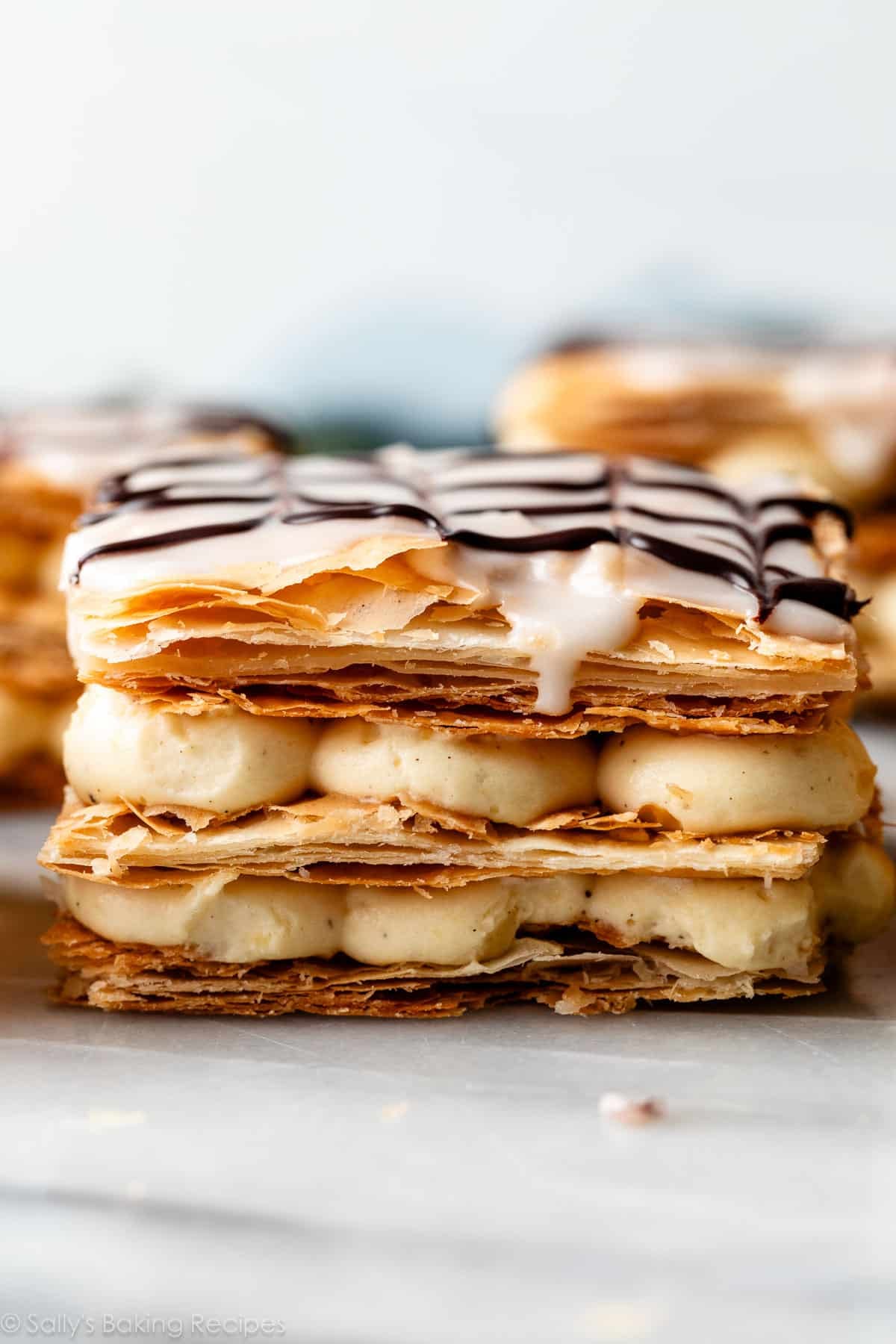
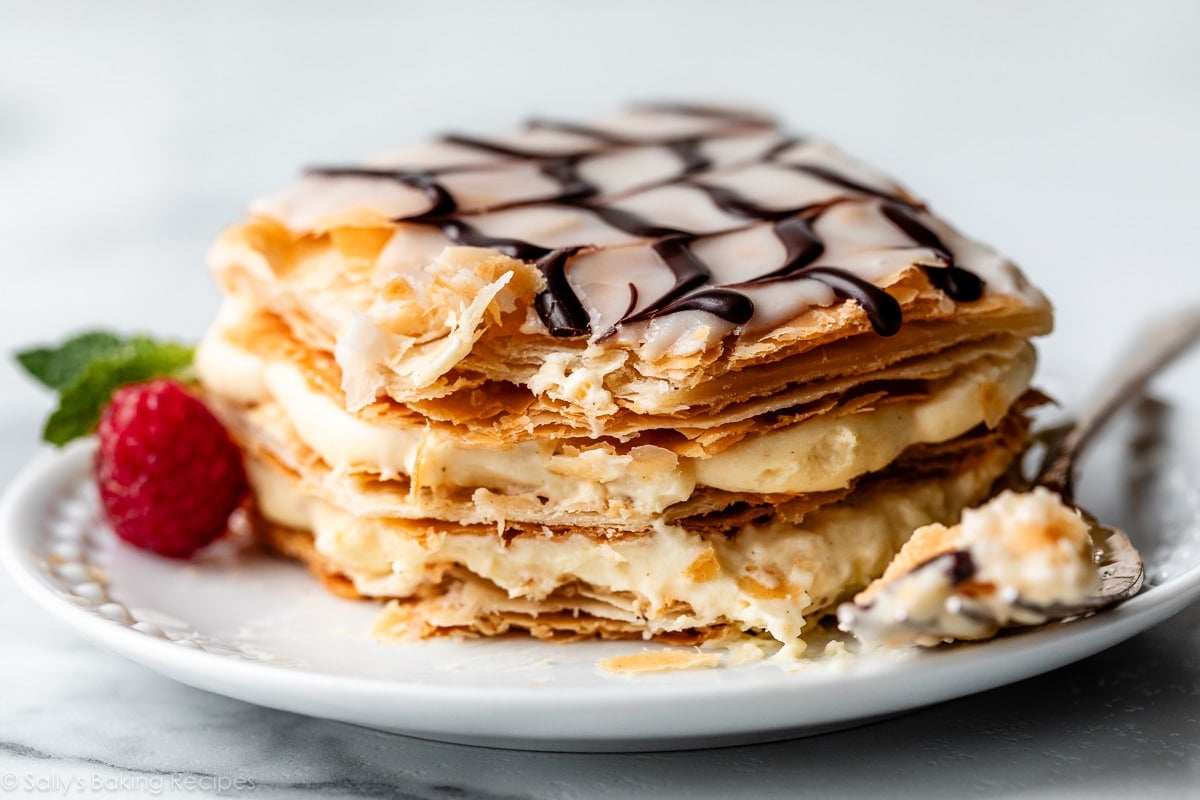
From the countless flaky layers of delicate puff pastry, to the creamy clouds of vanilla pastry cream, to the decorative marbled icing, mille-feuille is an impressive dessert worthy of a special occasion. Learn how to make this classic European pastry in your own kitchen—no complicated ingredients or pastry school diploma needed. I include thorough explanations in the blog post below, as well as many step photos in the recipe, to set you up for success.
One reader, Lauri, commented: “This has been on my baking bucket list for years, but I’ve always been too afraid! Sally made the step-by-step instructions very easy to follow, and these are delicious and worth every minute I put into them!! ★★★★★”
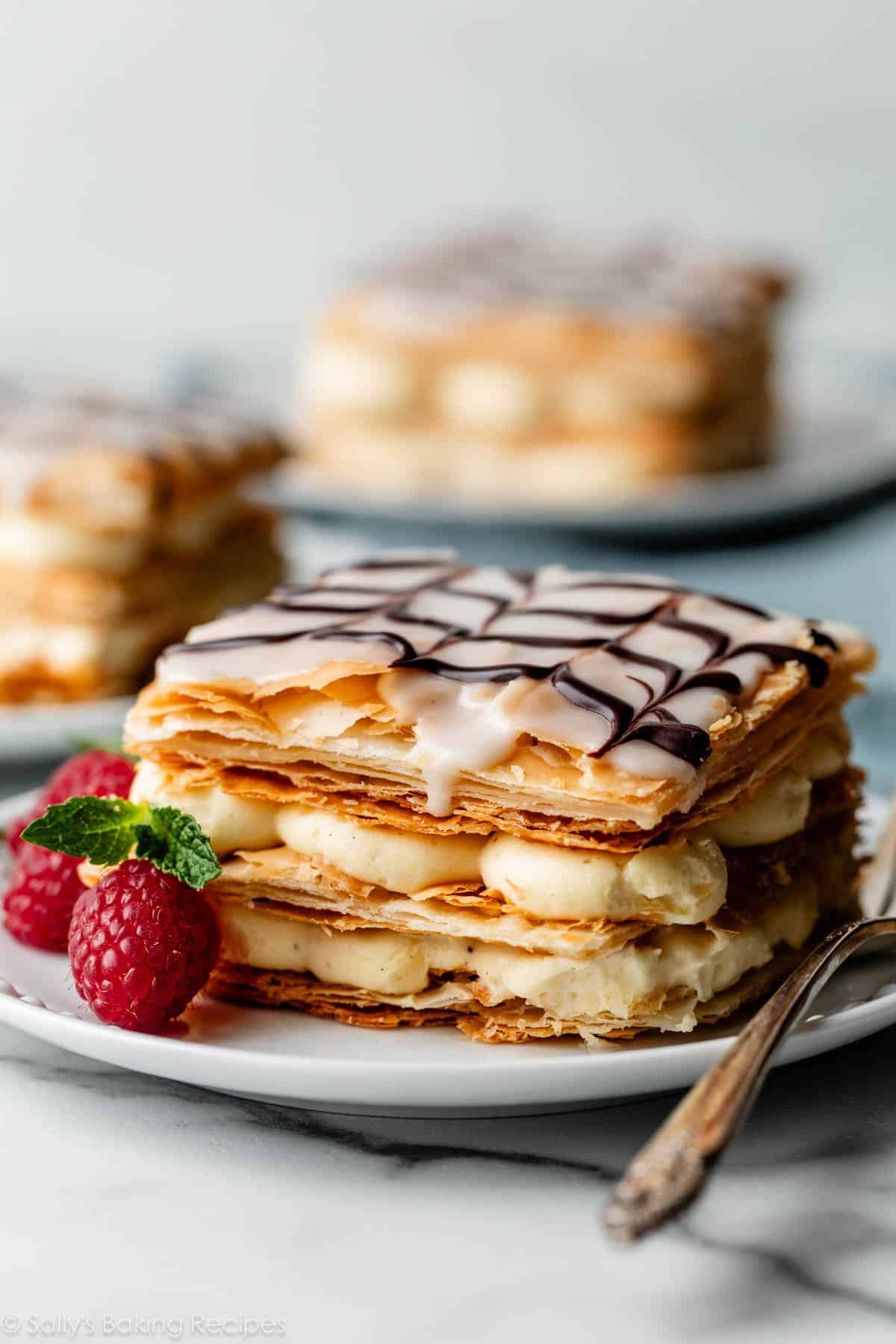
Ready to majorly impress yourself and anyone lucky enough to be a taste tester? Let’s make an ornate-looking (but totally approachable) pastry dessert.
What Is Mille Feuille (and How Do You Pronounce It)?
The French “mille feuille” (pronounced meel foy) translates to a thousand sheets or leaves, a description of this dessert’s many whisper-thin pastry layers. It’s also sometimes called a “Napoleon” or a “custard slice” depending on the filling and/or region. (There are so many versions!) No matter what you call it, this eye-catching European pastry is an impressive sight to behold in a pâtisserie display case.
I have loved poring over recipes online, including from The Spruce Eats, Erin Jeanne McDowell’s on Food52, Bake from Scratch, Preppy Kitchen’s mille feuille, and Prue Leith’s on GBBO. I set out to make my own version, using a couple of those recipes as my inspiration.
And today I’m going to teach you how to make it, too. Just like with homemade croissants, it may look like a daunting baking challenge, but if you take your time with some of the technical steps, I promise it’s doable! The process does take time, but the steps can be broken up over a couple of days.
How to Make Mille-Feuille (Millefeuille or Mille Feuille)
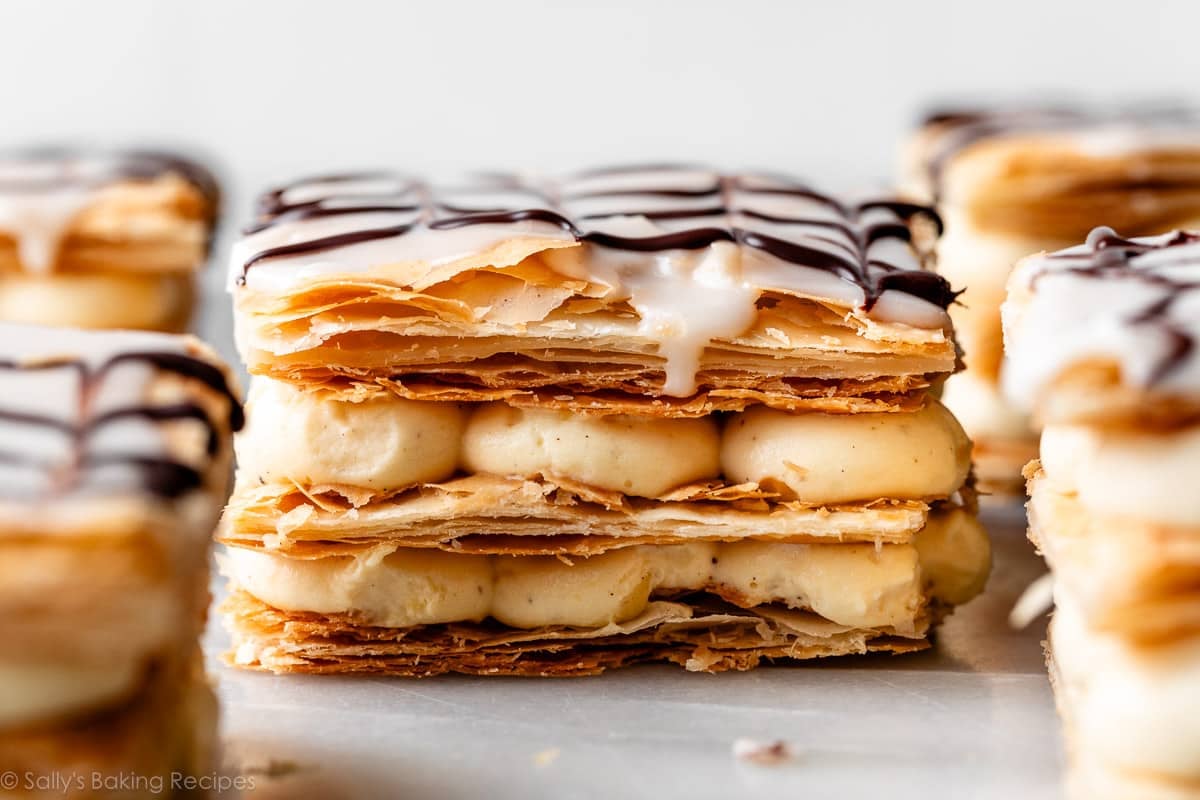
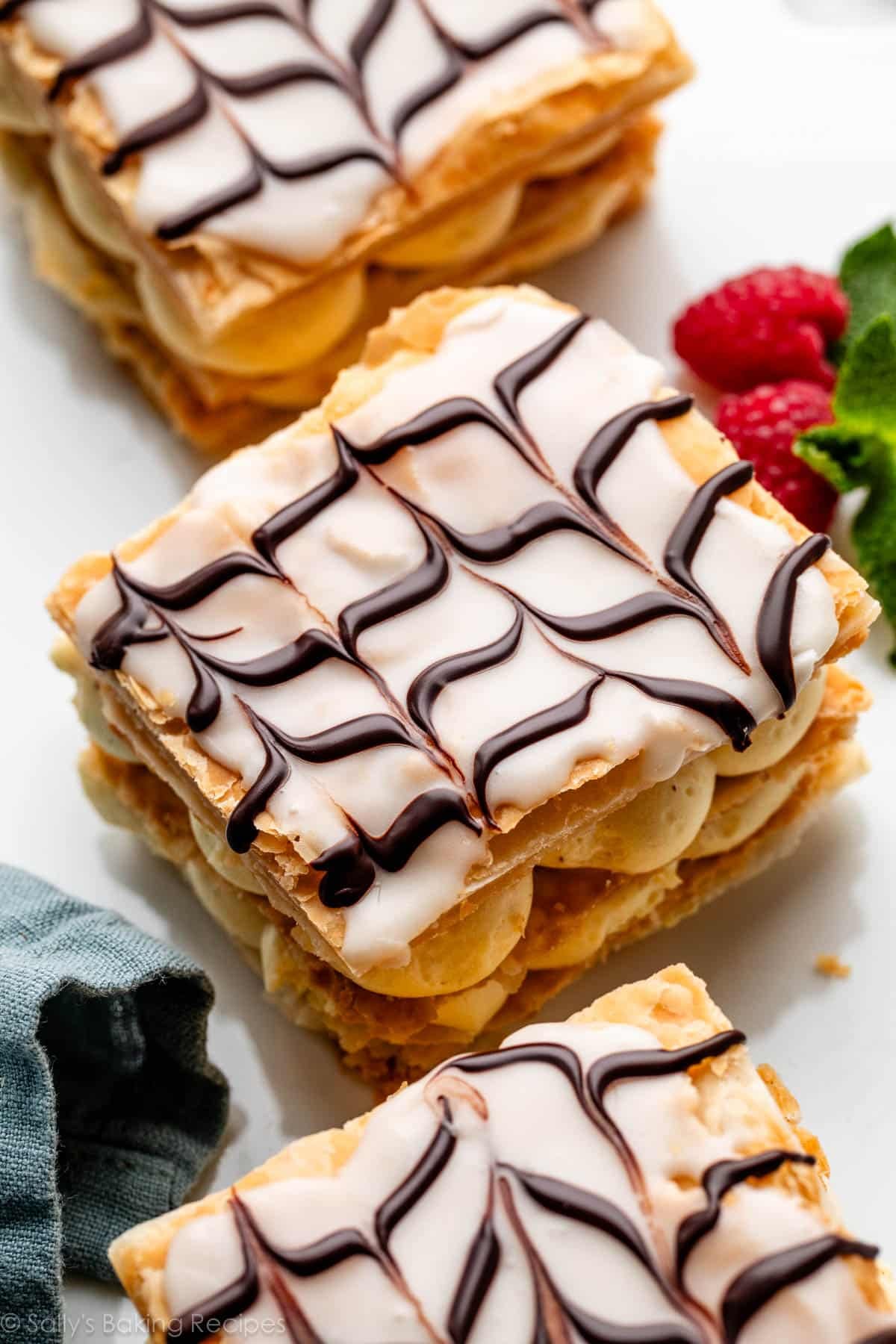
Today’s mille-feuille is made up of:
- 3 layers of baked puff pastry
- 2 layers of pastry cream
- 1 layer of marbled icing
Here is everything you need to make this recipe:
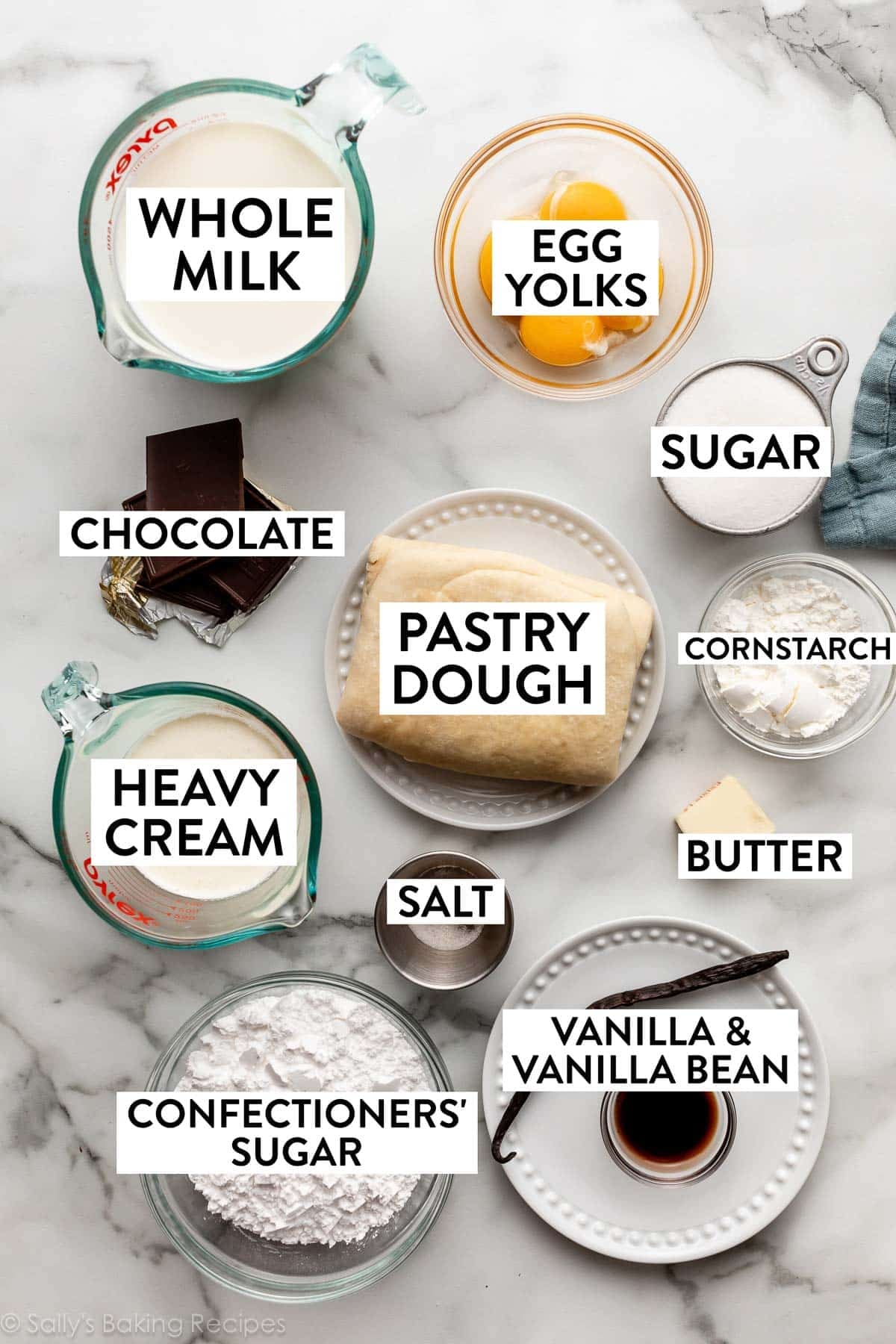
Pastry Cream Filling
Let’s start with the filling because it has cooling and chilling steps involved; it’s efficient to make this first so it’s ready when the baked puff pastry layers are ready. (You can also make it a day ahead.)
Pastry cream, or crème pâtissière, is a vanilla custard-like filling you can use for treats like pies, eclairs, doughnuts, and more. You cook it on the stove just like you prepare the pudding filling for banana cream pie. It’s quite thick after chilling, so you usually need to give it a stir to smooth it out again. In this layered mille-feuille, we actually take it a step further and add whipped cream. This considerably lightens up the texture, making it velvety-smooth—think homemade whipped cream, but richer and more substantial. When you add whipped cream to pastry cream, I learned, it’s called crème légère, or lightened cream. (It can also be called diplomat cream or crème diplomate, but that sometimes includes gelatin.)
If you’ve ever made Boston cream pie, you’re familiar with pastry cream. I deviated from that recipe, though. It’s a cake filling there, so it’s really sturdy and thick. I needed less pastry cream, and I wanted a lighter consistency for this dessert’s filling.
The detailed instructions and step photos are in the recipe below, but let me share some key steps and success tips so you have a better understanding.
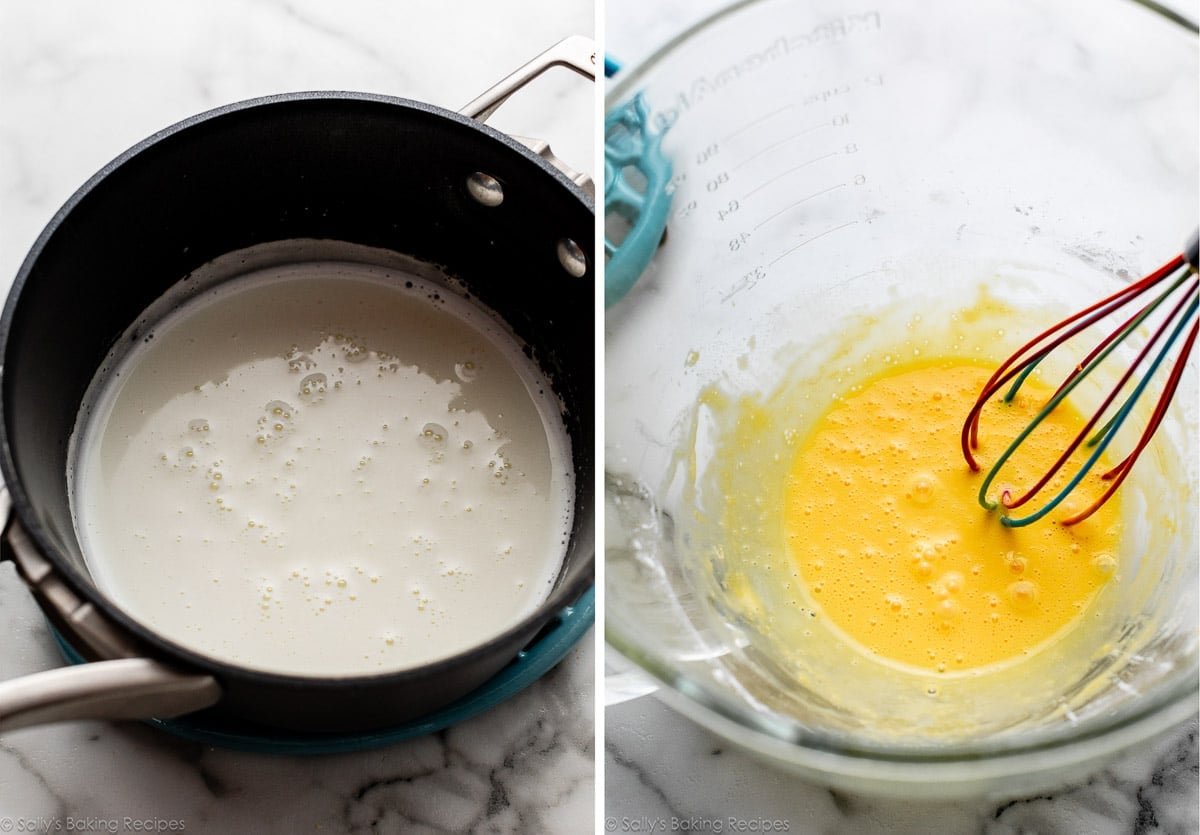
- Cornstarch and egg yolks thicken the cream. Combine those first, and then move to the stove. You’ll simmer whole milk and granulated sugar together, and then remove it from heat and temper the egg yolks.
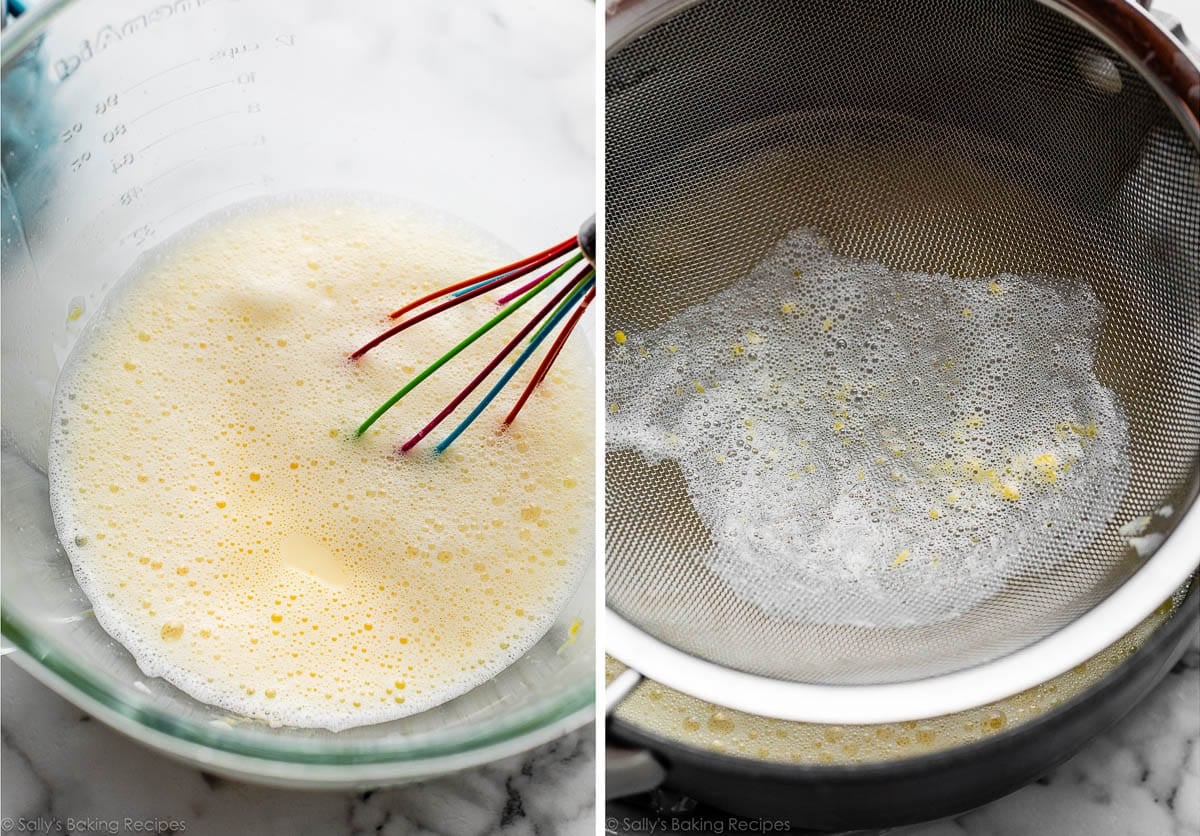
- Tempering is important here. To temper, slowly pour the hot milk mixture into the egg yolks and cornstarch, whisking constantly. This carefully and slowly raises the egg yolks’ temperature. The purpose of tempering is to prevent scrambling them.
- Strain it. Just in case there are some solids! Pour all of the mixture back into the saucepan through a fine-mesh sieve, to strain out any solids that may have formed.
- Bring it to a boil. At first it won’t seem like it’s thickening much, just getting frothy, but as soon as it reaches a boil with big bubbles bursting on the surface, it will thicken up pretty much immediately.
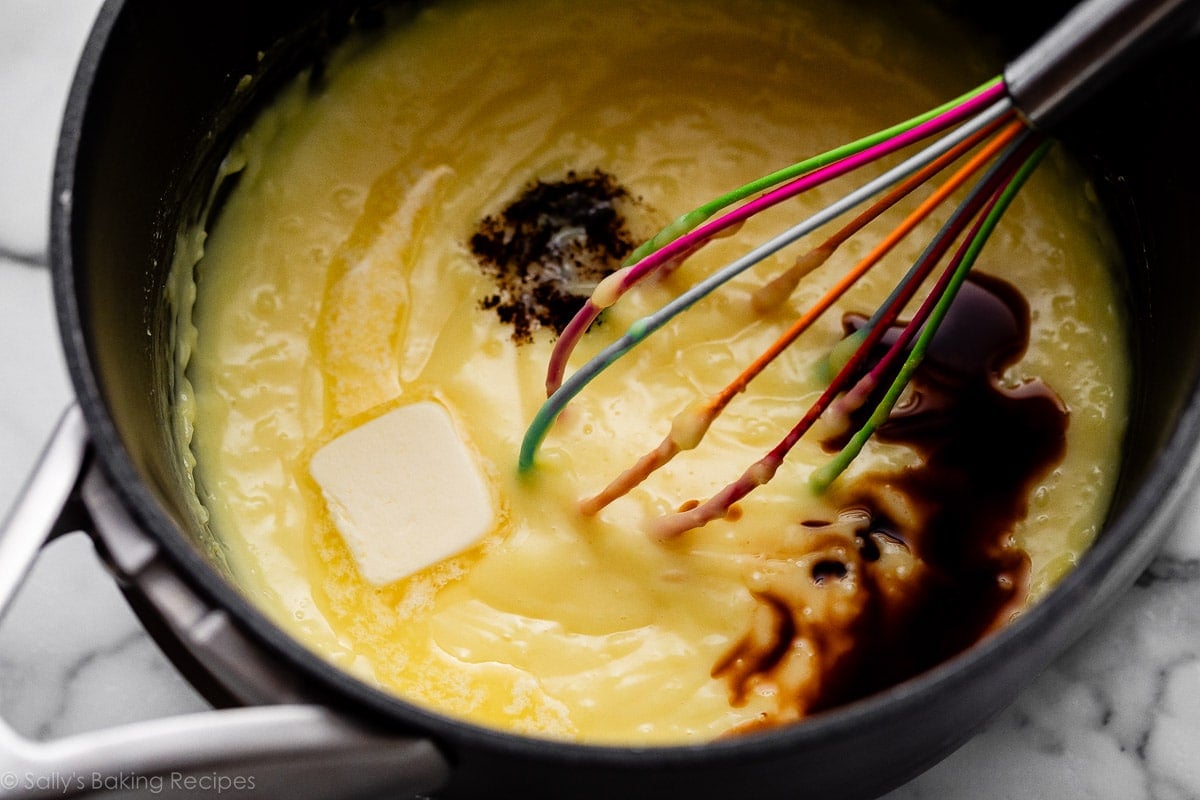
- Remove from heat & add flavor. Stir in butter, vanilla extract, vanilla bean + a pinch of salt.
Then you’ll need to refrigerate it so it thickens.
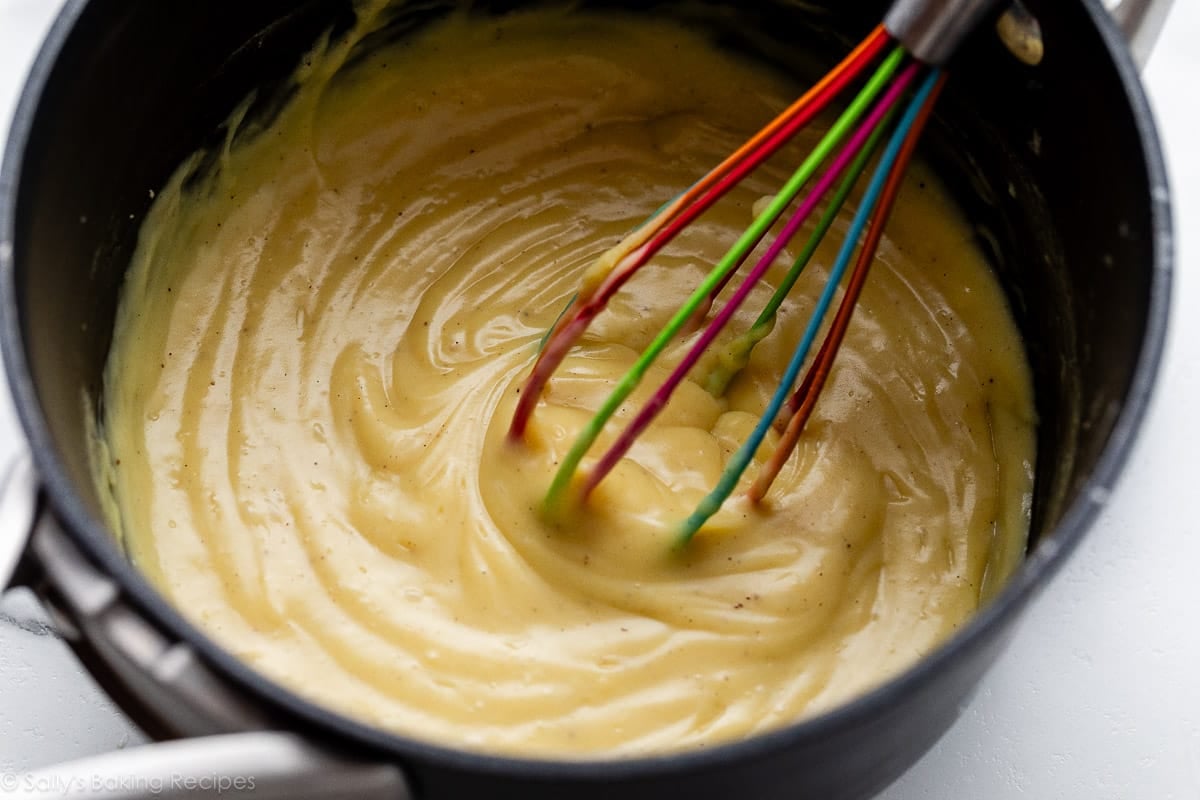
This is the velvet-rich pastry cream before chilling:
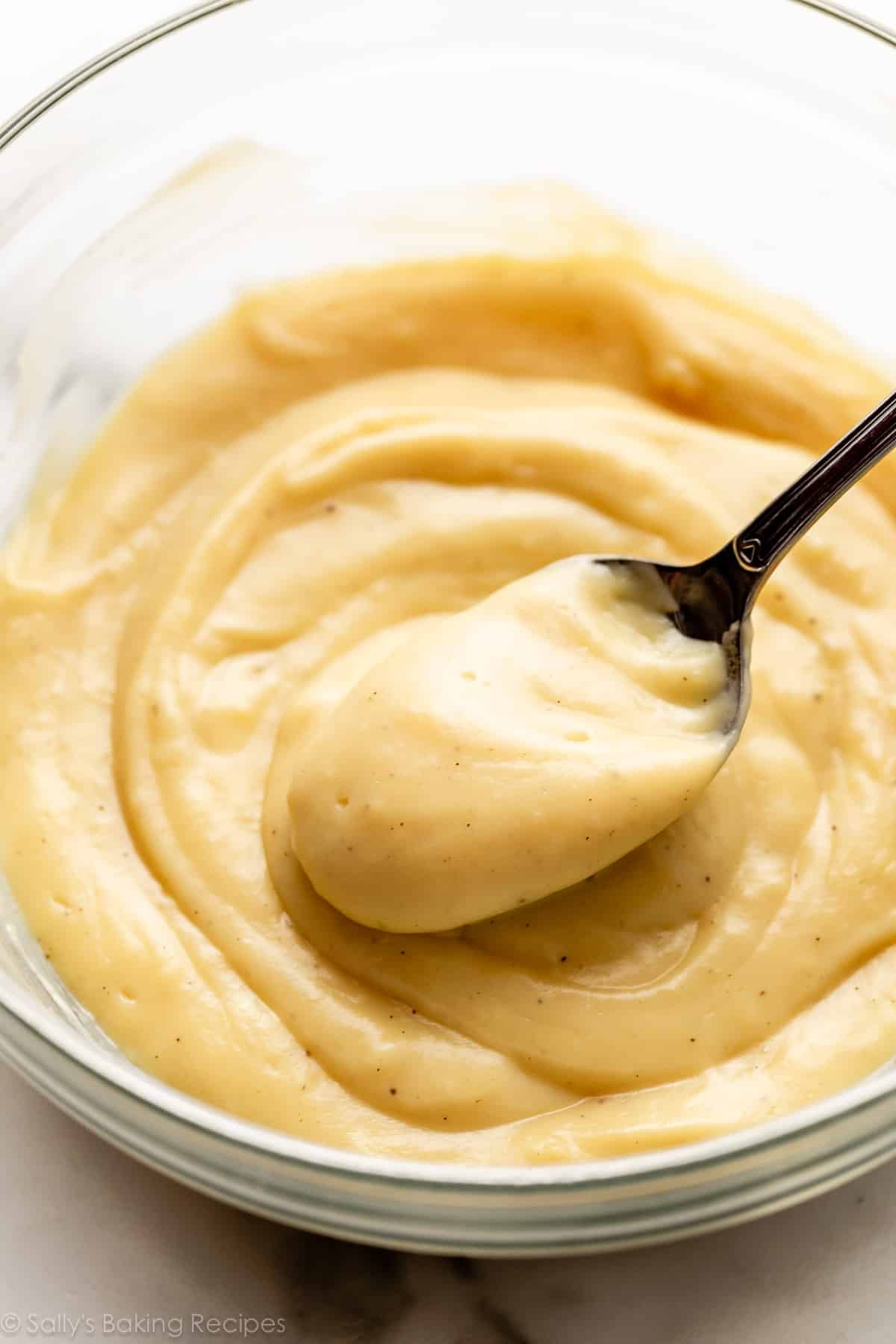
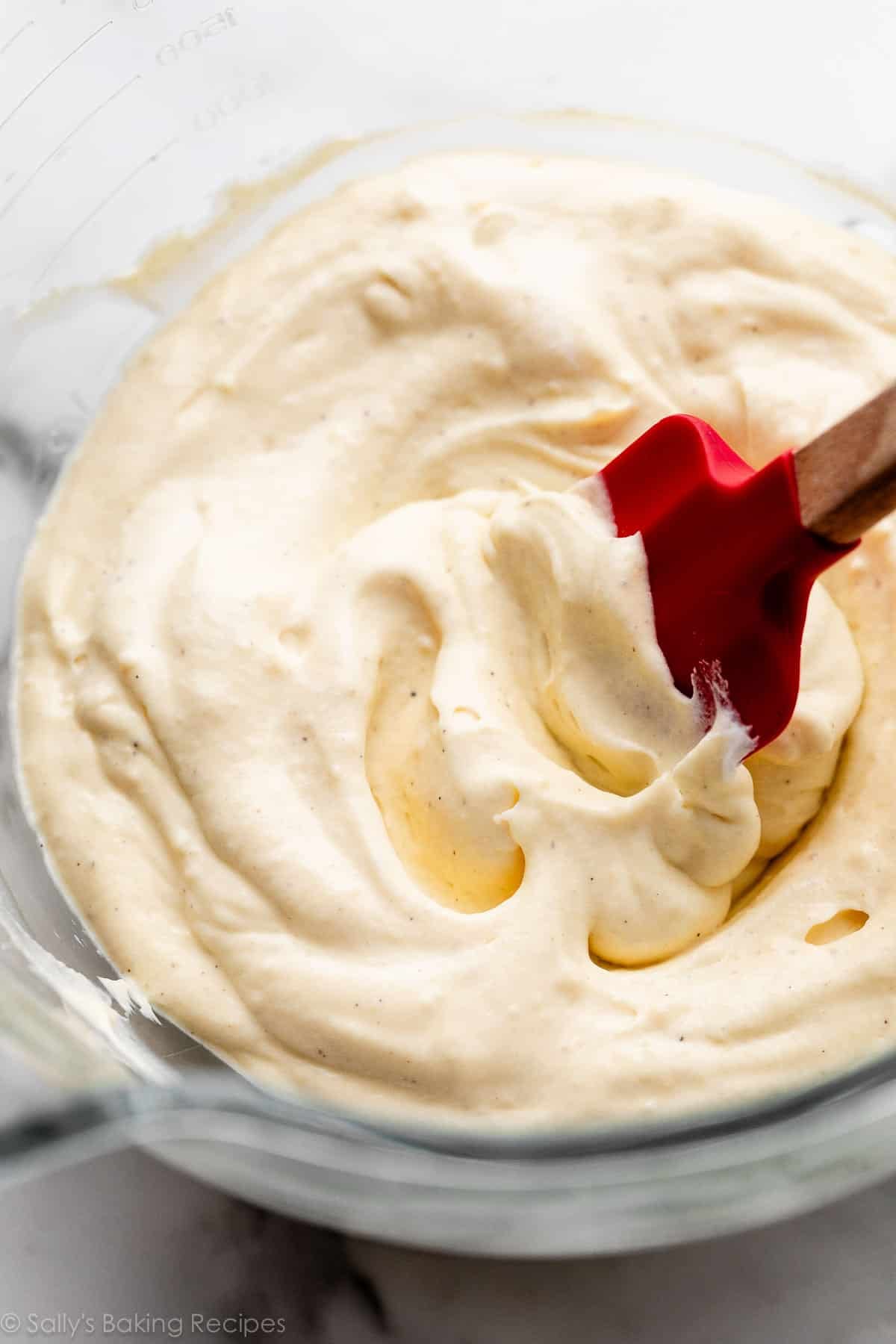
Chill it in the refrigerator for a minimum of 3 hours or overnight. It will firm up a lot during this time. Give it a stir and then combine it with whipped cream. Chill it once again for 1 hour, so it’s nice and thick for piping between the flaky pastry layers.
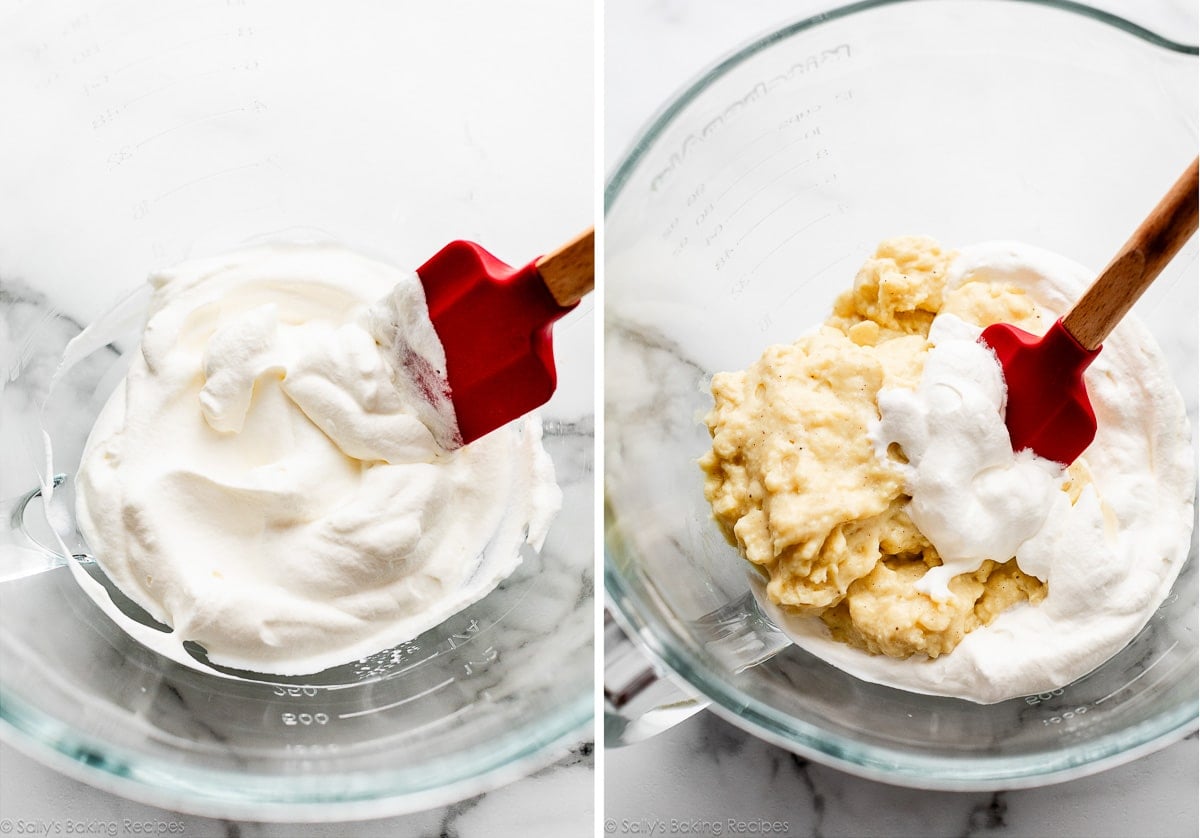
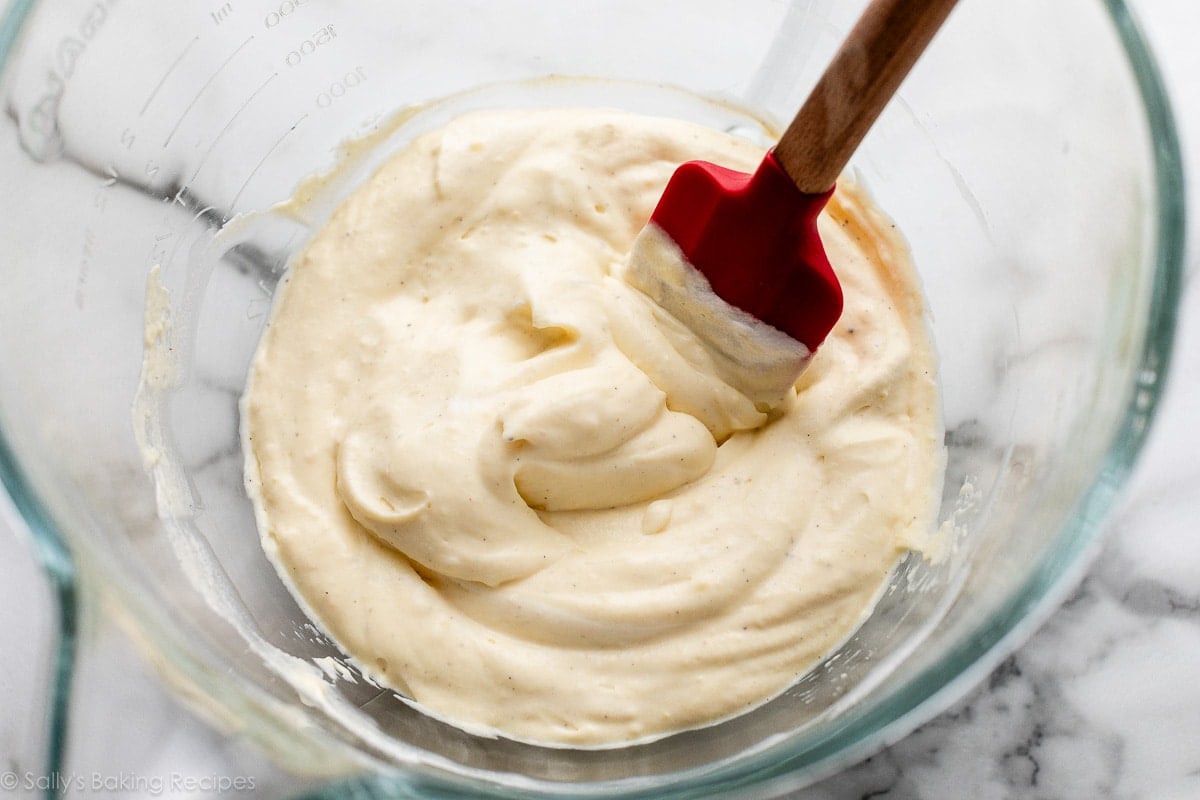
And this is the pastry cream after combining with whipped cream:
Puff Pastry Layers
I’m using my homemade rough puff pastry, but you can absolutely take the shortcut of using store-bought puff pastry. If frozen, thaw it according to package instructions before you begin.
If you’d like to make the rough puff pastry from scratch, you need just 5 ingredients: flour, sugar, salt, cold butter, and cold water. All of the same ingredients as butter pie crust, but there’s the added rolling and folding process, similar to biscuits, which gives us all of those flaky layers.
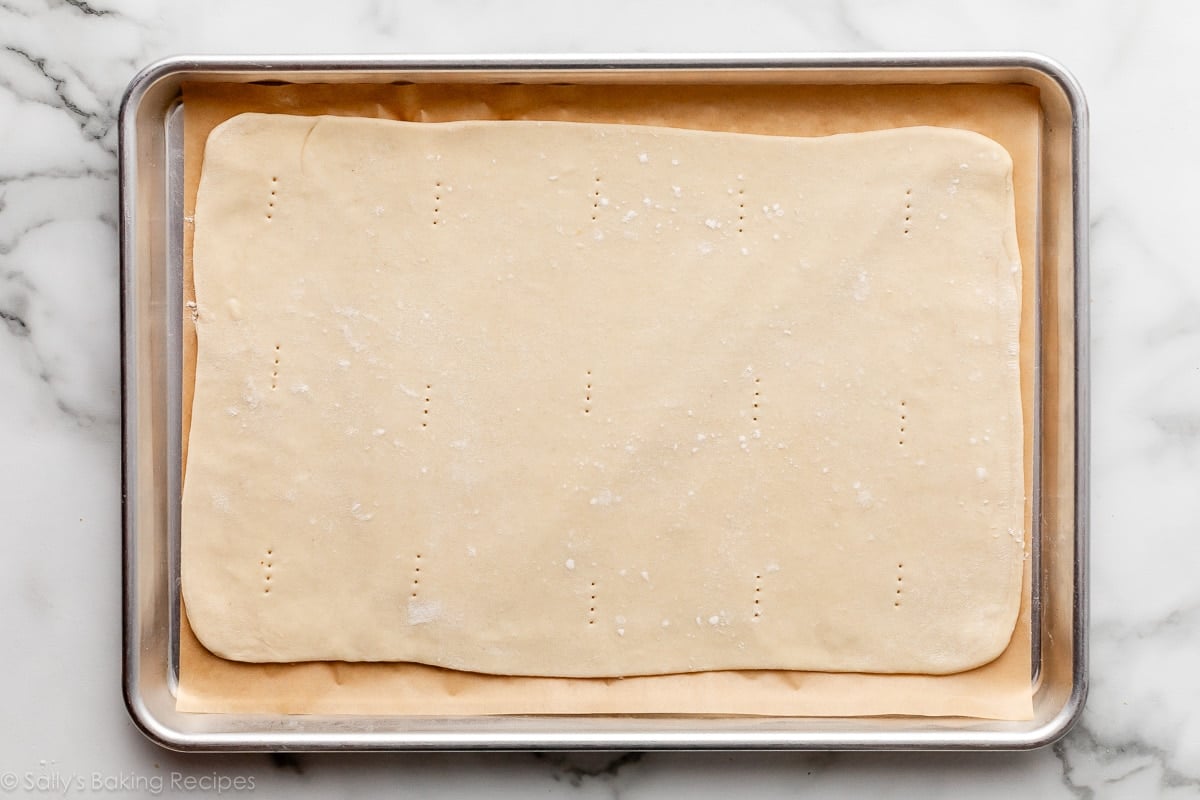
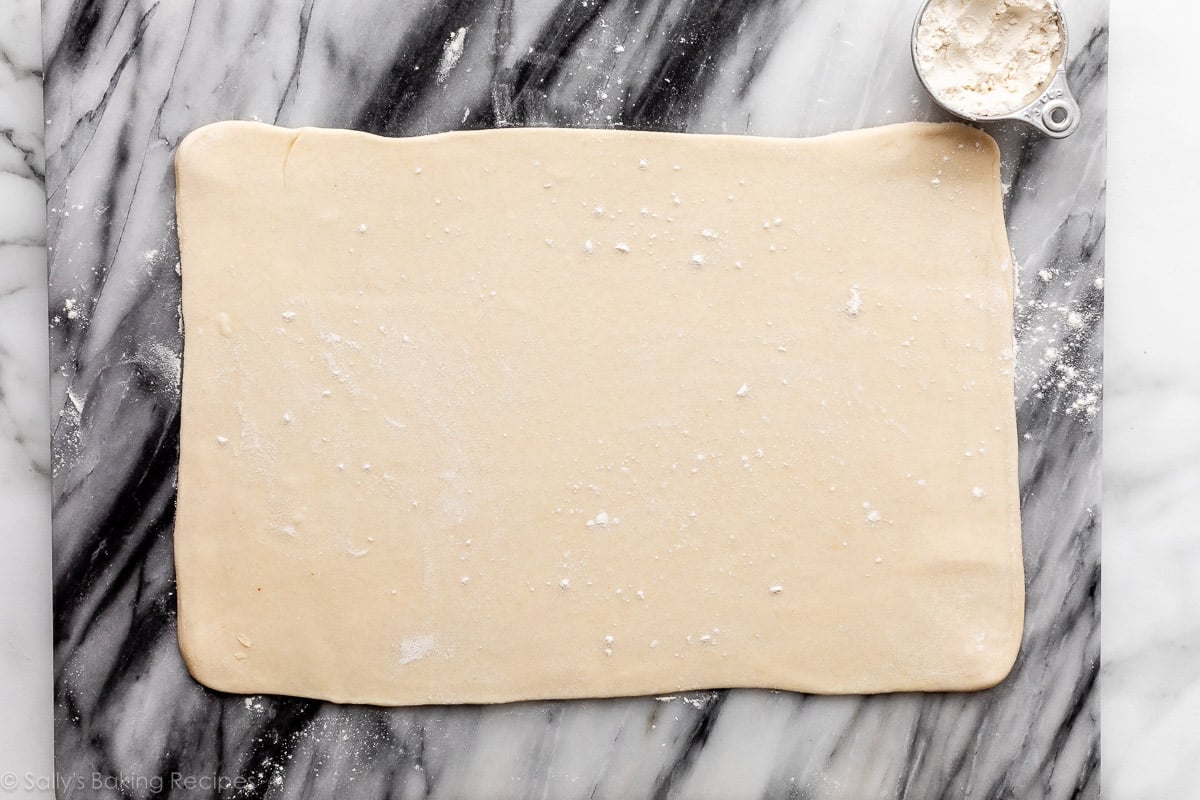
Once you have your store-bought dough thawed, or the homemade dough chilled (after the second refrigeration as detailed in the rough puff pastry post), it’s time to roll it out, and you’ll find those exact instructions below in the recipe. Place the rolled-out dough on a lined baking sheet and dock it with a fork, just like you would when par-baking pie crust.
This is the homemade puff pastry dough ready to bake:
This is the store-bought puff pastry dough ready to bake (you’ll connect the 2 sheets that usually come in a box):
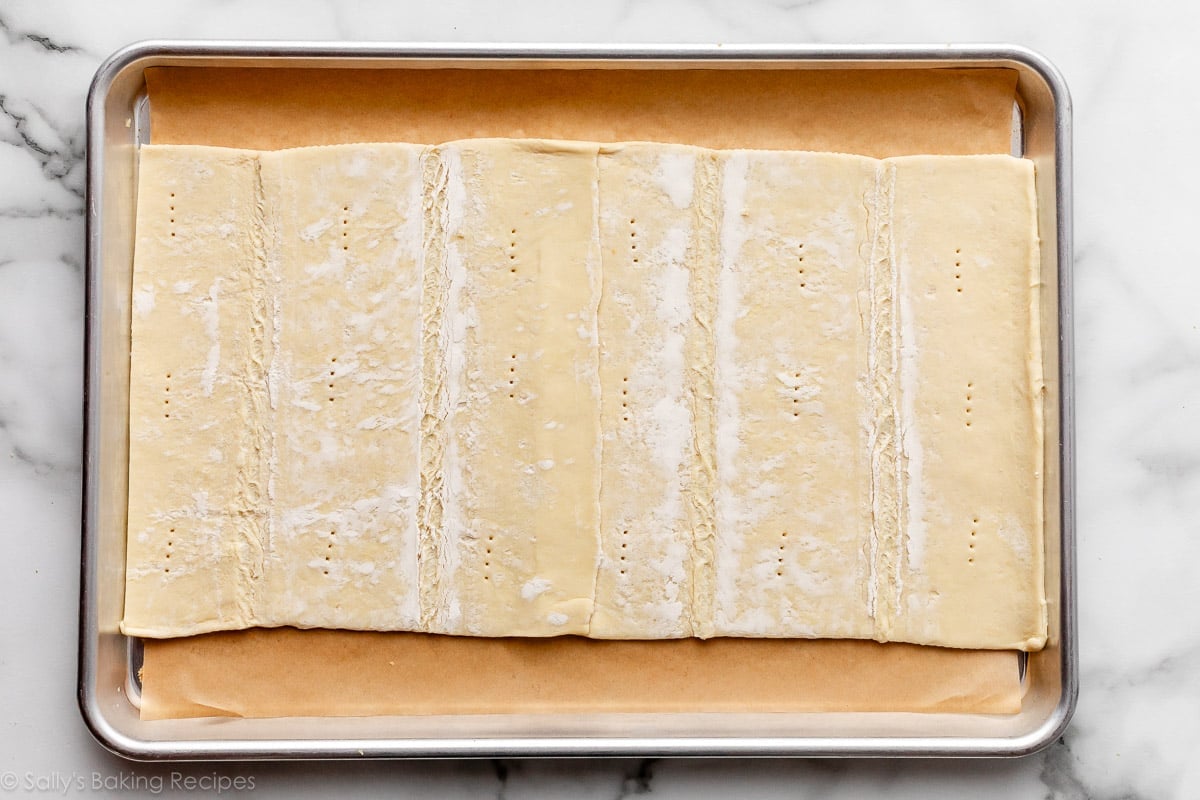
An Odd Step: Weigh It Down!
Now here’s the step not usually included in puff pastry recipes: we are going to weigh down the pastry to prevent it from puffing up too much.
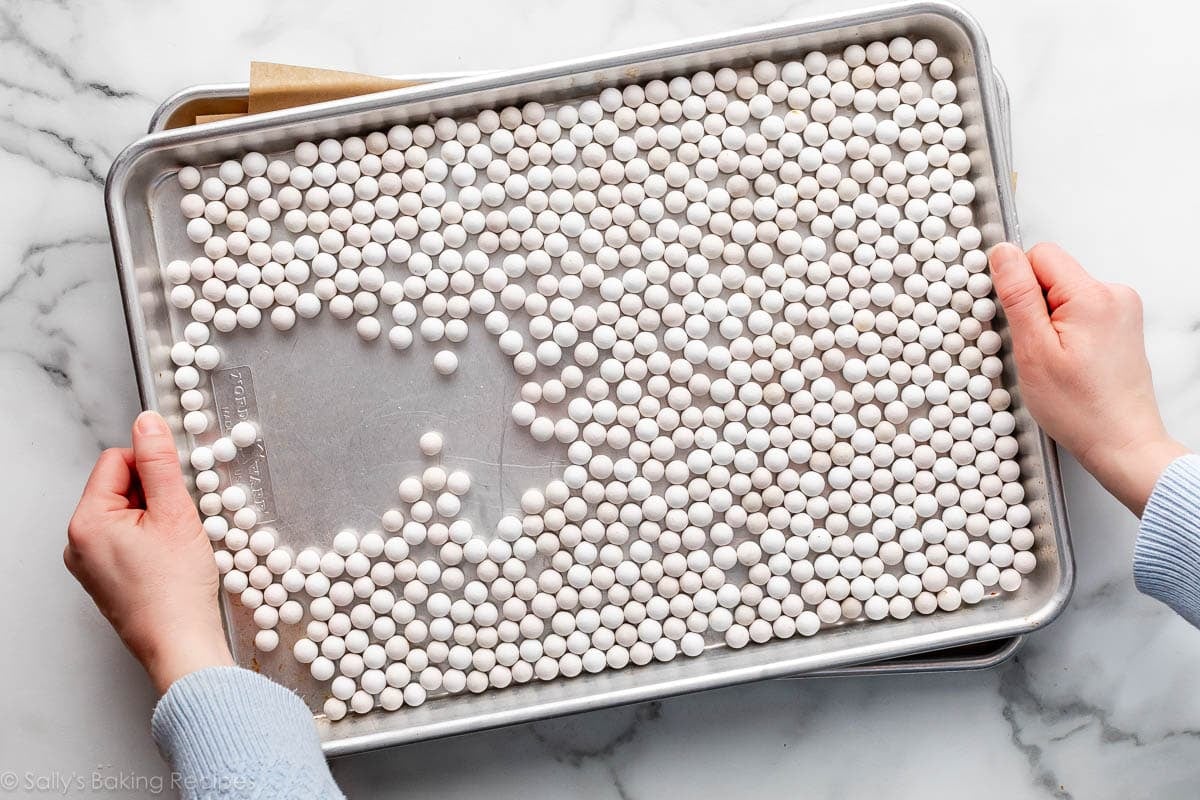
Place another sheet of parchment paper on top of the pastry dough, then set another baking sheet on top of that. If you have pie weights, pour them onto the top baking sheet. You could also use dried beans instead. If you don’t have either, bake it with just the (empty) top baking sheet, and when it comes out of the oven, set a pan or skillet on the top baking sheet while it cools.
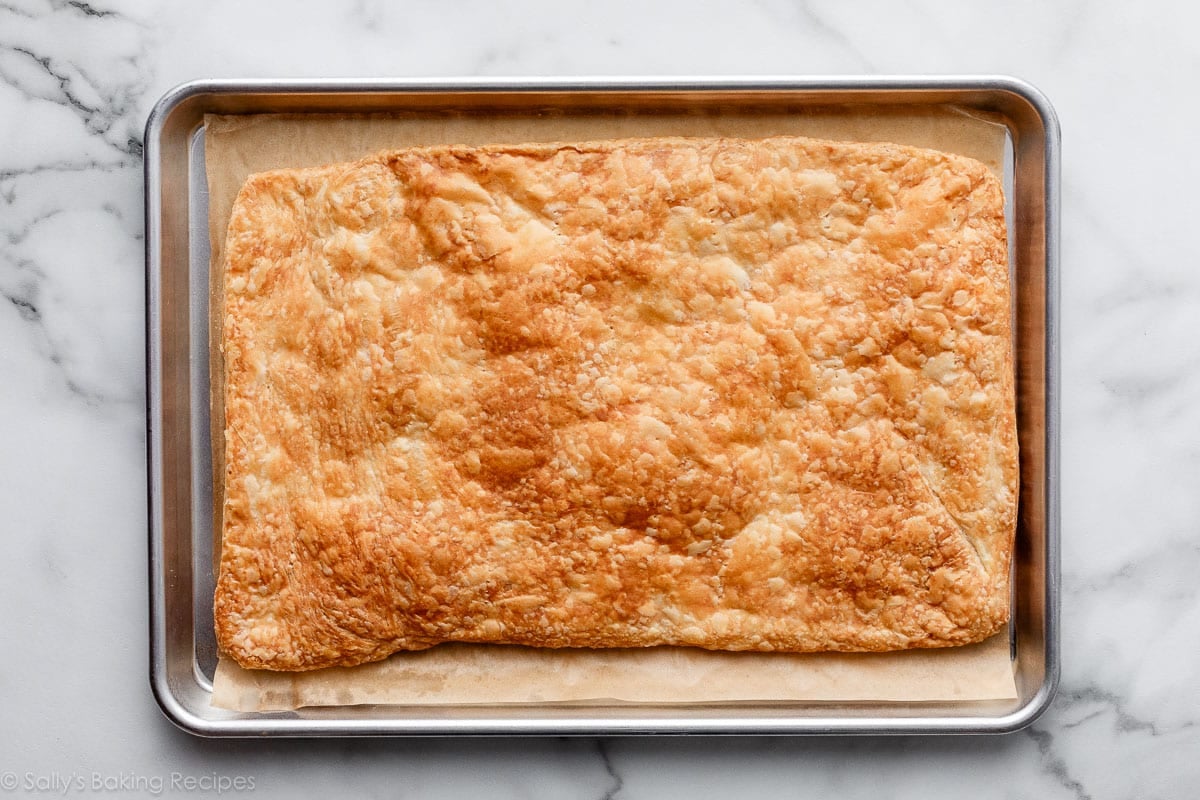
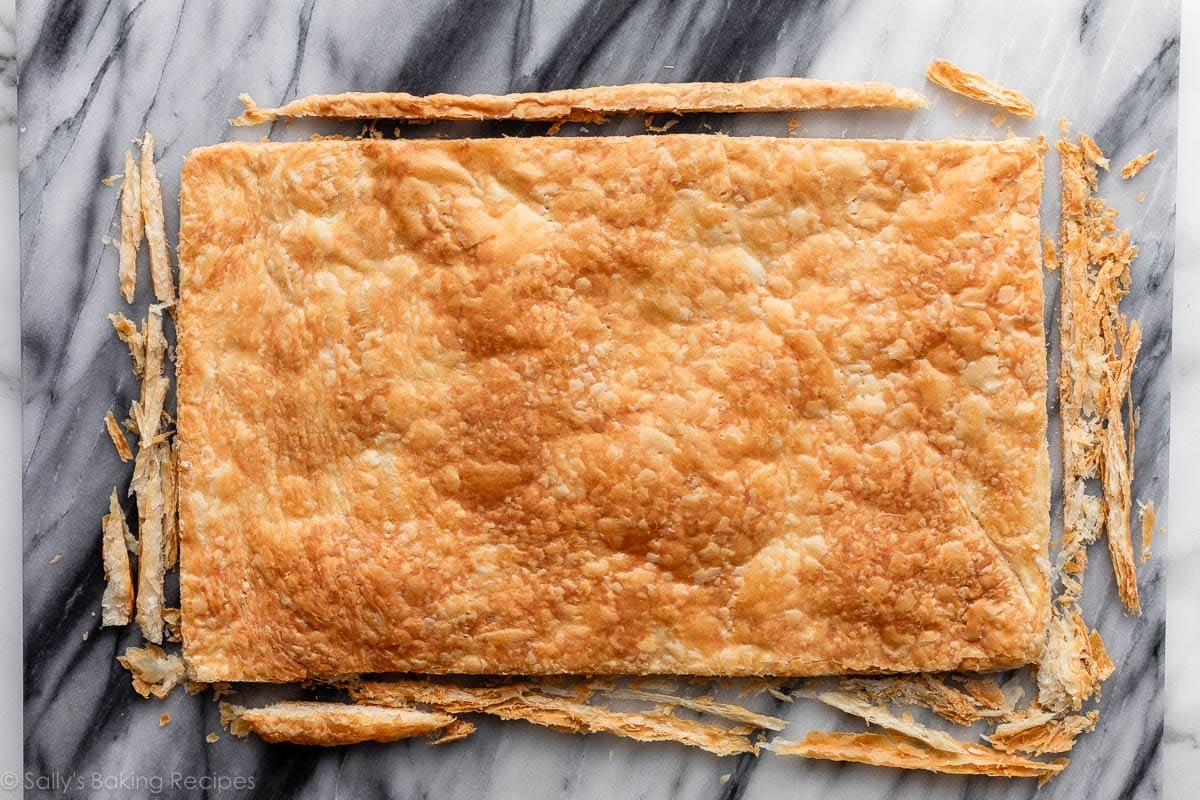
You’ll bake it covered with weights (or whatever you’re using) for 20 minutes, and then uncovered (without weights) for another 7–9 minutes.
Note: I found that the homemade puff pastry gets much darker than the store-bought; likely because it’s made with butter instead of oil-based fats.
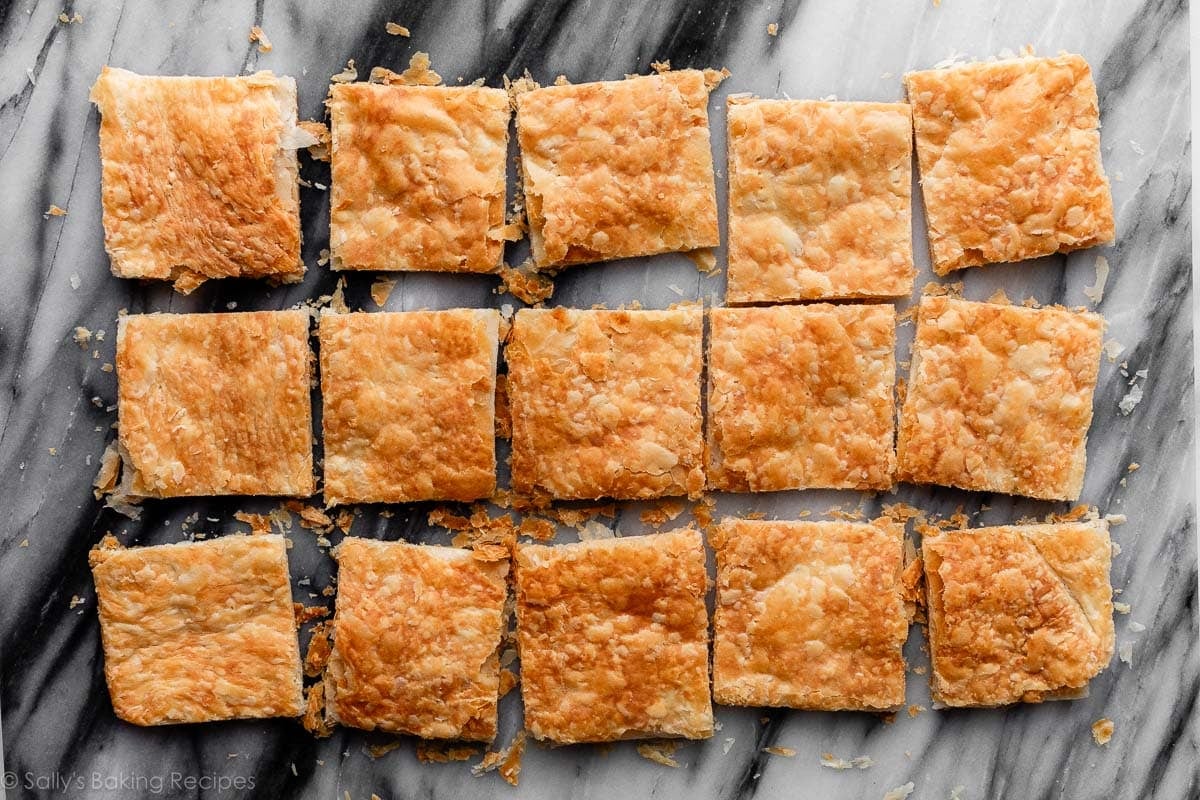
Once the baked pastry has cooled, you’ll cut it into 15 (roughly) equally sized pieces, to make 5 mille-feuille stacks containing 3 pastry layers each.
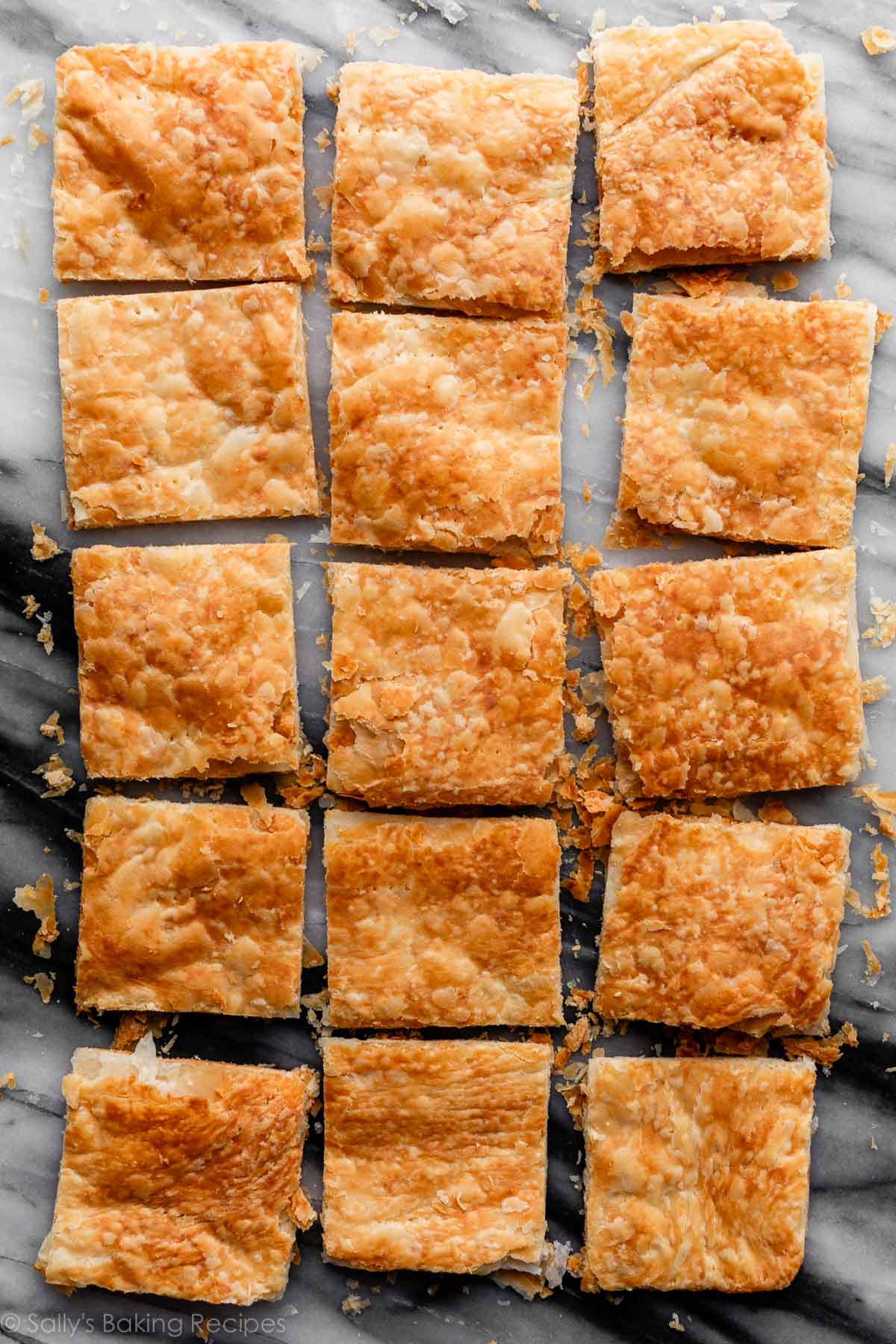
Mille-feuille are often rectangular in shape, but I found that making them as squares was easier when it came to cutting uniform-size pieces. When I tested these as rectangles, I found they were either too small and difficult to assemble, or else made 4 huge pastries that were much too large for individual portions. I had the best success with making 5 assembled 3-inch square pastries.
Top & Assemble the Mille-Feuille
There are many ways to top these, ranging from a simple dusting of confectioners’ sugar to fanciful swirls of two-toned icing. Some recipes call for royal icing, while others use fondant. I love the signature marbled icing look, so that’s what I’m demonstrating.
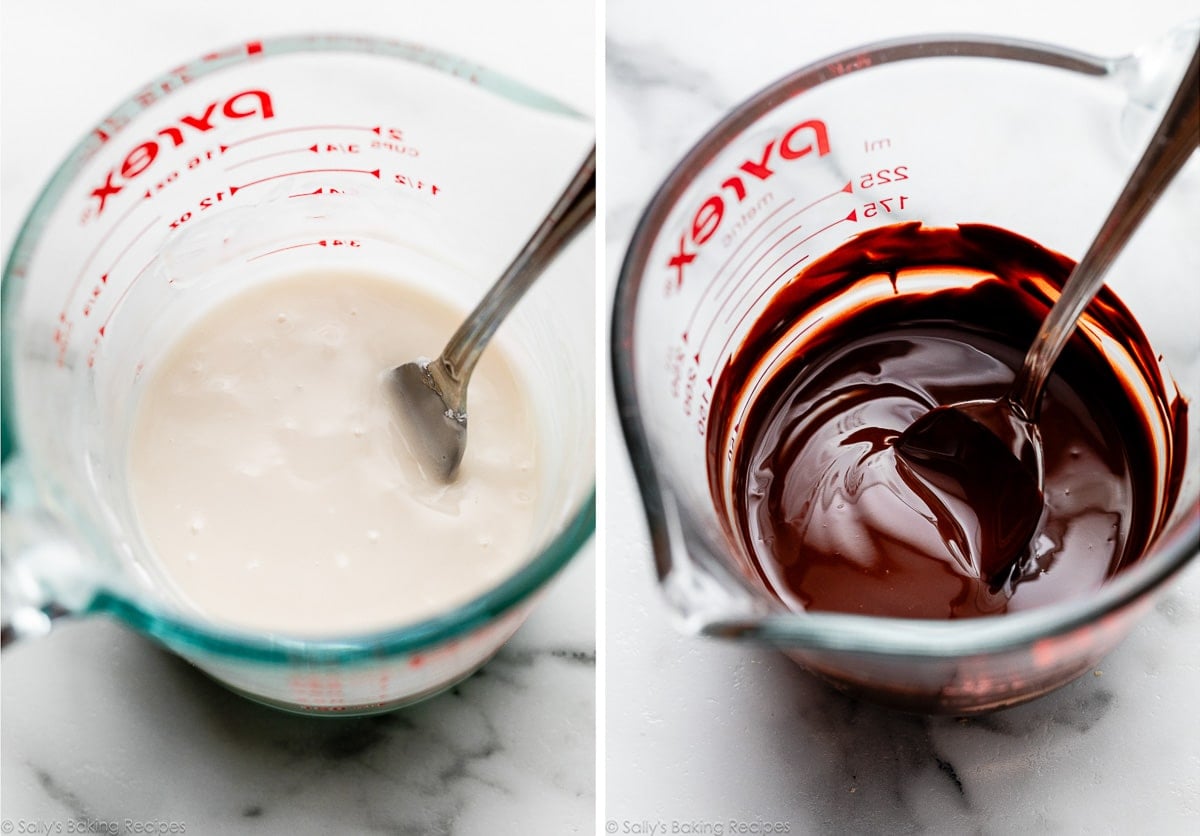
After testing many variations, my taste testers and I determined that a thick vanilla icing + melted chocolate pairing makes for the tastiest topping. Dark, bittersweet, or semi-sweet chocolate tastes best with the sweet vanilla icing. Like I always recommend for melting chocolate, chop up a bar of baking chocolate—save the chocolate chips for chocolate chip cookies.
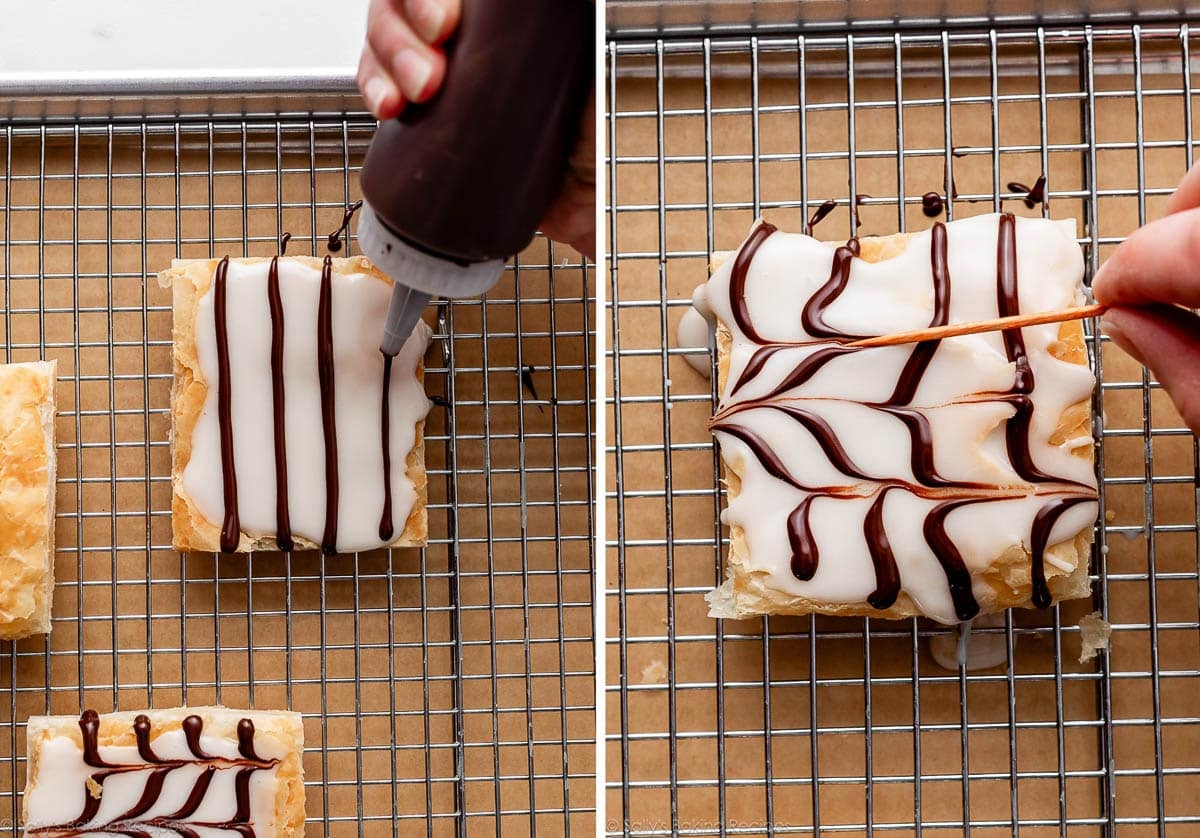
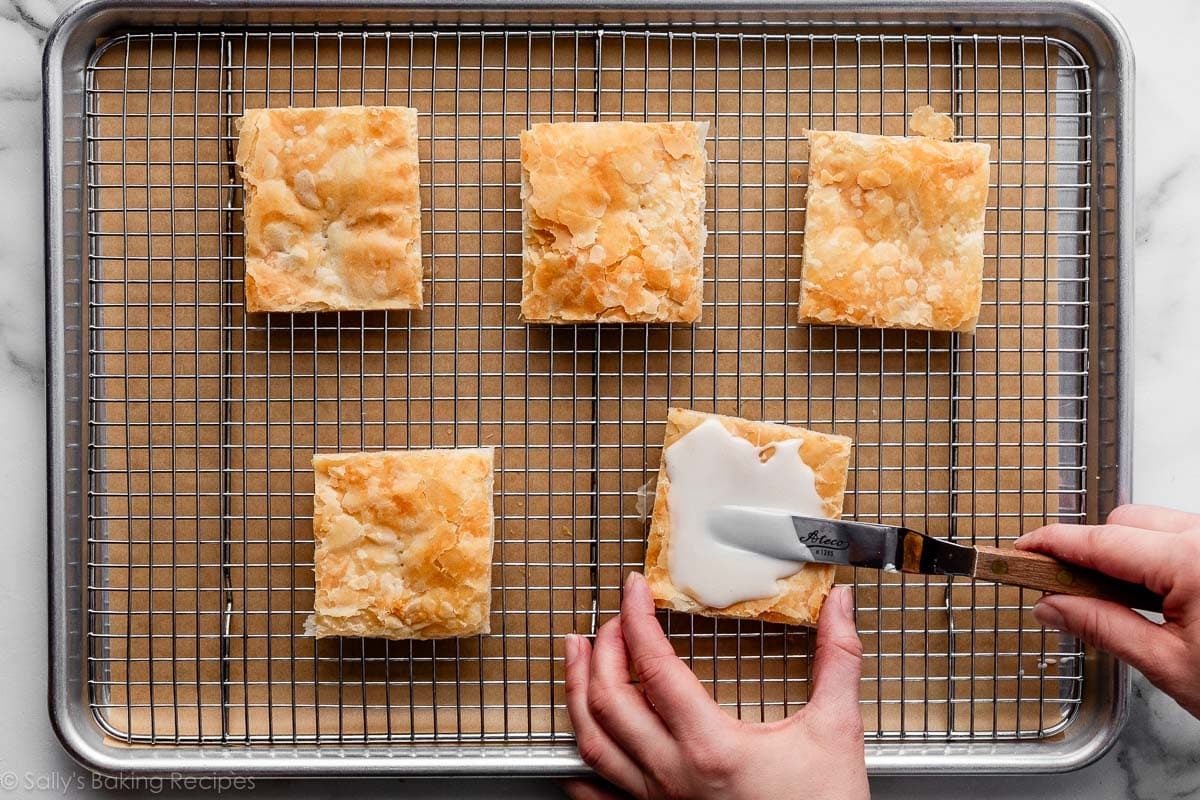
You’ll ice all of the tops first, before assembling, because it’s difficult to ice the tops efficiently when they’re layered on top of a creamy filling. Place the 5 pastry squares you’ll use for the tops on a wire rack. With an icing spatula or a spoon, spread the vanilla icing on each square. Then pipe or drizzle melted chocolate on top. For this, I piped 4 stripes across and then used a toothpick to create the classic chevron design by dragging it in a perpendicular direction. Like this:
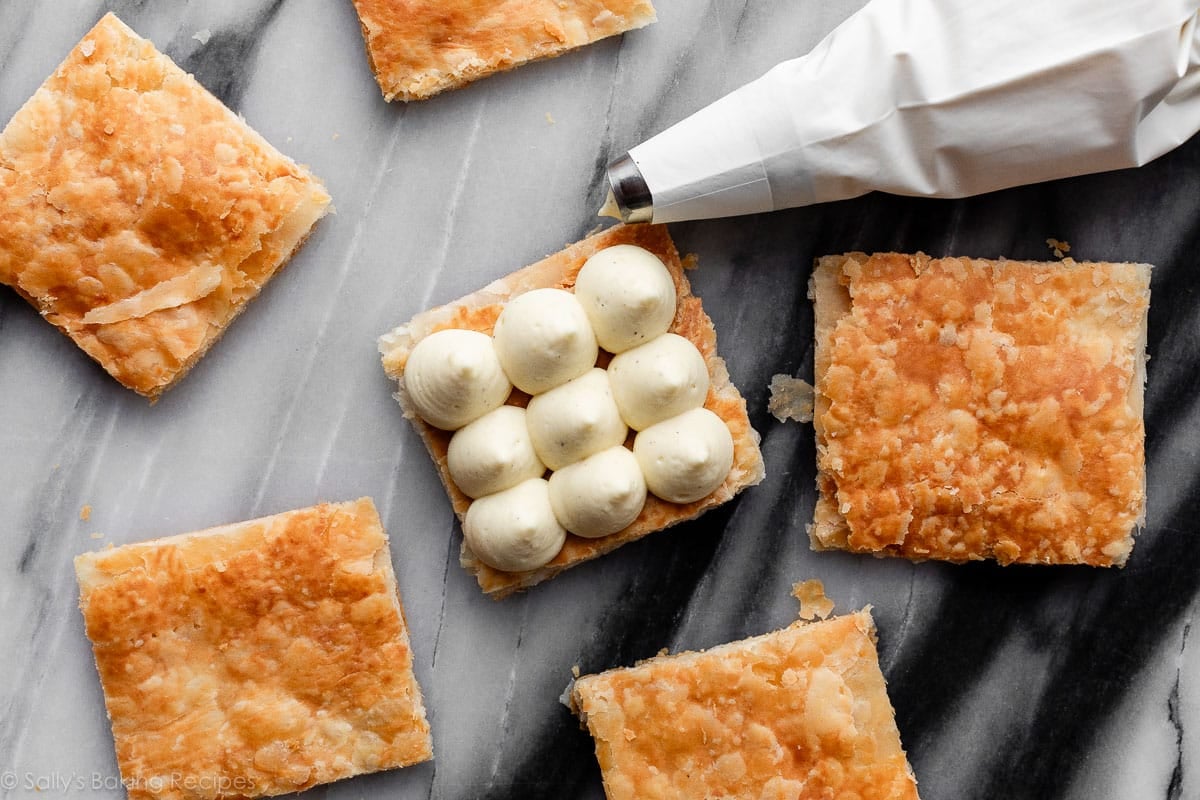
Now let’s fill the pastries. Fit a pastry/piping bag with a large round tip, such as Ateco 808 (which I use for a lot of cupcakes—see this piping tips post). Or, you can simply use a large plastic bag and snip off a bottom corner with scissors.
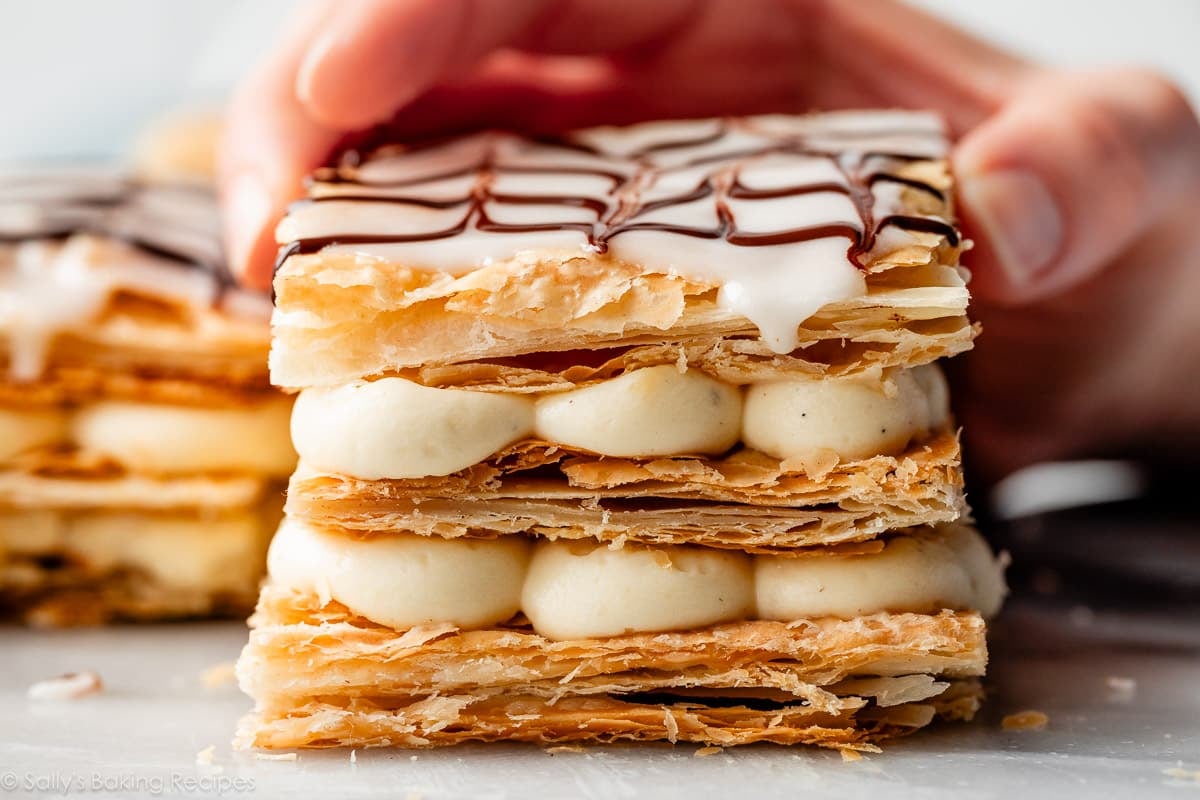
Start with one plain (un-iced) square of pastry and pipe on 3 dollops of cream in 3 rows, so you have a grid of 9 dollops. Place another pastry square on top of that, and then repeat the piping the same way. Finally, place one of the iced pastry layers on top.
Refrigerate the assembled pastries (uncovered) for a minimum of 30 minutes before serving, just so they aren’t toppling over. Like in most pastry recipes, the refrigerator is your friend here.
How to Eat Mille-Feuille
Ahh, yes. The most difficult instruction of the day. 😉 In this step, you’ll simply stuff your face with it. But slowly! Savor and enjoy every bite. Respect the time that went into making it!
Plate each mille-feuille and serve with a fork, or you can eat it handheld. The longer the assembled pastries sit in the refrigerator, the more solid they’ll become. But regardless of the time it sets, the soft filling will spill out the sides when you cut or bite into it, and that’s fine! It’s crispy, it’s creamy, it’s close-your-eyes-and-sigh dreamy.
Yes, absolutely. But if you want the challenge, and a heightened flavor experience, I strongly encourage you to use homemade puff pastry. You’ll be rewarded with an optimal flavor and texture experience. And you can really taste that butter in the homemade version!
You can use dried beans. OR you can just add the baking sheet on top and not fill it with weights or beans. (Always add a piece of parchment paper on top of the dough, though, so the pan is not touching it.) OR as the baked pastry is cooling, place something heavy like a pot or pan on top of the top baking sheet, to weigh down the baking sheet that is on the puff pastry. (I have done that last suggestion before and it works just fine.)
Though it’s the most common filling in this dessert, you do not have to use pastry cream between the layers. I have a list of other filling options below, like mousse or no-bake cheesecake filling.
Instead of the vanilla icing + chocolate combo, you can simply dust the tops with confectioners’ sugar. You can also skip the chocolate for a plain vanilla icing topping, or skip the vanilla icing and drizzle melted chocolate directly on top. Or, some recipes call for royal icing. (If you want to use my recipe for royal icing, I recommend halving it.)
Other Filling Options
- Peanut butter mousse from my homemade eclairs recipe
- Whipped cream (for an extra light and barely sweetened filling)
- Lightly sweetened whipped frosting
- No-bake cheesecake filling from these cheesecake jars
- Chocolate mousse filling from my dark chocolate mousse cake
Or you can still use pastry cream, or any of the suggestions above, and layer your filling of choice with fresh raspberries or thinly sliced strawberries and dollops of jam. Or pipe rows of raspberry cake filling between rows of your choice of cream/mousse filling. Lots of options!
Some Special Tools You Need
- Sieve
- Rolling pin
- Half sheet pans (12×17-inch baking sheets)
- Pie weights, but you can get around not having these!
- Electric mixer (handheld or stand)
- Squeeze bottle or pastry bag, a larger round tip like Ateco 808, or plastic sandwich & gallon-size bags with corner cut off for piping
Mille-Feuille (Napoleon Pastry)
- Prep Time: 1 hour, 45 minutes
- Cook Time: 35 minutes (includes stovetop time)
- Total Time: 5 hours (includes chilling)
- Yield: 5 3-layer squares (each is shareable!)
- Category: Dessert
- Method: Baking
- Cuisine: French
Description
From the countless flaky layers of delicate puff pastry, to the creamy clouds of vanilla pastry cream, to the decorative marbled icing, mille-feuille is an indulgent dessert worthy of a special occasion. Learn how to make this classic European pastry in your own kitchen by carefully following the detailed recipe below. I also include thorough explanations in the blog post above, and step photos in the recipe instructions, to set you up for success. Review recipe Notes below before starting.
Ingredients
Dough
- 1 lb. homemade rough puff pastry or store-bought frozen & thawed puff pastry (2 sheets)
- all-purpose flour as needed to roll dough
Pastry Cream Filling
- 4 large egg yolks, cold or room temperature
- 3 Tablespoons (23g) cornstarch
- 2 cups (480ml) whole milk (do not use low-fat or nondairy)
- 1/2 cup (100g) granulated sugar
- 1 Tablespoon (14g) unsalted butter, softened to room temperature
- 1 teaspoon pure vanilla extract
- seeds scraped from 1/2 vanilla bean (or extra 1/2 teaspoon vanilla extract)
- small pinch salt
- 1/2 cup (120ml) heavy cream or heavy whipping cream, cold
Topping
- 1 cup (120g) confectioners’ sugar, sifted
- 1.5 Tablespoons milk (dairy or nondairy)
- 1/2 teaspoon pure vanilla extract
- 2 ounces (57g) semi-sweet chocolate, coarsely chopped
Instructions
I encourage you to read through this recipe entirely before beginning, so you understand each step and are prepared for the various cooking, cooling, and chilling stages.
- Prepare homemade rough puff pastry dough through 2nd refrigeration. If using store-bought frozen puff pastry, thaw according to package directions. Keep either dough in the refrigerator until step 7 below.
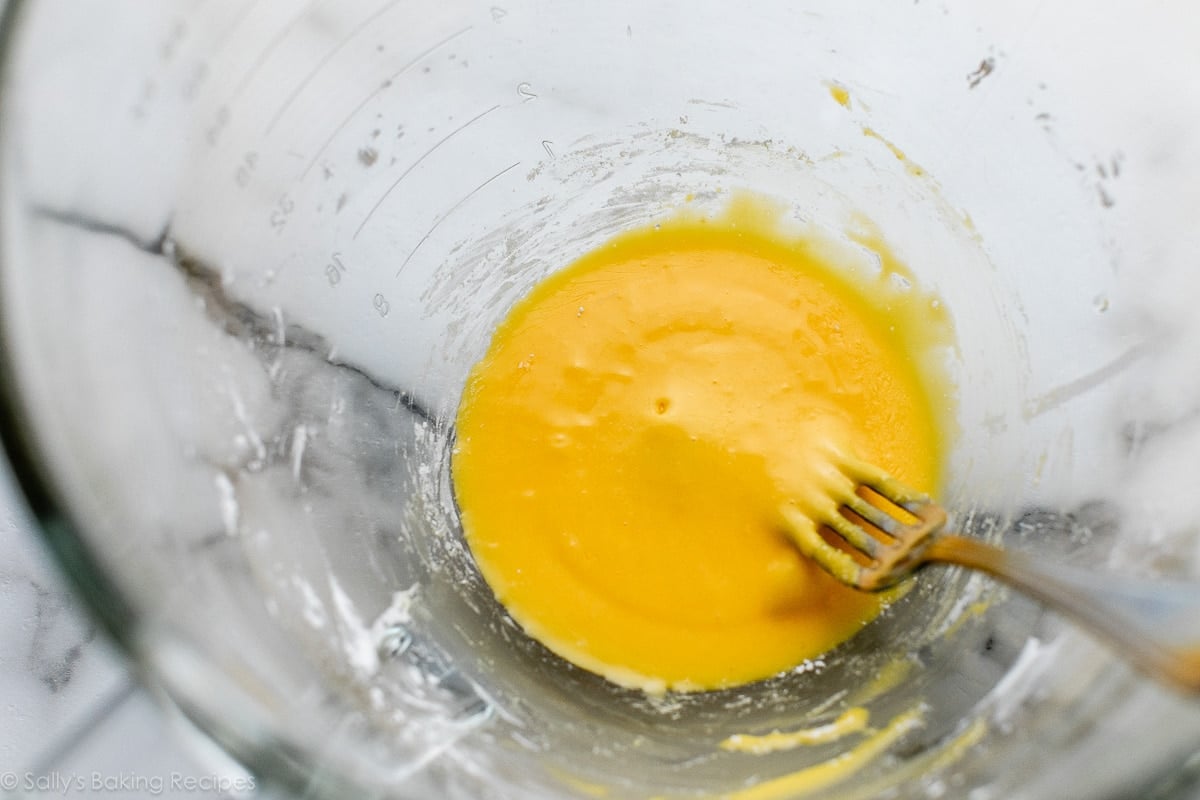
- Make the pastry cream: In a large heatproof bowl (preferably with a pour spout), whisk the egg yolks and cornstarch together with a fork. It may not look like it will all come together (it will be dry at first), but keep mixing until the mixture is thick and combined. If it’s not coming together at all, add a few drops of the milk you need in step 3 to bring together. Set aside at room temperature.

- Combine the milk and sugar in a medium saucepan over medium heat. Whisk until the sugar has dissolved, then bring to a gentle simmer. Remove from heat. Pour the warm milk and sugar mixture in a slow and steady stream into the egg yolk and cornstarch mixture, whisking the entire time. Keep those egg yolks moving so they don’t scramble. Over a sieve, to strain out any egg yolk solids that may have formed during tempering, pour the mixture back into the saucepan.


- Return the saucepan to medium heat, and whisk constantly. The mixture will be frothy on the surface at first, and then it will begin to thicken quickly and large bubbles will begin to burst on the surface. This usually takes about 1–2 minutes. Stand back and use caution. Let the bubbles burst for about 20 seconds, or until the mixture has thickened into a custard- or pudding-like consistency. (For a more accurate test, the custard is done when the temperature reaches 185–190°F (85–88°C).) Remove from heat. Whisk in butter, vanilla extract, vanilla bean seeds, and a pinch of salt. Cool for 10 minutes. (You will use the heavy cream later, in step 9.)
- Transfer the pastry cream from the saucepan to a heatproof bowl and place a piece of plastic wrap or parchment directly on the surface of the custard, to prevent a skin from forming. Refrigerate for at least 3 hours, and up to 24 hours. Makes 2–2.5 cups, or about 580–610g.
- Preheat oven to 400°F (204°C). Line a 12×17-inch baking sheet (half sheet pan) with parchment paper. Have a second baking sheet and more parchment paper out as well. Set aside.
- Shape the dough: On a floured work surface using a floured rolling pin, roll pastry dough into a rectangle about 11×16 inches in size. (If using store-bought puff pastry sheets, place them side by side, with the edge of one sheet overlapping the other in the center, and use a rolling pin to adhere them together as you roll the whole thing out into an 11×16-inch rectangle.)
- Transfer the dough to the lined baking sheet. Dock the surface with a fork to allow steam to escape. Place a second piece of parchment paper on top of the pastry dough. Set a second baking sheet, filled with pie weights (or dried beans, or other options see recipe Note below) on top. Bake for 20 minutes with pan & weights on top. Remove from oven and carefully remove the top weighted baking sheet and the top piece of parchment. Return the uncovered pastry to the oven for 7–9 more minutes, or until golden brown. Remove from the oven and cool for 20 minutes on the pan, and then carefully lift it and place on a cooling rack to cool completely.
- Finish the cream filling: Using a handheld or stand mixer fitted with a whisk attachment, whip the cold heavy cream on medium-high speed until medium peaks form, about 3 minutes. Add the chilled pastry cream to the bowl with the whipped cream. Beat on low speed until just combined and smooth. Do not over-mix. Cover and refrigerate for at least 1 hour and up to 4 hours. You’ll use it in step 12.

- Assemble the pastries: Using a large, very sharp knife, trim around the sides of the cooled pastry to straighten up any uneven edges. Use the knife to cut the pastry into 15 squares roughly uniform in size. NOTE: The pastry will shrink some while baking. After starting with dough rolled out to 11×16 inches, after baking it typically ends up around 9–10×14–15 inches. So if you have a baked pastry that’s 9×15 inches (after trimming the edges), your 15 squares will be 3×3 inches. If your pastry is a slightly different size, don’t panic! Use a measuring tape or ruler to measure the sides to determine exactly how wide to space your cuts. Measure the long side and divide by 5, then measure the short side and divide by 3.
- Make & add the topping: In a small bowl, whisk together the sifted confectioners’ sugar, milk, and vanilla until combined and smooth. Place the chopped chocolate in a small microwave-safe bowl or liquid measuring cup. Melt in 20-second increments in the microwave, stirring after each increment, until completely melted and smooth. Transfer the melted chocolate to a squeeze bottle or a piping bag fitted with a small round tip, or use a small plastic sandwich bag and cut off a bottom corner. Place 5 pastry squares on a wire rack set over parchment paper. With a spoon or icing spatula, spoon and spread the vanilla icing on one square. Before the icing has a chance to set, pipe 4 lines of melted chocolate across each top. Use a toothpick to create a chevron design, dragging it across the stripes in a perpendicular direction. Alternate directions with the toothpick, wiping the toothpick end with a paper towel in between each pass. Repeat with the remaining 4 pastry squares.
- Assemble the mille-feuille: Fit a pastry/piping bag with a large round tip. Or, you can simply use a large plastic bag and snip off a bottom corner with scissors. Starting with one of the (plain/un-iced) pastry squares, pipe 3 dollops of cream filling in 3 rows (9 dollops total). Place another (plain) pastry square on top, pressing down very lightly. Repeat the piping of 9 dollops on the next layer. Place one of the decorated (iced) pastry squares on top of the second layer of cream filling. Repeat with the remaining pastry squares; you will have 5 assembled pastries. Refrigerate uncovered for at least 30 minutes before serving, or up to 8 hours. The soft filling will spill out the sides when you cut or bite into it, and that’s expected.
- Store mille-feuille in an airtight container in the refrigerator for up to 3 days. The pastry will become softer and less crisp over time.
Notes
- Make-Ahead & Freezing Instructions: There are several ways to get started on this recipe. If using homemade dough, you can prepare it 1-2 days in advance. See rough puff pastry dough recipe for details. You can prepare the pastry cream 1 day ahead of time, see step 5. The baked and cooled puff pastry, either as a whole or cut into squares, is fine covered at room temperature for up to 1 day. To freeze, after the assembled pastries have been refrigerated for at least 30 minutes in step 12 (or until the icing sets), you can wrap them each in plastic wrap and freeze for up to 3 months. Thaw in the refrigerator. You will lose some of that crisp, flaky texture in the puff pastry though.
- Special Tools (affiliate links): Whisk | Sieve | Instant-Read Thermometer | Electric Mixer (Handheld or Stand) | Rolling Pin | Parchment Paper | Baking Sheet | Pie Weights | Cooling Rack | Small Offset Icing Spatula | Piping Bag (Reusable or Disposable) | Ateco 808 Piping Tip or other large round tip | Squeeze Bottle or small icing tip such as Wilton Icing Tip #5
- Puff Pastry: If using homemade puff pastry, be generous with the bench flour when rolling out, to prevent sticking.
- Pie Weights: If you don’t have pie weights, you can use dried beans. OR you can just add the second baking sheet on top and not fill it with weights or beans. (Always add a piece of parchment paper on top of the dough, though, so the pan is not touching it.) OR as the baked pastry is cooling, place something heavy like a pot or pan on top of the top baking sheet, to weigh down the baking sheet that is on the puff pastry. (I have done that last suggestion before and it works just fine.)
- Chocolate: The best chocolate for melting and drizzling is the “baking chocolate” bars found in the baking aisle of the grocery store. I typically use Baker’s or Ghirardelli brands, either semi-sweet or bittersweet. They are usually sold as 4-ounce bars, so you’ll need half of one for this recipe. Do not use chocolate chips because they contain stabilizers, which prevent them from melting into the correct consistency.
- Other Filling Options: Instead of pastry cream, you can use the peanut butter mousse filling from these homemade eclairs; whipped cream for an extra light and barely sweetened filling; lightly sweetened whipped frosting; the no-bake cheesecake filling from these cheesecake jars; or the mousse filling from this dark chocolate mousse cake. Or you can still use pastry cream, or any of the suggestions I just listed, and layer your filling of choice with fresh raspberries or thinly sliced strawberries and dollops of jam. Or pipe rows of raspberry cake filling between rows of your choice of cream/mousse filling.
- Other Topping Options: Instead of the vanilla icing and melted chocolate combo, you can simply dust the tops with confectioners’ sugar. You can also skip the chocolate for a plain vanilla icing topping, or skip the vanilla icing and drizzle melted chocolate directly on top. Or some mille-feuille recipes use royal icing. If you want to use my recipe for royal icing, I recommend halving it.
- Adapted from a combination of Bake from Scratch & The Spruce Eats; I made changes to the cream filling, used homemade pastry (and found baking it as a whole sheet and then cutting into squares to be easiest), and opted for vanilla icing and melted chocolate instead of topping with royal icing or confectioners’ sugar.










Reader Comments and Reviews
Delicious!! My pastry was slightly brittle, I think I overworked it in the first step but still tasted great. The pastry cream was oh so yummy. Will definitely make this again.
This is challenging, not my normal kind of baking, but I enjoyed trying something different. Probably wouldn’t make again, for fun to do something new there are a lot of steps, it takes a lot of time, and a lot of patience! But the directions are spot on if you follow them.
This was really fun to make!
This was a fun recipe to make and relatively easy! Definitely recommend this for a special occasion. This is one I would make again.
I enjoyed making these! My only difficulties were the chocolate drizzle hardening in the bottle and I accidentally left the cream at room temperature, so it got thin. The pastry tasted great and if you do everything right, they will look very neat. The design with the drizzle is attractive. Thank you for this recipe, Sally!
Years ago, I lived in Hungary and often went to a cafe that served these Napoleons. It was so fun to enjoy this and walk down memory lane. Delicious!
I was intimidated to try this but the recipe breaks down every step very well. My pastry cream was not firm enough, so next time I’ll definitely chill for longer. Everything else turned out great!
Glad I learned some new skills but this may be one of the things I don’t make again. Don’t get me wrong it’s delicious but with a family of 5 there aren’t any leftovers 🙂 My cream was a tad lumpy and a little thin but delicious!
This was a challenge but I’m so happy I leaved into it and learned something new– rough puff pastry and custard filling.
Recipe is delicious! Directions were easy to follow. I made these over two days. Based on other comments that the pastry cream was too soft, I added a bit more corn starch. It was perfect. I enjoyed making these as a challenge.
This is a great recipe! It’s definitely a challenge and labor intensive but lots of fun! The only problem I had was the icing being a little too runny. Overall they turned out great and I entered the contest!
Loved the cream! Great recipe!
loved this recipe! it turned out great!
Even though Mille-Feuille seemed challenging, it was only one way to find out, just get to it and bake.
Thanks Sally for all the details and tips you give on your recipes.
I loved baking it. This was my first time making puffy dough and custard.
Thanks again
I did enter the challenge and I sure learned a thing or two. Your instructions were spot on and I followed them very closely. One question though is, I did make the pastry from scratch and my pastry was kinda tough. Any ideas?
Hi Sherry! Could it have been over-worked or over-baked? So glad you enjoyed trying this challenge recipe.
The recipe was so detailed and straightforward that I was able to successfully complete this challenge. It was very time consuming but I enjoyed the process
Everything tastes amazing and this is definitely a challenge. The components are so delicate that small mistakes can ruin the presentation. My filling came out a little runny, I suspect I overmixed the custard with the cream. The great news is that even if disaster occurs, you can just mix all your components in a giant bowl and it will still taste delicious!
This was my first time attempting Mille Feuille, but I have wanted to try it for a long time. I have seen it made on numerous baking shows, and I was so glad to have Sally to walk me through it for the first time. It was time consuming, but not really difficult with all the helpful tips provided. I made it over a 2-day period, and it was all consumed in one day by my family! Delicious! This was probably the fanciest dessert I have ever made, and now I have it in my repertoire for the future. Thanks for another great recipe!
I enjoyed making this recipe. The instructions were thorough and really helped me through all the steps. The pastry cream is so delicious I can/will/want to eat it by the spoonful. The puff pastry shrunk a little more than I expected but its super flaky. Would make this again for sure!
This is what I like in a challenge!! I love a challenge where classic techniques and ingredients are involved. Once you master puff pastry and crème pâtissière there are so many other French pastries and deserts you can make. Bravo Sally.
Really good!
They came out beautiful, and my family enjoyed them. I made them at my brother’s and I forgot that his oven is touchy, and the puff pastry was over-baked. My brother said they were better the next day, after the pastry softened up. The pastry cream is tasty, but not sweet enough for my taste. I don’t know if adding more sugar will change the texture, but if I make them again, I may try that. It also made about twice as much pastry cream as I needed to fill the layers, but we ate up the cream anyway.
This recipe didn’t work out for me, but it has potential. I am a cottage baker, so I know my way around laminated doughs. I had high hopes for this, but it came out too compressed. It was also really brittle, and all the pieces broke apart. Also, the filling was twice as much as is needed. I have half of it left. Overall, it’s a nice looking dessert. I am going to use the leftover filling with my normal puff pasty recipe to make another batch.
The pastry creme for this recipe was delicious and this was a pretty simple puff pastry recipe! So glad the challenge pushed me to attempt this!
I decided to make this over the course of 3 days because I wanted to feel so much success and I sure did!
I made the rough puff on Wednesday and then chilled. I did the 6 folds on Thursday followed by another chill until Friday. I made the pastry cream on Thursday as well and finished it on Friday. I baked everything and put it all together Friday for a party with friends. It did not disappoint! I had a blast, I felt so relaxed doing it over the last few days. So fun and so yummy!
I used store bought pastry as not a lot of extra time right now but I have made pastry before, using another Sally’s recipe. This was delicious but a lot of work. The cream was so good it was hard to stay out of it while assembling the squares.
A delicious way to learn puff pastry! I wholeheartedly recommend trying to make Sally’s rough puff; you can’t beat the buttery, flaky, fresh taste! Definitely err on the shorter bake time for the homemade pastry dough though. It browns quickly. The pastry cream is worth making on its own.
The experience was great. I suck at the decorating. I learned a lot though.
I enjoyed making this. I added a bit of extra cornstarch based on other reviews and I felt it was too thick. Tastes great
I finally had success! This recipe is a process but Sally made sure to detail each step with helpful tips along the way. It’s a fun recipe to challenge yourself with and will easily impress those you choose to share it with 😉