
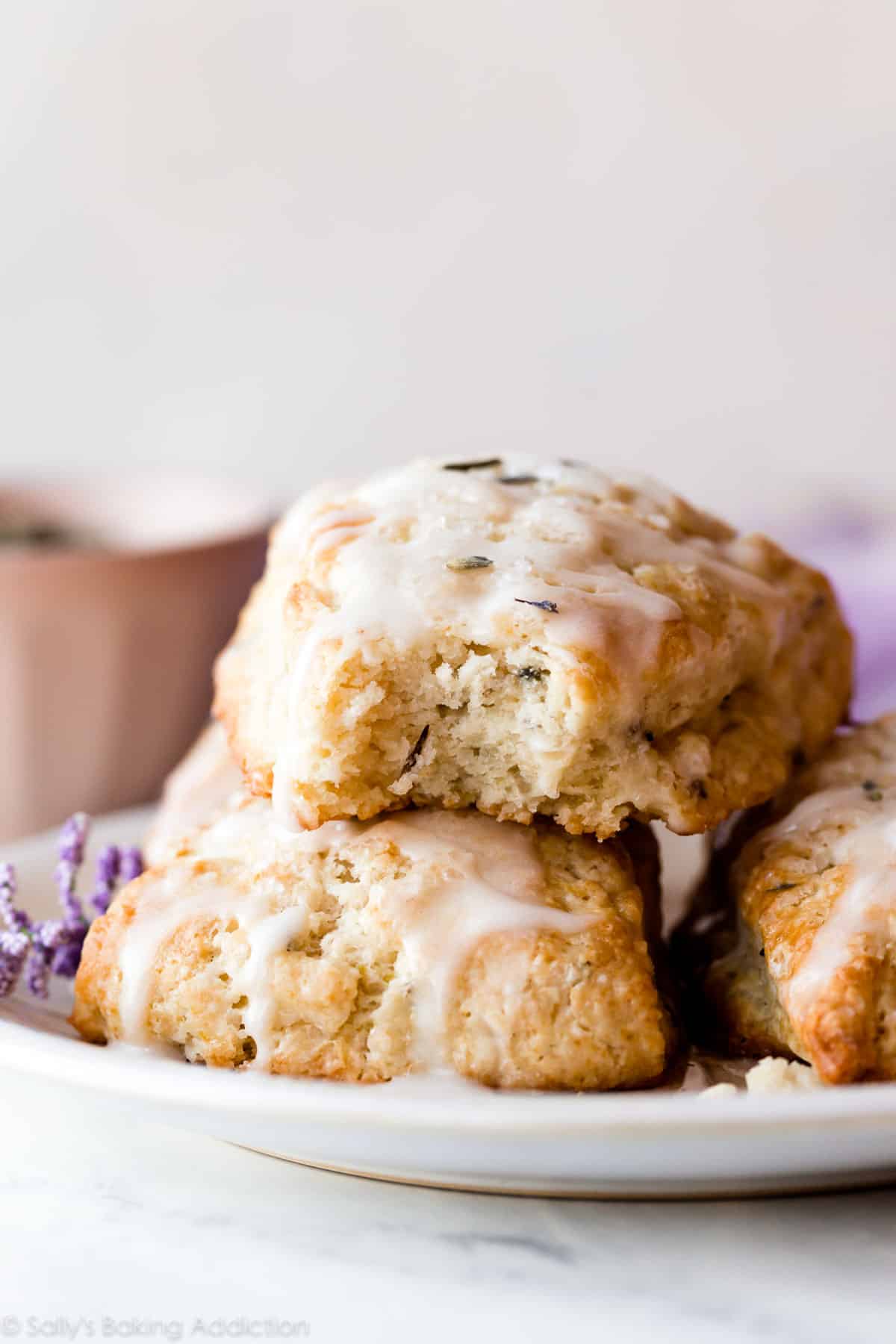
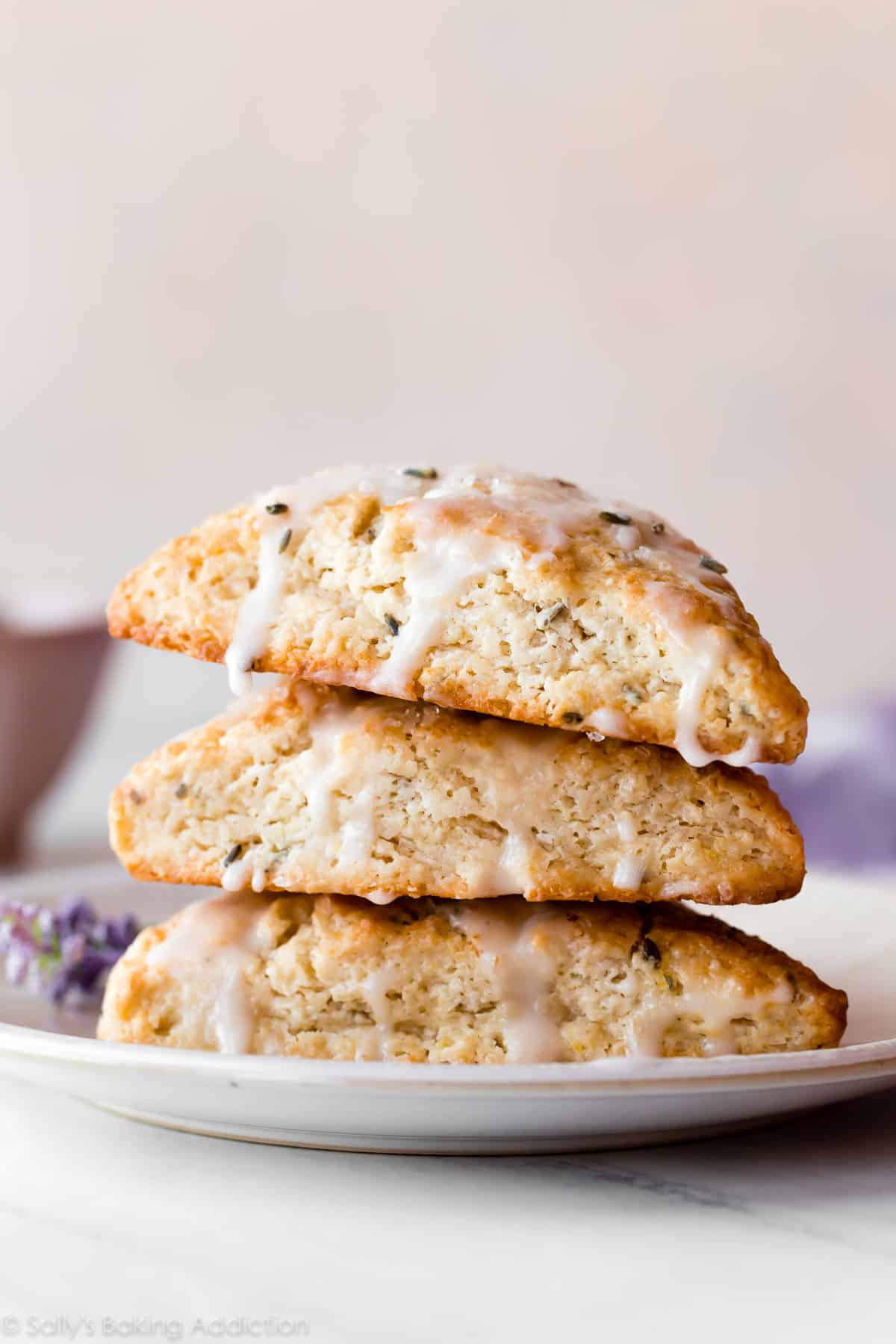
Using my favorite scones recipe, you can make bakery-style lavender scones right at home. Dried culinary lavender adds a lovely aromatic flavor without tasting overpowering. I love adding buttermilk and fresh lemon zest for extra flavor, too. The scones are crumbly, yet moist and perfect for spring brunches, tea parties, bridal showers, & Mother’s Day.
One reader, Cathy, commented: “I followed the recipe and these were a big hit. The flavors of the lavender and lemon came through and the scone was light and delicious! ★★★★★“
One reader, Nikia, commented: “I am about to make these for the 3rd time and am completely addicted! I LOVE all things lavender and I have just added these! The flavor is perfect! Not overwhelming and the glaze adds the perfect amount of sweetness! ★★★★★“

Let’s make Buttermilk Lavender Scones! But first, a briefing.
I never enjoyed floral flavors in baked goods—I mean, everything ends up tasting like hand soap or a candle. Am I alone here?!
Those were my thoughts until last year when, by the inspiration of Tessa who wrote Icing on the Cake, I tried Blackberry Lavender Cake. That day I ate my words and a fat piece of the most incredible cake to ever grace my tastebuds. Lavender, when used correctly, is DEEEEEELICIOUS.
Today I’m sharing a scone variation. Using my perfected scones recipe, I added fresh lemon zest and cooking lavender, swapped heavy cream for tangy buttermilk, and topped the scones with lemon lavender icing. These better-than-the-bakery scones are flaky and moist in the centers with crisp crumbly edges. The fresh spring flavors are completely divine and, thankfully, there’s not a trace of hand soapy flavor detected. 😉

These Buttermilk Lavender Scones Are:
- Filled with bright lemon zest
- Lightly flavored with lavender
- Moist & soft inside
- Crumbly on the edges
- Buttery & flaky
- Not dry like most scones you’re used to
Use My Popular Scone Recipe
I have several scone recipes that begin with the same basic recipe. Have you ever tried my blueberry scones, apple cinnamon scones, or chocolate chip scones? Those are just a few reader favorites. You only need 10 ingredients for today’s lavender scones.
- Flour: 2 cups of all-purpose flour is my standard amount, but set extra aside for the work surface and your hands as you shape the scones.
- Sugar: Use 1/2 cup of sugar for this scone dough.
- Baking Powder: Adds lift.
- Salt: Adds flavor.
- Lemon Zest: Adds more flavor.
- Dried Culinary Lavender: Make sure you’re using the correct dried culinary lavender. (More on this crucial ingredient below.) You won’t bite into coarse pieces of dried lavender, though—they’re broken down when you cut the butter into the dough.
- Butter: Besides flour, butter is the main ingredient in scones. It’s responsible for flakiness, flavor, crisp edges, and rise.
- Buttermilk: For the best tasting scones, stick with a thick liquid such as heavy cream or buttermilk. I usually use heavy cream, but I craved a slightly tangy flavor with the lavender, so I reached for buttermilk. If you’re interested, I have more information on the science of baking with buttermilk here (including a DIY buttermilk substitute recipe).
- Egg: Adds flavor, lift, and structure.
- Vanilla Extract: Vanilla extract adds flavor.
Scones Video Tutorial
Here’s a 5 minute video demonstrating the process. I’m making blueberry scones in this video, but the process is the same. For these lavender scones, you’ll add lemon zest and lavender to the dry ingredients and swap heavy cream for buttermilk.
Frozen Grated Butter – The Secret in These Lavender Scones
Did you know that keeping scone dough as cold as possible prevents over-spreading? (Same thing with cookie dough!) When scones over-spread in the oven, they lose the flaky, moist, and deliciously crumbly texture. The easiest way to avoid disaster is to use cold ingredients like cold buttermilk, egg, and butter. Don’t waste your time and money by overlooking this!
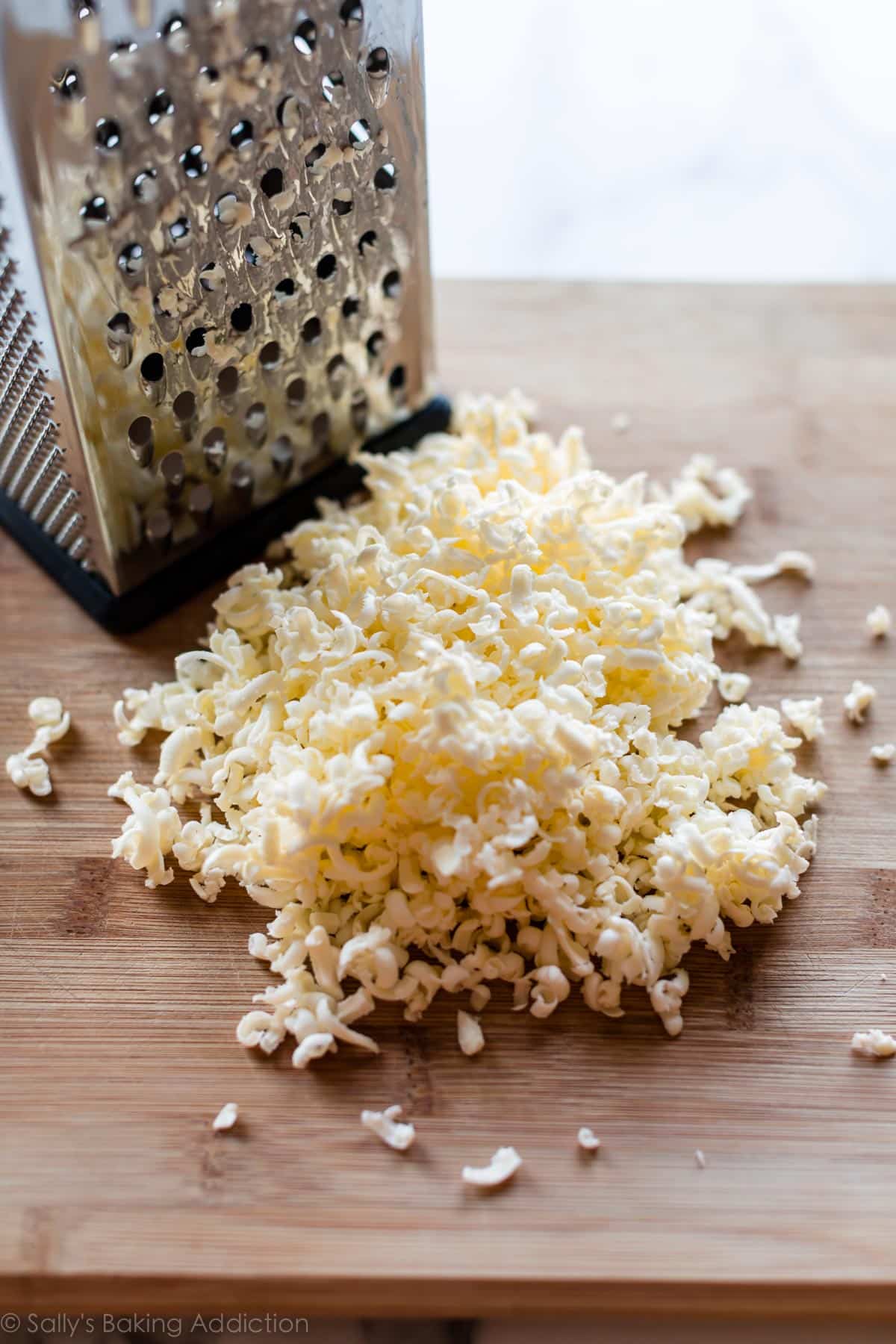
However, frozen + grated butter is the secret to real scone success. Like we do when making pie crust, work the cold butter into the dry ingredients to create crumbs. The butter/flour crumbs melt as the lavender scones bake, releasing steam and creating air pockets. These pockets create a flaky center while keeping the edges crumbly and crisp. Refrigerated butter might melt in the dough as you work with it, but frozen butter will hold out until the oven. And the finer the pieces of cold butter, the less the scones spread and the quicker the butter mixes into the dry ingredients.
Best Lavender to Use for Lavender Scones
There’s a fine line between eating a deliciously flavored lavender treat and eating potpourri. And up until recently, I was totally new to cooking with lavender. You might be too, so let me help you determine the best lavender to use here. This multi-use dried culinary lavender is perfectly edible and a wonderful addition to food, drinks, essential oils, and more. It’s exactly what I use when I make lavender scones.
Baker’s Tip: When transferring the sticky shaped scones from your work surface to the lined baking sheet, use a thin spatula. This is where the scones can fall apart, but a thin spatula helps seamlessly transfer the dough around.
Lavender Scones Icing
Since the lavender flavor is so light in the scones themselves, using lavender again in the icing makes sense. The best way to make lavender icing is to infuse the liquid ingredient (milk) with plenty of lavender flavor. Bring milk to a simmer, then let it steep with 1 teaspoon of dried cooking lavender. Strain the lavender through a fine mesh strainer, then whisk the infused milk with a little lemon juice and confectioners’ sugar. The icing is way easier than it sounds!
If you don’t have a fine mesh strainer (affiliate link to my favorite set), pick one up. You’ll use it a lot in your baking, especially when a recipe calls for a sifted ingredient.

I know you’ll love these!
Print
Lavender Buttermilk Scones
- Prep Time: 45 minutes
- Cook Time: 25 minutes
- Total Time: 1 hours, 15 minutes
- Yield: 8 large or 16 small scones
- Category: Breakfast
- Method: Baking
- Cuisine: American
Description
Using my favorite scones recipe, you can make bakery-style lavender scones right at home. They’re buttery and moist with crisp crumbly edges and soft flaky centers. Read through the recipe before beginning. You can skip the chilling for 15 minutes prior to baking, but I highly recommend it to prevent the scones from over-spreading.
Ingredients
- 2 cups (250g) all-purpose flour (spooned & leveled), plus more for hands and work surface
- 1/2 cup (100g) granulated sugar
- 2 and 1/2 teaspoons baking powder
- 2 teaspoons dried culinary lavender
- 2 teaspoons lemon zest
- 1/2 teaspoon salt
- 1/2 cup (8 Tbsp; 113g) unsalted butter, frozen
- 1/2 cup (120ml) buttermilk, plus 2 Tablespoons (30ml) for brushing
- 1 large egg
- 1 and 1/2 teaspoons pure vanilla extract
- optional: coarse sugar for topping
Lemon Lavender Icing
- 3 Tablespoons (45ml) heavy cream or milk
- 1 teaspoon dried culinary lavender
- 1 Tablespoon (15ml) fresh lemon juice
- 1 and 1/4 cups (150g) confectioners’ sugar
Instructions
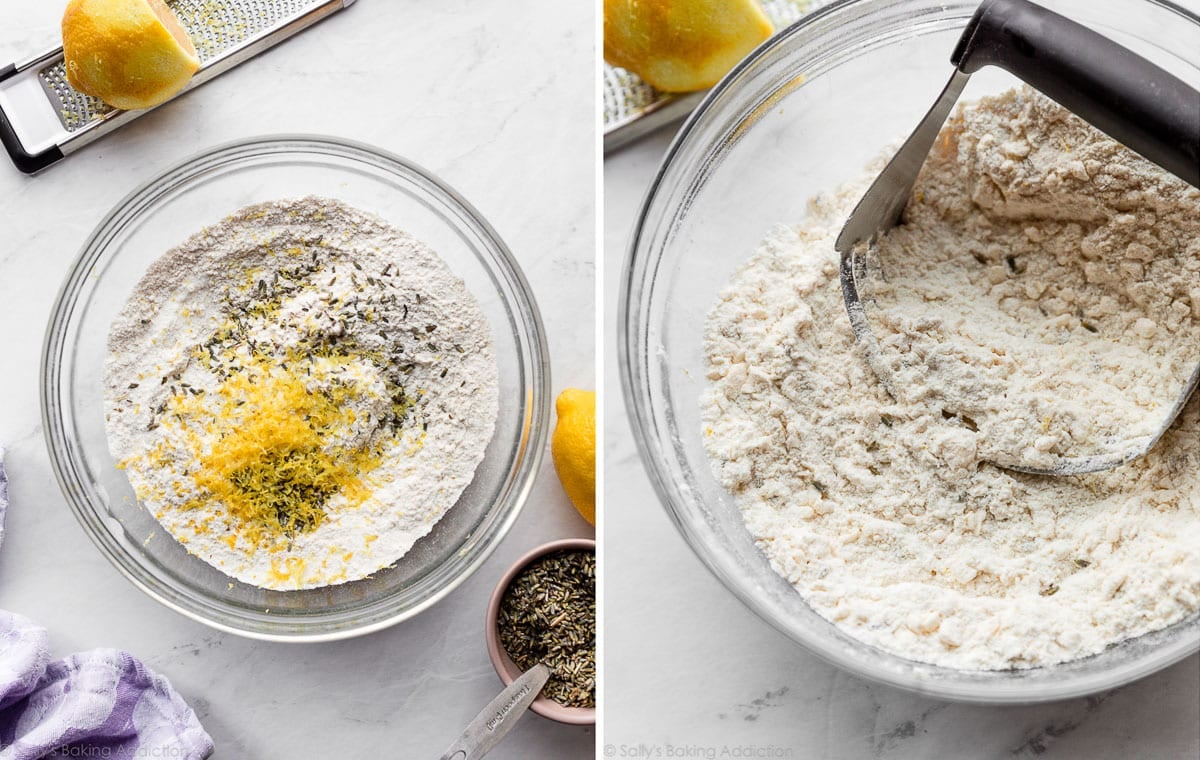
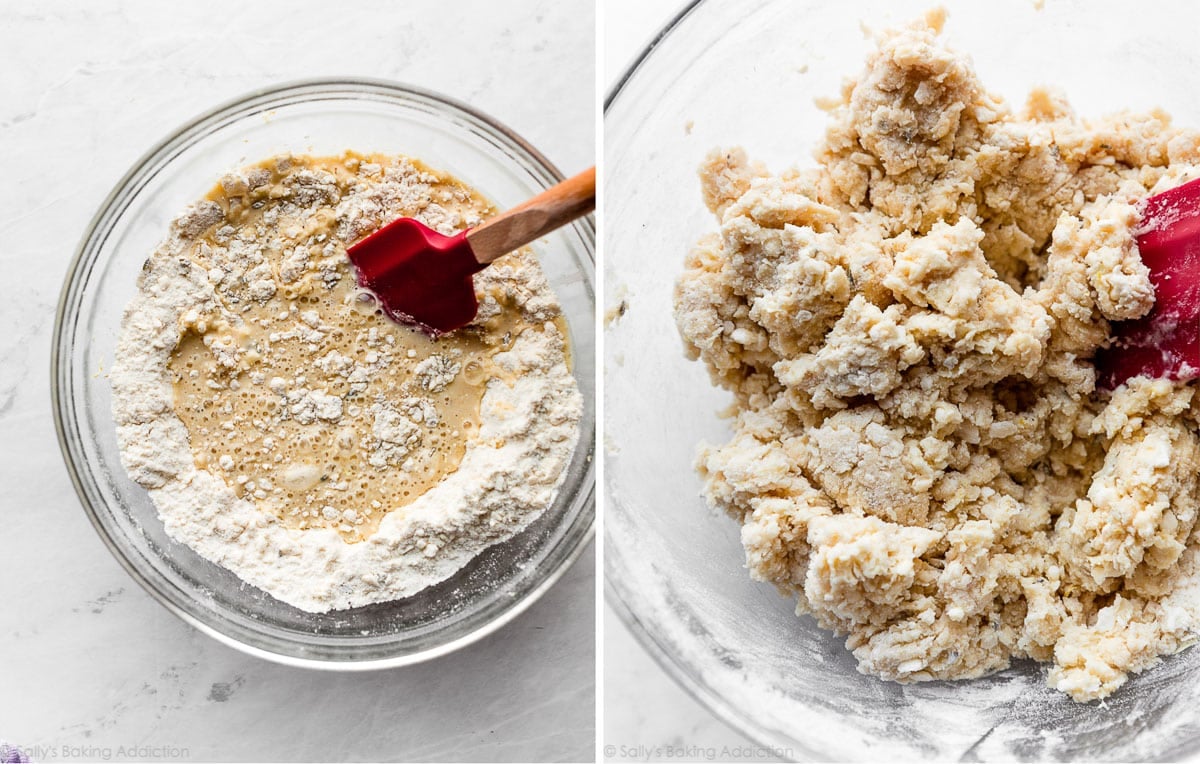
- Whisk flour, sugar, baking powder, lavender, lemon zest, and salt together in a large bowl. Grate the frozen butter using a box grater. Add it to the flour mixture and combine with a pastry cutter, two forks, or your fingers until the mixture comes together in pea-sized crumbs. See video and photo above for a closer look at the texture. Place in the refrigerator or freezer as you mix the wet ingredients together.
- Whisk 1/2 cup buttermilk, the egg, and vanilla extract together in a small bowl. Drizzle over the flour mixture, then mix together until everything appears moistened.
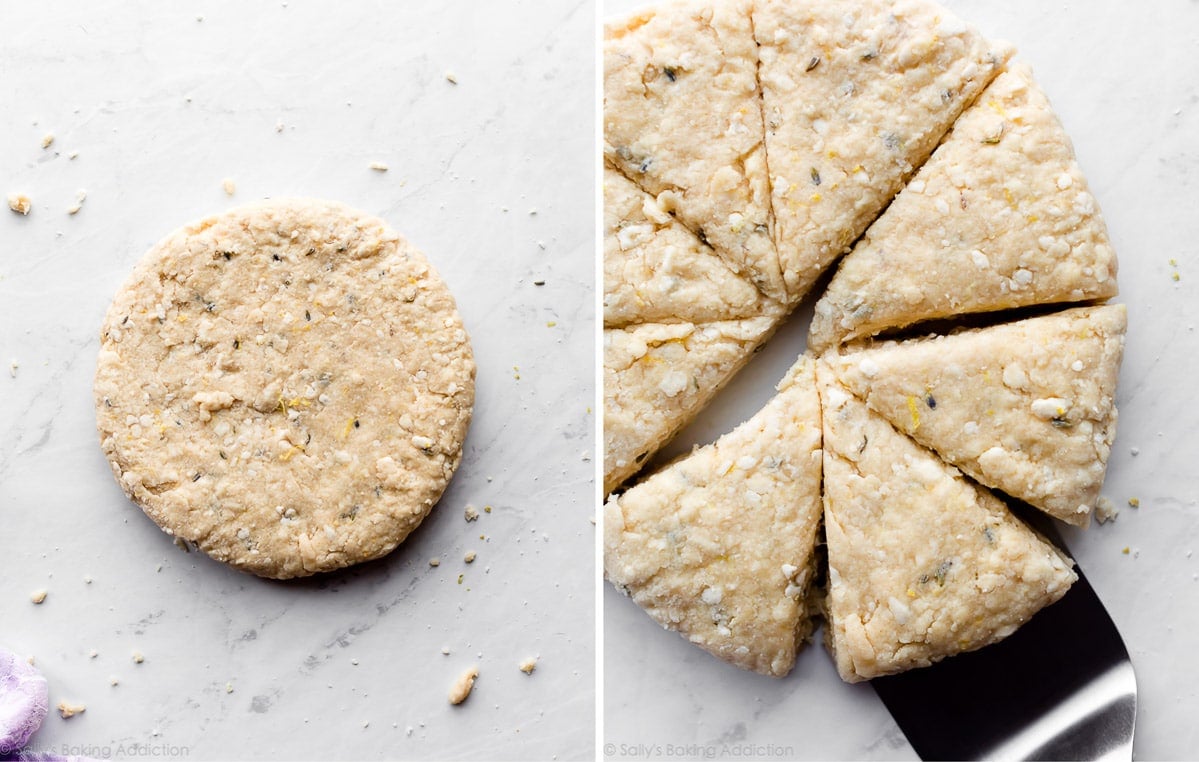
- To make triangle scones: Pour onto the counter and, with floured hands, work dough into a ball as best you can. Dough will be sticky. If it’s too sticky, add a little more flour. If it seems too dry, add 1 more Tablespoon buttermilk. Press into an 8-inch disc and, with a sharp knife or bench scraper, cut into 8 wedges. For smaller scones, press dough into two 5-inch discs and cut each into 8 wedges. To make 10-12 drop scones: Keep mixing dough in the bowl until it comes together. Drop scones, about 1/4 cup of dough each, 3 inches apart on a lined baking sheet.
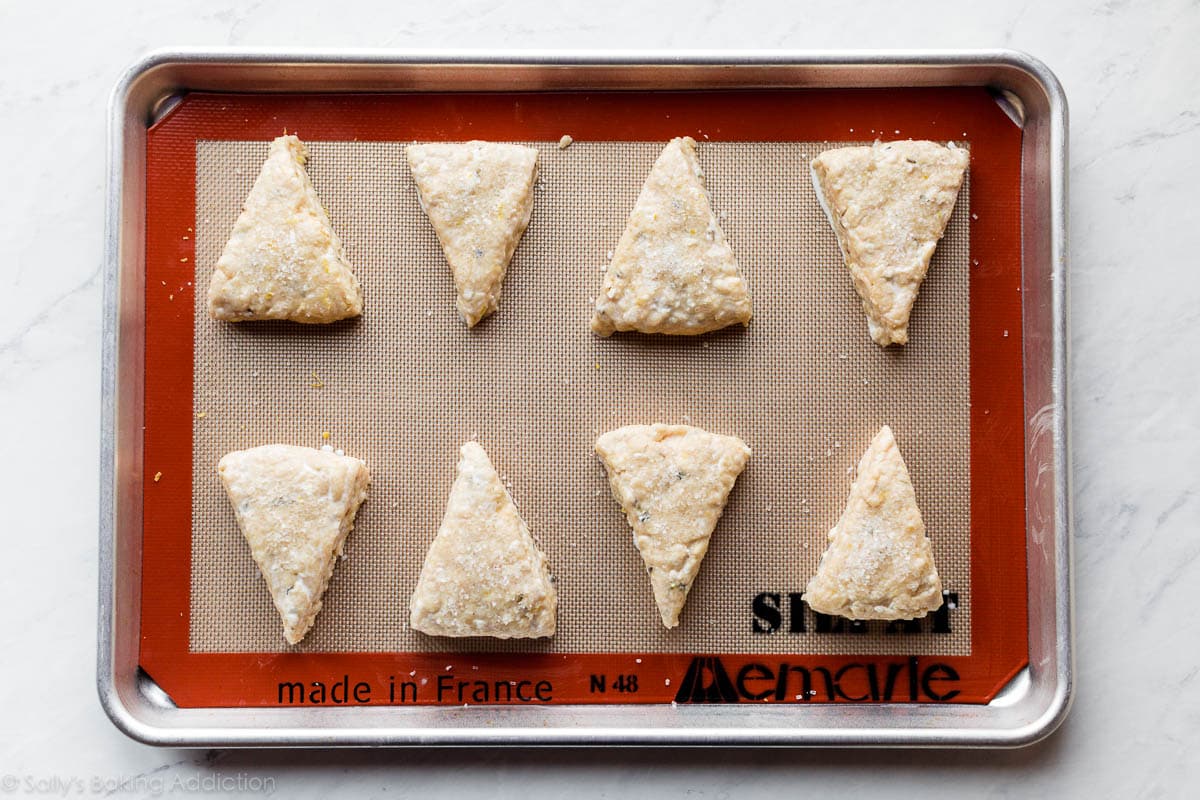
- Brush scones with remaining buttermilk and for extra crunch, sprinkle with coarse sugar. (You can do this before or after refrigerating in the next step.)
- Place scones on a plate or lined baking sheet (if your fridge has space!) and refrigerate for at least 15 minutes.
- Meanwhile, preheat oven to 400°F (204°C).
- Line a large baking sheet with parchment paper or silicone baking mat(s). If making mini or drop scones, use 2 baking sheets. After refrigerating, arrange scones 2-3 inches apart on the prepared baking sheet(s).
- Bake for 18-26 minutes or until golden brown around the edges and lightly browned on top. Larger scones take closer to 25 minutes. (Tip: I like to start the icing while the scones cook so the milk has a chance to steep.) Remove from the oven and cool for a few minutes before icing.
- Make the icing: In a small saucepan over low heat, bring the milk to a simmer. Remove from heat and immediately add the lavender. Set aside to steep for 15 minutes. Strain the milk through a fine-mesh sieve set over a bowl, then discard the lavender. Cool for 5 minutes. Whisk in the lemon juice and confectioners’ sugar. Feel free to add more confectioners’ sugar to thicken, if desired. Drizzle over warm scones. Icing can be made 1-2 days ahead and stored in the refrigerator.
- Leftover scones keep well at room temperature for 2 days or in the refrigerator for 5 days.
Notes
- Freeze Before Baking: Freeze scone dough wedges on a plate or baking sheet for 1 hour. Once relatively frozen, you can layer them in a freezer-friendly bag or container. Bake from frozen, adding a few minutes to the bake time. Or thaw overnight, then bake as directed.
- Freeze After Baking: Freeze the baked and cooled scones before topping with icing. I usually freeze in a freezer-friendly bag or container. To thaw, leave out on the counter for a few hours or overnight in the refrigerator. Warm in the microwave for 30 seconds or on a baking sheet in a 300°F (149°C) oven for 10 minutes.
- Overnight Instructions: Prepare scones through step 4. Cover and refrigerate shaped scones overnight. Continue with the recipe the following day.
- Special Tools (affiliate links): Glass Mixing Bowls | Box Grater | Pastry Cutter | Bench Scraper | Baking Sheet | Silicone Baking Mat or Parchment Paper | Pastry Brush | Citrus Zester | Citrus Juicer | Fine Mesh Sieve
- Over-spreading: Start with very cold scone dough. Expect some spread, but if the scones are over-spreading as they bake, remove from the oven and press back into its triangle shape (or whatever shape) using a rubber spatula.
- Lemon: 1 medium lemon is plenty for the zest and juice you need for this recipe (zest for the dough and juice for the icing).
- Buttermilk: You can substitute heavy cream for buttermilk if desired. Acidic buttermilk isn’t needed in order for the scones to rise since we’re using baking powder. However if you’d like the tangy flavor you can make your own buttermilk substitute. Add 1 teaspoon of fresh lemon juice or white vinegar to a liquid measuring cup. Add enough milk to make 1/2 cup. Whisk together, then let sit for 5 minutes before using in the recipe. For the extra 2 Tablespoons needed for brushing on top of the scones, you can use regular milk or heavy cream. Whole milk is best for the DIY sour milk substitute, though lower fat or nondairy milks work in a pinch. (The scones will spread more if using lower fat or nondairy milks.)








Reader Comments and Reviews
Hi! Wondering if I could add honey to have them be lavender honey scones? Not sure if it would make them too sweet or change the consistency and/or bake time. Would love to find out!:)
Hi Michelle! Adding honey would take some testing because it would be adding liquid to the dough. Maybe a honey glaze would be a good way to add honey flavor? Let us know what you try!
So good! Just the right amount of lavender, especially in the icing. I made this as written and added some fresh blackberries at the end. They were delicious!
Hi there. Love your emails, tips, and recipes. I have a general question, not specific to this recipe, although I notice one baker’s dough was more moist than expected and I wondered if that is connected to my question. So here it is: Have you noticed any differing results based on different flours? I have read that there is soft wheat flour and hard wheat flour. Soft wheat flour is supposedly prized for baking. It is grown in the south and so not found in many stores. White Lily flour is one brand of soft wheat flour. I’ve used it for cookies with excellent results but with some scones I made recently the recipe did not work as well as in the past. Never fear this was NOT one of your recipes. Your thoughts please on the performance of soft wheat flour vs hard wheat flour.
Hi Chris, Soft wheat flour is generally the same as cake flour. Both have a finer texture and a lower protein count than all purpose and they are not always a 1:1 substitute. You can read more about it in our post all about cake flour.
I absolutely love these…and everyone that I give them to rave about them. The only question I have is how can I get them to maintain their shape better. I made the smaller version and they kind of melted on me….they slightly maintained their shape but not perfectly. The texture was fantastic so I know it wasn’t a mis-measure. Does cooling them prior to baking help greatly in maintaining shape?
Yes, chilling the scones before baking is key to maintaining their shape while baking. Did you chill them as instructed? A longer chill time will help!
This is heavenly. When I ate my lavender scones, I felt I was at one of those very chic coffee shops eating a delicacy. Thanks!!!!!!
Can these be made into petite scones? If so how would you recommend cutting into that size and how long would you bake them for?
Hi J. Rose, To make smaller scones, press dough into two 5-inch discs and cut each into 8 equal wedges. Bake for 18-20 minutes or until lightly browned.
Can I put the icing on and then freeze them?
Hi Donna, we recommend freezing the baked and cooled scones before topping with icing.
250 grams of flour is not sufficient, dough is way too wet. I will increase to 300 next time and see how it goes. I ended up working the dough way too much, texture was less crispy than I would have liked. They do smell amazing.
I made the recipe using heavy cream and a very light sprinkling of raw sugar. We do not care for scones with icing because of too much sweetness. They were perfect for our taste!
I’ve made this recipe at least five times, it’s one I always go back to! Everyone enjoys, warming up in the microwave is a must!!
Made these last night and I’m TICKLED with the result!! Perfect scone consistency and clear, bright flavors! The only thing I added in addition was a little less than a pint of blackberries. I also needed to add a little extra splash or two of buttermilk to get a good cohesive consistency. I put it in the fridge for about 30 min and then in the freezer for the final 15 min or so while the oven was preheating. Put them straight on a greased baking sheet for about 20-21 min and ta-da! The lemon lavender glaze was the chefs kiss. Thank you so much for this recipe! I now have 2 go to scone flavors, this one and a dirty chai scone adapted from your master scone recipe.
Taste was great, but took waaaay too long to make! Grating the frozen butter took almost 30 min. Could accomplish the same thing with cutting cold butter in as normal to pea size and then freeze mixture for 15 minutes. Also 2 cups flour is not enough- 2.5 + will yield scones that do not spread nor are dry.
The best! Tender and sweet with a subtle hint of lavender. Turned out so tender! I did reduce the temp to 390 and reduced the baking time to about 13 min. I find that scones burn easy on the bottom even with parchment.
Tasty but disappointing ! I followed the recipe exactly and my scones burned and the texture was more like cake. A little more doughy then I would have liked. Next time I will probably reduce the oven temp
And bake for longer.
Hi! I want to try this recipe, but, is there a way to add earl grey tea to the scone? Would I add it to the icing? Thank you for your help!
Hi Kendra, we haven’t tested anything, but adding some to the icing would be a great place to start! Let us know if you give it a try.
I will give it a try and let you know how they turned out!
Oh my goodness!! So good. I doubled the heavy cream because I was scared it would overpowering adding both the lavender and the tea. Such great flavors, you can actually taste the different layers of flavors in the icing. I added the 1 tsp of lavender and 1 tsp of earl grey tea.
So glad it worked out for you, Kendra—thanks for reporting back!
I let earl grey tea bags sit in the buttermilk while it’s coming to room temperature. When taking the bags out, squeeze them and the tea flavor will visibly go into the buttermilk 🙂
This is my first attempt at lavender scones and I was a little anxious that it might be too “lavendery.” I harvested my culinary lavender, dried it and it worked perfectly! For my own taste, I’ll probably use half the amount of sugar next time and will use more powdered sugar in the icing. I was able to “dip” the tops of the scones in the icing and it tastes amazing!
These are the best scones, literally of my entire life. Everyone who tried them was shocked at just how good they were. Thank you for sharing!!
Has anyone made using gluten free cup 4 cup flour or any other gluten free flour? If so, how were the results?
Hi Deborah, we haven’t tested this recipe with gluten free flour, so we’re unsure of results. Although some readers report using an all-purpose 1:1 gluten-free flour in many of my recipes with success, you should expect slightly different results anytime you substitute ingredients.
I have made these twice using king Arthur’s Measure 4 Measure. We loved them! The flaky texture was perfect!
I made these for me and my friends before the Taylor Swift concert this weekend. I was nervous because I’d never used lavender before in cooking, but these were delicious. I’ll definitely make more for non-concert weekends, too. 😉
Can you substitute heavy cream for buttermilk in the mix and the icing?
Thank you
Hi Julie, No real difference except you lose a very slightly tangy flavor. We use the two interchangeably in scone recipes.
I have loved everything I’ve ever made on this website. It’s awesome that Sally brings the biochemistry into baking. I mention the website to my biology students, it makes the concepts more relatable. My co-workers love everything I’ve brought into work to share too! Thank you, from a high school science teacher.
The lavender scones are delicious and your instructions clear. I would make one recommendation in the preparations. I tried grating the frozen butter but found it hard to do and messy so I returned to the method I use when making pies. Cut the butter into 1/2 cubes, then freeze. When ready to make the scones, put the frozen butter cubes and flour in the food processor and pulse a few times. It takes no time for the butter to be evenly distributed in the flour. I keep the flour cold until ready to use. Clean up is a breeze, just wash the processor. I use the processor also when adding the water. It takes just a few pulses and the pie pastry is ready to be rolled out.
This is one of my favorite recipes.
I followed the recipe and these were a big hit. The flavors of the lavender and lemon came through and the scone was light and delicious! Thank you. Will definitely make again.
The flavor of these is incredible!! I added some white chocolate chips and skipped the icing. I will say that the recipe calls for a little too much liquid so I would add it in a little at a time until the dough just starts to come together. More of a cake-like American scone instead of a traditional scone. But again, flavor is great 🙂
These are amazing – I’ve been buying pre-made lavender scones whenever I see them but the lavender never really comes through but these have just the right level of lavender perfectly offset by that tangy lemon!
I wholeheartedly agree with Eva! After about 10 minutes I started to smell the smell of smoke. I opened the oven door to see that my triangular, scone shapes were melted into one big cake and oozing off of the cookie sheet. Everything was done to the “T” and I’ve been baking for 4 decades.
These are not scones, this is a cake recipe. The worst scone recipe I’ve ever made. What a waste of time, money and energy.
My afternoon coffee was celebrated with these lovely lavender infused scones. My daughter who comes and visits me during my retirement said she totally love the taste, I served them with an apricot marmalade and a dollop of whipped cream if she wanted.
Tag on instagram
I painstakingly followed this recipe, as these were for a special event.
I made the larger, triangular scones (8 total), which the recipe recommends to bake for 25 minutes at 400 degrees. Within 12-13 minutes of baking, however, the smell of burning drew me to the kitchen. The bottoms were scorched almost black, and the middle still undercooked. I’m not sure what’s going on here–maybe that I have a gas oven?–but I’d even set them at 385 because 400 seemed high.
Be warned! LOWER BOTH THE OVEN TEMP AND COOK TIME!!!
Wondering if anyone has tried these using dairy free butter such as Miyoko’s? I’d love to make these for my daughter, but she can’t eat dairy.
These are incredible! My whole family loves them!!! Anyone know the calorie/nutrition facts for these?