
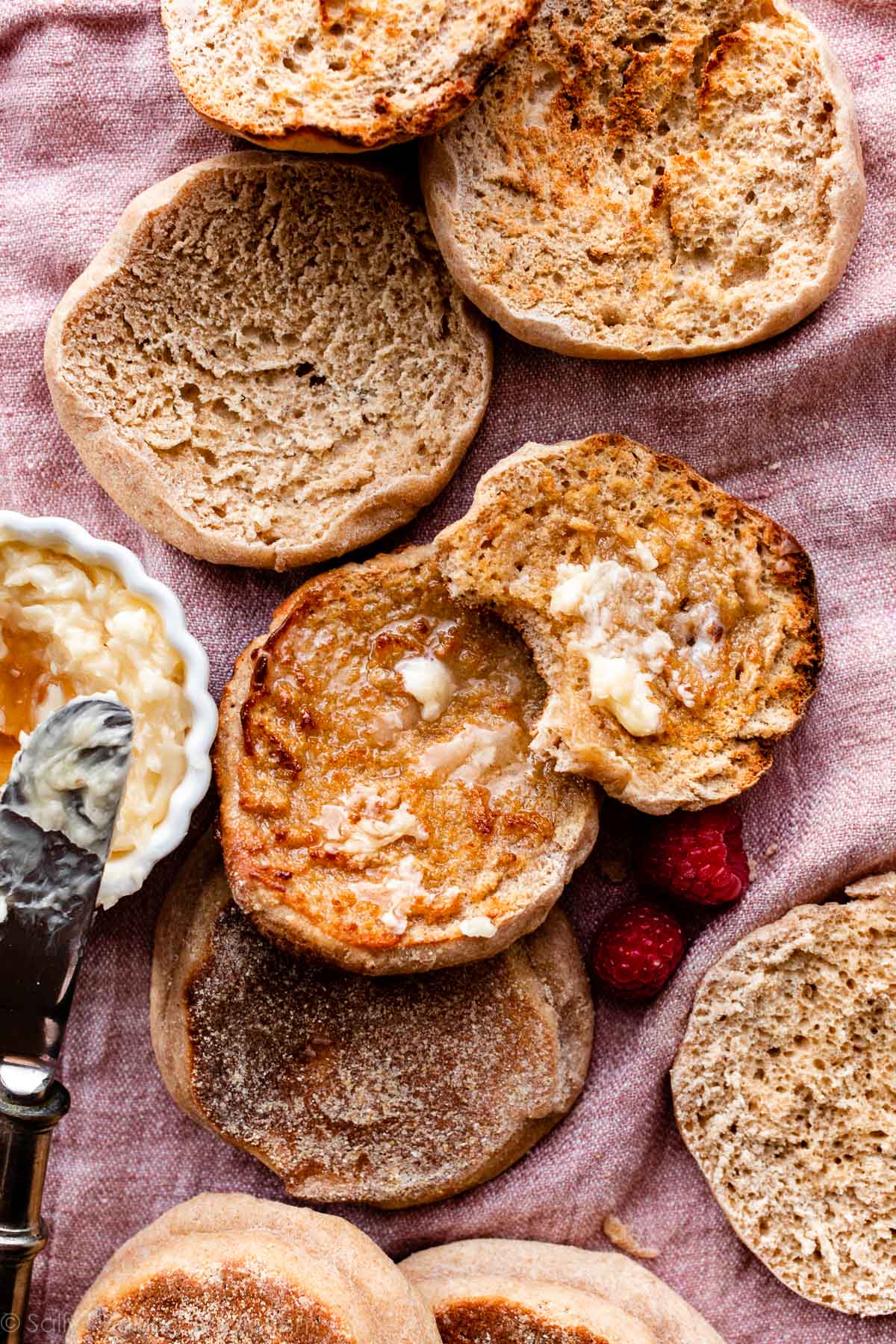
These honey wheat English muffins are completely homemade from a simple 8 ingredient dough. The sticky dough does not require kneading and you can skip the rolling pin entirely. Some homemade English muffin recipes call for a round biscuit/cookie cutter, but you don’t need it for these—your hands sprinkled with cornmeal or semolina flour are your best tool.
Though the dough rises and is ready in about 2 hours, I strongly recommend refrigerating it for at least 6 hours so your English muffins have better flavor.
This post is lengthy because I want you prepped for the best success possible. If you’ve never made homemade English muffins before, I encourage you to review the entire post as well as the video and step-by-step photos below the recipe. Are you a yeast beginner? This Baking with Yeast Guide is helpful.
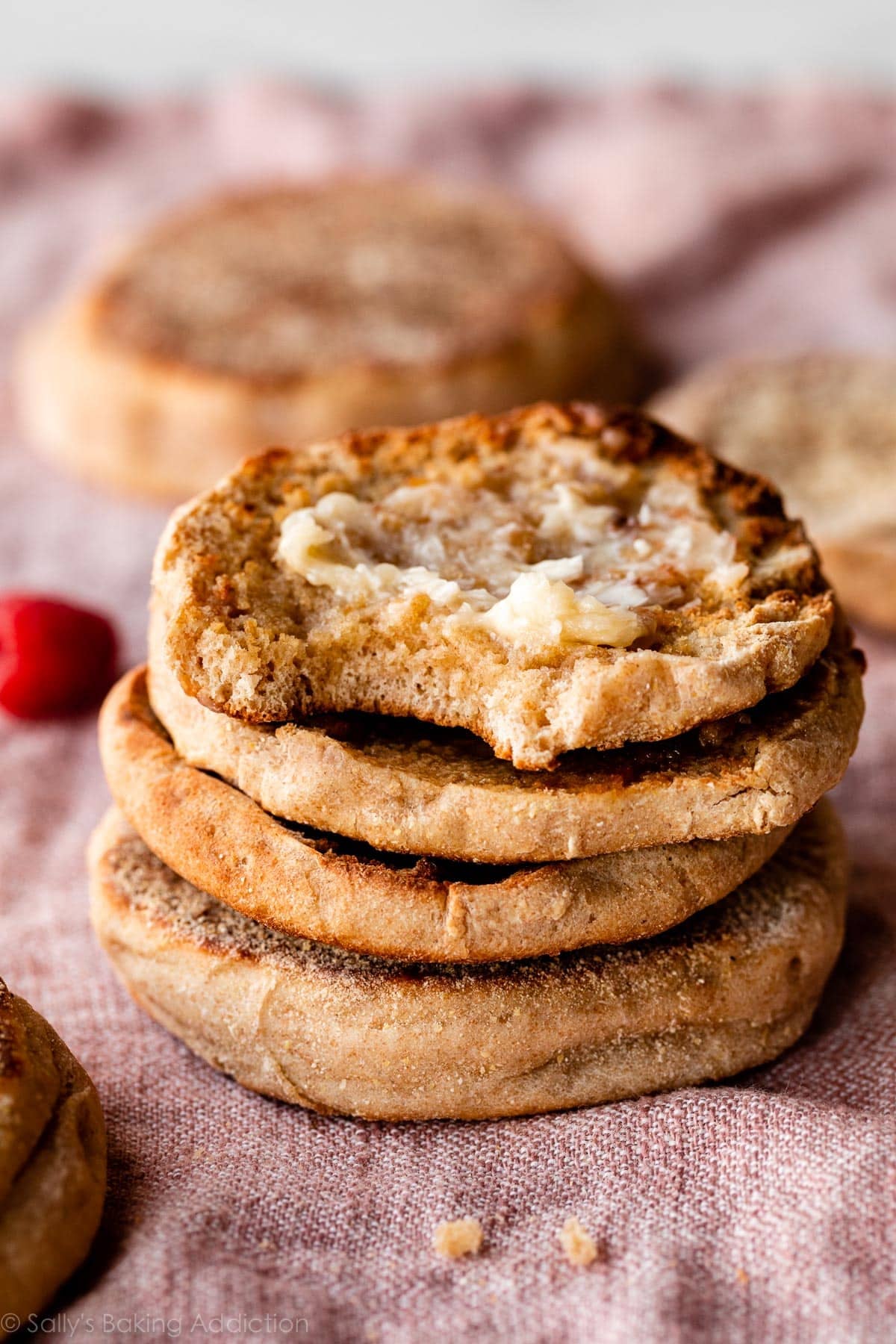
English muffins are a breakfast staple in the US, inspired by the traditional English crumpet. You can enjoy them plain, but they taste divine toasted with butter, honey butter, jam, or even raspberry sauce. English muffins are essential for eggs Benedict and as the bread for breakfast sandwiches with breakfast sausage. If you’ve never heard of English muffins before, imagine a homemade yeasted bread patty with plenty of airy pockets inside—much denser and flatter than dinner rolls. The craggy, airy goodness inside is branded as “nooks and crannies” by the company Thomas’.
Today’s recipe is a variation of English muffins, which are traditionally made with all white flour and very little sugar. I like to use a combination of all purpose and whole wheat flours here and sweeten them with honey. They’re NOT sweet like regular quick bread-style muffins—just a little touch of honey goodness to pair with the whole wheat flavor.
By the way, if you enjoy baking with whole wheat flour, try this hearty, yet soft whole wheat pizza dough. It’s a whole grain favorite!
One reader, Laurie, commented: “So very delicious and surprisingly easy. I’ve been contemplating this recipe for months thinking it was going to be a gloopy, sticky mess to deal with. That couldn’t be further from the truth! Wish I didn’t wait so long to try them, but I can say with confidence that I will not be buying store-bought again! ★★★★★“
Another reader, Andy, commented: “We’ve tried a few different recipes so far, and not only is this the BEST tasting, it’s also the easiest. Definitely a keeper. ★★★★★“
Another reader, Andi, commented: “I’ve made English muffins before and they were good. These are amazing! Next level! There are a lot of steps but overall not difficult to make. Thanks for another great recipe. ★★★★★“
Are English Muffins… Bread?
Yes, a yeast bread. I learned they’re called English muffins so they aren’t confused with sweeter cupcake-like muffins such as blueberry muffins.
Let me brief you on today’s recipe.
These Homemade English Muffins Are:
- Made with a simple 8 ingredient no-knead dough
- Fresher-tasting than store-bought
- Perfect if you’re looking for a fun baking project
- Started on the stove and finished in the oven
- Heartier than white flour English muffins
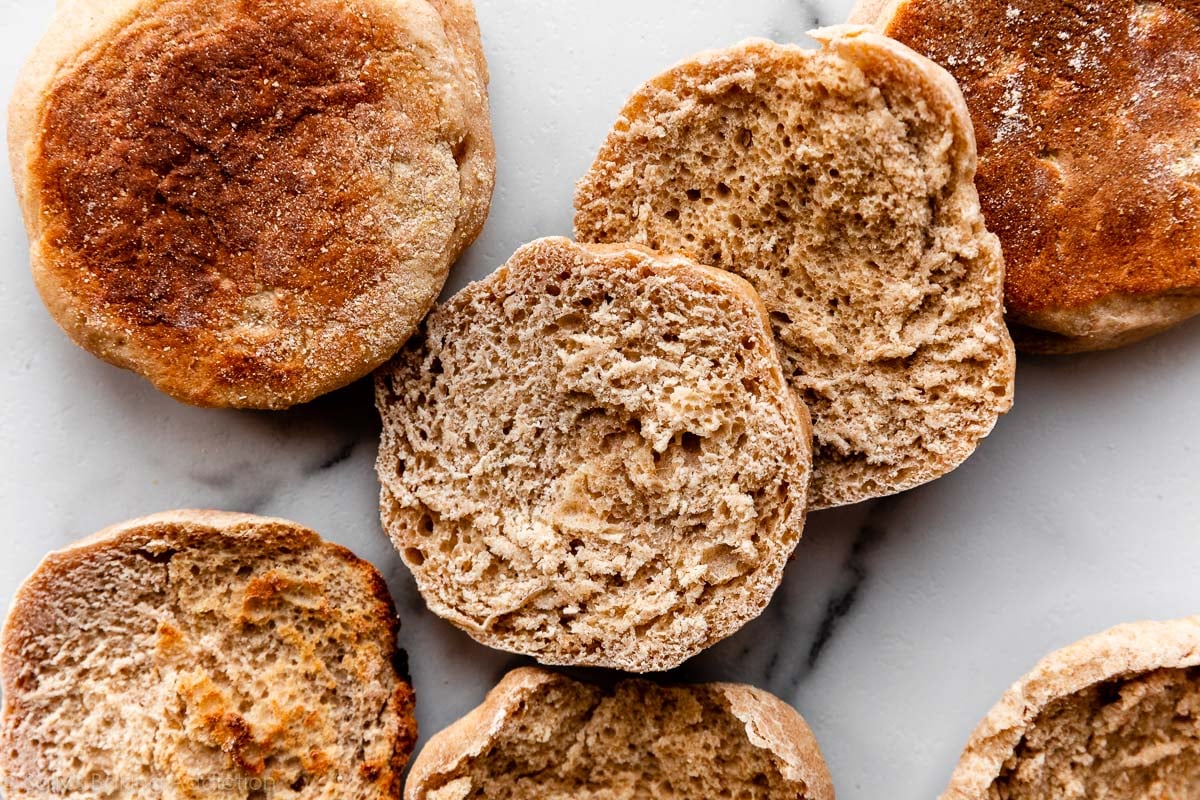
- Super soft and filled with their signature jagged texture aka “nooks & crannies”
- Begging you to slice & toast them and slather with butter!
- An intermediate baking recipe
They don’t have the same exact texture as store-bought, but the flavor is out-of-this-world especially if you let the dough rest in the refrigerator for at least 6 hours (and up to 24 hours). Your kitchen will smell like a bakery and it’s just so satisfying.
Start on the stove: Homemade English muffins can be cooked entirely on the stove, but it depends on your stove and griddle/skillet situation. I have a large griddle, but it doesn’t heat evenly so the batch is never consistent. I also find that English muffins solely cooked on the stove end up doughy inside. For best (and most uniform) results, I recommend starting the muffins on the stove and finishing them in the oven.
Recipe Testing: What Worked & What Didn’t
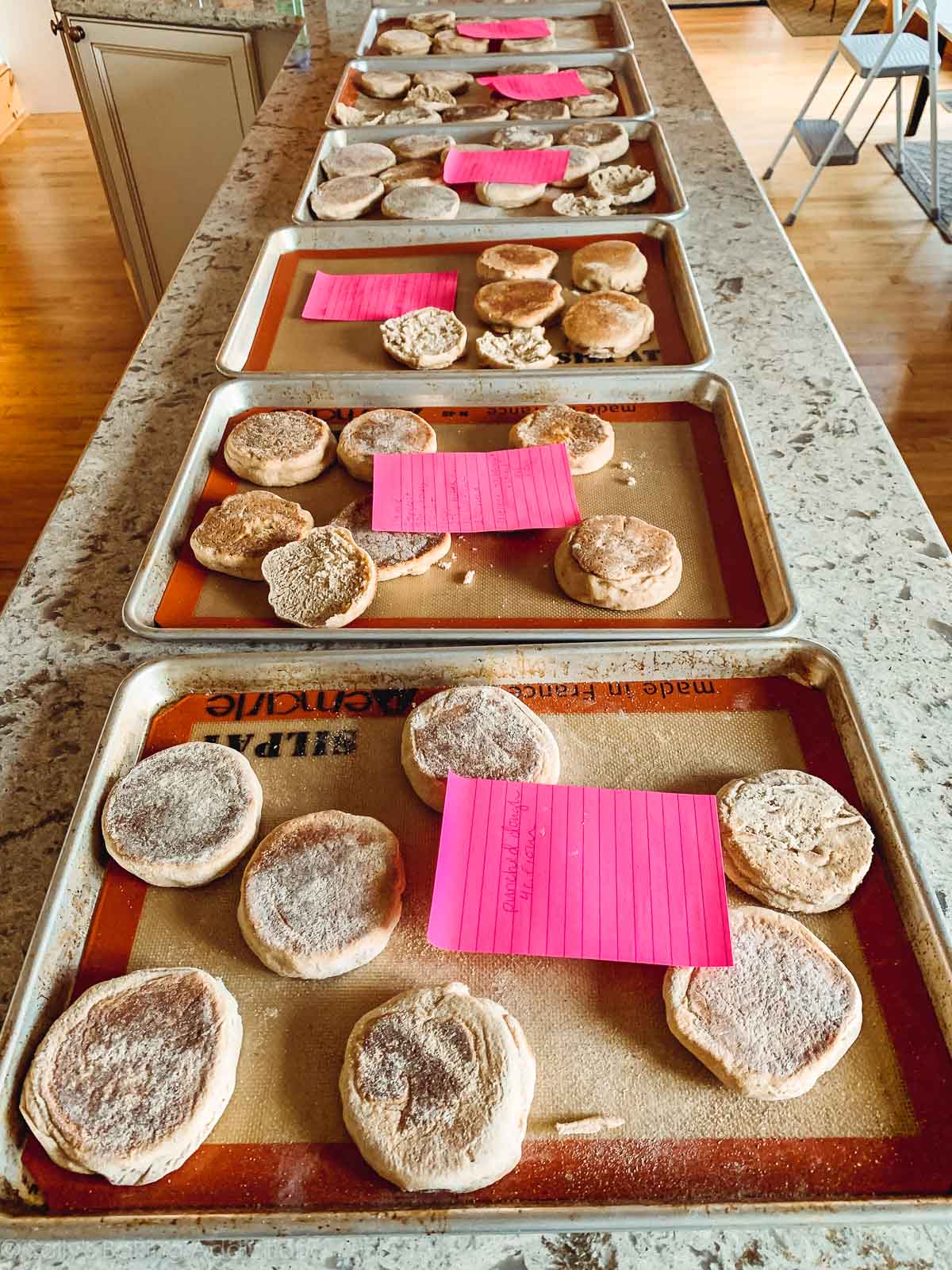
After making homemade English muffins from King Arthur Baking, I decided to try my hand at a honey wheat version. This recipe went through 6 rounds of dough variations.
Here’s What Works:
- Use melted butter because recipe tests made with softened butter weren’t as flavorful.
- Embrace a sticky dough made with *some* whole wheat flour and *some* all-purpose or bread flour.
- You will be tempted to add more flour, but don’t. The high hydration level is key to obtaining that shaggy & airy texture inside.
- Let the dough rise on the counter until doubled, about 2 hours. Then let it rest in the refrigerator for at least 6 hours. This time gives the muffins extra flavor, plus cold dough is MUCH EASIER to work with. (We do the same when making artisan bread, cranberry nut no-knead bread, no-knead pizza bread and olive bread.)
- Start the muffins on the stove in a skillet or on a griddle and finish them in the oven. Cook until an instant read thermometer reads the center as 200°F (93°C). If you don’t have an instant read thermometer, cut a muffin open and if it’s still extra doughy in the center, return to the oven.
Here’s What Doesn’t Work:
- A firm, dry dough will not produce an airy center.
- Avoid using ALL whole wheat flour because you may end up with bread hockey pucks.
- Do not punch down the dough after it rises.
- Do not skip the cornmeal or semolina flour because it’s needed to coat the dough and your hands.
- Do not flatten the shaped muffins with force because they will deflate.
Step-by-step photos are found below the printable recipe.
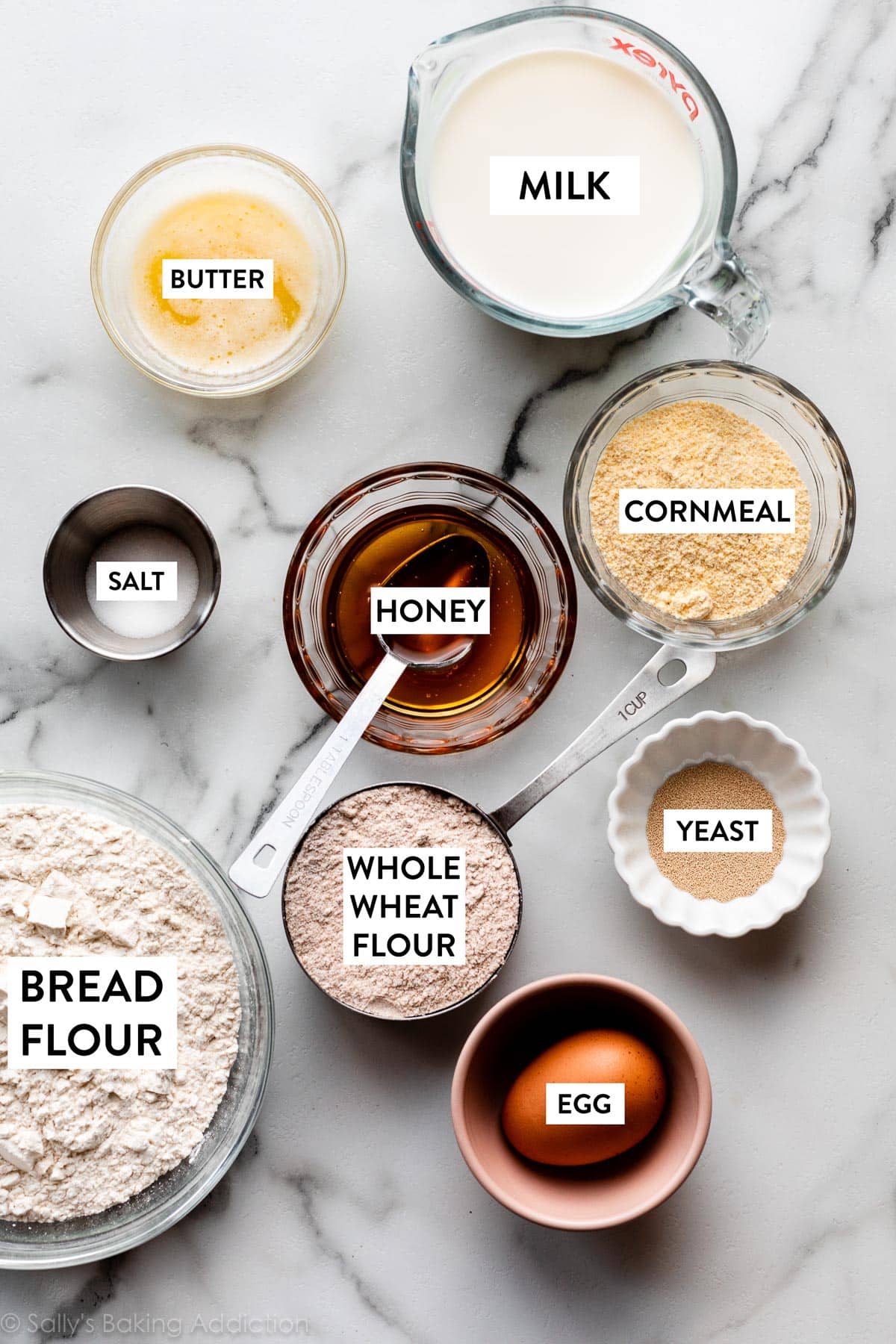
9 Ingredients You Need
There are 8 ingredients in the dough, plus cornmeal for hands + cooking surface.
- Milk: Some recipes call for using some milk and some water, but I found using all milk ideal especially when using whole wheat flour because it’s so drying. Whole milk is great, but you can use any milk—non dairy or dairy + any milk fat.
- Yeast: Use active-dry or instant yeast.
- Honey: Honey adds flavor. Feel free to replace with regular granulated sugar, but I would reduce down to 2 Tablespoons.
- Egg: Do not skip the egg because the muffins lacked structure and flavor.
- Melted Butter: Some fat adds flavor and melted butter is ideal.
- Salt: A scant 1 and 1/2 teaspoons of regular table salt gives the bread nice flavor and balances out the 3 Tablespoons of honey.
- Whole Wheat Flour: Use 1 cup of whole wheat flour.
- Bread Flour or All-Purpose Flour: The remaining flour should be bread flour or all-purpose flour. This amount *slightly* varies based on humidity, weather, brand of flour, and so many other little factors that are imperative to yeast dough’s performance. However, 2 cups + 3 Tablespoons was the perfect amount each time I tested.
- Cornmeal or Semolina: You need either for coating the dough and your hands. Using regular flour instead will dry out the dough—you want something coarse that the dough can’t really absorb. As a bonus, this adds a lovely little crunch on the muffin’s exterior.
Quick Test Recipe Comparison
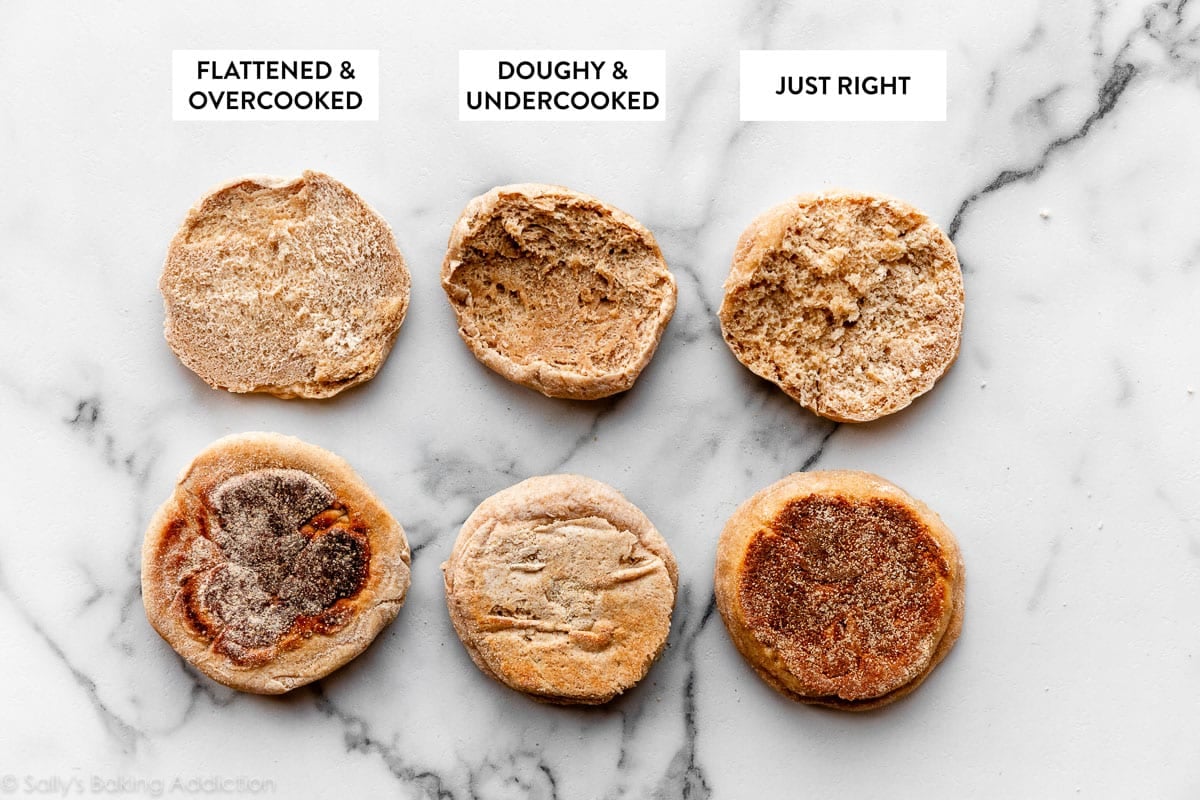
Once I landed on the perfect dough, it’s all a matter of shaping and cooking the muffins. Use your hands to gently shape the dough into 1-inch thick discs. The next photo shows 3 columns of cooked English muffins. Let me explain each.
- Below Left: As the muffins cook on the stove, avoid flattening them too much with a spatula. A little is fine, but don’t overdo it or you’ll end up squeezing all the air out and eating hockey pucks. The heat was also a little high on my stove and I cooked them too long, so they burned.
- Below Center: It’s best to cook the muffins over medium or medium-low heat. Anything lower may not properly cook the muffins as you can see.
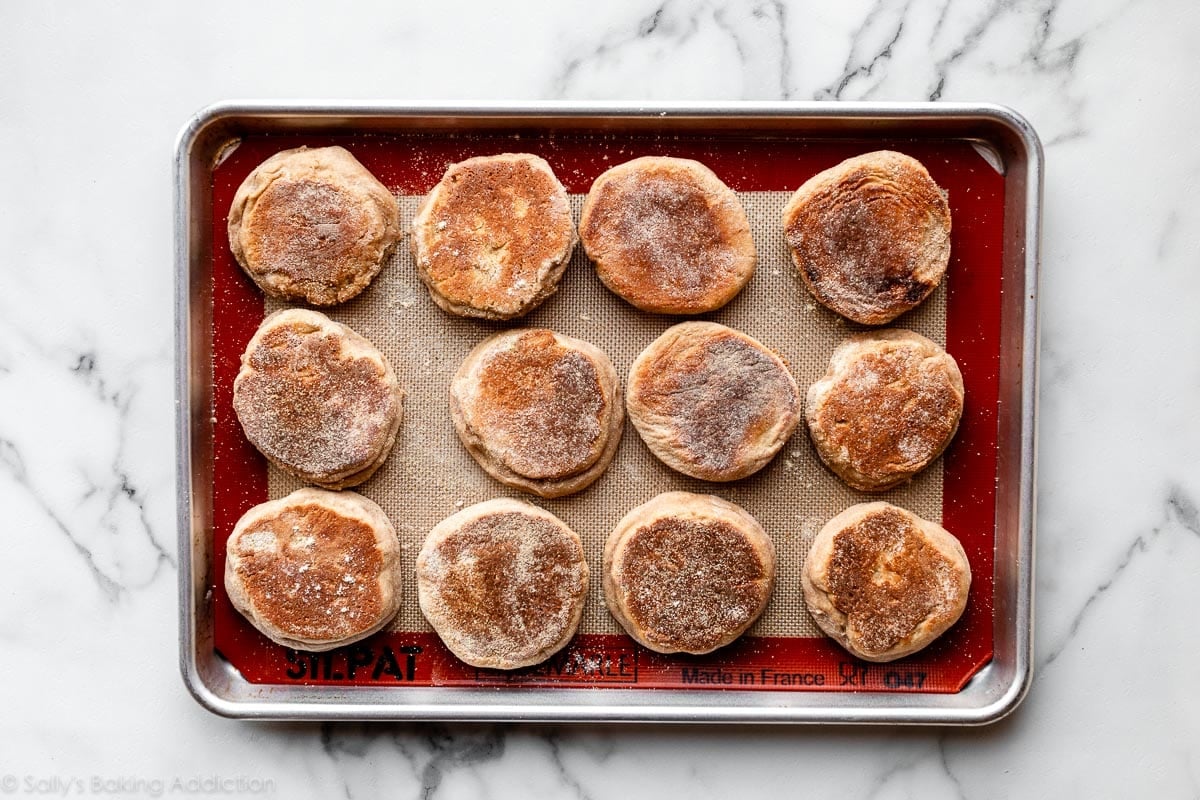
- Below Right: Perfectly cooked English muffins are browned with oodles of crumbly air pockets inside. These are cooked over medium heat on a griddle (medium low heat for a skillet) for 7-8 minutes on each side and finished in the oven.
Can I Skip the Stove?
I do not recommend it. Cooking them entirely or briefly on the stove browns and sets the exterior, preventing them from puffing up too much. If cooked entirely in the oven, you’ll have rounded dense dinner rolls, not English muffins.
Cutting Into Your English Muffins
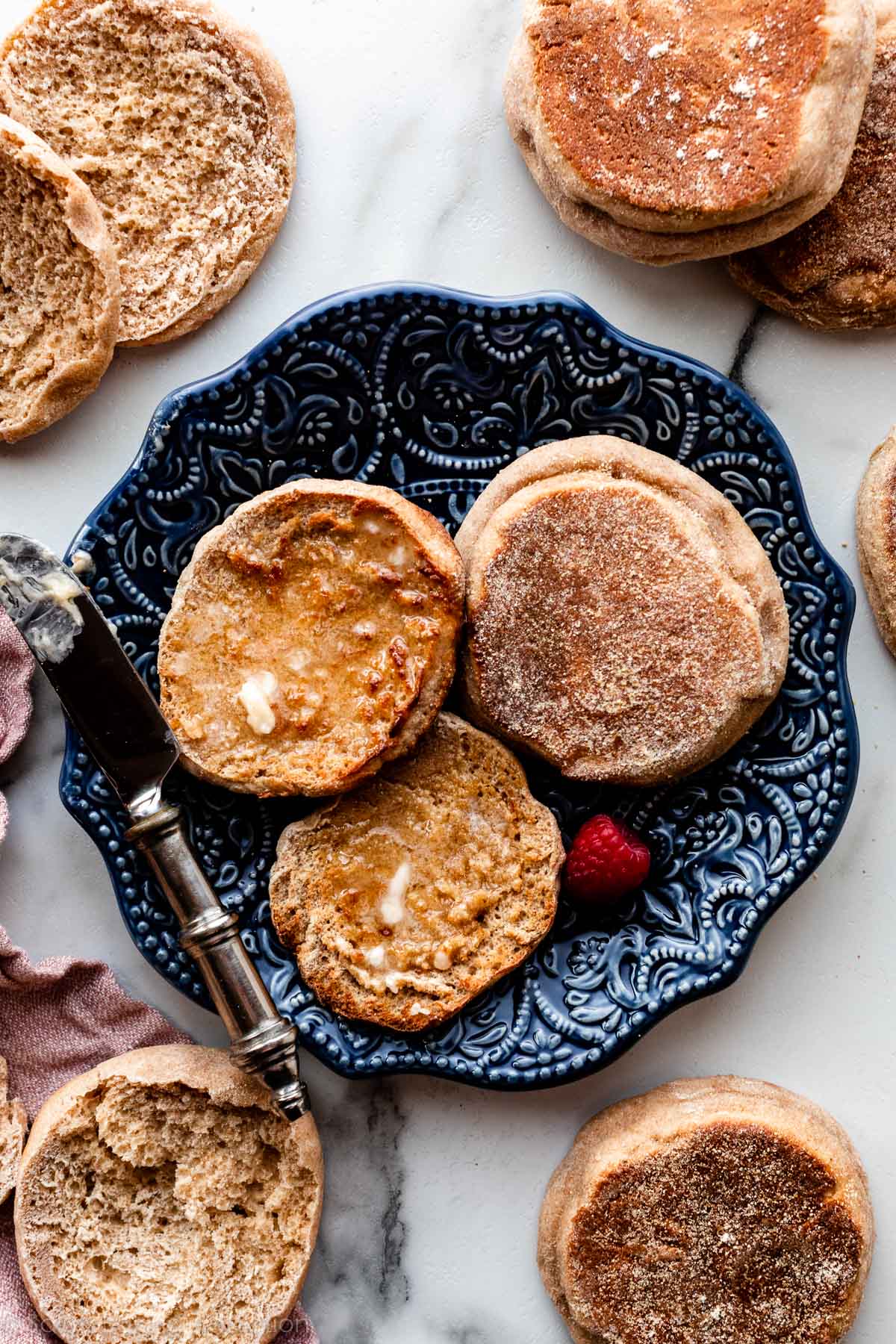
To preserve the craggy texture, I recommend slicing the honey wheat English muffins in half using a serrated knife. Or you can slice around the edges with a regular sharp knife and then pry the two halves apart with a fork.
How to Store & Freeze English Muffins
This recipe yields 12 muffins. The shelf life of homemade English muffins is shorter than store-bought. Store leftovers covered at room temperature for up to 2 days and then transfer to the refrigerator for up to 3 days. After that, it’s best to freeze them. Freeze for up to 3 months and then thaw by defrosting in the microwave or setting out on the counter. For best taste and texture, slice and toast them.
See Your Homemade English Muffins
Many readers tried this recipe as part of a baking challenge!
Print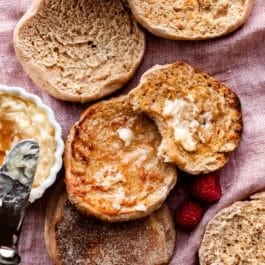
Homemade English Muffins
- Prep Time: 8 hours, 45 minutes (includes dough rise)
- Cook Time: 25 minutes
- Total Time: 9 hours 10 minutes
- Yield: 12 muffins
- Category: Breakfast
- Method: Baking
- Cuisine: American
Description
These honey wheat English muffins are completely homemade from a simple no-knead 8 ingredient dough. Though the dough rises and is ready in about 2 hours, I strongly recommend refrigerating it for at least 6 hours so your English muffins have better flavor. For best success, review recipe notes, video tutorial, and step-by-step photos (below) before starting.
Ingredients
- 1 and 1/4 cups (300ml) milk, warmed to about 100°F (38°C)*
- 2 teaspoons (6g) instant or active dry yeast*
- 3 Tablespoons (64g) honey*
- 2 Tablespoons (28g) unsalted butter, melted & slightly cooled
- 1 large egg, at room temperature
- 1 and 1/2 teaspoons salt
- 1 cup (130g) whole wheat flour (spooned & leveled)*
- 2 cups + 3 Tablespoons (280g) bread flour or all-purpose flour (spooned & leveled)*
- cornmeal or semolina flour for handling dough (at least 1/2 cup (60g))
Instructions
- Prepare the dough: In a large un-greased mixing bowl, whisk the warm milk, yeast, and honey together in the bowl of your stand mixer fitted with a dough hook attachment. Cover and allow mixture to sit for about 5 minutes or until foamy on top. *If you do not own a mixer, you can do this in a large mixing bowl and in the next step, mix the dough together with a large wooden spoon/silicone spatula. A hand mixer works, but the sticky dough repeatedly gets stuck in the beaters. Mixing by hand with a wooden spoon or rubber spatula is a better choice.*
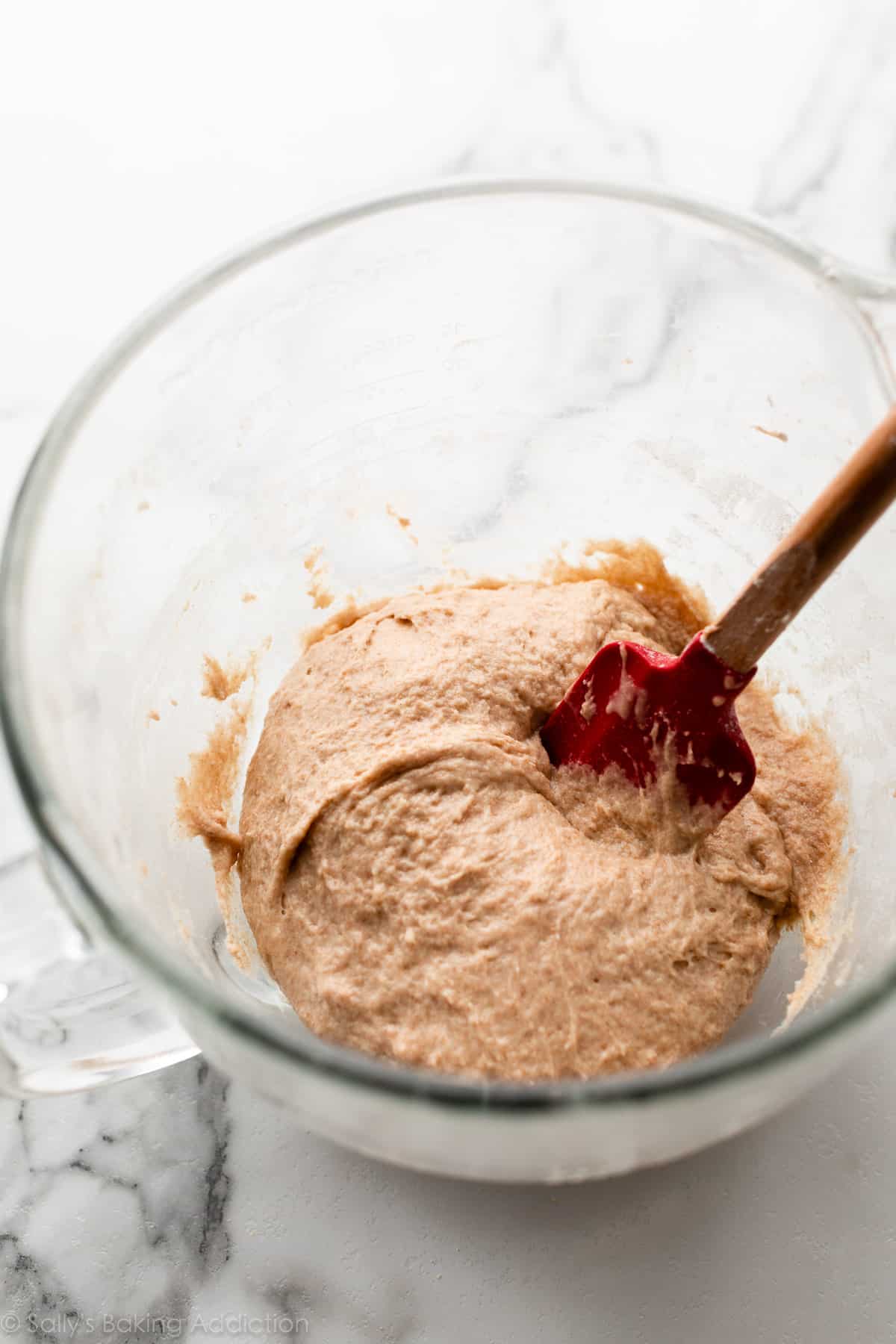
- Add the butter, egg, salt, whole wheat flour, and 1 cup (about 130g) of the bread flour. Whisk to combine. Add 1 more cup (130g) bread flour and beat on low speed for 2 minutes. Dough will be extremely sticky and like a loose batter. Add remaining flour, scrape down the sides of the bowl with a silicone spatula, and then beat on low speed for 1 minute to combine. Scrape down the sides of the bowl again and then fold the dough together a few times with your silicone spatula. Do not be tempted to add more flour. It’s supposed to be very sticky.
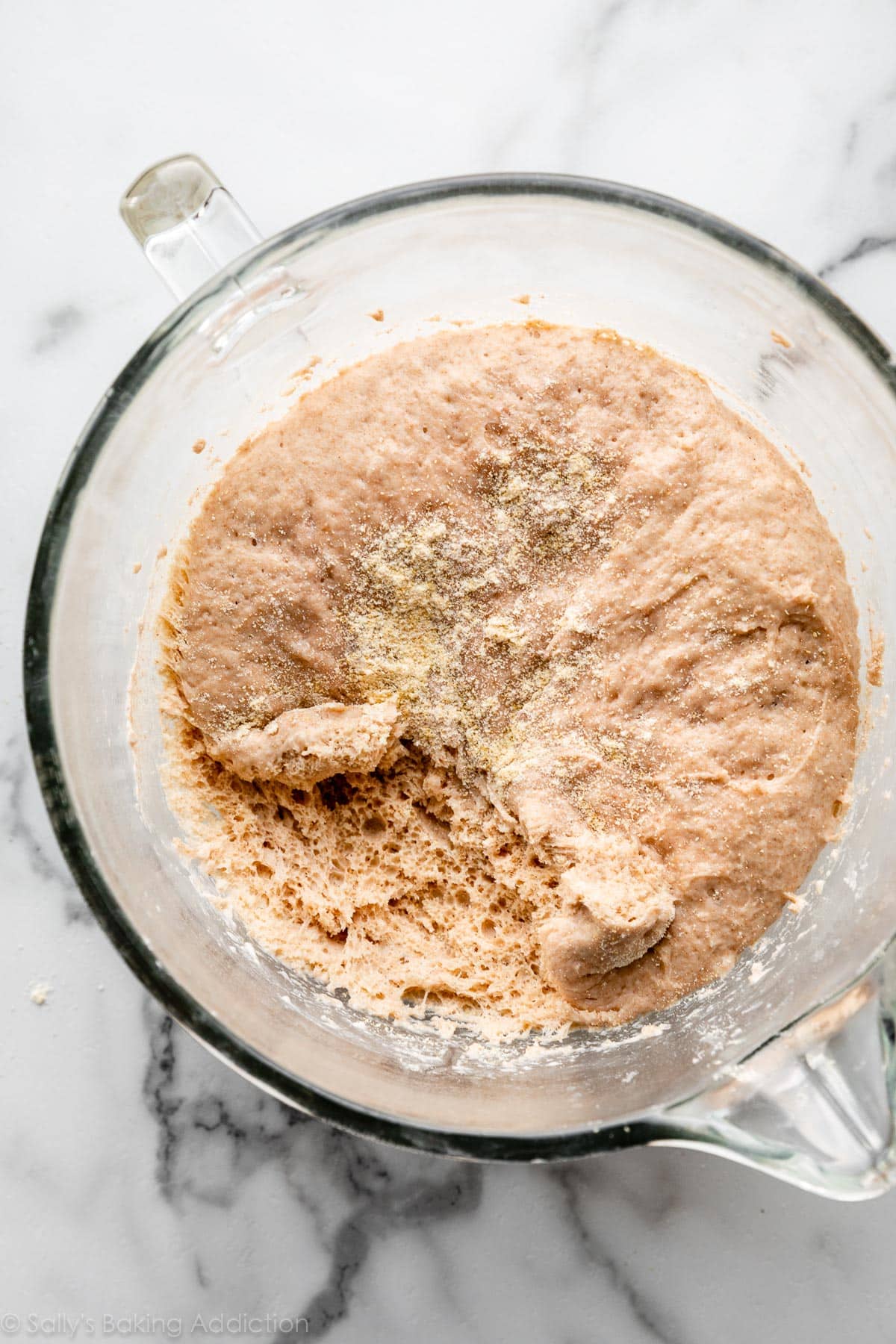
- Cover the dough tightly with plastic wrap or aluminum foil and set on the counter at room temperature. Allow to rise until double in size, about 2 hours. The dough will be sticking to the sides of the bowl and have a lot of air bubbles. You can continue with step 4 immediately, but for absolute best flavor and texture, I strongly recommend letting this risen dough rest in the refrigerator for at least 6 hours and up to 24 hours. Place covered dough in the refrigerator for 6-24 hours. The dough will very slightly puff up during this time, but may begin to deflate after 24 hours.
- Line two large baking sheets with parchment paper or silicone baking mats. One is for the shaped uncooked muffins and the 2nd is for baking the muffins.
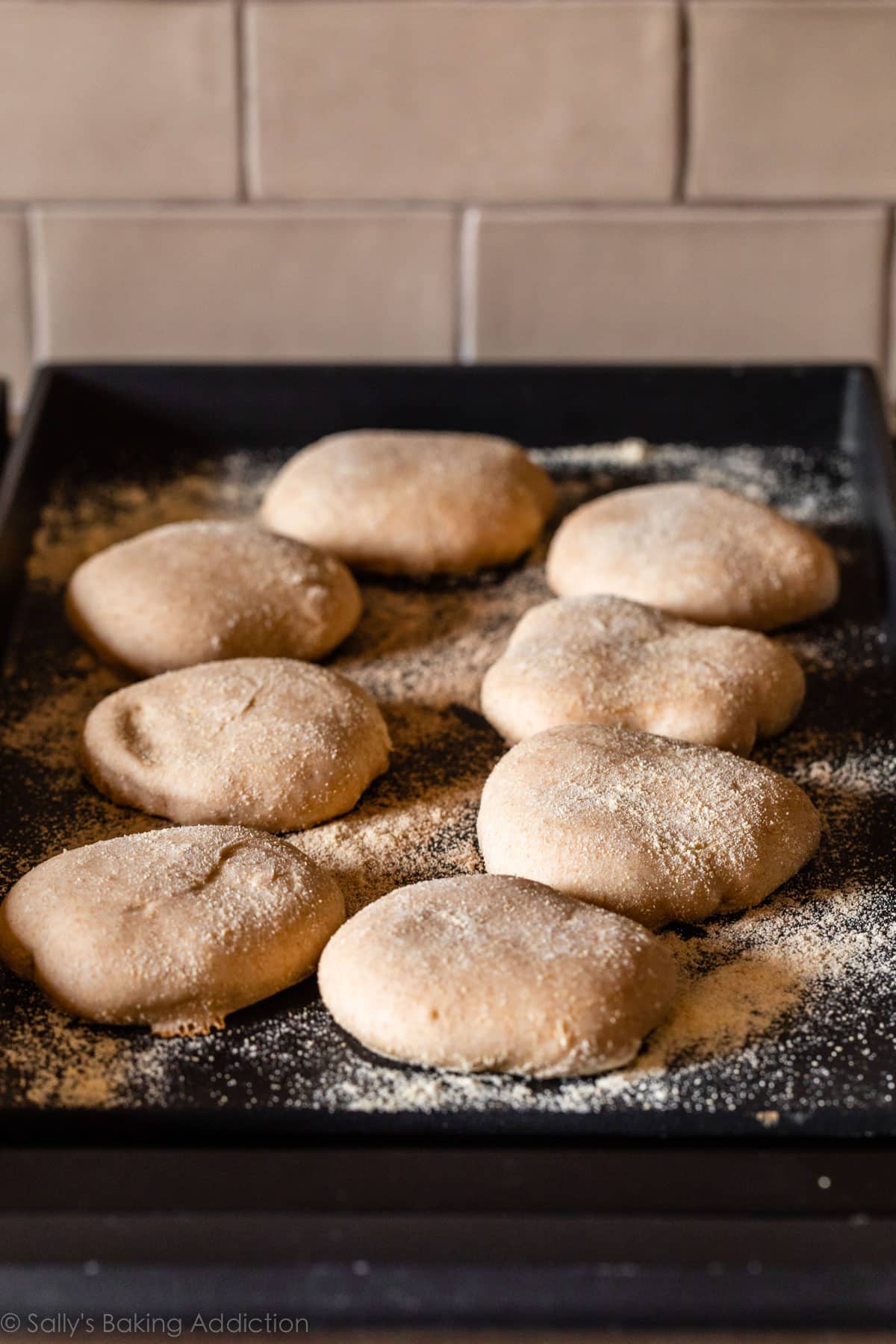
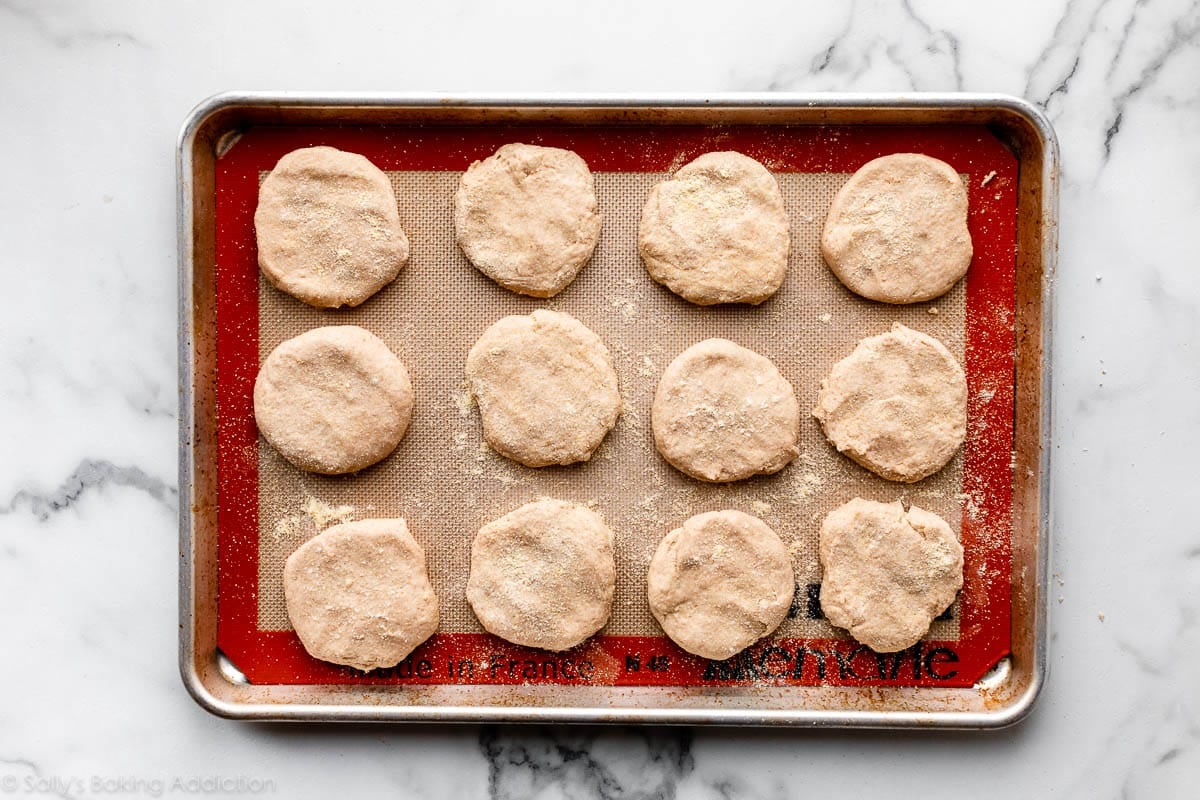
- Shape the muffins: Remove cold dough from the refrigerator—no need to bring it to room temperature. Sprinkle a little cornmeal/semolina on the surface of the dough and all over your hands. Have more nearby and use whenever things begin getting super sticky. Grab a small handful of dough, about 1/3 cup of dough or 2.5-3 ounces if you have a kitchen scale, and gently form into a 1-inch thick disc that’s about 3.5 inches in diameter—doesn’t need to be perfect—and place onto lined baking sheet. You’re basically shaping them as you’d shape hamburger patties. Repeat with remaining dough for a total of about 12. Sprinkle the tops of the shaped discs lightly with more cornmeal and cover to rest for 20 minutes. (Do not extend this time or the muffins will puff too much.)
- Meanwhile, as the shaped muffins rest, get your stove ready. Heat a griddle to medium heat or about 325°F (163°C) or use a large skillet or cast iron skillet over medium-low heat. If your griddle/skillet/cast iron is nonstick or seasoned, there’s no need to grease it. If not nonstick, grease with a little butter. Once greased pan/griddle is heated, sprinkle lightly with cornmeal/semolina flour and begin to cook the muffins in the next step.
- Read this entire step before starting to cook the muffins. Using a flat spatula, carefully transfer however many muffins can fit on your pan/griddle with at least 2 inches between each because muffins will puff up as they cook. Gently flatten them around the edges with the back of your spatula, being careful to not flatten too hard which would deflate them. Cook for 7-8 minutes and then flip over, gently flatten again, and cook for another 7-8 minutes. (No need to grease or sprinkle more cornmeal/semolina when flipping.) This cook time is a general guideline because griddles/stoves/pans can heat differently and/or unevenly. You want to cook until golden brown on each side and edges seem set. If muffins seem to be over-browning quickly, slightly turn down the stove’s heat. And, as the muffins cook, you can start preheating the oven (next step). Transfer cooked muffins to the unused prepared baking sheet.
- Preheat oven to 350°F (177°C).
- Bake for 8-11 minutes or until an instant read thermometer reads the center as 200°F (93°C). If you don’t have an instant read thermometer, cut a muffin open after 8 minutes and if it’s still extra doughy in the center, return to the oven until baked through. I usually bake them for at least 10 minutes.
- Remove from the oven and cool for 10 minutes on the baking sheet before slicing and handling. To preserve the craggy texture, slice the honey wheat English muffins in half using a serrated knife. Or you can slice around the edges with a regular sharp knife and then pry the two halves apart with a fork. Toast halves in the toaster if desired (taste best that way!) and serve warm with desired toppings such as butter, honey butter, jam, apple butter, or other topping of choice. Muffins can also be used for breakfast sandwiches or eggs Benedict.
- Store leftovers covered at room temperature for up to 2 days and then transfer to the refrigerator for up to 3 days. After that, it’s best to freeze them. Freezing instructions in notes.
Notes
- Make Ahead Instructions: Prepare the dough through step 3 and let the dough rest in the refrigerator for up to 24 hours before continuing with step 4. No need to bring dough to room temperature before you begin to shape the muffins—cold dough is easier to work with!
- Make Ahead Instructions – Freezing: Baked English muffins freeze well up to 3 months. You can freeze in a large container or freezer bag or wrap individually in plastic wrap. Thaw by defrosting in the microwave or setting out on the counter to come to room temperature. For best taste and texture, slice and toast them after thawing. You can also freeze the English muffins after they come off the stove (after step 7). Cool completely and then freeze in a large container or freezer bag or wrap individually in plastic wrap for up to 3 months. Thaw and then continue with step 8.
- Special Tools (affiliate links): Stand Mixer or Large Mixing Bowl with Silicone Spatula or Wooden Spoon | Griddle or Skillet | Baking Sheets | Silicone Baking Mat or Parchment Paper | Flat Spatula | Instant Read Thermometer
- Milk: Whole milk is great, but you can use any milk—non dairy or dairy + any milk fat.
- Yeast: You can use active-dry or instant yeast. The instructions are the same no matter which you use. Note that 2 teaspoons (6g) is less than 1 standard packet.
- Honey: You can substitute the honey with granulated sugar, but reduce it down to 2 Tablespoons (25g).
- Flour: This ratio of whole wheat to white flour is best. I do not recommend using more whole wheat flour because the texture of the English muffins will change. For the white flour, you can use bread flour or all-purpose flour. I recommend bread flour for the best texture.
- Adapted from King Arthur Baking. I reduced the flour, reduced the butter and switched to melted, used some whole wheat flour, swapped sugar for honey, and reduced the milk.
Let Me Show You a Few Steps
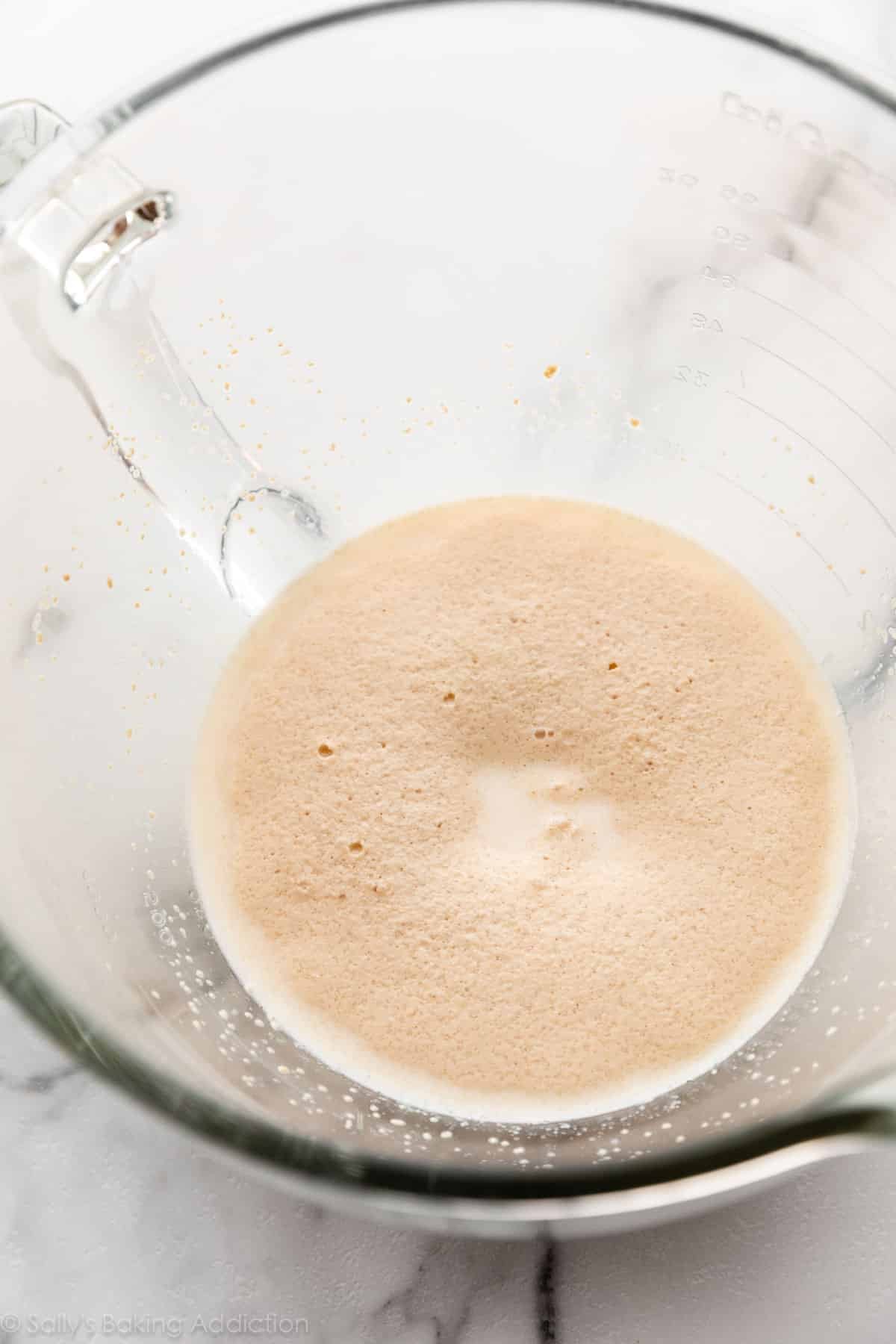
Here is the yeast proofing mixture that you prepare in step 1 above. The foamy top proves the yeast is ready and active.
After the dough comes together, use a silicone spatula to fold the dough a few times and scrape down the sides of the bowl. The dough is very, very sticky:
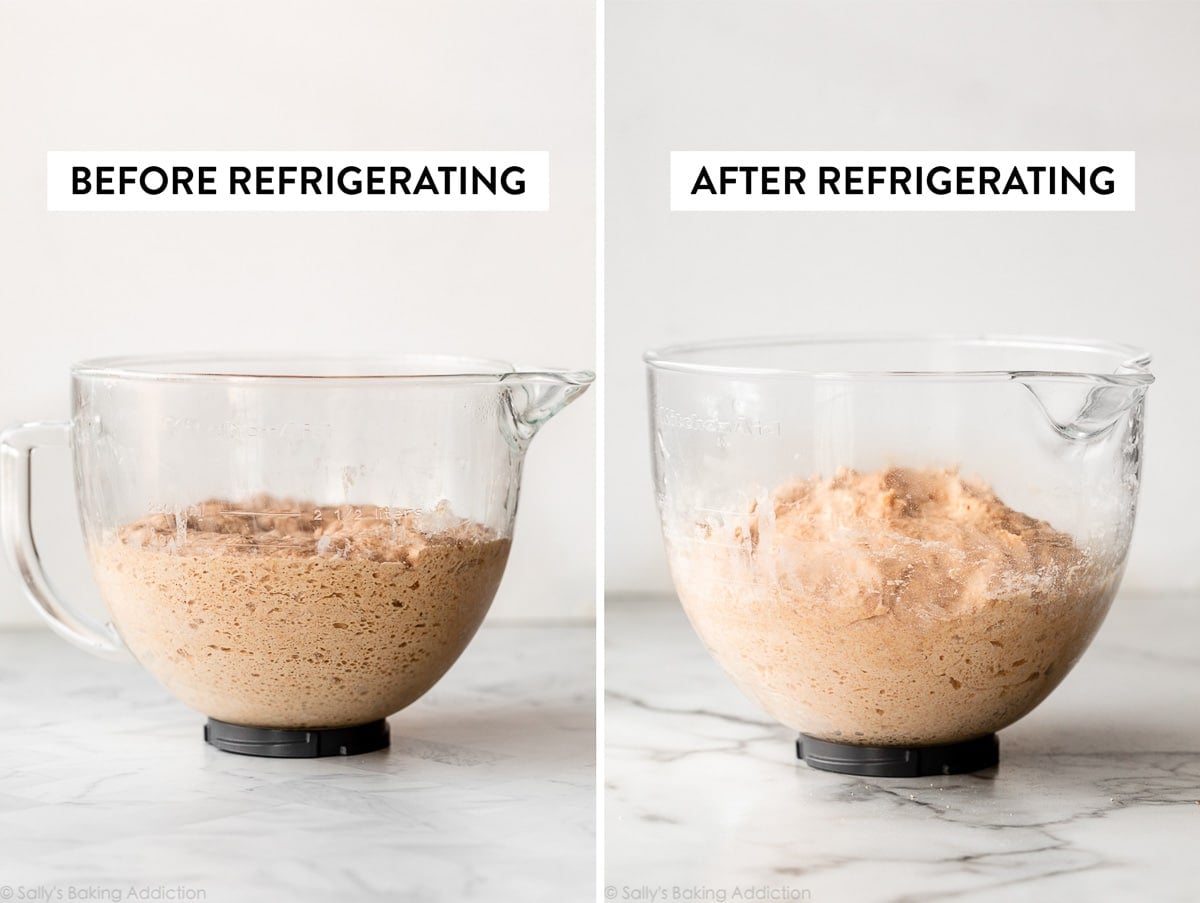
Below left: Let the dough rise at room temperature until doubled.
Below right: Refrigerate for at least 6 hours. The dough doesn’t rise that much in the refrigeration period—just a little. Cold dough does, however, produce a more flavorful English muffin and it’s a lot easier to work with than room temperature dough.
Unlike most yeasted bread recipes, do not punch the dough down—you do not want this dough to collapse or release air. With cornmeal or semolina dusted hands, begin pulling sections of dough and gently shaping into discs. The dough is very sticky, but manageable since it’s cold.
Arrange on a lined baking sheet and then cover and let rest for 20 minutes as you prepare the stove for cooking.
After cooking the muffins on both sides on the stove—a photo you can find above as well as shown in the video tutorial—bake until the centers are 200°F (93°C) or no longer doughy.









Reader Comments and Reviews
It’s ok. The amount of yeast is high and gave us stomach aches – I suspect a lower amount of yeast and longer proof would prevent that. I also thought overall the dough was kinda on the dense side (it did puff up nicely in appearance). Overall easy and ok flavor. I’ve made a few various EM recipes and not sure I felt the actual bread itself was that good
Can I make the dough in a bread machine?
Hi Christine! We don’t have a bread machine so can’t say for sure. Let us know if you try!
Hello:
I love your recipes and am excited to make English muffins. I’m wondering how to modify the recipe to use sourdough starter instead of active yeast. Is it possible? I keep sourdough discard in the refrigerator for crackers but would like to use it for this recipe, if possible. Thanks!
Hi Ernestine, we don’t have any experience baking with sourdough starter. Let us know if you try!
Just made these today. It was easier than I expected. I didn’t have cornmeal so I just made sure to spray my hands when I was molding the muffins
I always follow your recipes exactly the first time, and everything turns out great– thank you!
However, I accidentally added those 3 T of flour with the rest of the second batch of floor flour. I’m wondering if this is why I only had enough dough for nine SMALL muffins. The dough seemed to rise fine. Any ideas or suggestions would be appreciated. Thank you!
I wanted to try making English muffins from scratch for Eggs Benedict on Christmas Eve. But if Sally didn’t have a recipe for them, I wouldn’t try! I followed this recipe and everyone raved about them. They weren’t difficult at all. I’m going to do it again!
It’s hard to find whole wheat flour in Costa Rica. Can I substitute something else?
Hi LC, you can skip the whole wheat flour and use all bread flour in this recipe instead.
This was my first time making English muffins and they turned out amazing. Thank you for a easy to follow recipe!
Can these be made without any sweetener?
Hi Toni, we recommend having some, but you can reduce the honey to 2 Tbsp.
I like this recipe—made it 3x so far
However
It needs more nooks/cranies
Help!
Hi Shelley! These homemade English muffins may not have quite as many nooks and crannies as the store-bought kind, but they shouldn’t be dense. I’m wondering if it was an issue of a little too much flour. Make sure to spoon and level when measuring, or use a kitchen scale. The flour amount can vary slightly based on humidity, weather, brand of flour, and so many other little factors that are imperative to yeast dough’s performance. Thank you for giving this recipe a try!
I love this recipe! I’m making personal pizzas with it for dinner.
What should do if we don’t wanna use oven and just use the stove to cook the dough? How much should it be changed?
If I make this recipe x3, do I need to make any changes?
Hi Tina, for best results, we recommend making separate batches rather than tripling.
Loved the recipe very clear and easy to follow. I think once you make it once it shouldnt be too difficult the second time.
Is it possible to put less honey? I found them a bit sweet
Hi Ariana! You can use 2 Tbsp honey next time. So glad you enjoyed them!
Perfect recipe; easy to follow and results match perfectly! As always, by reading your notes, tips and full instructions, the results are consistently as desired. Thank you for doing all of the legwork on these.
very good recipe, didn’t even need to kneed the dough at all. I did leave the dough in the refrigerator but for an hour. The dough still rising. With the recipe, I made about 12 English Muffins
Excited to try these out. Can I substitute Oat flour for the whole wheat flour? Thanks!
Hi Rosemary, we don’t recommend it—oat flour has very different baking properties than whole wheat or bread/all-purpose flour, and it may not be a 1:1 swap. Best to stick with the recipe as written for best results!
I would love to try these! Is there a regular version without the wheat flour?
Hi Aubrey, yes, absolutely. Use the same total amount of flour. Enjoy!
Can I use all white flour?
Absolutely. Same amount.
These are certainly some work but nothing like home made, wholesome and good English muffins in the morning. Thank you so much for all the recipe, notes and insights. I will certainly make them again. They are delicious.
Could you use an ice cream scoop to measure out the dough since it is meant to be sticky? Or would that just result in flattened, tough muffins? Looking forward to trying the recipe
Hi Megan, that should be fine, but you’ll still want to form the dough into a 1-inch thick disc that’s about 3.5 inches in diameter. Hope you enjoy the recipe!
This recipe was pitch perfect. I overbrowned a few tops, but I was figuring out the griddle. I made the dough the previous night, let it hang out, and finished the English muffins in the morning. Every recipe I’ve made from this site has been great, and the instructional material on yeast baking—hello windowpane technique!—has been so helpful.
Sadly these were a major fail for me. I had previously made the original King Arthur recipe, which came out perfect. These came out like dense hocky pucks. Im nit sure if it was the direction to use bread flour ir to put in the refrigerator overnight, but I made exactly as the recipe and they are nearly inedible.
Hi Hilary, I’m so sorry to hear this! I’m wondering if it was an issue of a little too much flour. The flour amount can vary slightly based on humidity, weather, brand of flour, and so many other little factors that are imperative to yeast dough’s performance. Thank you for giving this recipe a try!
Absolutely loved this recipe, store bought doesn’t even come close to comparing! Even better I just threw all the ingredients in my bread maker as is, put it on the dough setting and skipped the refrigeration step and they still were incredible!
I’ve never had a recipe of Sally’s fail like I have with this one. The dough is always way to sticky to even work with, even when absolutely covered in cornmeal it is still nearly impossible to shape and after resting it always sticks to the parchment and comes out deflated because it sticks. I can express how frustrating it is to follow a recipe exactly, even leaving it in the fridge for 24 hours just to have to throw it all away.
Hi Josh, I’m sorry you struggled with this dough. If you ever want to try it again, feel free to start with more flour. You want a sticky dough, but you should still be able to gently mold it (when it’s cold) into discs.
I only had whole wheat and almond flour on hand, so I took a leap and tried it out. It worked! I did half and half. They came out beautifully, thanks for the great recipe!
I used My homemade gluten-free flour mix, Maple syrup, plantation black strap molasses and added in some ground flaxseed. I wanted some more flavor and just turned out great even though I winged it, LOL! I also didn’t have a whole eggs. I basically used all egg whites.
I followed that recipe instructions other than that and after the two initial hours of ricing followed by another 6 hours ended up cooking these late at night. And the results were fantastic. These were super tasty, And I used my stick thermometer to ensure that they were not doughy inside and took them out at the right time.
Great recipe! I think my son is going to love those. He doesn’t do well with gluten.
Cloud you use buttermilk in this recipe instead of plain milk?
Hi Jenny, we haven’t tested it, but think buttermilk should be ok here. Hope they turn out great!
Hi, Sally! Love how thorough you are in your instructions. Thank you.
One gripe, though, if I may – and I apologise for introducing a negative – but English muffins are not inspired by crumpets, which are a very different – and even more delicious – bread product, and far more popular this side of the Atlantic. English muffins are inspired by … Yes, English muffins. And a tip: Never slice a muffin. Work your way around it by inserting a fork until it splits. That’s will give you extra nooks and crannies for the butter to seep into. I take the liberty of adding a link to the site of an English chef, who really knows his muffins, in the hope that it may prove helpful. Thanks again.
https://www.youtube.com/watch?v=GSoK-XKp_1g
This worked for me with 2 cups of whole wheat flour and only one cup of bread flour, plus the tablespoons. I also used soy milk. Perfect!
So very delicious and surprisingly easy. I’ve been contemplating this recipe for months, thinking it was going to be a gloopy, sticky mess to deal with. That couldn’t be further from the truth! Wish I didn’t wait so long to try them, but I can say with confidence, I’ll not be buying store bought again! ❤️
These English muffins turned out fantastic! I will say that I was VERY frustrated with how sticky they were coming out of the refrigerator, but I stuck to the recipe and they turned out perfectly! Only thing I would change is to probably fold the dough a little less than I did because I wanted them to be just a tad but more airy! Either way, these were perfect for eggs benedict!