
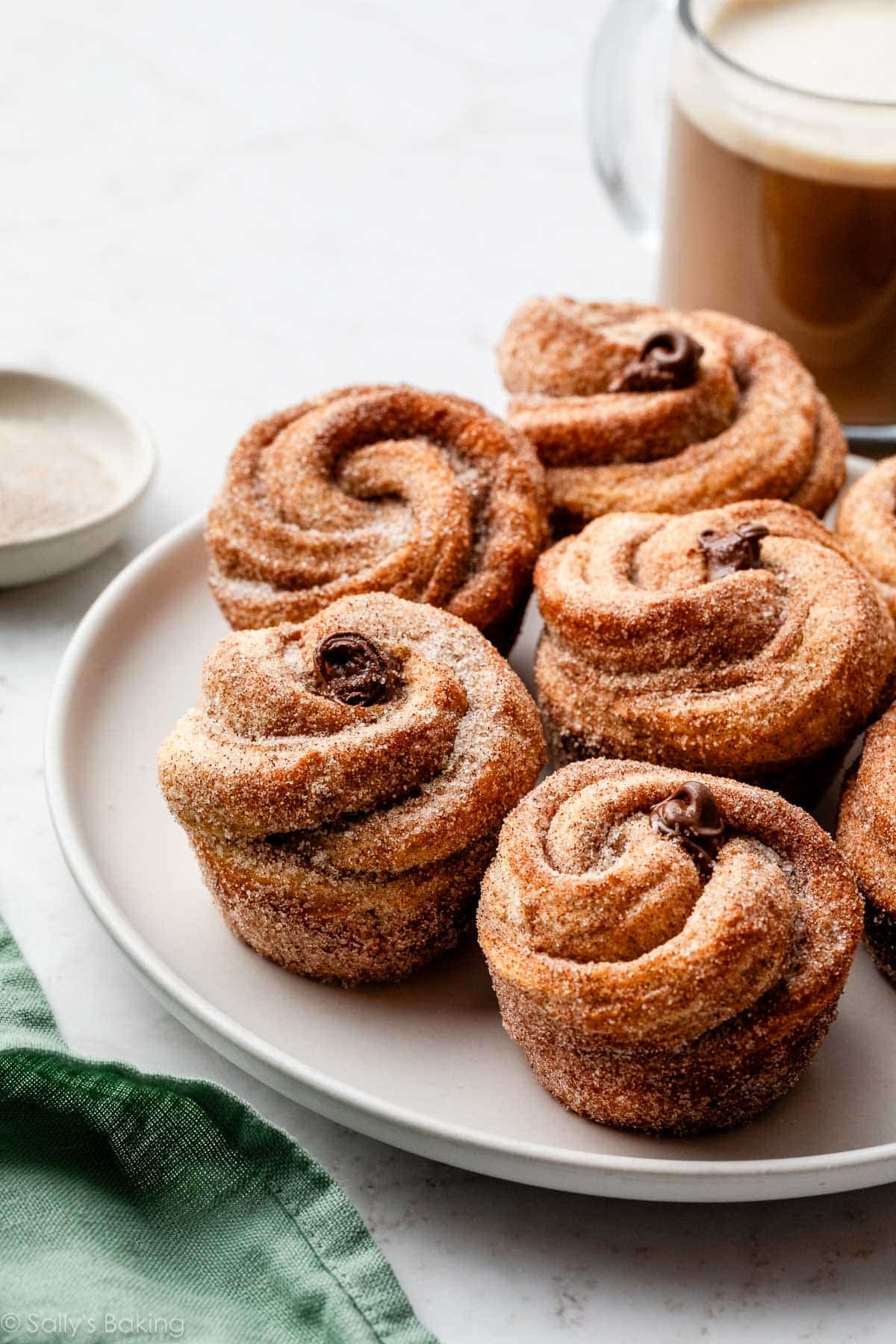
Buttery and flaky croissant dough gets twisted up with a generous dose of cinnamon-sugar and baked in a muffin pan, combining two tasty treats into one: croissants + muffins = cruffins. If you’re looking for a new one-day baking challenge, this unique pastry is a fun one to try. And absolutely delicious to eat! This is an egg-free baking recipe.
One reader, Kristen, commented: “Oh my goodness, the smell of these cruffins baking was enough of a reason to make them! They came out so fluffy and buttery, and the cinnamon sugar was the perfect accent to these sweet treats. As expected, they took most of the day to make, but they were fairly simple, especially considering how complex laminated baked goods can be. I will be filing this recipe away for my next homemade brunch for sure! ★★★★★“
What Are Cruffins?
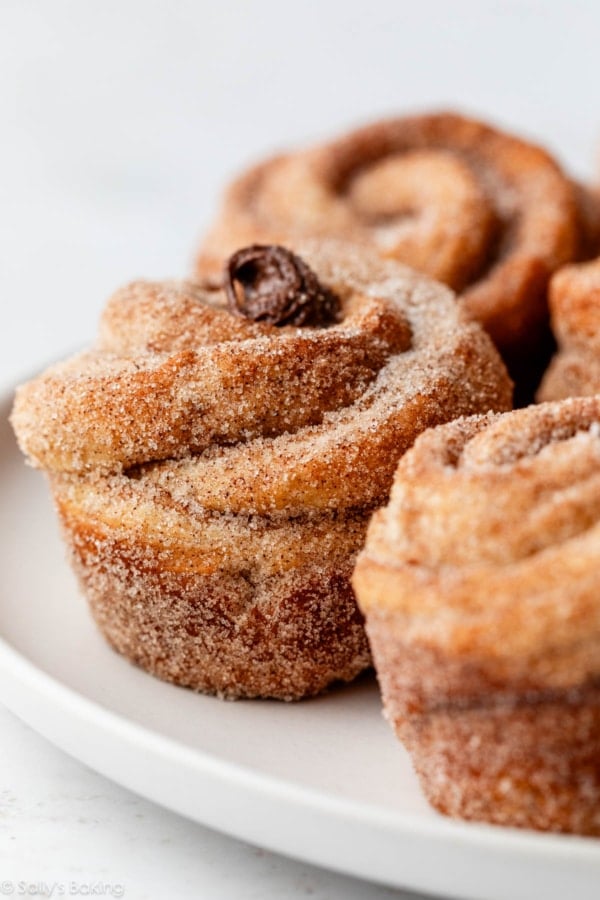
Cruffins are a delightful hybrid of two beloved bakery treats: croissant dough baked into a beautifully spiraled muffin shape. When I decided to make a homemade version, I wanted to learn more about their origin. It turns out cruffins were first created in Melbourne, Australia, by Lune Croissanterie and later made their way to the U.S., thanks to Australian pastry chef Ry Stephen.
And we can all agree—this buttery masterpiece was a creation worth selling!
Let’s Try an Approachable Homemade Version
If you have ever taken the time to make flaky, buttery croissants from scratch, you’ll know that homemade pastry requires time, precision, and patience, but is a very rewarding baking project. I know it can seem intimidating, but I thoroughly break down the process for you, step by step, in the tutorial below.
*Bakery cruffins are usually taller than today’s homemade version because they’re baked in deeper pans, such as popover pans. Since many home bakers don’t have popover pans, this recipe is designed for a standard muffin pan.
Homemade cruffins do not require any special ingredients, but they do require 4 rounds of 20-minute refrigerations, 3 rounds of rolling-and-folding (laminations), and 2 rises. For these reasons, I categorize this as an advanced baking recipe. But I’m here to walk you through each step.
You can absolutely do this!
Start by Making the Dough
The base dough for these cruffins is the same yeasted dough we use to make this croissant bread loaf, which is a scaled-down version of my recipe for homemade croissants.
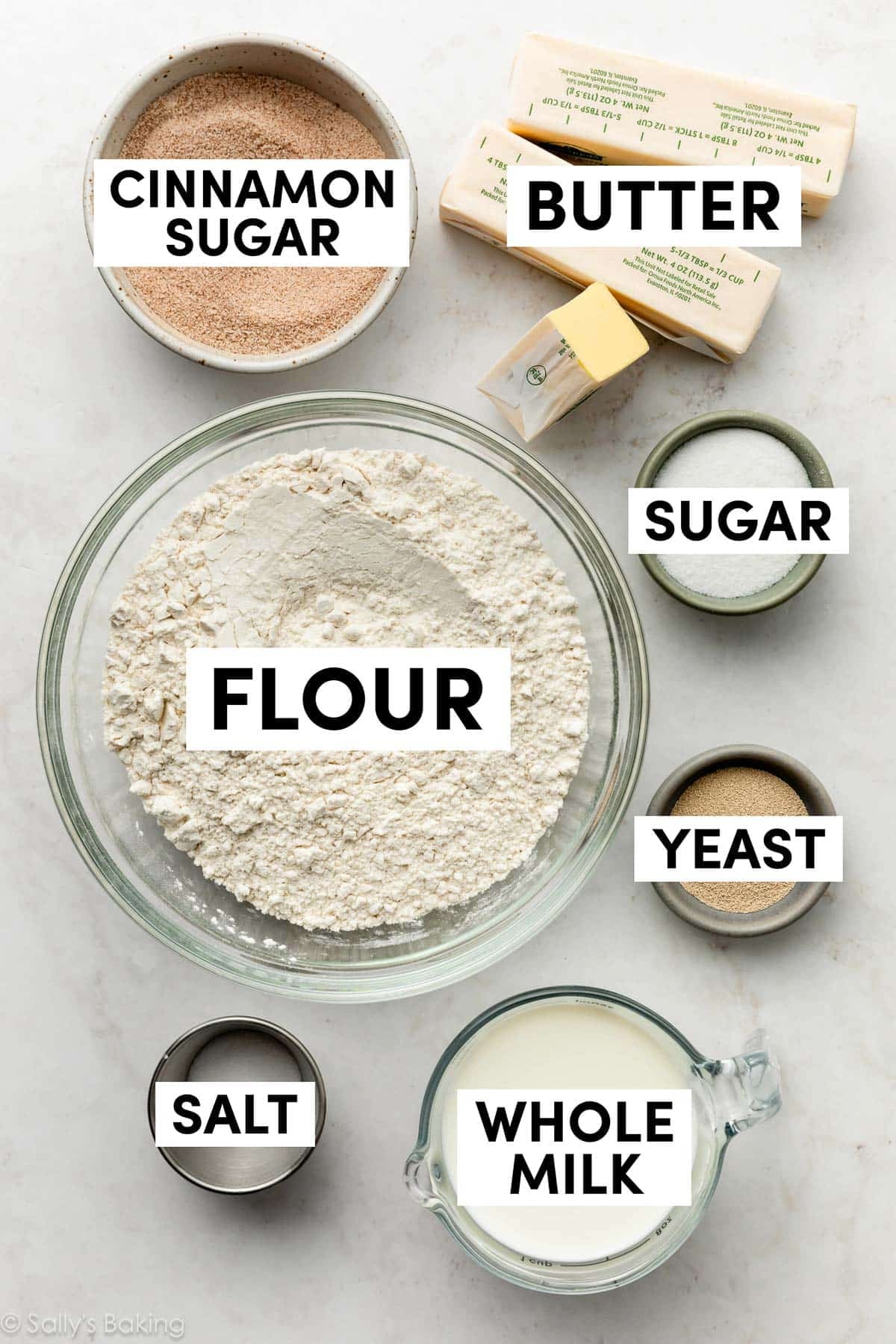
You need very basic ingredients: whole milk, yeast, sugar, salt, butter, and all-purpose flour. I recommend European-style butter here. It has a higher fat content than American-style butter, giving it a richer flavor. While the difference is subtle in many baked goods, it becomes more noticeable in recipes where the butter is the main ingredient… like cruffins!
Not only did my team and I notice better flavor, the dough was easier to roll out when laminated with European-style butter. It’s softer, which made the dough more pliable… and the process easier! 😉
If you have a stand mixer with a dough hook attachment, you can use that to make and knead the dough, but it’s not required. See my How to Knead Dough tutorial if you need any extra help with the kneading step.
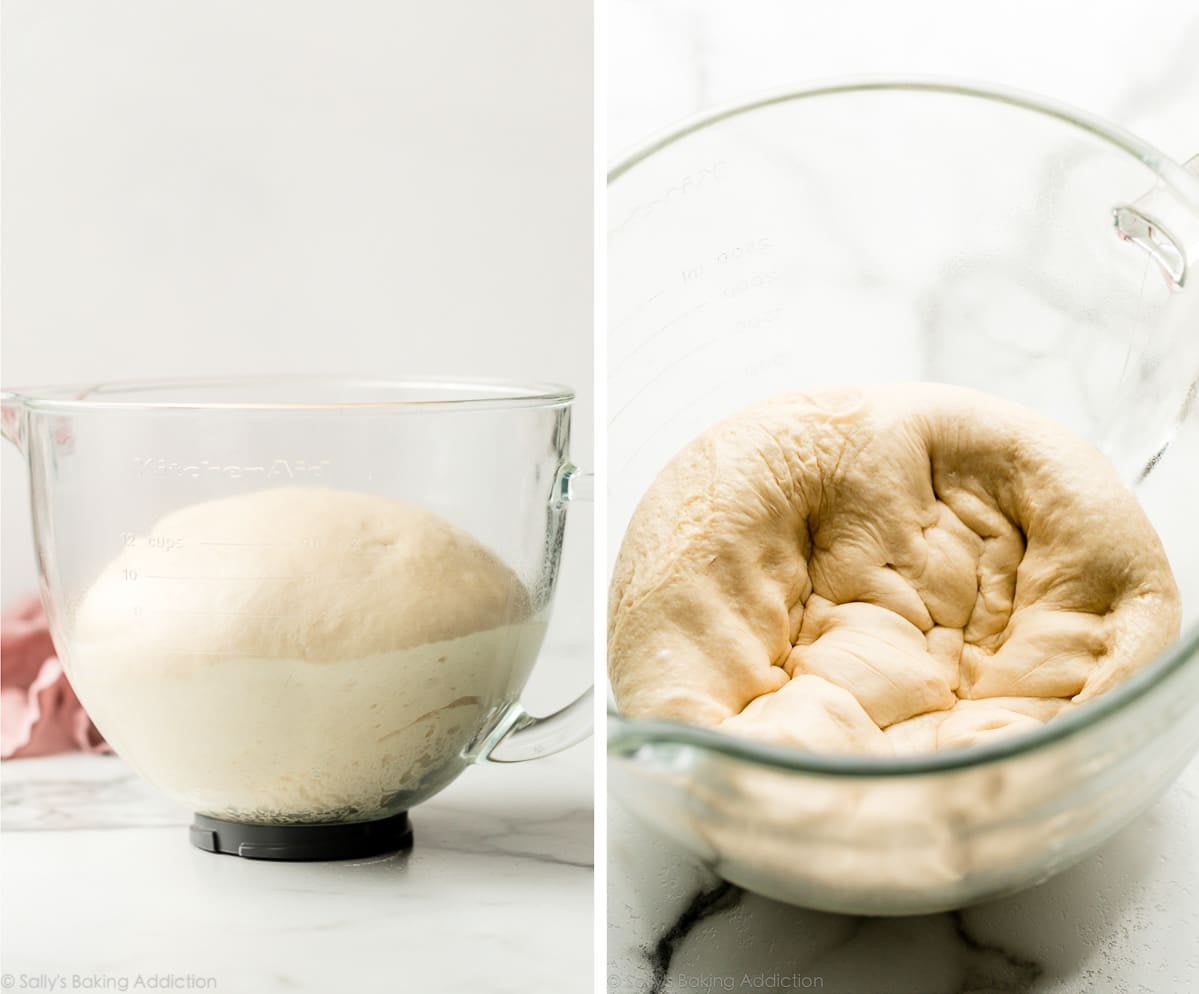
When the dough is ready to rise, cover it and let it rise for around 2 hours, until it’s nearly doubled in size. Gently punch down the risen dough to deflate it:
Roll the dough into a 10×14-inch rectangle on a lightly floured silicone baking mat or piece of parchment paper. If your baking mat has a border like a Silpat (pictured below), you can use the border of the baking mat as your guide—it’s like having a cheat sheet!
Place the baking mat on a baking sheet, cover, and refrigerate for 20 minutes. During this first refrigeration, prepare for the lamination.
In Photos: Lamination Process
Laminating dough is the process of folding butter into dough many times, which creates multiple alternating layers of butter and dough. When the laminated dough bakes, the butter melts and creates steam. This steam lifts the layers apart, leaving us with dozens of flaky airy buttery layers. We achieve something similar in rough puff pastry, pie crust, and biscuits.
The butter you use for laminating this cruffin dough should be slightly softened but still cool—about 60–64°F (15–18°C) is ideal. You want it to be about the same temperature as the refrigerated dough. If you have an instant-read thermometer, you can insert it in both the butter and the dough to check.
With a mixer, beat the butter with a Tablespoon of flour. I learned this from Zoe at Zoe Bakes. (Please go follow Zoe, she is the absolute best!) Start with softened butter and beat it with flour so it has some stability, which makes laminating easier.
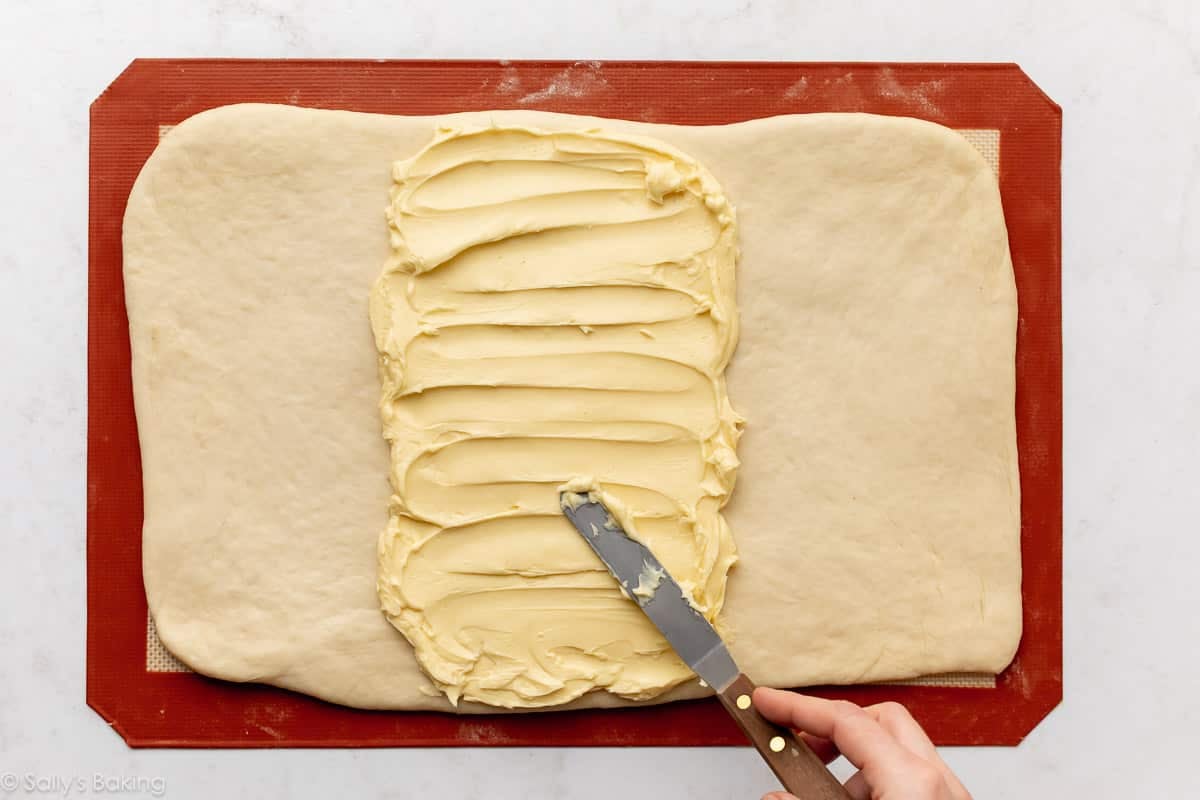
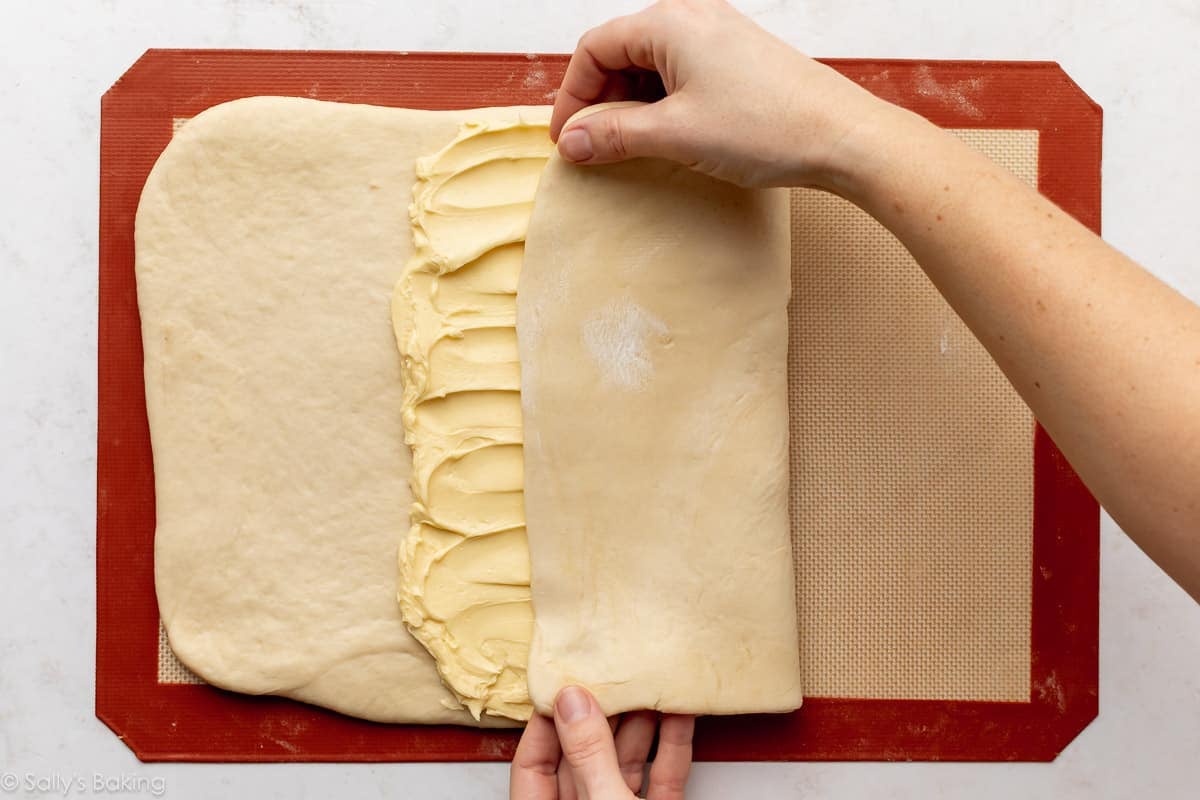
1st lamination: Remove the dough from the refrigerator and spread the beaten butter down the middle third of the dough with a sturdy knife, leaving a ½-inch border at the top and bottom:
Fold the sides of the dough over the butter, like you’re folding a letter into thirds:
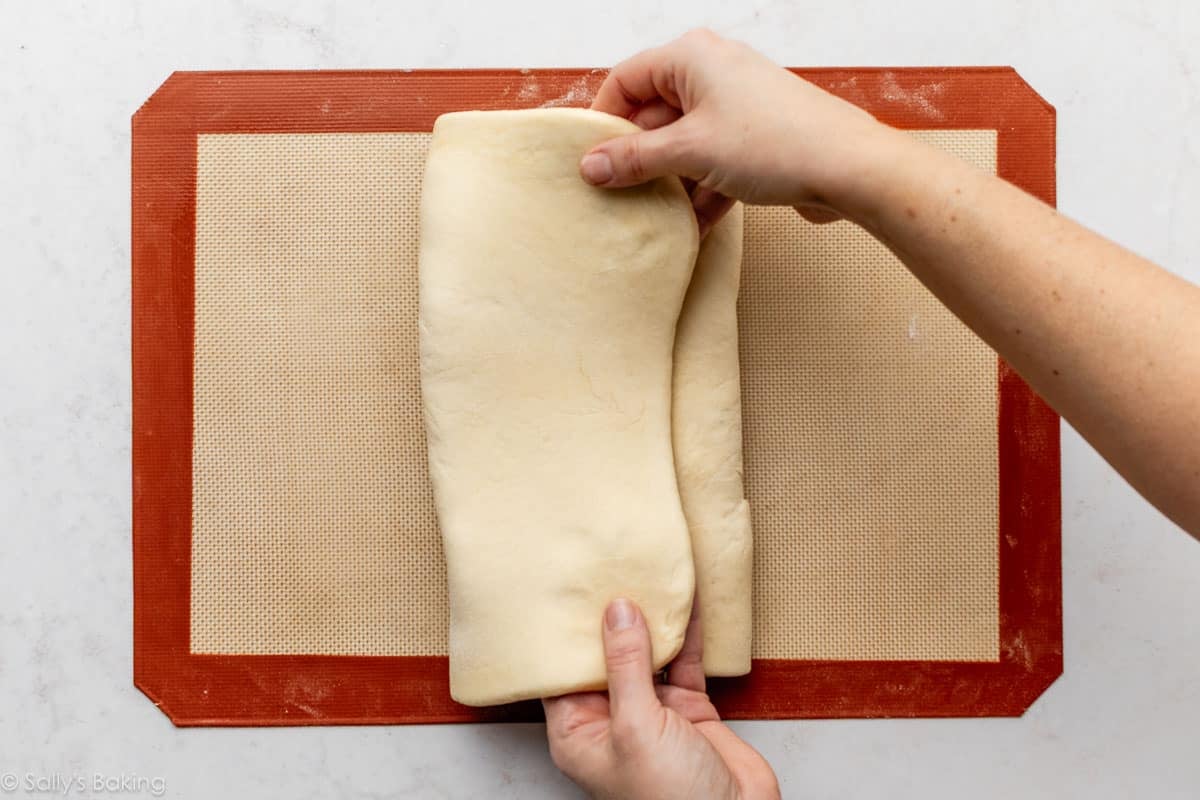
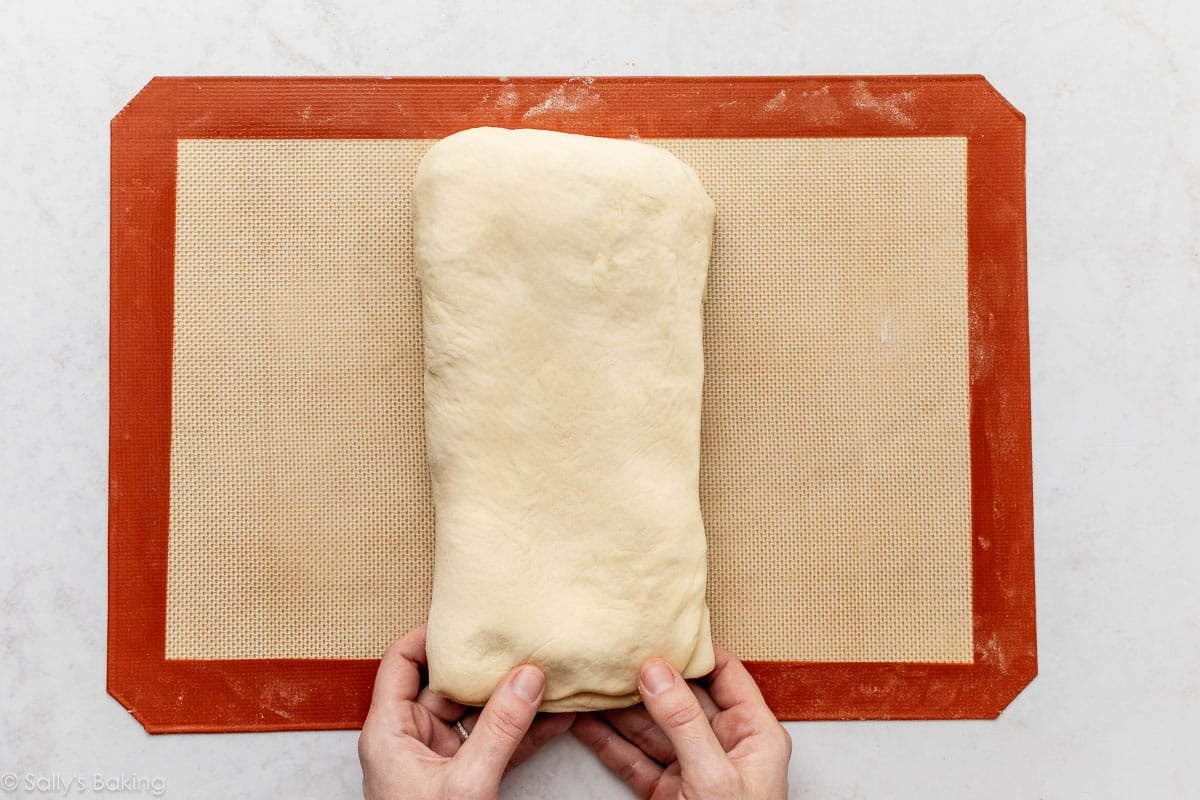
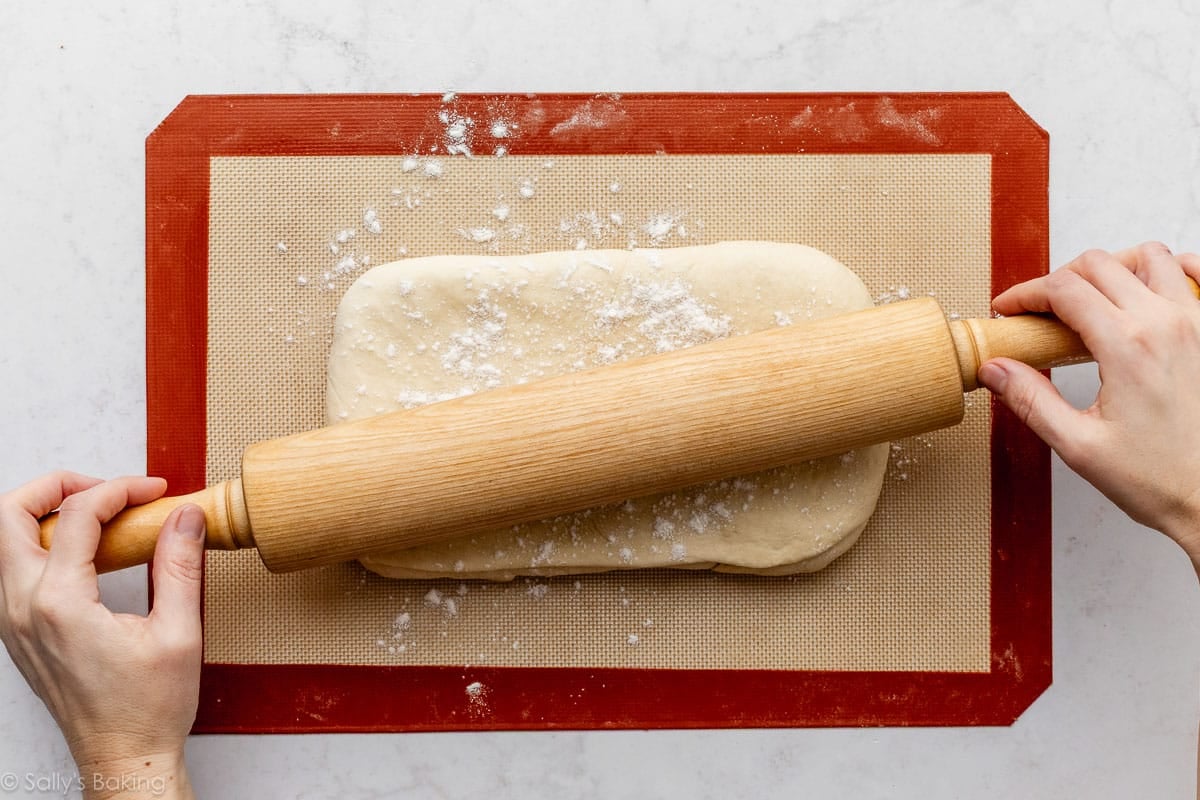
Pinch the top and bottom ends to seal the butter inside. Turn the dough 90 degrees, so the longer side is horizontal in front of you. Sprinkle with flour. Roll out to 9×12 inches.
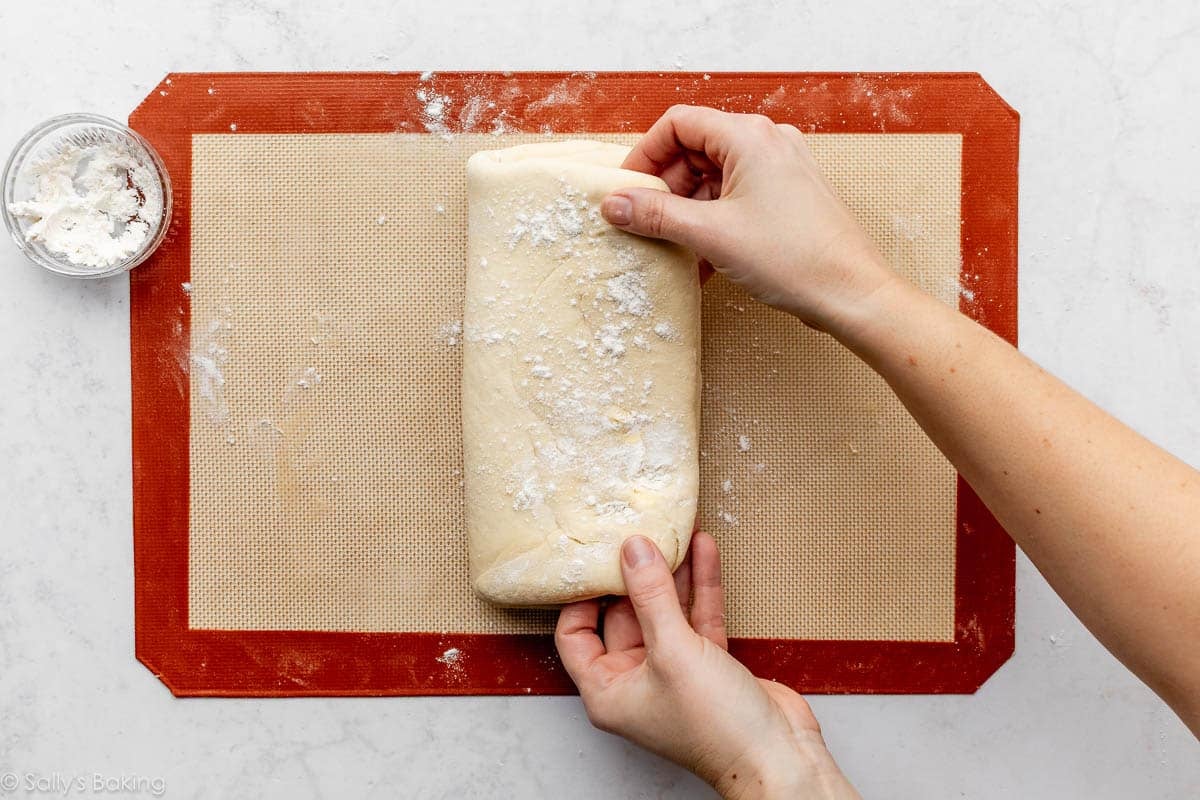
Fold in thirds again:
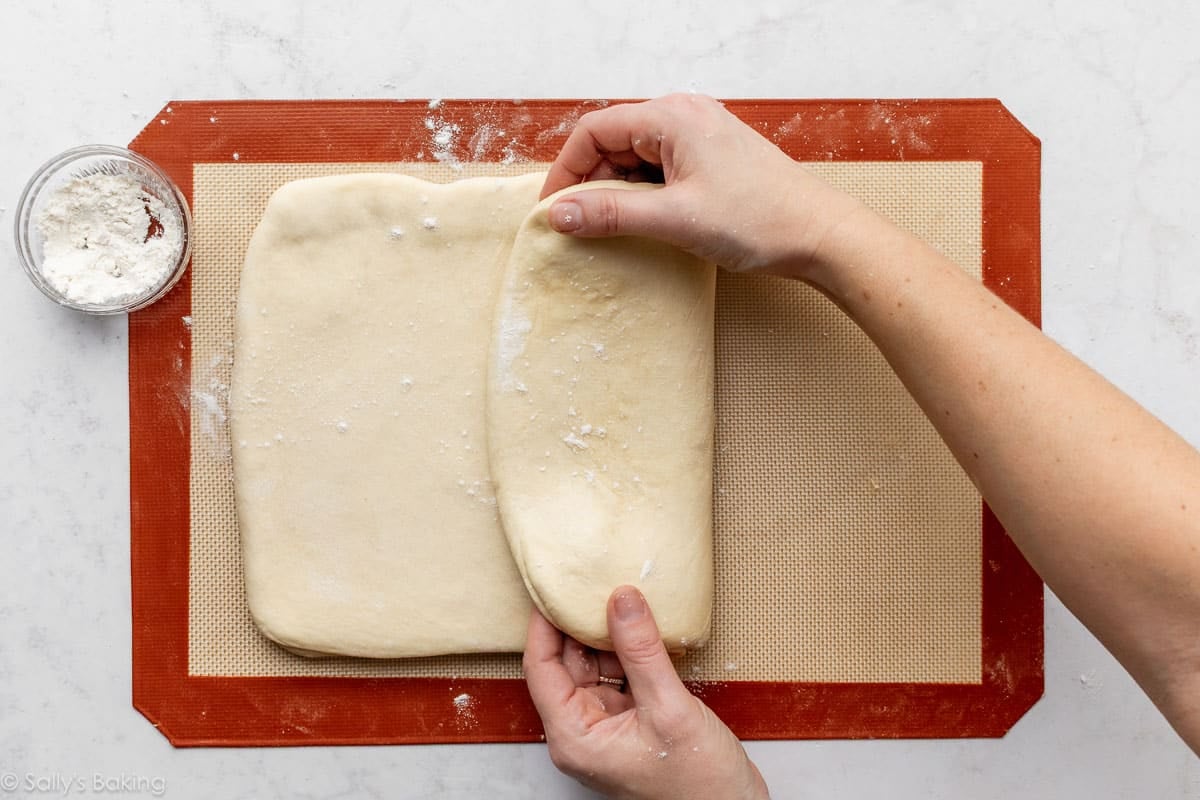
Cover and refrigerate for 20 minutes.
2nd lamination: Turn the dough horizontally in front of you, and roll it out to 9×12 inches again. Fold in thirds. Turn 90 degrees. Roll out to 9×12 inches again. Fold in thirds. Cover and refrigerate for 20 minutes.
3rd lamination: Repeat the same steps as the 2nd lamination. Cover and refrigerate for 20 minutes.
3 Lamination Success Tips
- Do not extend the time between laminations, or it will become too stiff and difficult to roll out.
- It’s OK if there are air bubbles in the dough; your rolling pin will pop them.
- If the butter starts coming through the dough in spots, sprinkle some flour over it and continue to roll. You may need to flip the dough upside down and sprinkle more flour on the bottom to keep it from sticking to the baking mat/your work surface.
Shaping the Cruffins
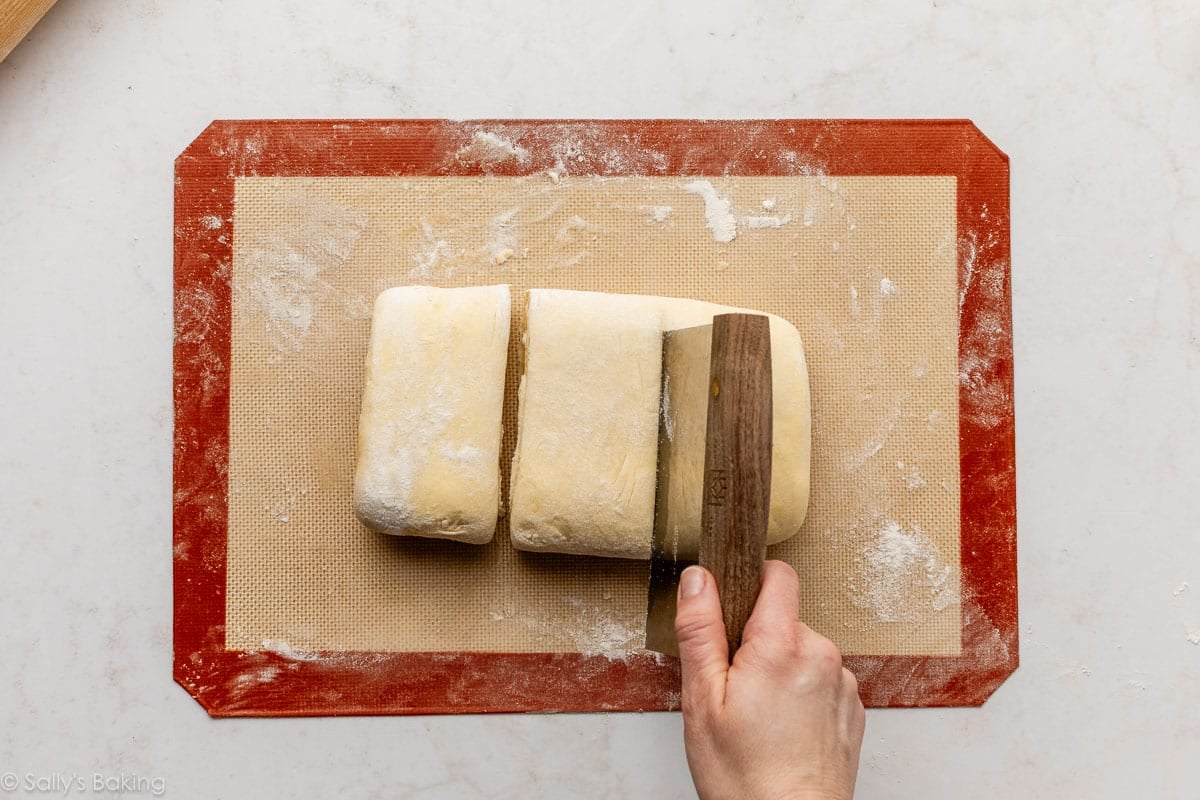
Cut the chilled dough into 3 roughly equal portions. They should each weigh around 300–340g, give or take. Take one dough portion and roll it out to 8×12 inches; it will keep shrinking back and not reach these dimensions yet. Set it aside to rest while you roll out the next piece. Set that one aside. Roll out the last piece and set it aside.
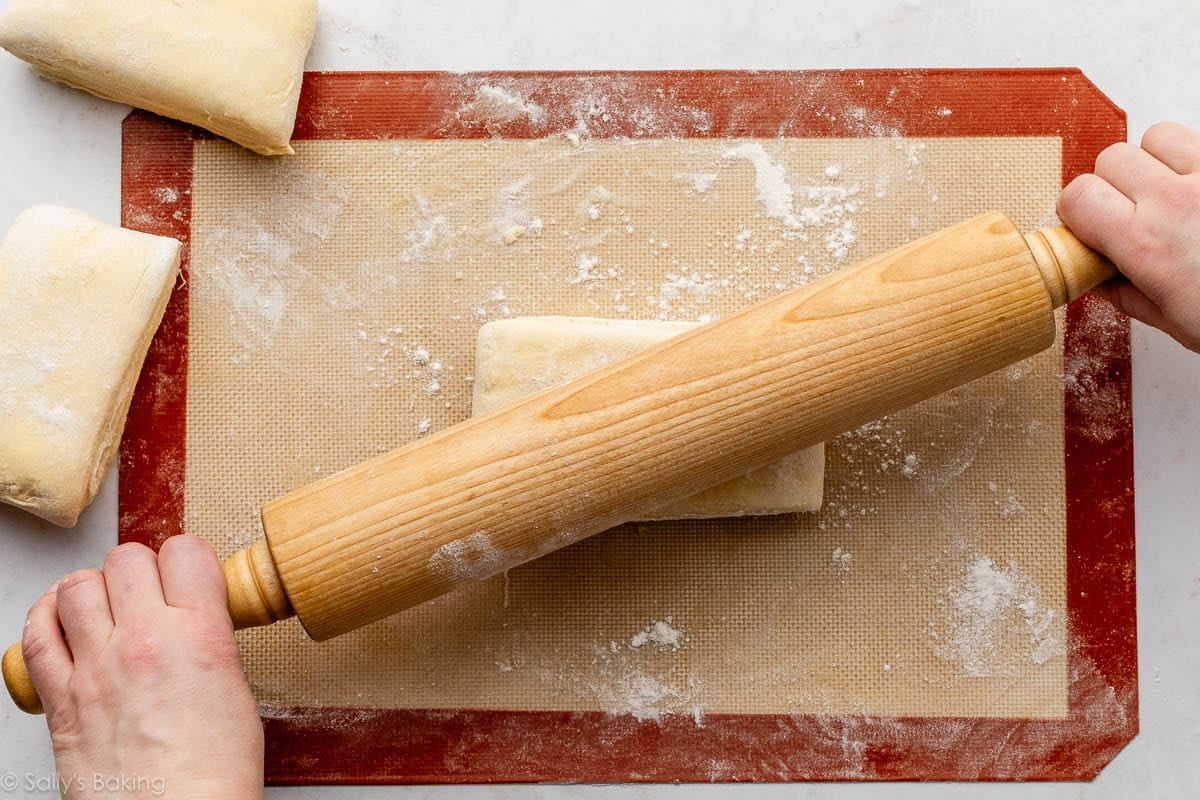
Take the first piece you rolled out and roll it out again. After its short rest, it should be much easier now to roll it out to be 8×12 inches. Re-flour and flip the dough over as needed to keep it from sticking to the surface or rolling pin:
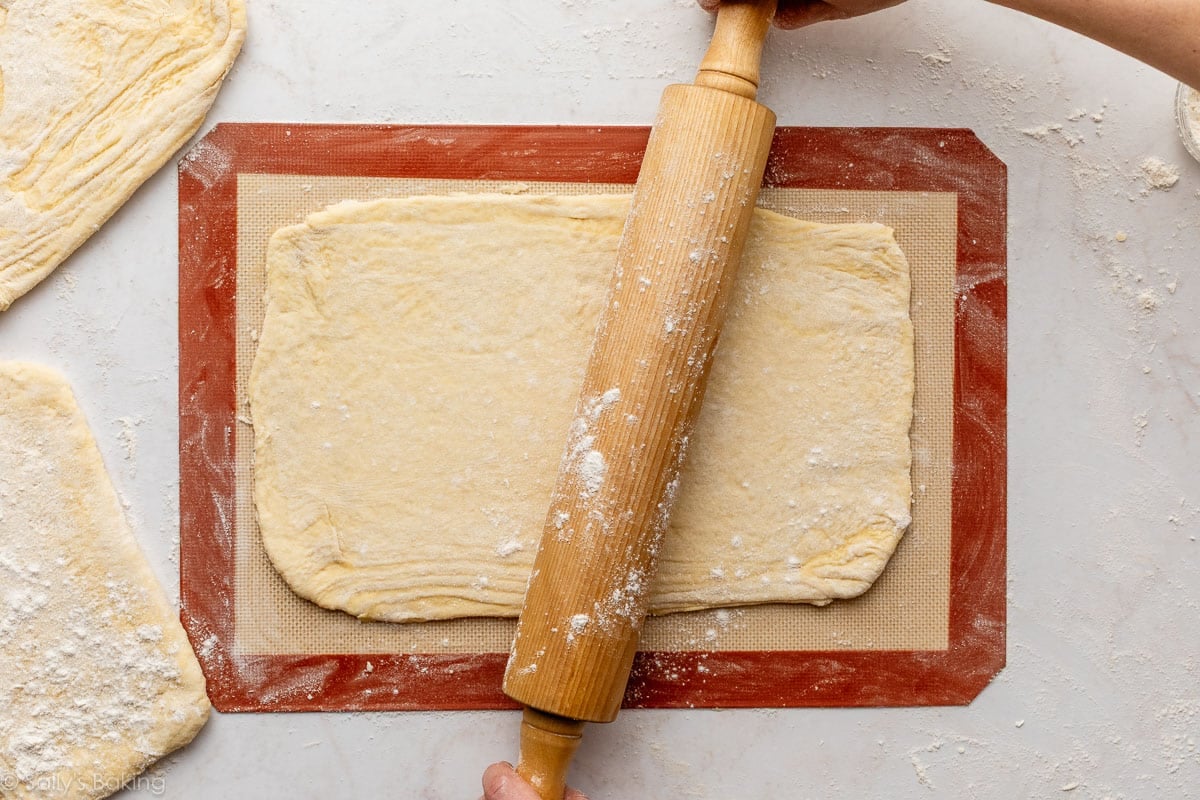
Sprinkle the surface with cinnamon-sugar.
With a pizza cutter or sharp knife, cut 1-inch strips of dough.
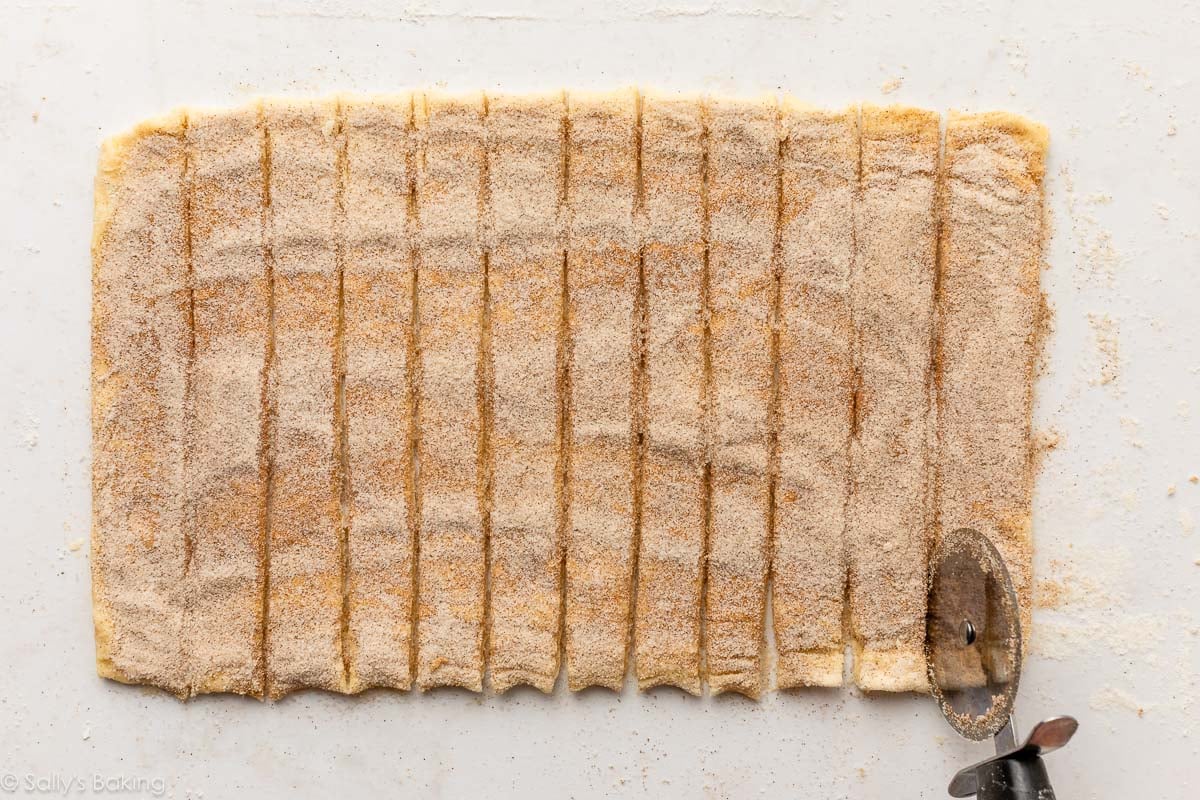
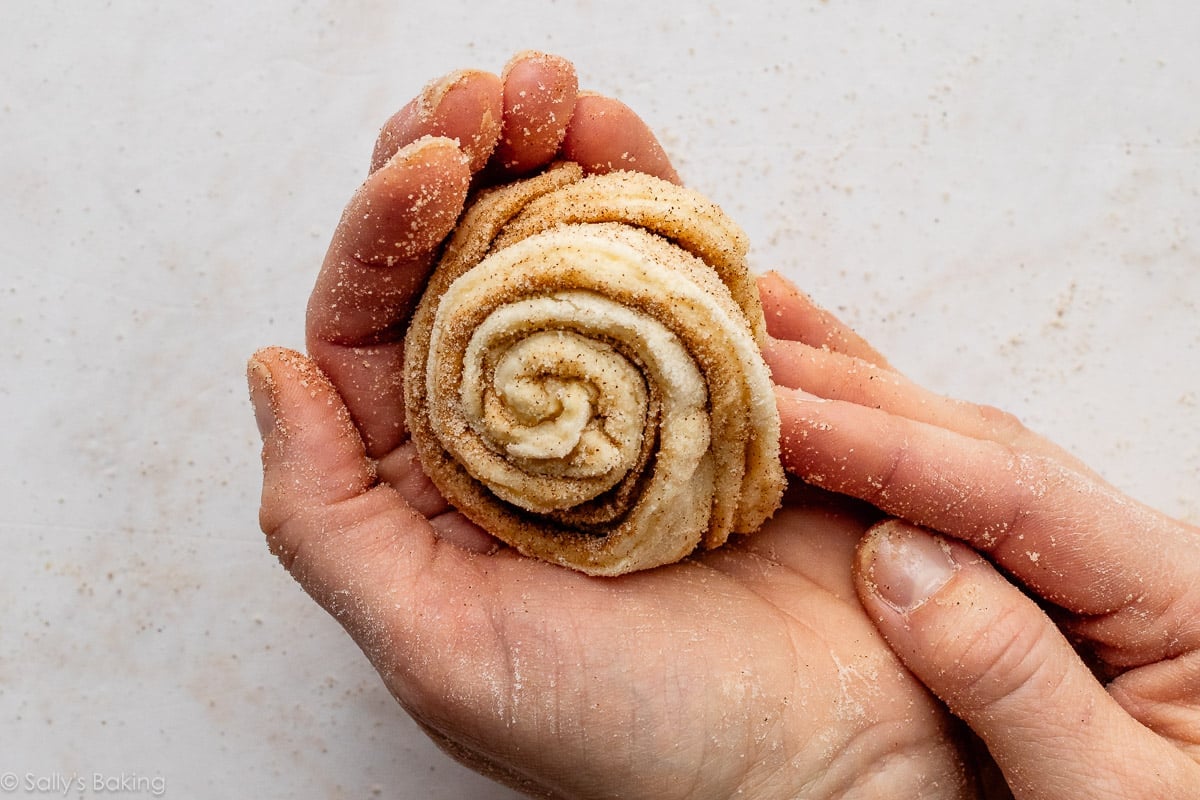
Working with 3 strips at a time, layer them on top of one another. Roll them up together in a spiral cinnamon-roll shape:
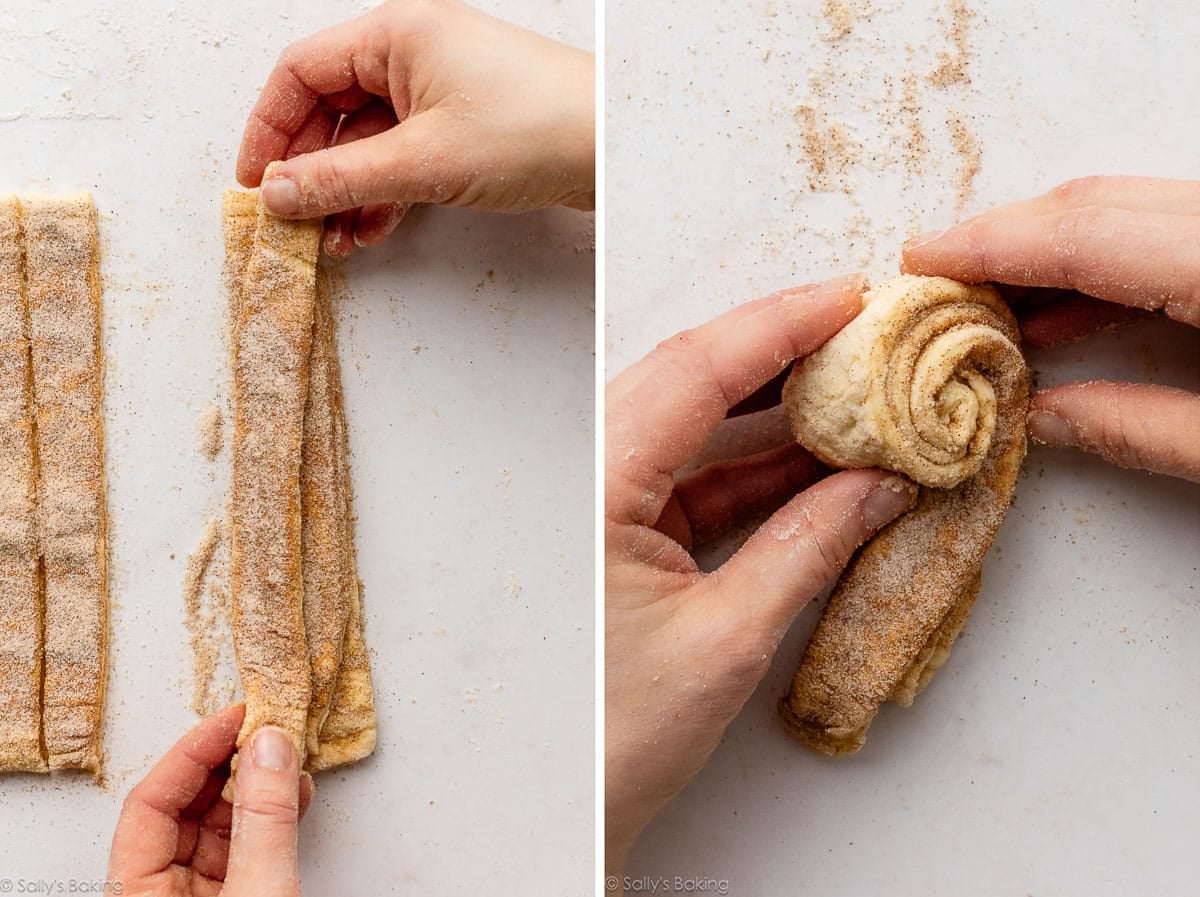
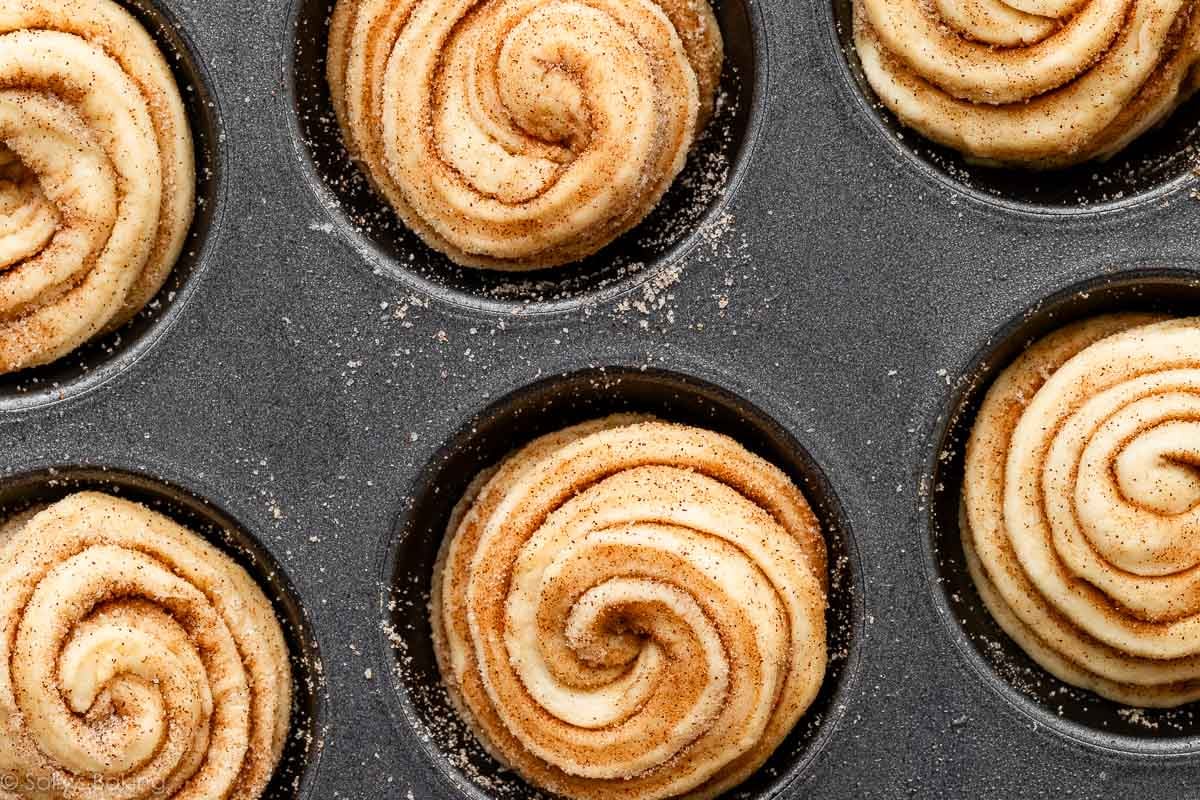
Place in one well of a greased muffin pan. Repeat with the remaining strips to get 4 cruffins.
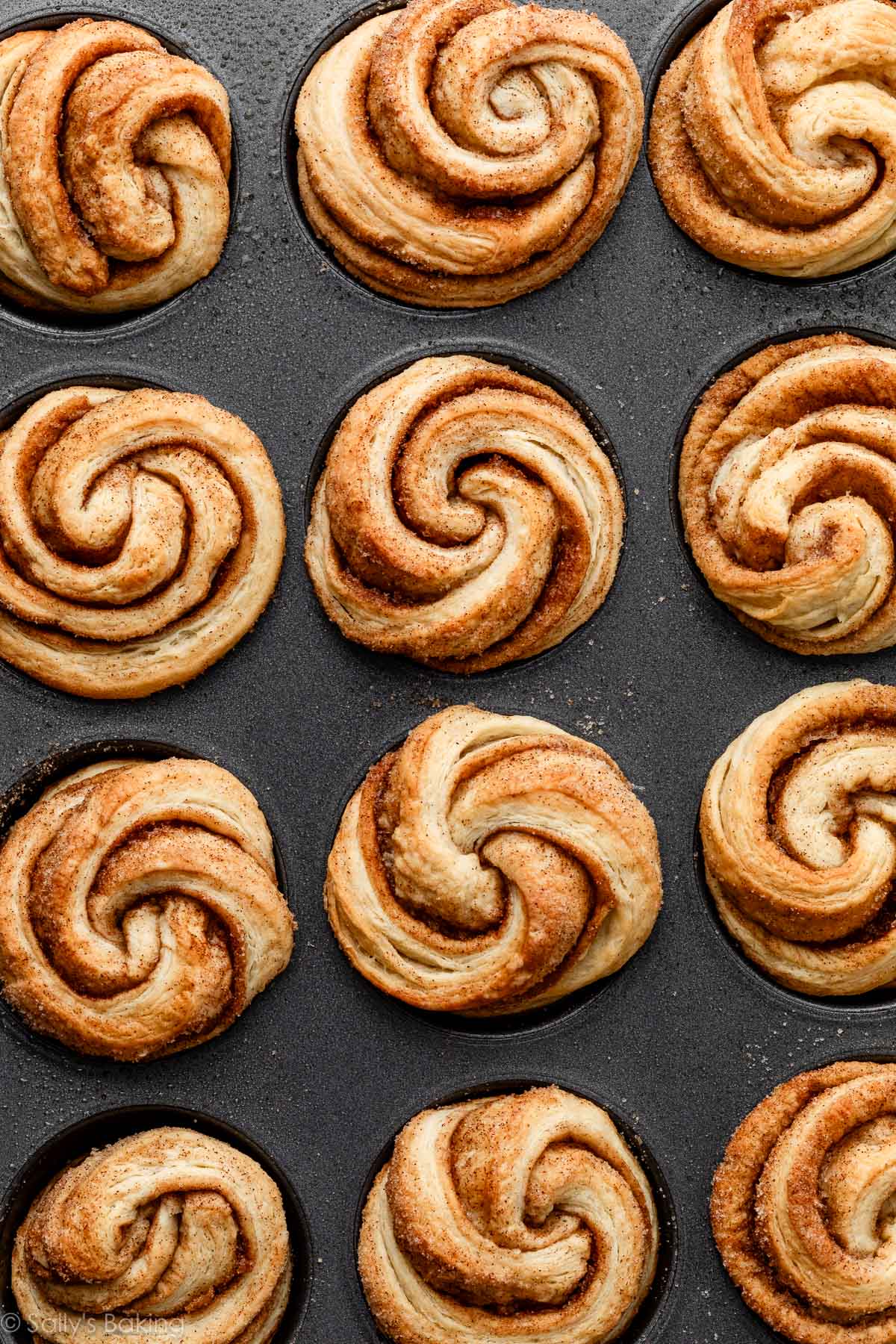
HAVE NO WORRIES: Keep in mind that your cruffins may look slightly different from these photos, and from each other. That’s OK! Because of the way we’re shaping them, each cruffin bakes up a little differently. Once you roll the baked cruffins in sparkly cinnamon-sugar at the end, they somehow all look uniquely beautiful, no matter how they looked in the muffin pan.
Now repeat this shaping process with the remaining 2 portions of dough—you’ll end up with 12 cruffins. Lightly cover the cruffins and let them rise for 1 hour.
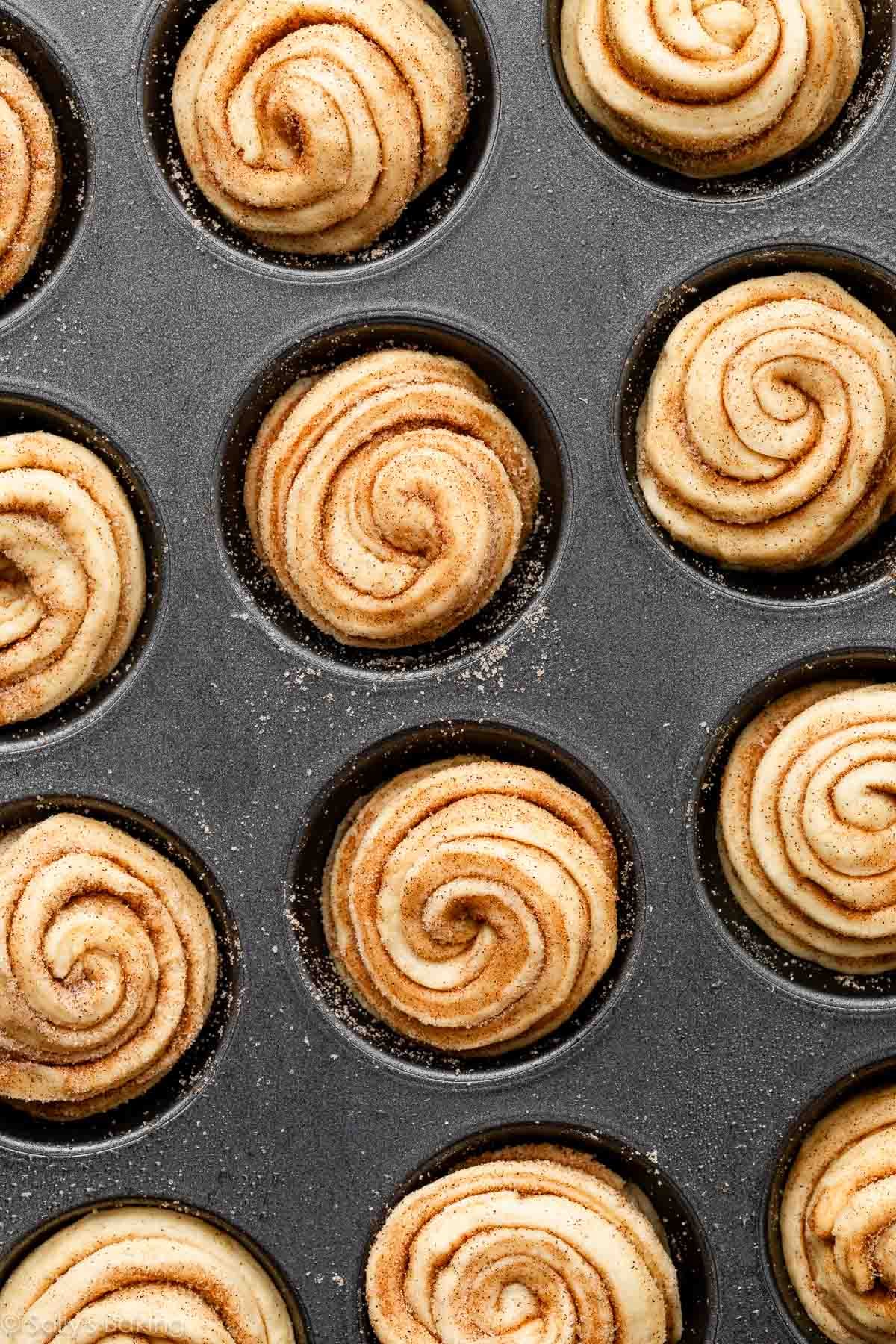
The cruffins take about 25–28 minutes to bake. If you check one with an instant-read thermometer, they’re done when the internal temperature reaches 200°F (93°C).
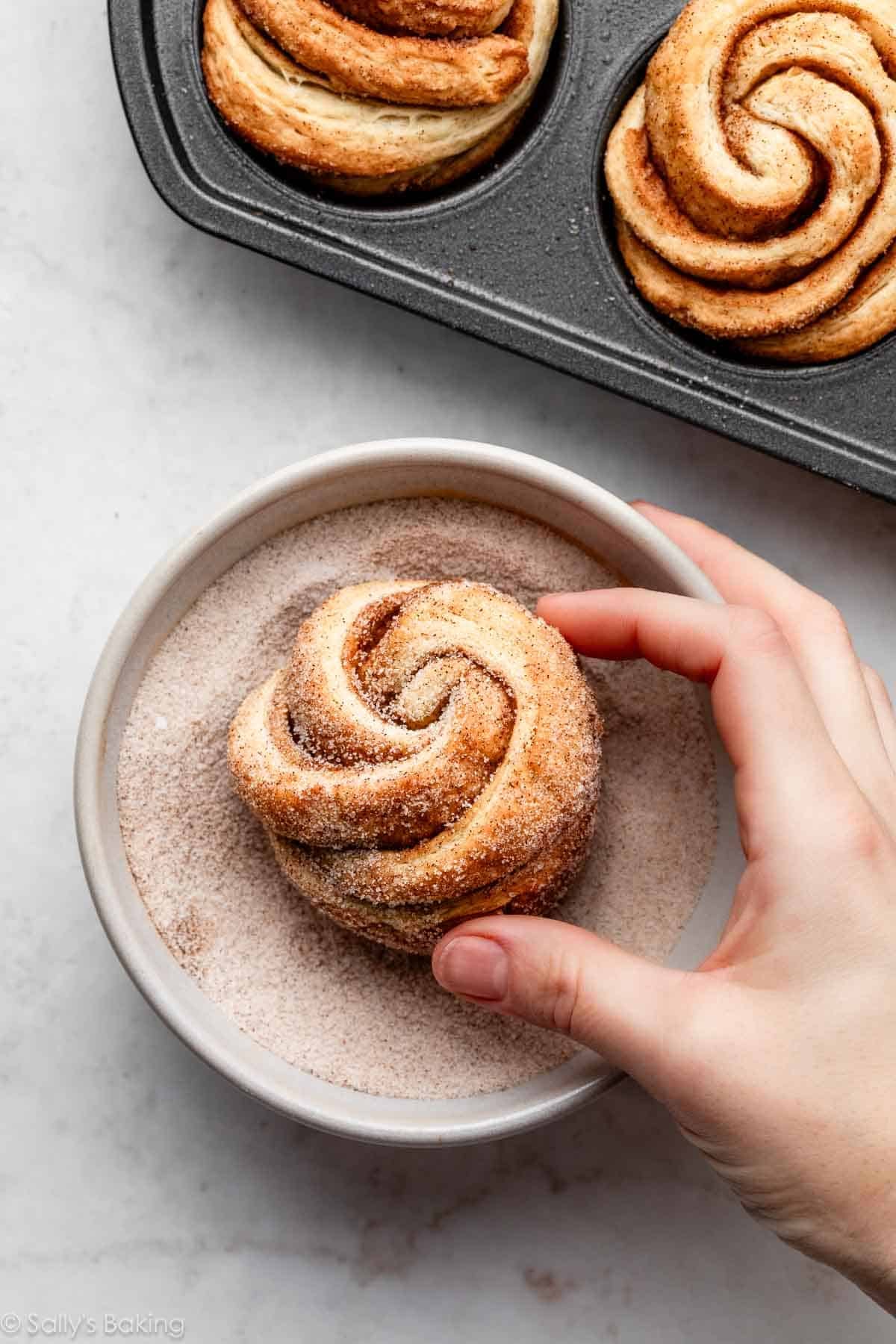
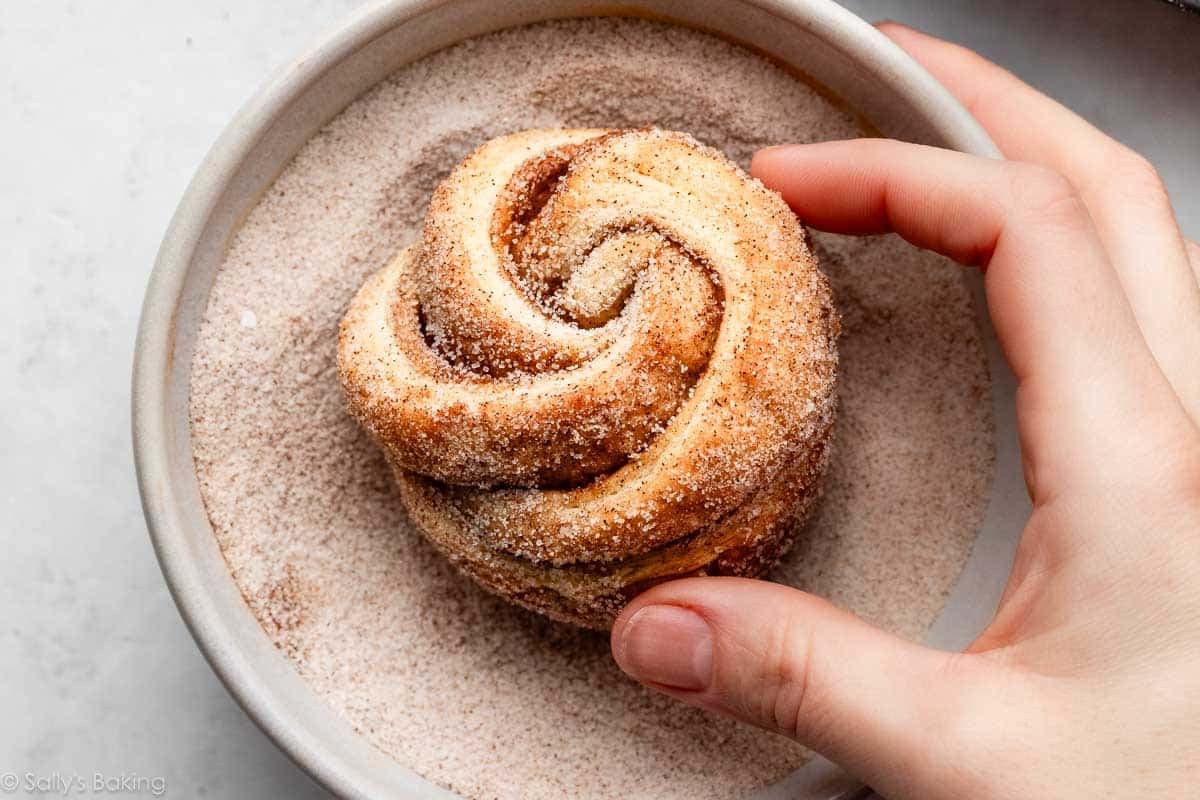
Let the cruffins cool slightly in the pan, just about 10 minutes. Once they are cool enough to handle but still warm, roll them in the remaining cinnamon-sugar. (Feel free to make some extra cinnamon-sugar if you want to be generous with your coating!)
Optional Filling
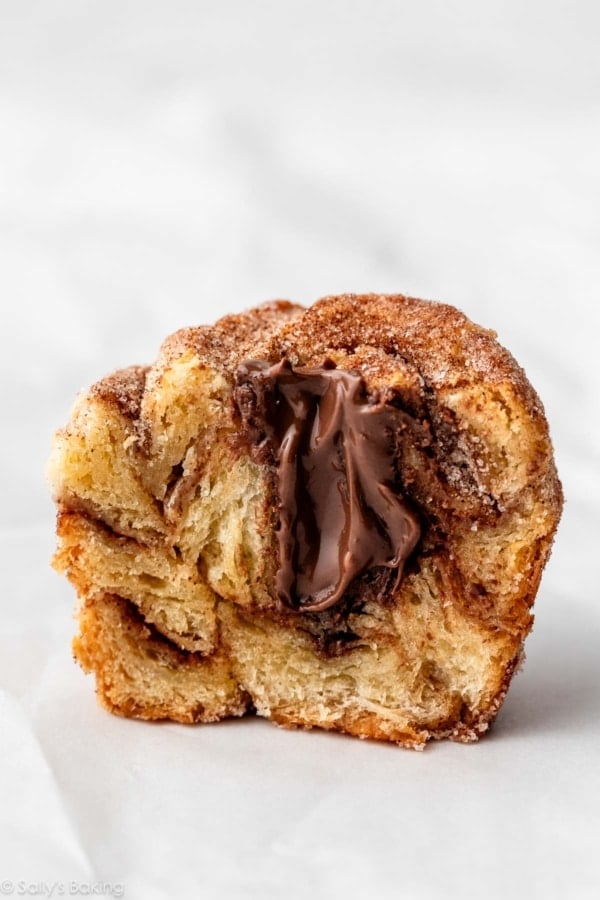
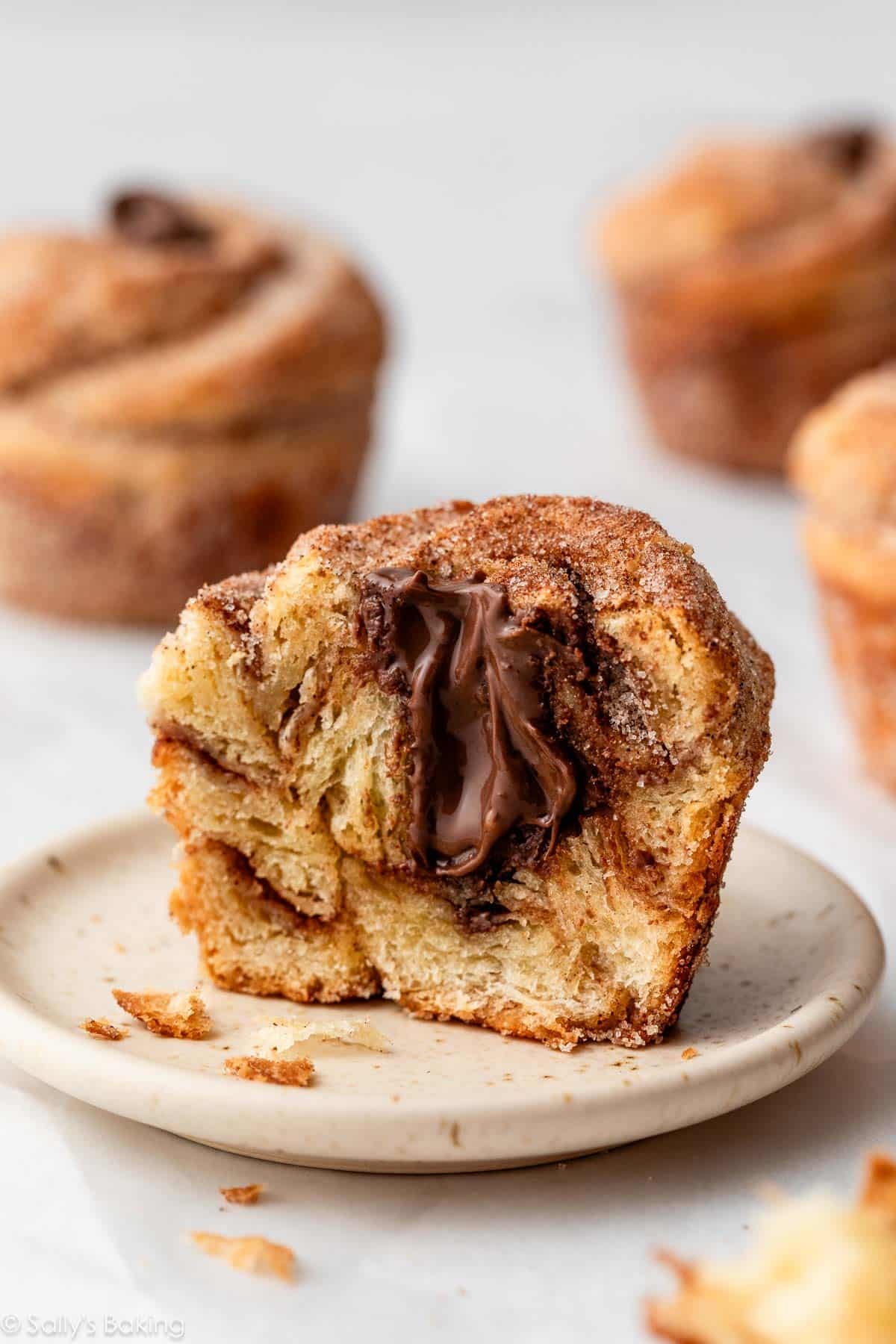
These cruffins are perfect as is, but if you want to take them one step further, you can fill them. These cinnamon-sugar cruffins taste utterly fabulous with Nutella; and other fillings such as jam, lemon curd, or pastry cream are equally delicious.
Like when we fill cupcakes, a long thin piping tip is great for this task. I use Wilton #230 to fill cruffins. Poke a hole in the center of a cruffin with a skewer, insert the piping tip into the hole, and squeeze the piping bag until the filling reaches the top of the cruffin.
Check out these layers:
I hope you enjoy diving into this wonderful layered, laminated, and spiraled world of buttery pastry!
Helpful Tools for Making Cruffins
- Stand mixer with dough hook attachment (not required, but helpful)
- A timer
- Silicone baking mats or parchment paper
- Baking sheet (make sure it fits in your refrigerator)
- Instant-read thermometer
- Rolling pin
- Muffin pan
- Pizza cutter or sharp knife
- Measuring tape or ruler
- Bench scraper
- Piping bag + long, skinny piping tip such as Wilton #230

Homemade Cruffins
- Prep Time: 4 hours, 45 minutes
- Cook Time: 25 minutes
- Total Time: 5 hours, 45 minutes (includes some cooling)
- Yield: 12 cruffins
- Category: Pastries
- Method: Baking
- Cuisine: French
Description
Buttery and flaky croissant dough gets twisted up with a generous dose of cinnamon-sugar and baked in a muffin pan, combining two tasty treats into one incredible hybrid: croissants + muffins = cruffins. Bakery cruffins are usually taller than this homemade version because they’re baked in deeper pans, such as popover pans. Since many home bakers don’t have popover pans, this recipe is designed for a standard muffin pan.
Ingredients
Dough
- 1 cup (240ml) whole milk, warmed to about 110°F (43°C)
- 2 and 1/4 teaspoons (7g) instant or active dry yeast (1 standard packet)
- 3 Tablespoons (38g) granulated sugar
- 3 Tablespoons (43g) unsalted or salted butter, softened to room temperature and cut into 3 pieces
- 3 cups (375g) all-purpose flour (spooned & leveled), plus more as needed
- 1 and 1/4 teaspoons salt
Lamination
- 1 cup (16 Tbsp; 226g) salted butter, slightly softened (see Note)
- 1 Tablespoon all-purpose flour
Filling & Coating
- 3/4 cup (150g) granulated sugar
- 1 Tablespoon ground cinnamon
- optional fillings: 6 Tablespoons Nutella, jam, lemon curd, or pastry cream
Instructions
- Preliminary notes: Use the step-by-step photos as visuals before you begin. Read the recipe instructions and notes before beginning. Make room in the refrigerator for your baking sheet for steps 6–10.
- Prepare the dough: Whisk the warm milk, yeast, and sugar together in the bowl of your stand mixer fitted with a dough hook attachment. Cover and allow mixture to sit for about 5 minutes or until foamy on top. *If you do not own a mixer, you can do this in a large mixing bowl and in the next step, mix the dough together with a large wooden spoon/silicone spatula. A hand mixer works, but the sticky dough repeatedly gets stuck in the beaters. Mixing by hand with a wooden spoon or silicone spatula is a better choice.*
- Add the butter, 2 cups (250g) of flour, and the salt. Beat on medium speed for 2 minutes, stopping and scraping down the bowl as needed to help the mixture combine. There may still be chunks of butter—that’s ok. Add the remaining 1 cup (125g) of flour, scrape down the bowl as needed, and beat on low speed until a soft dough forms and pulls away from the sides of the bowl. Dough will be soft, but not overly sticky. Beat in 2 more Tablespoons of flour if dough seems very sticky. Avoid adding more flour than you need.
- Knead the dough: Keep the dough in the mixer and beat for an additional 5 full minutes, or knead by hand on a lightly floured surface for 5 full minutes. (If you’re new to bread-baking, my How to Knead Dough video tutorial can help here.) If the dough becomes too sticky during the kneading process, sprinkle 1 teaspoon of flour at a time on the dough or on the work surface/in the bowl to make a soft, slightly tacky dough. Do not add more flour than you need because you do not want a dry dough. After kneading, the dough should still feel a little soft. Poke it with your finger—if it slowly bounces back, your dough is ready to rise. You can also do a “windowpane test” to see if your dough has been kneaded long enough: tear off a small (roughly golfball-size) piece of dough and gently stretch it out until it’s thin enough for light to pass through it. Hold it up to a window or light. Does light pass through the stretched dough without the dough tearing first? If so, your dough has been kneaded long enough and is ready to rise. If not, keep kneading until it passes the windowpane test.
- 1st rise: Lightly grease a large bowl with oil or use nonstick spray. Place the dough in the bowl, turning it to coat all sides of the dough in the oil. Tightly cover the bowl and allow the dough to rise in a relatively warm environment for around 2 hours or until nearly double in size. (For a tiny reduction in rise time, see my answer to Where Should Dough Rise? in my Baking with Yeast Guide.)
- Flatten dough: Gently punch down the dough to release the air. Place dough on a lightly floured silicone baking mat– or parchment paper-lined baking sheet. (I highly recommend a silicone baking mat because you can roll the dough out in the next steps directly on top and it won’t slide all over the counter.) Gently flatten the dough out into a 10×14-inch (25x36cm) rectangle using lightly floured hands to carefully stretch, but not tear, the dough. (You could also use a floured rolling pin.) Lightly cover and place the entire baking sheet in the refrigerator, and allow the covered dough to rest and chill for 20 minutes. Do not extend this time.
- Meanwhile, prepare for lamination: Make sure the butter is slightly softened but still cool—between 60–64°F (15–18°C) is ideal. Using a hand mixer or a stand mixer fitted with a paddle attachment, beat the butter and 1 Tablespoon flour together until completely combined. It’s important to note the following 3 tips before you begin laminating: (1) Have a bowl of flour at hand to continually flour your surface and rolling pin as needed. If the dough tears and butter is exposed, sprinkle the exposed butter with flour. (2) If the dough is impossible to roll, try flipping it over. If it’s still impossible to roll, cover and let it rest for 5 minutes before trying again, to let the gluten relax. (3) Do not extend the refrigeration times, because the folded dough will begin to over-expand, and it will also become very difficult to roll out.
- 1st lamination: Remove dough from the refrigerator and set the baking sheet aside. I like to keep the dough on the silicone baking mat when I’m rolling it because the mat is nonstick. Working with the longer (14-inch) edge in front of you, spread the beaten butter down the center of the dough, covering the center third of the dough. Fold one dough edge over on top of butter, and fold other edge on top of that (like folding a business letter). Pinch/seal the two short ends to enclose butter inside. Rotate dough so the long edge is horizontally in front of you. Lightly flour the top of the folded dough and, using a lightly floured rolling pin, roll out to a 9×12-inch (23x30cm) rectangle. Fold dough edges over on top like folding a business letter. Cover dough, place back on baking sheet, and refrigerate 20 minutes. Do not extend this time.

- 2nd lamination: Remove dough from the refrigerator and set baking sheet aside. Rotate dough so the long edge is horizontally in front of you. Lightly flour the top of the folded dough and, using a lightly floured rolling pin, roll out to a 9×12-inch (23x30cm) rectangle. Fold dough edges over on top like folding a business letter. Rotate dough horizontally and repeat rolling out to 9×12 inches and folding like a business letter. Cover dough, place back on baking sheet, and refrigerate 20 minutes.
- 3rd lamination: Remove dough from the refrigerator and set baking sheet aside. Rotate dough so the long edge is horizontally in front of you. Lightly flour the top of the folded dough and, using a lightly floured rolling pin, roll out to a 9×12-inch (23x30cm) rectangle. Fold dough edges over on top like folding a business letter. Rotate dough horizontally and repeat rolling out to 9×12 inches and folding like a business letter. Cover dough, place back on baking sheet, and refrigerate 20 minutes.
- Shape & fill: Lightly grease a standard 12-cup muffin pan. In a medium bowl, mix together the sugar and cinnamon. Remove dough from the refrigerator and set baking sheet aside. Place the chilled dough on a cutting board and cut into 3 even rolls. (You can also cut the dough into thirds right on the silicone baking mat, but make sure you are not using a super sharp knife on your baking mat—I use a bench scraper.)
- (Note: this step can get messy!) Lightly flour your work surface and rolling pin. Working with one portion of dough at a time, roll out to an 8×12-inch rectangle. If it keeps shrinking back as you try to roll it out, let it rest for 5 minutes and then try again. It will eventually relax enough to get to 12 inches in length. Sprinkle evenly with 2 Tablespoons of cinnamon-sugar, and use the back of a spoon or a spatula to press it down into the dough. With a pizza cutter or sharp knife, cut 12 1-inch strips of dough. You can mark them out first with a ruler/measuring tape and a knife. Working with 3 strips at a time, layer them on top of one another. Roll them up together in a spiral and tuck the ends underneath. Place in one cup of the prepared muffin pan. Repeat this step with the remaining 2 portions of dough to get 12 cruffins.

- Cover cruffins lightly and allow to rise for 1 hour, until puffy.
- Preheat the oven to 350°F (177°C).
- Bake for 25–28 minutes, or until the internal temperature reaches 200°F (93°C). Remove from the oven and let the cruffins slightly cool in the pan set on a cooling rack.
- Coat the cruffins and fill, if desired: Once cool enough to handle, roll each cruffin in the remaining cinnamon-sugar. At this point you can enjoy the cruffins plain, or fill them with your filling of choice. Fill a piping bag (reusable or disposable) fitted with a long, skinny filling tip, such as Wilton 230, with the filling. Poke a hole 3/4 of the way down into the cruffin with a skewer (or just insert the long piping tip) and squeeze to fill the cruffin.
- Cover and store leftover cruffins at room temperature for up to 3 days.
Notes
- Overnight Dough Instructions: After step 12, tightly cover the shaped cruffins in the pan and refrigerate for up to about 12 hours. At least 2 hours before you need the cruffins the next day, remove from the refrigerator, keep covered, and allow to rise on the counter for about 1 hour before baking. Alternatively, you can let the dough have its 1st rise (step 5) in the refrigerator overnight. Cover the dough tightly and place in the refrigerator for up to 12 hours. Remove from the refrigerator and allow the dough to fully rise for 2 more hours. Continue with step 6.
- Freezing Instructions: After the coated cruffins cool completely, wrap each individually in plastic wrap and place in a freezer-friendly container. Freeze up to 3 months. Thaw at room temperature. I do not recommend freezing this dough before lamination because it makes laminating difficult. I also do not recommend freezing the shaped unbaked cruffins, as they will simply not puff up in the oven.
- Special Tools (affiliate links): Stand Mixer (preferred), Hand Mixer, or Glass Mixing Bowl with Wooden Spoon / Silicone Spatula | Silicone Baking Mat or Parchment Paper | Baking Sheet | Instant-read Thermometer | Rolling Pin | Bench Scraper | Pizza Cutter | 12-count Muffin Pan | Cooling Rack | Piping Bag (Reusable or Disposable) | Long, skinny piping tip such as Wilton #230
- Milk: Whole milk is ideal, but you can swap a lower-fat or non-dairy milk. Avoid nonfat milk.
- Yeast: You can use active dry or instant yeast in this recipe. Follow all of the same instructions. If using active dry yeast, the rise times are usually *slightly* longer, but not much. Reference my Baking with Yeast Guide for answers to common yeast FAQs.
- Butter: I strongly recommend European-style butter here, and you can use salted or unsalted in the dough. I strongly recommend salted butter for the lamination process. I use Kerrygold brand butter. It has a higher fat content than American-style butter, giving it a richer flavor. Not only did my team and I notice better flavor, the dough was easier to roll out when laminating with European-style butter. Additionally, it’s important to make sure your lamination butter is not too cold/hard and you don’t want it too greasy/soft either, because it needs to be about as pliable as the dough to incorporate into it. To be precise, it’s ideal both the dough and lamination are between 60–64°F (15–18°C).
- Popover Pan Instructions for Taller Cruffins: Cut 2-inch strips instead of 1-inch strips and swirl 2 strips together instead of 3. The bake time is about the same, or a minute or 2 longer.
- Egg Wash: Though I don’t typically apply one, you can brush the shaped cruffins after rising (after step 13) with an egg wash for a golden, glossy finish. Egg wash = 1 egg beaten with 1 Tablespoon milk.
Cruffins were first created in Melbourne, Australia, by Lune Croissanterie and made popular in the U.S. thanks to Australian pastry chef Ry Stephen. Dough recipe developed from croissant loaf.











Reader Comments and Reviews
Delicious and worth the effort! This was a fun and slightly challenging recipe. I’m only sad that I don’t have a piping tip to fill any with.
Delicious! Not too sweet and the dough came out amazing.
They take forever but the flavor is amazing! I turned my 3 strands into braids which made a very pretty looking cruffin when rolled up. I filled some with lemon curd and some with pistachio butter! So tasty!
This was a full afternoon adventure but Sally walked me through it and it turned out delicious and well worth the effort! Can’t wait to have my taste testers try them.
I loved this recipe! Thank you for creating great step by step directions to create something so delicious. I loved how buttery and great the dough was.
? – Costco sold a “breakfast roll” similar to this that had orange and cinnamon. They quit carrying about a year ago. Wondering if you are anyone else knows what they might have to beyond the recipe to get the orange – it didn’t seem quite so strong as zest. Maybe it was. Any ideas on a potential variation that might create it? Thanks.
Time consuming and at times tedious, but SO worth the time.
This was my first time laminated dough. I always found it too intimidating to try but the instructions and picture for reference helped make it so much more manageable than I thought it would be. They turned out perfect.
This was my first time making any type of croissant, and it was surprisingly easy! The pictures especially helped make the process easier! They were delicious, and I would definitely make them again.
I enjoyed the cruffins, however I felt like they were very reminiscent of a cinnamon roll but involved a lot more work. They were not as flaky as croissants and required quite a lot of time in the kitchen between all the laminations.
I’m happy I did it, but I don’t think I’d do it again. Instead I’d do cinnamon rolls or croissants.
This recipe is a great 1 day project and the recipe instructions are very clear! The end result is a delicious cinnamon muffin but with a lighter texture. It is quite time and labor intensive so I recommend it for a day you are home all day anyway as the timing is sensitive. I did learn a lot while making these and it help build my confidence with laminated dough.
The cruffins were delicious and a big hit but I found the dough difficult to work with- it tore a lot and was more difficult to roll out with each step despite following the directions exactly – I also ended using 2 strips per cruffin as 3 made them too big for the tins. Not sure what I did wrong – that being said everyone loved them!
These take a bit of time to make but they are tasty. The instructions made the process easy.
Holy deliciousness! So worth the hours it takes to make these beauties. Just when you think a croissant can’t get more delicious. My family ate these practically right out of the oven. 100% going to make again even if it is a labor of love.
Very tasty but definitely a lot of work and time.
Tasted delicious and instructions were very clear. I would say to maybe add something for those of us that are rolling pin challenged and struggled to create a rectangle. Seemed my dough was thicker in one area over the other and I didn’t really know how to fix it.
These were so yummy! I was so impressed that I was able to make a laminated pastry! The dough and lamination process was straight forward. While time consuming, it was easy! The rolling out and cutting strips to create the cruffins was definitely messy as stated. The result was well worth it.
I didn’t read all the shaping instructions properly and missed tucking my ends under. They aren’t very pretty, but they taste good. I also need to work on my laminating skills. A good rainy day project.
Wow, I had my doubts at my patience for this, but it really wasn’t that bad and had clear instructions. Delicious, I could barely wait for these to fully bake before eating them!
Tricky and timely to make for sure, but they were so delicious warm out of the oven! My hubby enjoyed it with ice cream!
We enjoyed these very much. The laminating and shaping were a bit tricky but I think that will get better with practice.
This was a full day project and I’m not sure if I’ll make them again. Butter, sugar, cinnamon is always a winner though, and I’m glad to have my first attempt at a laminated dough work out.
This recipe was a challenge, but in a good way! As most have said, it IS time-consuming, but a lot of it is hands-off chilling & rising time. This was my first time w/laminating and I’m not sure how I did, mine seemed to come out more like a cinnamon roll texture, maybe my butter got too warm in my layers and just was absorbed by the dough. I’m not sure, but that’s my best guess, lol. What I *do* know for sure though, is that they are delicious!
I tried this recipe twice with no success. I know that my lamination is going wrong, but I am following the directions to a T (checking temperatures, weighing ingredients, etc). I wish there was a guide to diagnosis problems with lamination. It could cover the most common reasons lamination fails and how to avoid them. I would have liked to make this recipe successfully, but after two time consuming attempts I can’t justify trying again if I can’t figure out what I am doing wrong!
Hi Leia, I’m so sorry the lamination process was frustrating both times. Can you give me more feedback, if you don’t mind, about what was happening/what was going wrong? Was the butter getting too soft/spilling out the sides? Was the dough too firm to roll?
So yummy! I was a little nervous to try laminating for the first time, but the instructions and the pictures made it easy to follow. The cruffins were delicious and really not that difficult – just a little time consuming.
I had a lot of trouble with this recipe. Very “challenging.” 😉 I either over or under kneaded the dough, and during the lamination butter kept squirting out from the edges. (Anybody else?) The results were good, but not spectacular. Tasted like biscuit dough baked into cinnamon rolls. I’m glad for the challenge but probably not something I’ll make again. Sally has many more recipes worth making!
These were delicious! I didn’t put any filling, but next time I’d love to try them with a jam or Nutella.
Sally’s directions were so thorough and helpful (as always!) but I will say – don’t be afraid to use your own judgment! My kitchen was a bit warm so I extended the chill time during lamination and it worked out perfectly.
This recipe was SO fun and very rewarding. I love a challenge and while this was challenging, no part of it felt overly difficult because of the clear step by step directions. They were a 10/10 from my family!
Definitely a labor of love! It was fun to try and learn a new technique. Thanks for the very clear instructions! I refrigerated them overnight and baked this morning. My husband said I can make these for him anytime! Delicious!
What a fun challenge! Mine did not look as cute as many I see. I rushed through the rolling stage. I will absolutely make these again when I have more time. They were absolutely delicious!