
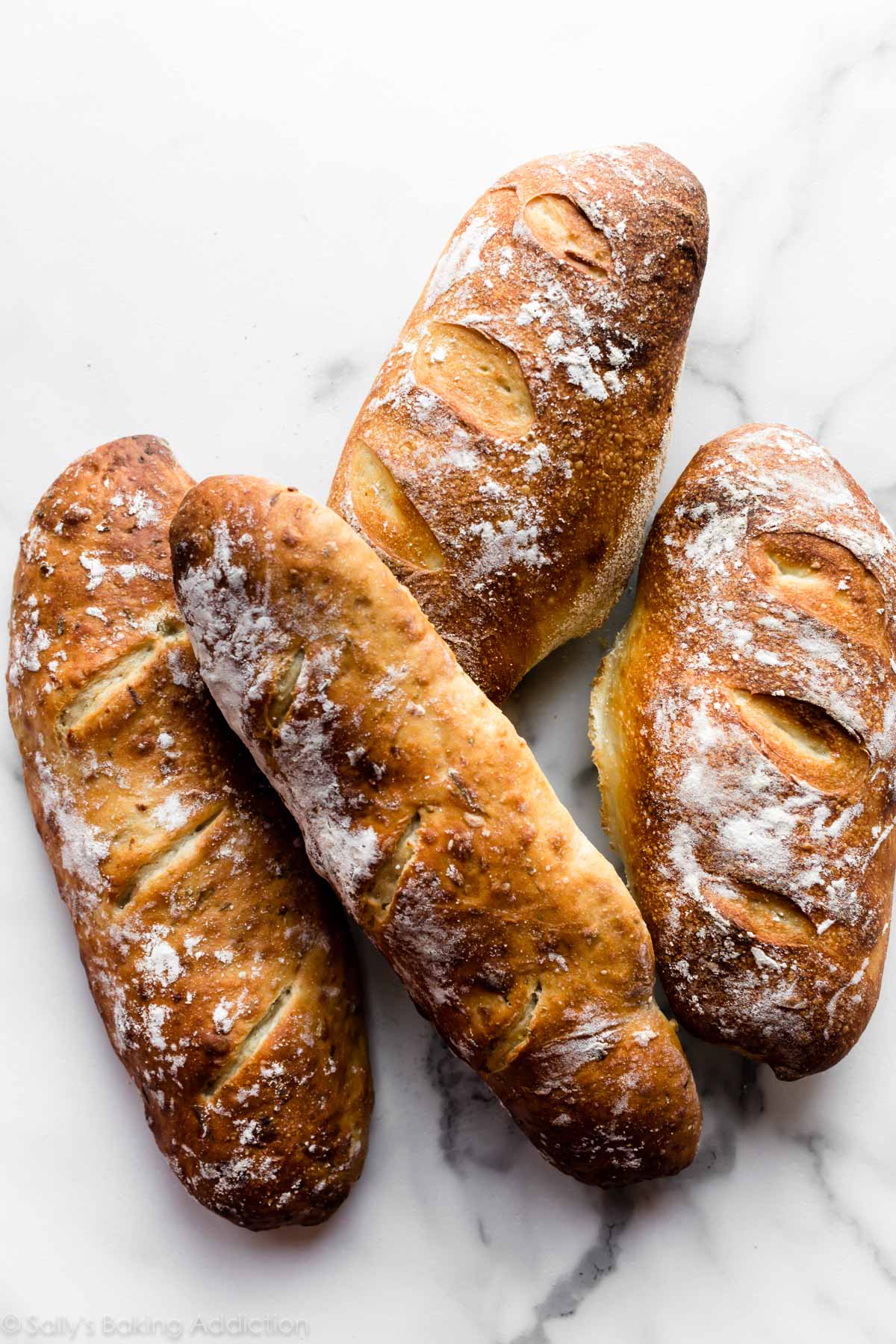
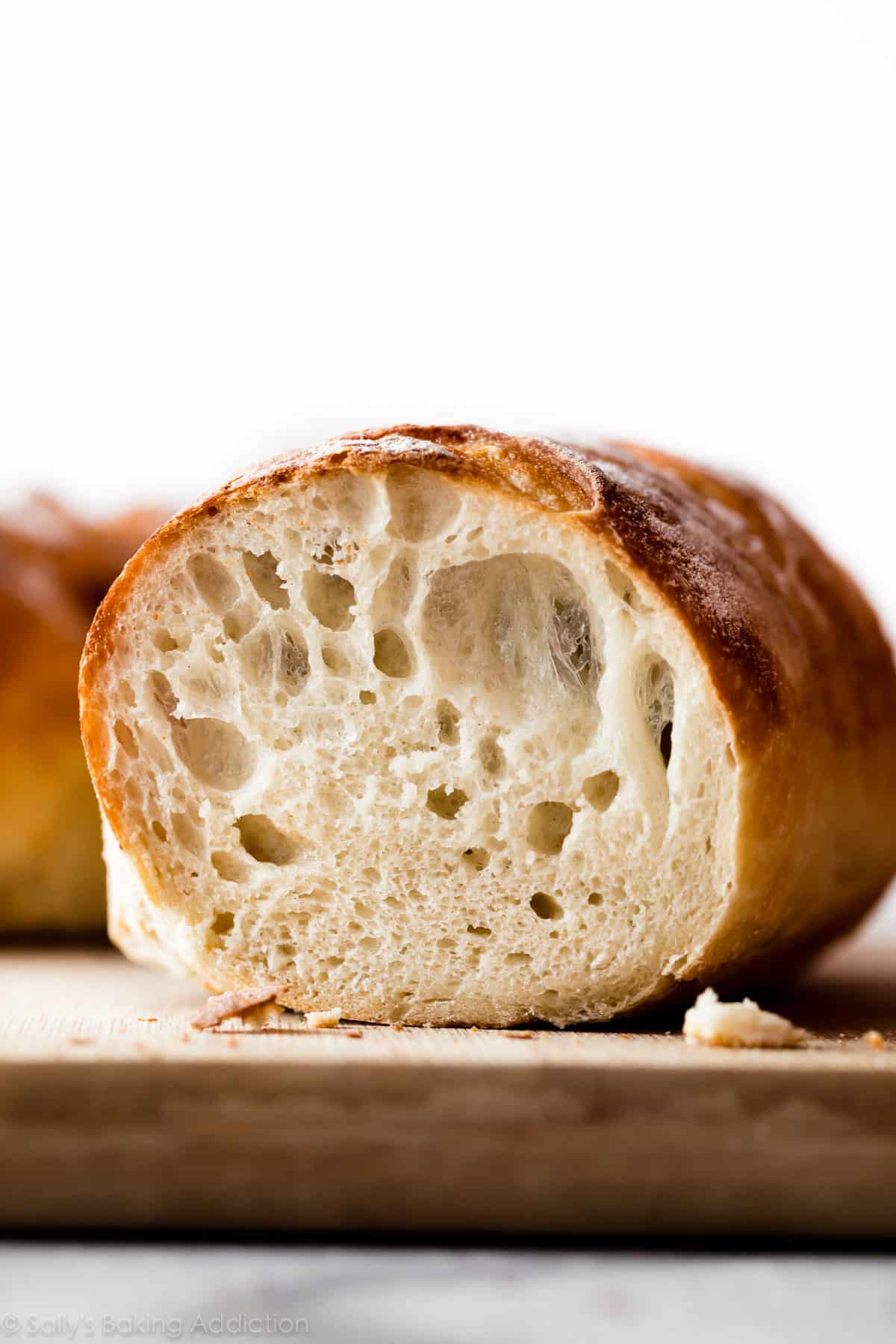
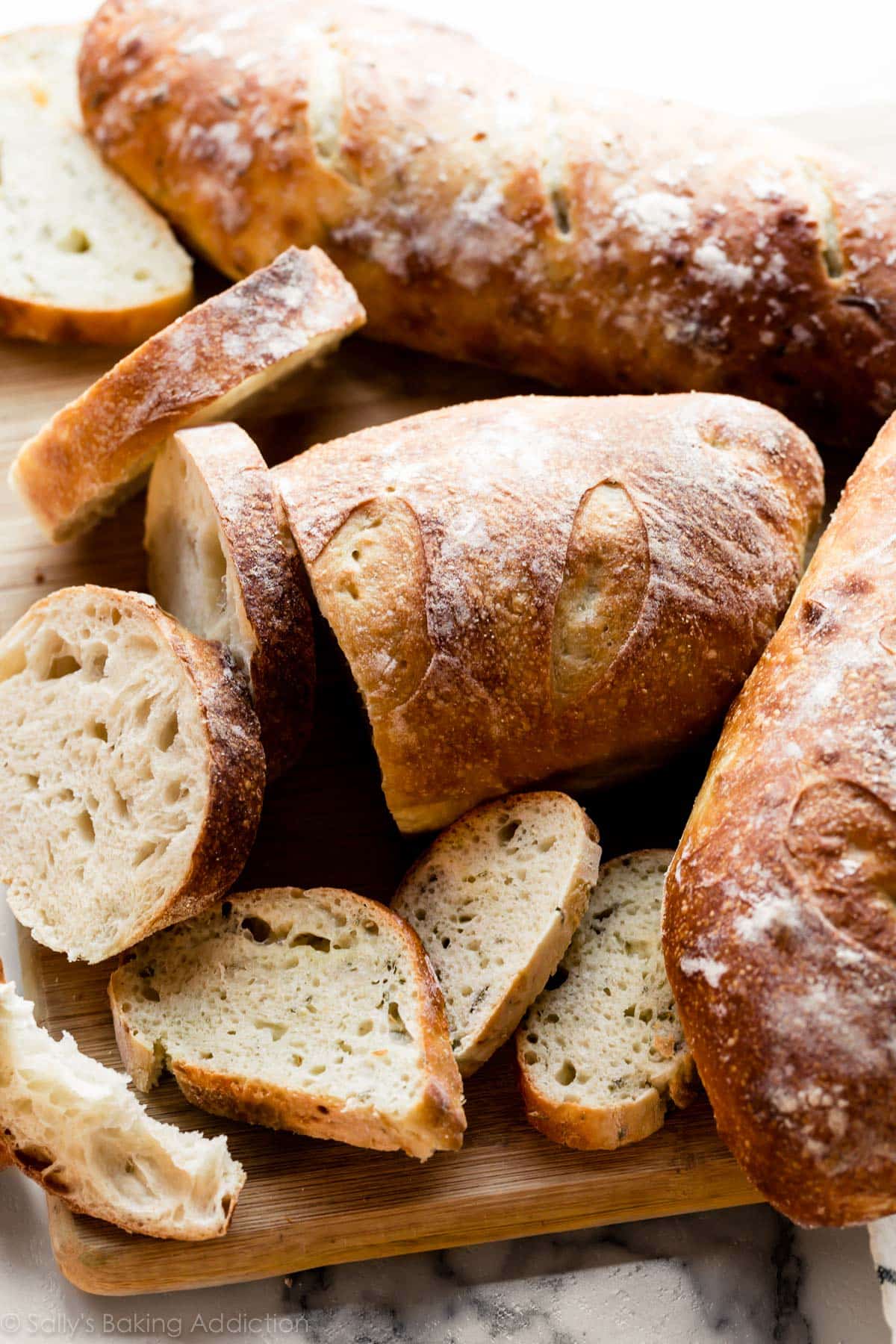
Even if you’ve never made homemade bread or worked with yeast before, this homemade crusty artisan bread is for you. It’s the perfect beginner recipe because it only requires 4 ingredients without any special pans or mixer, there’s no kneading or complicated shaping involved, and 95% of the work is hands-off. Bread masters will appreciate this recipe too because it delivers with delicious flavor, a slightly crisp and mega chewy crust, and those signature soft holes inside like ciabatta or French bread.
Bread Beginners—Start Here
Have you ever wanted to master homemade bread? Real, crusty, chewy, delicious bakery-style loaves that taste incredible with dips, soups, sauces, and comforting dinners? This is where you start. This artisan bread recipe is for beginners, but even bread masters will appreciate its flavor and ease. It’s so fresh, so flavorful, and so surprisingly easy because it basically makes itself.
You only need 4 ingredients without any special pans or mixer, there’s no kneading, no poolish or dough starter required, and you can add herbs, cheeses, and spices to make a variety of bread flavors.
This base recipe will soon be on repeat in your kitchen. After you realize how easy it is to make real homemade bread, you’ll find any excuse to bake a loaf. You can even turn it into garlic bread and homemade croutons.
What is Homemade Artisan Bread?
When it comes to bread, the term “artisan” doesn’t mean 1 particular thing. But, generally, artisan bread is homemade, fresh, crusty, and deliciously rustic-looking. An artisan is a skilled worker, one who works with their hands. But ironically, there isn’t much “work” involved with this recipe.
Why You’ll Love This Bread Recipe
- Easier than you ever imagined
- Soft + flavorful
- Chewy, slightly crisp crust
- Shape however you want
- No special pans, poolish, or dough starter required
- Only 4 ingredients
- You decide the length of time it rests
Like sandwich bread, whole wheat bread, focaccia, homemade English muffins, seeded oat bread, and homemade bagels—the process is surprisingly easy. If you’re new to yeast, reference my Baking with Yeast Guide for answers to common yeast FAQs.
Only 4 Ingredients
The crustier and chewier the bread, the less fat in the dough—also known as a “lean dough.” We’re using a lean dough for our artisan loaf today. (If you’re curious, a “rich dough” is a soft bread dough with the presence of fat, such as butter and eggs—the kind we need for overnight cinnamon rolls, sweet potato dinner rolls, brioche, and honey butter rolls.) Without fat, we’re left with the basics.
- Bread Flour: While you can use all-purpose flour in this recipe, I strongly recommend using bread flour. Just like when we make olive bread, pizza bread, and asiago-crusted skillet bread, bread flour produces a stronger, chewier bread and that makes a big difference in a recipe with only 3 other ingredients.
- Instant Yeast: Instant yeast is key in this recipe. While you can use active dry if that’s all you have, any quick rise or instant yeast will produce flavorful results in less time. I use more yeast in this recipe compared to my cranberry nut no-knead bread and no-knead jalapeño cheddar bread. Why? Those doughs rest and rise at room temperature. However, for more flavor and just as much rise, I use more yeast and let this dough rest in the refrigerator. (Cool air slows the fermentation process.)
- Salt: You can’t make good bread without salt and for best flavor, I recommend a coarse salt, such as coarse sea salt. I find the bread’s flavor lacking with regular table salt.
- Water: I normally encourage you to use warm liquid with yeast because warm liquid helps the yeast work faster. However, use cool or room temperature water here. Not freezing cold, not super warm—cool to touch. 70°F (21°C) is great, but the exact temperature doesn’t matter as long as it’s not hot or warm. The cooler the water, the longer the dough takes to rise and, usually, the better the bread’s flavor. (This is important since there are so little ingredients to add substantial flavor!) We use the same cool water method for no knead honey oat bread.
- Optional Cornmeal: Dusting the pan with cornmeal adds a pop of flavor and a little crunch to the bottom crust. This is completely optional. If you have it, use it. If you don’t have it, don’t worry about it.
You can also add herbs and seasonings such as garlic, rosemary, dill, chopped onion, jalapeño, shredded cheese, chopped nuts, dried cranberries, etc. My no yeast bread is the quick bread alternative here—you can add flavors to that loaf, too!
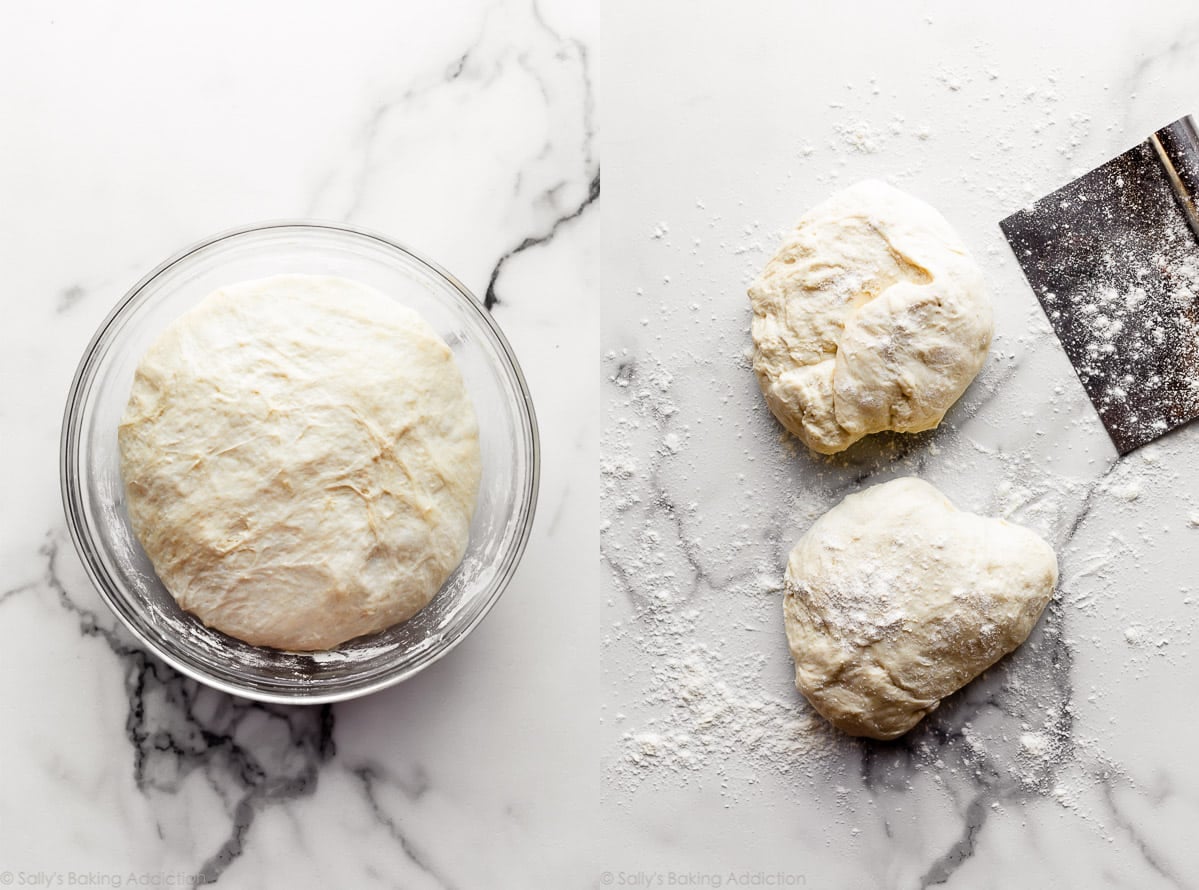
Baker’s Tip: Avoid adding too much flour to the dough as you work with it. The stickier it is—and the longer it sits in the refrigerator—the more likely you’ll have those big airy pockets of air in the crumb.
How to Make Homemade Artisan Bread in 5 Steps
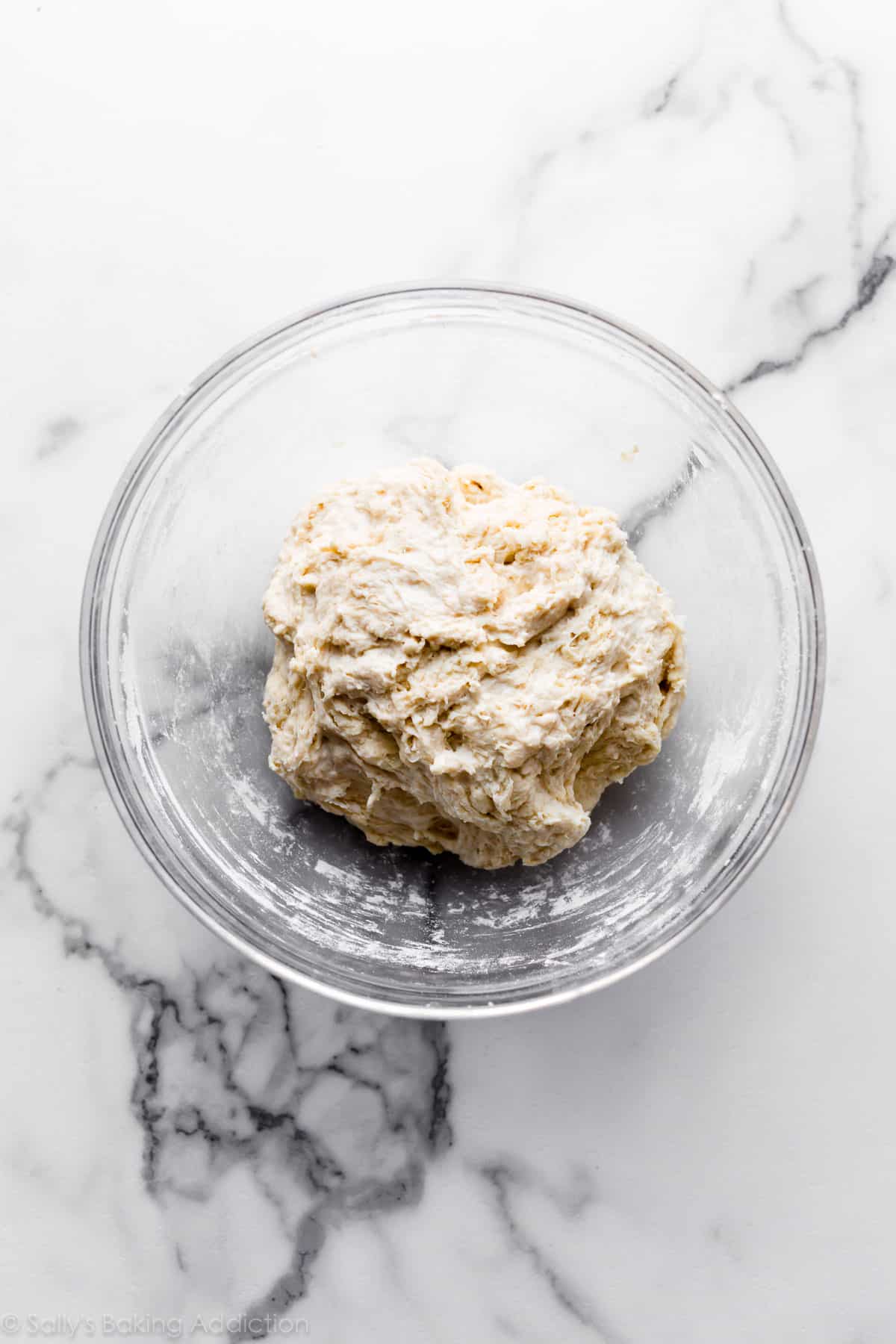
- Mix the dough ingredients together. At first the dough will seem very dry and shaggy and you’ll question if it will even come together. But it will. Use a spatula at first, then switch to your hands to ensure all of the flour is moistened. The dough is actually a little sticky after it’s thoroughly mixed.
- Let it rise at room temperature for 2-3 hours. Cover the dough and let it rise at room temperature for about 2-3 hours until doubled in size.
- Use right away or refrigerate. After 2-3 hours, you can immediately continue with the next step. However, for ideal flavor and texture, I strongly recommend letting the dough sit in the refrigerator for at least 12 hours and up to 3 days. Yes, 3 full days! I usually only let it rest for about 18 hours. During this crucial step, the cold air slows the fermentation process and adds so much flavor and texture. So, you can bake bread in 2-3 hours or in 3 days. The longer it sits, the better it tastes. 🙂
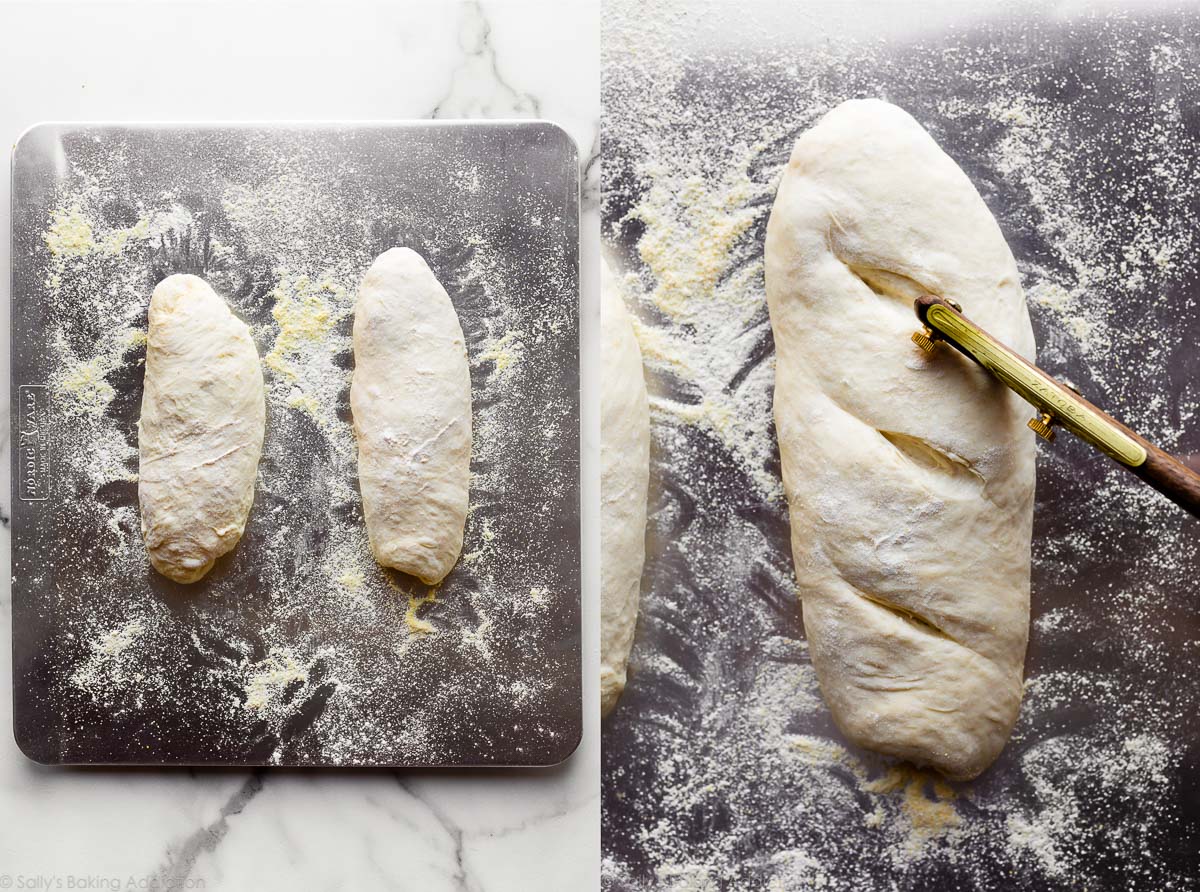
- Shape into 2 loaves or 1 boule. Rest as oven preheats. You can shape the bread into a round loaf (boule) or two longer loaves. I usually make two longer loaves side-by-side on a flat baking sheet, about 9×3 inches each. Preheat the oven to a very hot 475°F (246°C). The extremely hot air will immediately set the crust so the bread rises up instead of spreading all over. Score the loaves on top right before baking. Scoring also helps control the bread’s expansion. To help ensure a crispier crust, after the oven preheats, pour boiling water into a metal or cast iron baking pan on the bottom oven rack. Immediately place the baking sheet inside and shut the oven door to trap the steam. The steam will help create that coveted crisp crust.
- Bake until golden brown, about 20-25 minutes. Gently tap the loaves because if they sound hollow, they’re done.
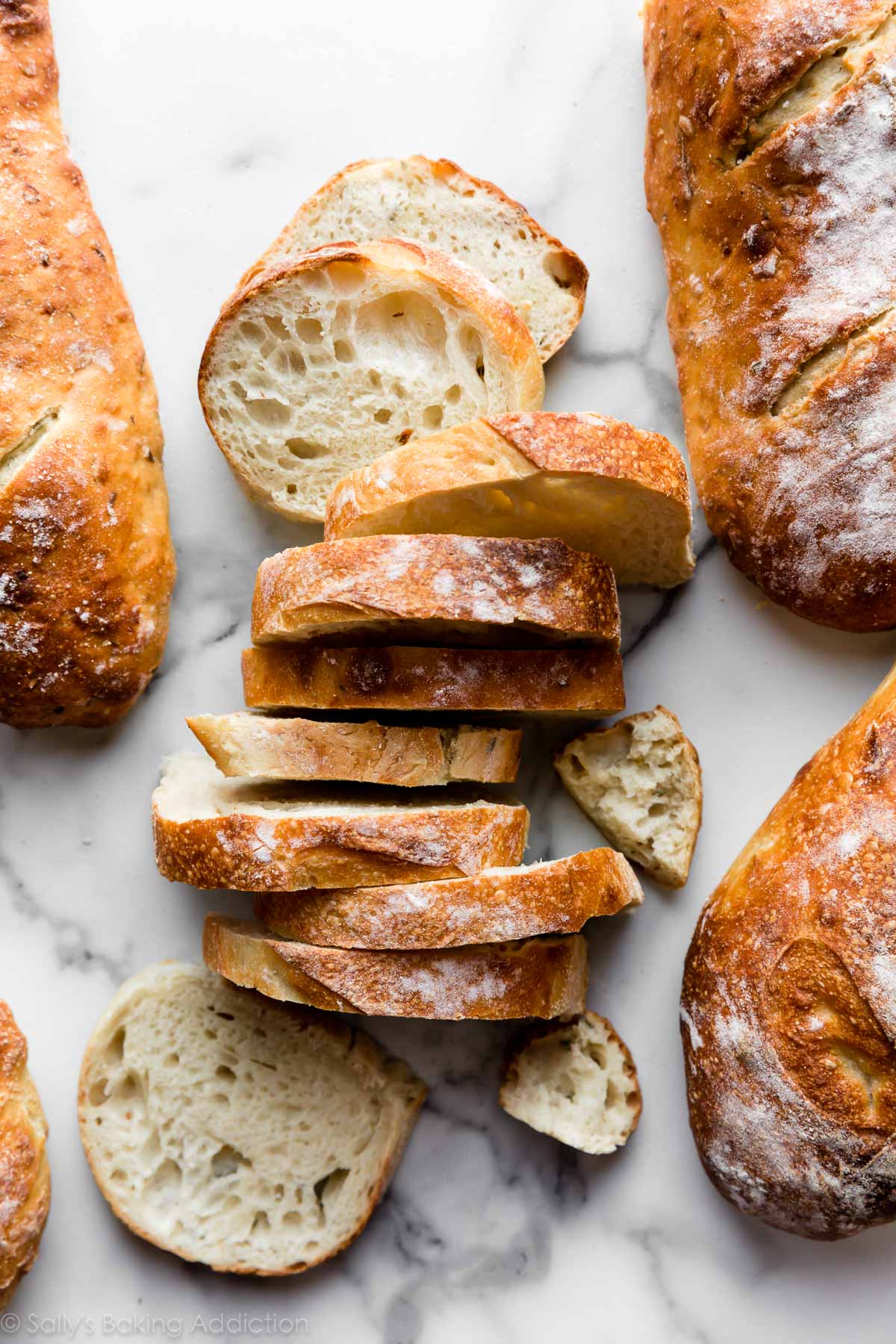
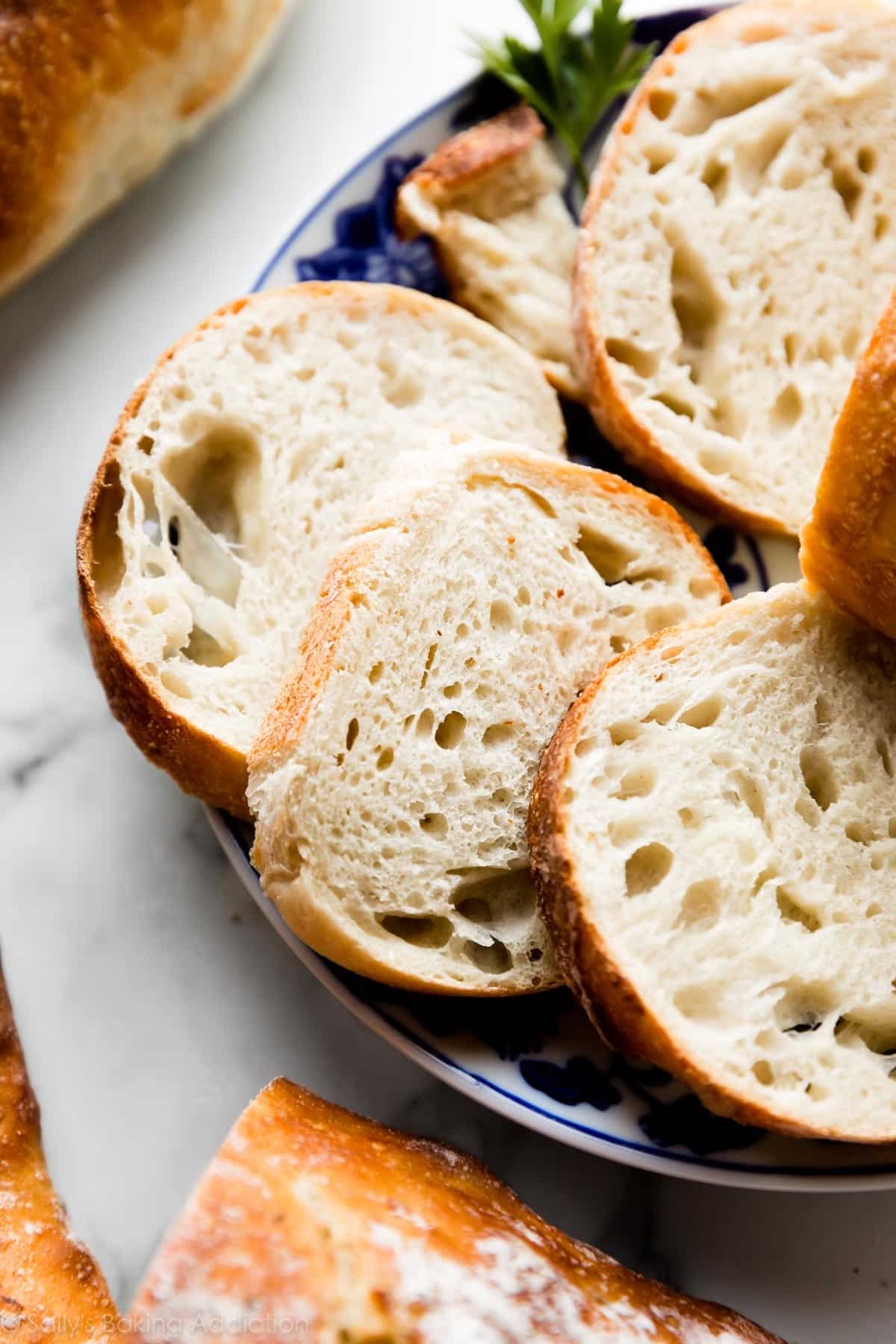
Look at those deliciously soft holes inside! Reminds me of ciabatta or a French baguette, both of which can be a little more complicated to make.
Serve Artisan Bread With
- Slather with homemade honey butter or cinnamon butter
- Slice and dunk in crab dip, beer cheese dip, garlic & bacon spinach dip, or even homemade Italian dressing
- Serve alongside slow cooker chicken chili or pumpkin chili
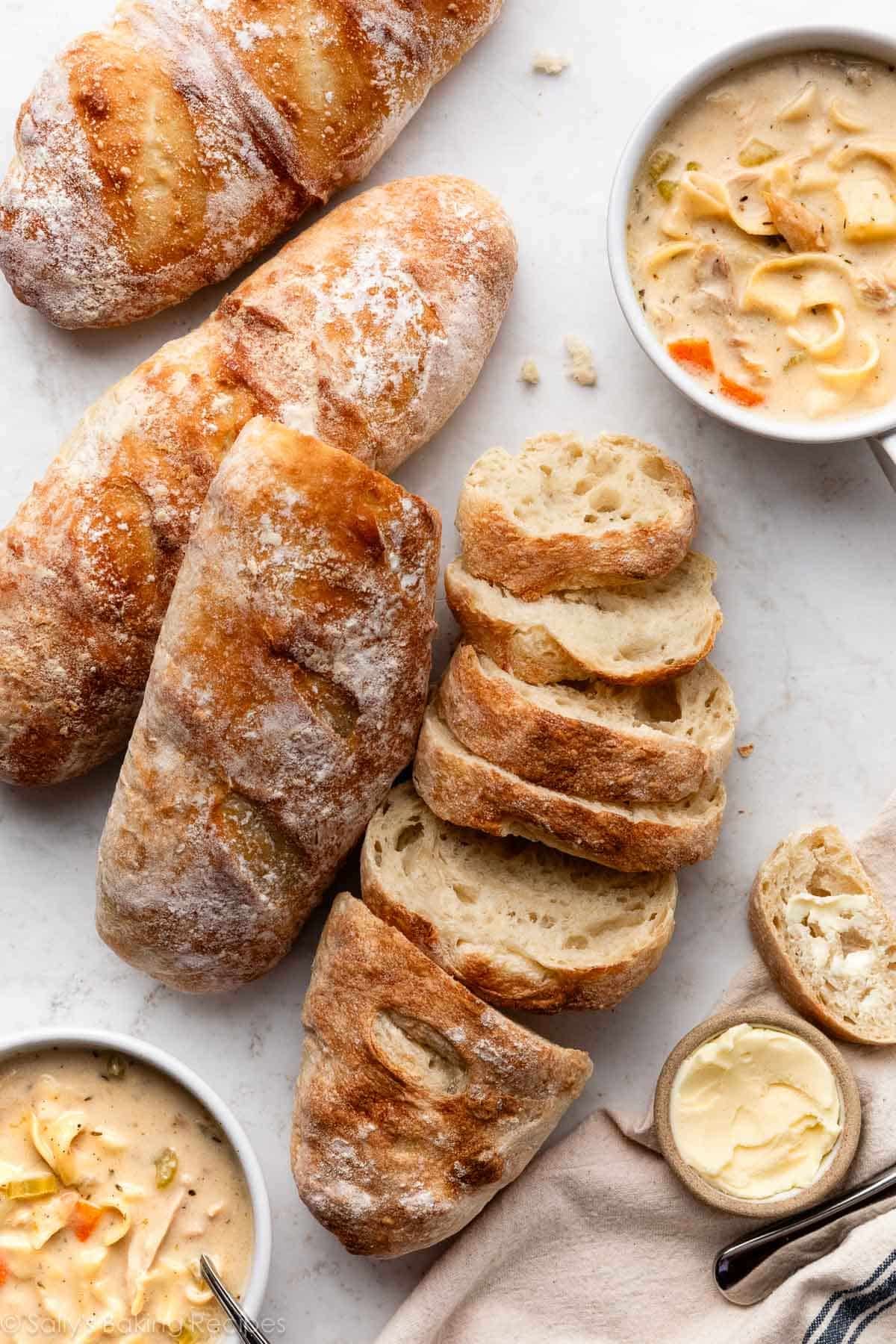
- As a dunker for homemade tomato soup, creamy cauliflower potato soup, minestrone soup, creamy chicken noodle soup, crab soup, or slow cooker creamy chicken & corn soup
- With a big bowl of mac & cheese or spaghetti with slow cooker turkey meatballs
- Use for my goat cheese & honey crostini
- It’s the perfect starch in breakfast casserole or baked apple cider French toast
- Use it to make homemade garlic bread or homemade croutons
- With anything because homemade bread is everything’s best friend

Homemade Artisan Bread Recipe
- Prep Time: 4 hours
- Cook Time: 25 minutes
- Total Time: 4 hours, 25 minutes
- Yield: 2 8-inch loaves
- Category: Bread
- Method: Baking
- Cuisine: American
Description
Even if you’ve never made homemade bread or worked with yeast before, this homemade artisan bread is for you. Watch the video tutorial below and review the recipe instructions and recipe notes prior to beginning. If you’re new to working with yeast, reference my Baking with Yeast Guide for answers to common yeast FAQs.
Ingredients
- 3 and 1/4 cups (about 430g) bread flour (spooned & leveled), plus more for hands and pan
- 2 teaspoons (about 6g) instant yeast
- 2 teaspoons (about 9g) coarse salt (see note)
- 1 and 1/2 cups (360ml) water, close to room temperature at about 70°F (21°C)
- optional: cornmeal for dusting pan
Instructions
- In a large ungreased mixing bowl, whisk the flour, yeast, and salt together. Pour in the water and gently mix together with a silicone spatula or wooden spoon. The dough will seem dry and shaggy, but keep working it until all the flour is moistened. If needed, use your hands (as I do in the video tutorial below) to work the dough ingredients together. The dough will be sticky. Shape into a ball in the bowl as best you can.
- Keeping the dough in the bowl, cover the dough tightly with plastic wrap or aluminum foil and set on the counter at room temperature (honestly any normal room temperature is fine!). Allow to rise for 2-3 hours. The dough will just about double in size, stick to the sides of the bowl, and have a lot of air bubbles.
- You can continue with step 4 immediately, but for absolute best flavor and texture, I strongly recommend letting this risen dough rest in the refrigerator for at least 12 hours and up to 3 days. Place covered dough in the refrigerator for 12 hours – 3 days. I usually let it rest in the refrigerator for about 18 hours. The dough will puff up during this time, but may begin to deflate after 2 days. That’s fine and normal—nothing to worry about.
- Lightly dust a large nonstick baking sheet (with or without rims and make sure it’s nonstick) with flour and/or cornmeal. Turn the cold dough out onto a floured work surface. Using a sharp knife or bench scraper, cut dough in half. Some air bubbles will deflate as you work with it. Place dough halves on prepared baking sheet. Using floured hands, shape into 2 long loaves about 9×3 inches each (doesn’t have to be exact) about 3 inches apart. Loosely cover and allow to rest for 45 minutes. You will bake the dough on this prepared baking sheet.
- During this 45 minutes, preheat the oven to 475°F (246°C).
- When ready to bake, using a very sharp knife or bread lame (some even use kitchen shears), score the bread loaves with 3 slashes, about 1/2 inch deep. (“Score” = shallow cut.) If the shaped loaves flattened out during the 45 minutes, use floured hands to narrow them out along the sides again.
- Optional for a slightly crispier crust: After the oven is preheated and bread is scored, place a shallow metal or cast iron baking pan or skillet (I usually use a metal 9×13-inch baking pan) on the bottom oven rack. Carefully and quickly pour 3-4 cups of boiling water into it. Place the scored dough/baking pan on a higher rack and quickly shut the oven, trapping the steam inside. The steam helps create a crispier crust.
- Place the shaped and scored dough (on the flour/cornmeal dusted pan) in the preheated oven on the center rack. Bake for 20-25 minutes or until the crust is golden brown. Gently tap the loaves—if they sound hollow, the bread is done. For a more accurate test of doneness, the bread is done when an instant read thermometer inserted in the center reads 195°F (90°C).
- Remove the bread from the oven and allow to cool for at least 20 minutes before slicing and serving. Store leftovers loosely covered at room temperature for up to 5 days or in the refrigerator for up to 1 week.
Notes
- Make Ahead & Freezing Instructions: The dough can sit in the refrigerator for up to 3 days, so this is a wonderful recipe to begin ahead of time. You can also bake the bread, allow it to cool, and freeze for up to 3 months. Thaw at room temperature before serving. You can also freeze the dough. Complete the recipe through step 3. Wrap in plastic wrap and place in a freezer-friendly container. To bake, allow dough to thaw overnight in the refrigerator, or for 2-3 hours at room temperature. Continue with step 4 and the rest of the recipe instructions.
- Special Tools (affiliate links): Glass Mixing Bowls | Silicone Spatula or Wooden Spoon | Baking Sheets | 2-cup Measuring Cup | Bread Lame | Instant Read Thermometer
- Flour: For absolute best flavor and chewy texture, I strongly recommend using bread flour. You can use a 1:1 substitution of all-purpose flour in a pinch with no other changes to the recipe. I recommend avoiding whole wheat flour in this dough. If necessary, use half bread flour and half whole wheat flour. The bread will taste dense.
- Yeast: You can use instant or active dry yeast, but I highly recommend an instant (aka “rapid rise” or “quick rise” yeast). The bread will rise faster. I usually use Platinum yeast by Red Star, which is an instant yeast. 2 teaspoons is a little less than 1 standard packet. If using active dry yeast, there are no changes needed to the recipe. The rise time in step 2 may take longer.
- Salt: Use a coarse salt, such as coarse sea salt, in this bread. I find the flavor slightly lacking when using regular table fine salt. If you only have fine salt, reduce to 1 and 1/2 teaspoons.
- Water: Use cool water. 70°F (21°C) is great, but the exact temperature doesn’t matter as long as it’s not hot or warm.
- Round Loaf: If you want to shape the dough into a boule (round loaf) simply shape into a round ball instead of 2 loaves in step 4. Baking instructions are the same, but the loaf will take a few extra minutes in the oven. If you want to bake the boule in a dutch oven, see next note.
- Using a Dutch Oven: Follow this dough recipe through step 3, then follow the simple shaping/baking instructions (steps 2-5) in my Cranberry Nut No Knead Bread recipe including using the parchment paper. If your parchment paper can’t withstand heat this high, you can either lower the oven temperature and bake the bread for longer or grease the Dutch oven instead.
- Using a pizza stone: If you want to bake your bread loaves on a pizza stone, place pizza stone in the preheating oven. In step 8, place the shaped and scored dough on your preheated pizza stone. If the bottom of the shaped dough is pretty sticky, dust the hot pizza stone with some extra cornmeal. Bake as directed.
- No Nonstick Pan: If you don’t have a nonstick baking sheet, line it with parchment paper instead. Coat with a dusting of flour and/or cornmeal before placing the dough on top. Parchment paper can burn, so it’s best to check the box to see how much heat yours can tolerate. Lower your oven heat if necessary and bake the bread for longer until golden brown and when gently tapped, sound hollow.
- Flavor ideas: Before pouring in the water in step 1, add any of the following ingredients/combination of ingredients to the dry ingredients in the bowl: 4 cloves minced garlic + 3 Tablespoons chopped rosemary, 3 Tablespoons your favorite fresh herb (chopped), 1 cup your favorite shredded cheese, a diced jalapeño, 3/4 – 1 cup dried cranberries and/or chopped nuts, 2 teaspoons garlic powder, etc.
- Reference my Baking with Yeast Guide for answers to common yeast FAQs.
- Recipe adapted from King Arthur Flour & Red Star Yeast, similar method originally from Jim Lahey.
Nutrition
- Serving Size: 2 slices
- Calories: 136
- Sugar: 0.1 g
- Sodium: 389.8 mg
- Fat: 0.7 g
- Carbohydrates: 27.2 g
- Protein: 4.7 g
- Cholesterol: 0 mg









Reader Comments and Reviews
Is the scoring on top necessary? What does it do for the bread?
Hi S.R., Scoring the tops of the loaves will create a natural spot for the heat to escape and the bread to rise.
Are the metric measurements actually tested or just converted from volumetric measures by using a generic converter? I am an experienced bread baker and have always used weight measurements for accuracy but this bread dough was just goo after following the recipe to the letter. Really disappointed because I love Sally’s recipes and needed to make a rustic bread for a special dinner and I just got gloopy dough that didn’t give me the results I was hoping for. I can only assume that the positive ratings come from people using cups and spoons. I would recommend not adding the metric weight measurements if they haven’t been properly tested.
Hi Alex, I’m glad you love my recipes and I’m sorry you were disappointed with this one. Yes, my recipes are tested with metric measurements. We bake them both ways, and this is why I have hired a kitchen team to help. This is a high hydration dough. If the dough is simply too slick, you can add more flour. Thank you for the feedback and, again, I’m sorry you were disappointed.
Amazing! This was only my second time ever making bread from scratch and you made the instructions so easy to follow (used the video too). This makes the whole journey of getting into breadmaking seem so much less scary so thank you so much! If I wanted to try this recipe with all or half whole wheat flour, what adjustments should I make?
I have made this recipe so many time and it makes the most delicious bread! We love it!
I am wondering if anyone has made this recipe using a loaf pan?
I wanted to try doing so on my next attempt.
Hi Matthew, there is a little too much dough for a standard size (9×5-inch) loaf pan, so you could try dividing the dough in half and using 2 loaf pans. The edges should still crisp up and the bake time may vary. Let us know how it turns out if you give it a try!
The flavor is good but it was so incredibly dense. I followed the recipe exactly. I always seem to have this issue when I try to make bread
Hi Shannon, we’re happy to help troubleshoot. Every loaf will turn out differently, some with more air bubbles than others. If you overwork the dough and pop those bubbles, it would result in a denser loaf. Be sure to spoon and level (or use a kitchen scale) to measure your flour too, as too much flour in the dough can cause it to turn out dense. Hope this helps for your next batch!
A beginners recipe at 83% hydration.
Well, that is how to give a lot of folk a fail experience.
Too often your recipes come up on the forums with people struggling. They are too often poorly though out.
Hi, I am in the process of buying a proofing basket for my bread, and it gives various sizes per weight of the dough.
I make this recipe for Artisan Bread on a regular basis, and love it. Can you tell me what the weight of the dough is in this recipe for Artisan Bread.
I know your recipe says it makes 2 loaves, but I also would like to know what weight the dough is so I can use it when I buy my proofing basket.
Thank you so much for your help.
Teresa
My family loves this bread and make it all the time!! Would you say the dough would still be good after 4 days? I often have the second half leftover past the three day mark and hate to throw it out.
Hi Rhetta, we’re so glad you love this bread! At that point we would recommend following the freezing instructions.
If I wanted to make this as a single larger loaf of bread rather than splitting it into 2, how long would you recommend putting it in the oven for & would it still be at the same temperature
Hi Adam, If you want to shape the dough into a boule (round loaf) simply shape into a round ball instead of 2 loaves in step 4. Baking instructions are the same, but the loaf will take a few extra minutes in the oven.
I made this bread recipe for the first time last week; I’m not a very experienced bread maker, but have tried a few different recipes from different food bloggers (Chef Billy Parisi and Spend With Pennies, to start). Although those recipes turned out well, they were more of a sandwich bread. And though I have baked Sally’s Sandwich Bread, which was a hit, I decided to try an Artisan bread recipe. I’m thankful to be (finally) retired now and so had the time to read carefully through the recipe (maybe MORE THAN ONCE, lol), watch the tutorial, and follow Sally’s recommendations of chilling the dough (mine chilled for ~19 hours) and putting a pan of boiling water on the bottom rack of the oven. Friday morning, dough was ready to cut in half, shape, score and bake! WOW! What a lovely crust on the bread, and the center was a perfect soft chew! This will be my go-to recipe when I want a bread for my homemade soups, pasta sauces, or an olive oil/balsamic dip! Thanks, Sally, for yet another amazing recipe!
This is the best bread recipe I have ever tried in my life. I am humbly begging for a hamburger bun recipe.
Hi,
Just wanted to say that I’ve been kneading bread with this exact recipe (using active dry yeast) in my bread maker and removing the pan right after the kneading process is complete. I let it rise (covered with a light towel) in that pan on the counter for three hours or so and put it in the oven immediately after the rise periods are done and it turns out fine!
Thanks for sharing this Steve!
Sally, I want to make this recipe!! I have made other no-knead breads, but always in my enameled cast iron pot. I do not have a non-stick baking pan. Is it absolutely necessary? I’ve been on a roll pinning your recipes today and the result is I’ve bought the recommended bundt pan and pie plate! The thought of adding another item to my kitchen is daunting!!
Marsha
Hi Marsha, If you don’t have a nonstick baking sheet, line it with parchment paper instead. Coat with a dusting of flour and/or cornmeal before placing the dough on top. Parchment paper can burn, so it’s best to check the box to see how much heat yours can tolerate.
Can you make gluten free bread dough with this receipe
Hi Linda, we haven’t tested a gluten free version of this bread, but let us know if you do.
Hi, could I use baguette pans for this?
Hi Lilly, yes, absolutely.
This bread is amazingly delicious! The instructions are easy to follow! I am so glad I made this bread! The next time, I will add some additional add ins!
I followed the recipe exactly even weighing and measuring ingredients to make sure it came out with nice airy pockets. The flavor was very good. Left in fridge for 24 hours before baking. The bread was dense and not filled with air pockets like video/picture. Used an instant temp thermometer as well as hollow sound. 195 degrees pulled it out of oven. Again, great flavor and will get eaten but more dense than what I wanted. Used Fleishman’s yeast, would Red Star yeast make a difference or longer in the fridge? Did not over work it, at least don’t think I did, in forming the two loaves. Thanks for any help and appreciate all the recipes and compliments we get when we use them. (Scones, Lime Coconut Cookies, Maple Brown Sugar Cookies to name a few.)
Hi Jim, happy to help troubleshoot. Make sure to handle the dough very carefully to prevent compressing the air bubbles. Be sure to also spoon and level your flour (or use a kitchen scale) to ensure it’s not over-measured, which can make the bread dry and dense. Are you using instant yeast or active dry? Active dry can take a little longer to rise. Finally, a digital thermometer is helpful for ensuring the water temperature isn’t too hot, which can kill the yeast. Hope this helps for next time!
Just made this today and wow! Thank you so much. I did sub frozen veggies and this was an easy add to my Sunday meal prep.
Sally have tried too contact you asking if you could please give a cannoli recipe and cream horn recipe please I have looked everywhere you are my go too for all and any please help I would love too see what you dream up and CC invent thank you, Lynda
Hi Lynda, we haven’t developed a cannoli or cream horn recipe at this time, but we will keep it in mind for the future!
I prepared two separate batches of dough yesterday morning. I weighed everything out on my food scale. I added chopped fresh rosemary because I had some on hand and I also added granulated garlic. I always use distilled water which I store in a closet when I bake bread, the water temperature was 74 degrees Fahrenheit. I let the dough rise for just under two hours because it had more than doubled. I then refrigerated the dough until 10 am this morning. I used a cast iron skillet in the bottom shelf of the oven filled half was with boiling water then I added one tray with two long loaves. I did not use a non-stick cookie sheet with corn mean on the first two loaves which I learned does not work (as the instructions does say to use non-stick pan, haha). I did learn from that mistake and on the second batch I did use a non-stick cookie sheet with corn meal and the loaves did not stick. All of the loaves turned out perfect, except losing some crust on the bottom of the first batch. The crust on the outside is crisp and on the inside the texture is fabulous. This recipe is definitely a keeper. I would like to know if I could use half the dough from the recipe in a well greased, glass bowl that is 2.3 qrts and oven proof to 550 degrees Fahrenheit. I saw another recipe that used the seasoning, Everything but the Bagel and want to try mixing those seeds with butter and push against the glass of the bowl and add half the dough. Thoughts or suggestions?
Hi Holly! We haven’t tested baking this dough in a glass bowl, but we would be cautious a relatively high baking temperature here. You could definitely try adding everything but the bagel seasoning by mixing some into the dough, and adding some to the top before baking, but it may burn a bit if added to the outside.
Wow .. what a great recipe. I’ve tried making bread several times with little success , so I decided I needed something simple to start again .I saw this recipe and thought I’d give it a try . I couldn’t wait three days for the results so I baked it after two .The bread was delicious crusty and flavoursome, it reminded me of a crumpet flavour with a spongy texture ,the family loved it ,and I will definitely be making it again tomorrow.
I love this recipe, I’ve used it so many times. I personally like doing a boule instead of 2 loafs because I like bigger slices, the only thing I struggle with is getting it to shape the way that I want. Am I able to put the batter in a loaf tin or something so I can get a better shape?
Hi Lexy, so glad you love this bread recipe. There is a little too much dough for a standard size (9×5-inch) loaf pan, so you could try dividing the dough in half and using 2 loaf pans. The edges should still crisp up and the bake time may vary. Let us know how it turns out!
Hi Erin, I tried halving the recipe and putting it in a loaf tin and it worked perfectly well! Very soft though so if doing this I would definitely recommend putting hot water in the bottom or something to crust the outside. I put paper in the tin but next time I think I’ll grease it instead, but yeah. Worked pretty well!
Can you double this recipe and bake on 2 different levels in your oven or is this not recommended.
Hi Gail, For best results, we recommend making two separate batches rather than doubling and then baking on the same rack, if room allows.
This recipe is so easy and makes the best bread! I would like to double it because we eat all the bread up too fast. I’m assuming I should just double the ingredients right? Sorry if this is a dumb question!
Hi Halley, we’re so glad you enjoyed it! For best results, we recommend making two separate batches rather than doubling.
I accidentally left my dough out on the counter overnight (in an air conditioned house). Is the dough still safe to bake and eat?
Hi Jess, it should be fine if left to rise overnight on the counter, if you were able to place it in the refrigerator first thing in the morning. Glad this is a favorite for you!
Hello,
I try the artisan bread, they are great but pale in color, shall I not put hot water in the oven ?
how to get a bread like your picture or any French bakery …..
thank you
Nicole
Hi Nicole, have you tried baking the loaves either in a Dutch oven or with a water/steam bath (optional step 7 in the recipe)? The steam helps create that crispier, golden brown crust. Is your oven hot enough?
Hi Sally, first time doing this recipe. I measured everything as you mention, but, yes there is a but , when I put the 1 1/2 water, the mixture was dry, I mixed with the spatula, but at the bottom still some flour, I use my hands to work the dough ingredients together . It was dry , not as your on the video, I didn’t want to add more water. I keeped it like that, rise for 3 hr, some moisture was added , 45 min, the to 475 degrees oven for 23 min (they were golden hollow sound and 95 internal temp. After 5hr I cut it and I did’t get the big holes you have in your pics, small and few holes to be honest, but it taste good like a french o ciabata bread. Maybe I’ll get those holes on a 2 o 3 days rise on the refrigerator. That it”s gone a be my next try thanks
I finished making these loaves for the past few days. The first time made them with the first method. after the 3 hr. rise I proceeded to bake them . The second method I refrigerator the dough for the 18 hrs after the 3 hr. rise. I really couldn’t tell the difference in the taste, as all four loaves came out DELICIOUS. With the second 2 loaves I did add garlic, parsley and Italian seasoning to the dough. That was a true hit. What I did notice however with 18hr./ refrigerator rise of the loaves was ,they rose higher as they baked, which gave a prettier look to the loaves. Either way everyone was so so pleased with them. I will definitely use this method again and again, as they are not only easy but so much better than store bought. Thank you Sally. I just enjoy all your recipes.
I have made this bread a number of times and we love the flavor with a couple of teaspoons of garlic powder added. However, the bread has always seemed a little flatter than I would expect. We are in Florida, so I suspect humidity is affecting the dough and I need to experiment with adding a touch more flour.
We recently got a new stove that has a Steam Bake setting on the oven, which I have used for baking this bread. The instructions for the oven say to use a 25° lower setting for recipes that aren’t specifically for steam bake, which resulted in almost scorched bread. I made a couple of loaves today where I used 425° for 15 minutes, then 400° for 10 and that seemed to produce a nice color. Your video says the high heat is to set the crust. Would you suggest 450° for a shorter period, maybe 5 minutes, then knock the temp down? Any other suggestions to try to get/keep a bit more height?
Hi Pat, we’re happy to help troubleshoot. As you mention, humidity can definitely impact how bread bakes, so there is nothing wrong with adding just a bit more flour to the dough so that it comes to a workable consistency. This no-knead bread doesn’t rise a ton, but make sure to handle the dough very carefully to prevent compressing the air bubbles. Be sure to also spoon and level your flour (or use a kitchen scale) to ensure it’s not over-measured, which can make the bread dry and dense. Are you using instant yeast or active dry? Active dry can take a little longer to rise. Finally, a digital thermometer is helpful for ensuring the water temperature isn’t too hot, which can kill the yeast and prevent the bread from rising properly. We haven’t baked this particular recipe using a steam bake setting, but it may just take some trial and error to find out what works best for you. We hope this helps and thanks so much for giving this recipe a try!
Do I really need instant yeast if I’m leaving the dough in the fridge for 18 hours? That seems counterintuitive. I want to slow the rise in the fridge, so why do I need fast yeast?
Hi Melanie, instant or active dry yeast would both be fine here. Let us know if you give the recipe a try!
Hello Sally! Can you help me? I’ve tried both this recipe and your no-knead olive bread, and neither worked. With both, I mixed until all the flour was moistened, but the dough still looked rather wet (not like yours in the video) and then it didn’t rise.
I’ve been able to make some of your more complex kneaded dough recipes so I want to figure this out too—what could I be doing wrong?
Hi Becca! This is a very wet dough. There are a lot of variables that can go into the consistency of dough, down to even the weather/humidity. If you find your dough is especially wet/loose, you can certainly add more flour (1 Tablespoon at a time) until the dough comes into a workable consistency. The baked bread doesn’t rise a ton, but if the dough isn’t rising at all, could it be a bad batch of yeast? Our Baking with Yeast Guide may also be helpful to review. Let us know if we can help troubleshoot further!
What if the dough is so wet that it doesn’t form a shape at all but sinks in the bowl? Trying to trust the process haha
Hi Eliza, have you tried adding additional flour? You can add a bit more flour (1 Tablespoon at a time) until the dough comes together.
For the Artisan Bread what size of dutch oven should I use?
Hi Pearl, we would use a 5- to 6-quart Dutch oven.