
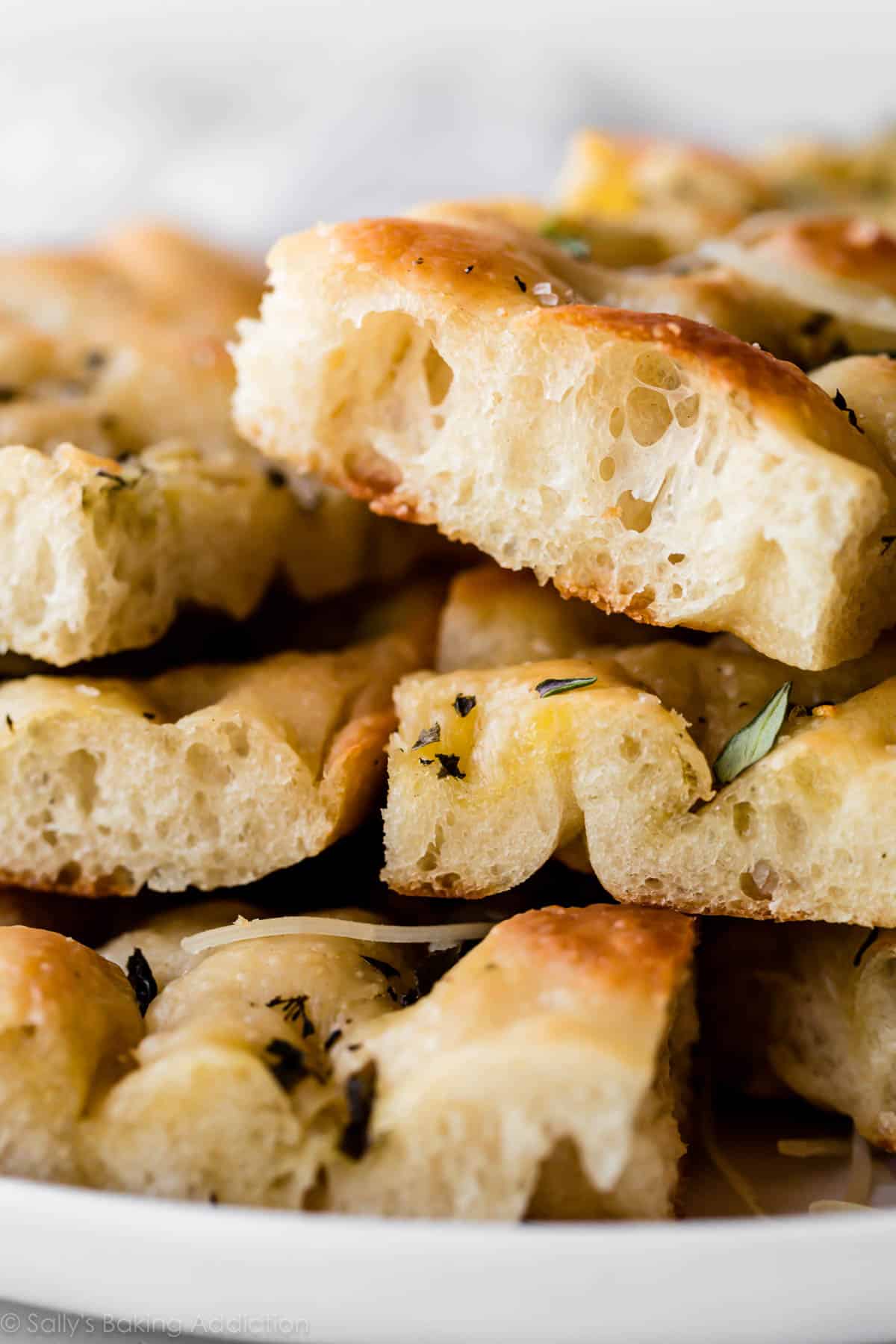
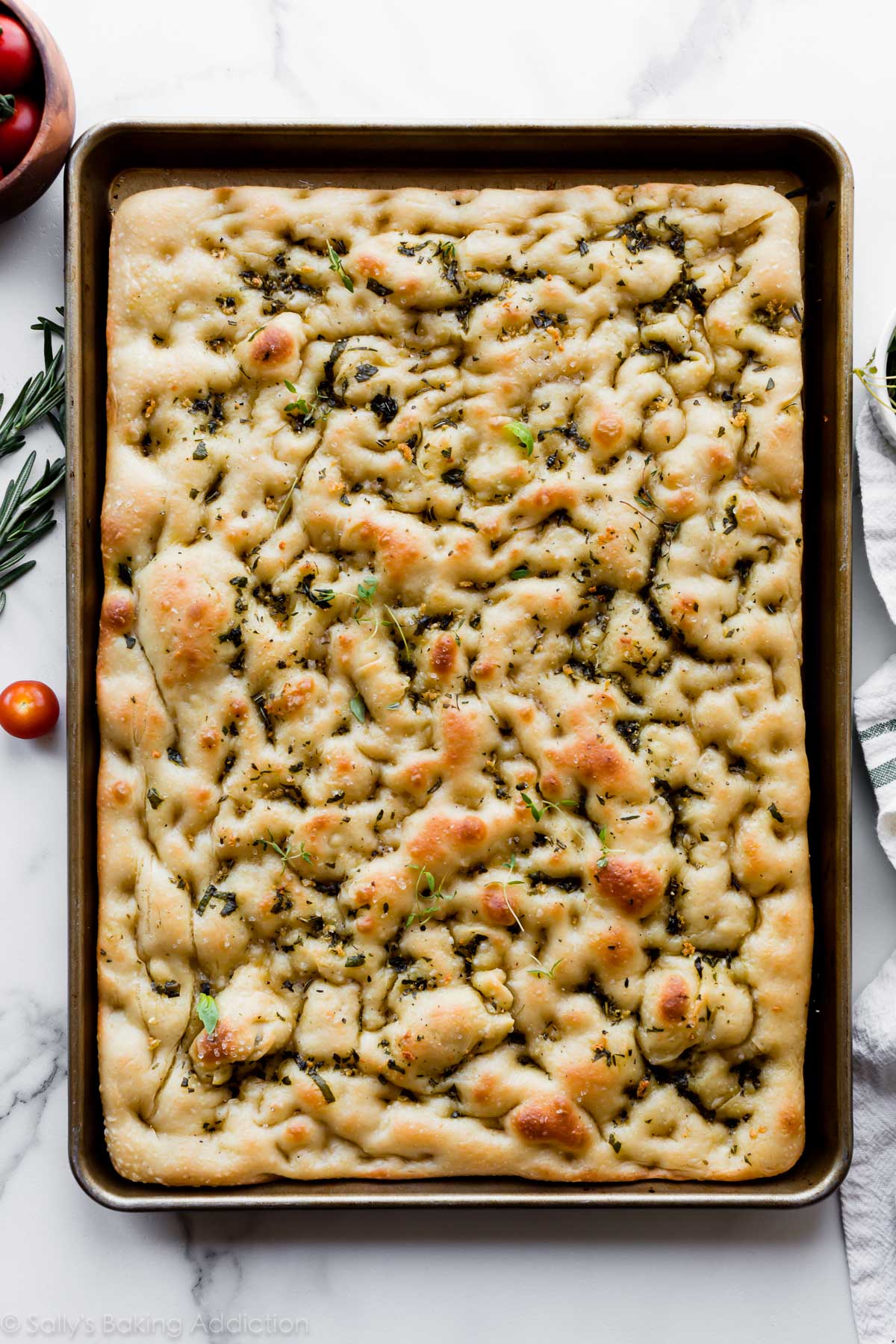
This simple 6 ingredient focaccia dough is a wonderful starting point for many different flavors, including garlic rosemary herb focaccia. The homemade bread is chewy and soft in the center with a mega crisp exterior. For the BEST flavor, let the dough rest in the refrigerator overnight. Olive oil seeps down and infuses every bite. You’ll love it!
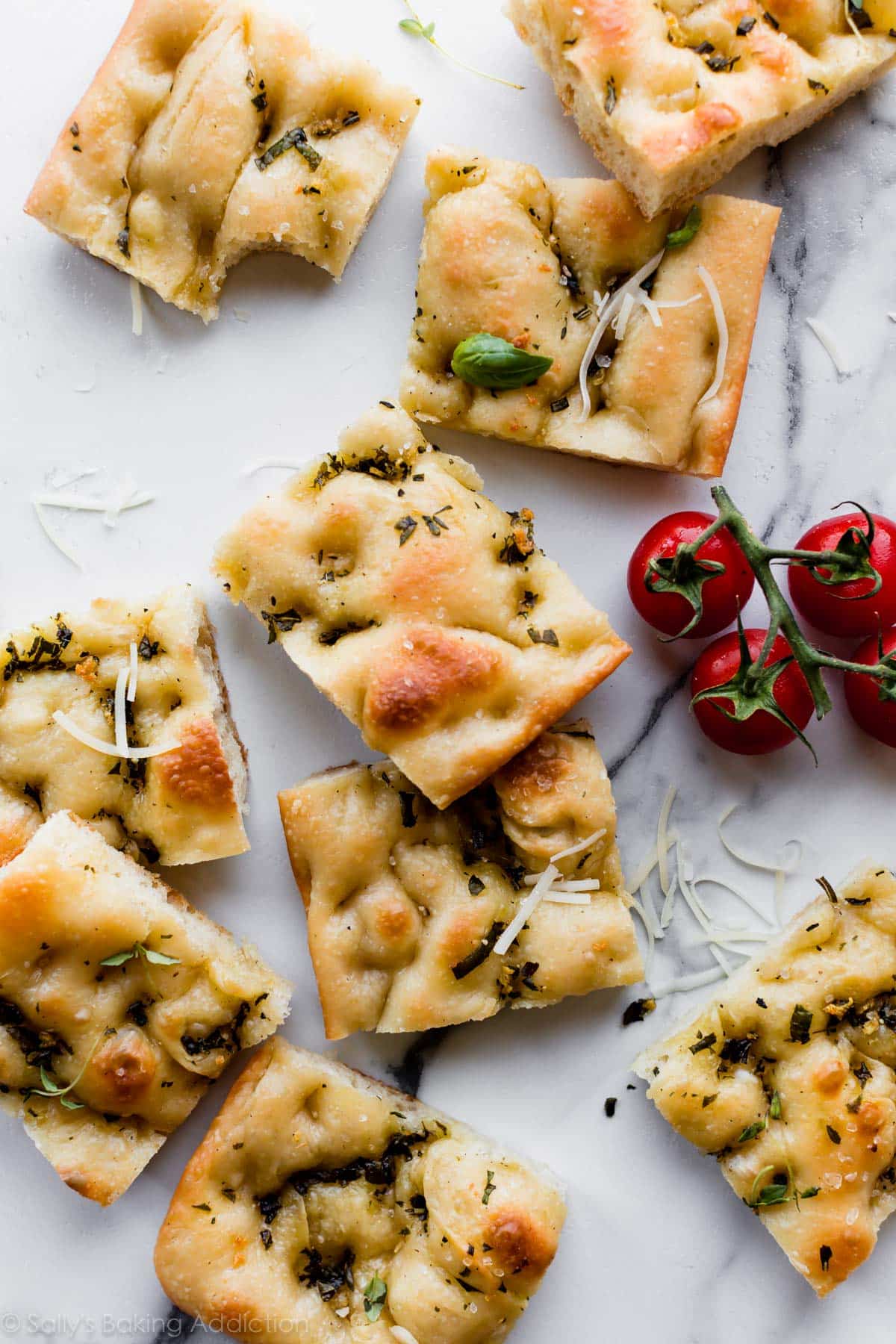
Let’s make focaccia!! I’ve been working on perfecting focaccia for awhile. Focaccia is an Italian yeast bread. At the heart of it, focaccia is pizza dough without the sauce and cheese. Though it appears plain, focaccia is anything but boring. Its defining characteristics are the olive oil infused flavor and deliciously crisp exterior. Olive oil enrobes the entire crust, seeping into the interior as the bread bakes. Herbs and garlic are popular toppings, but you can add anything like olives, tomatoes, sesame seeds, parmesan cheese, pine nuts, pesto, caramelized onions, and more.
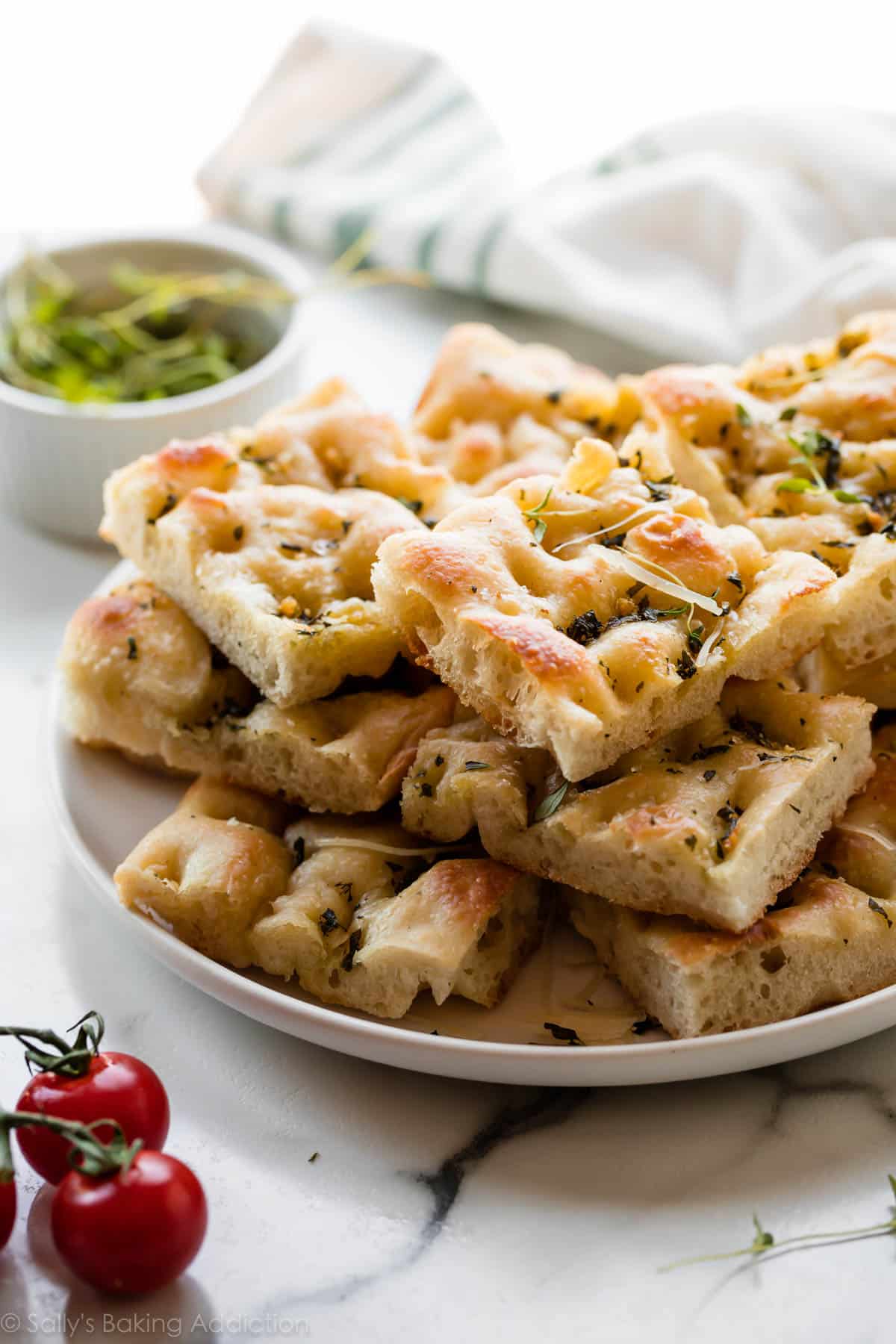
Pizza is a meal, but focaccia can be part of a meal, an appetizer, a soup dipper, a sauce soaker-upper, and even the crust of a sandwich or panini. I particularly enjoy serving it in the summer and always include it on my menu of Memorial Day recipes. Regardless of how and when it’s served, this garlic rosemary herb focaccia is remarkably chewy, rich, and flavorful.
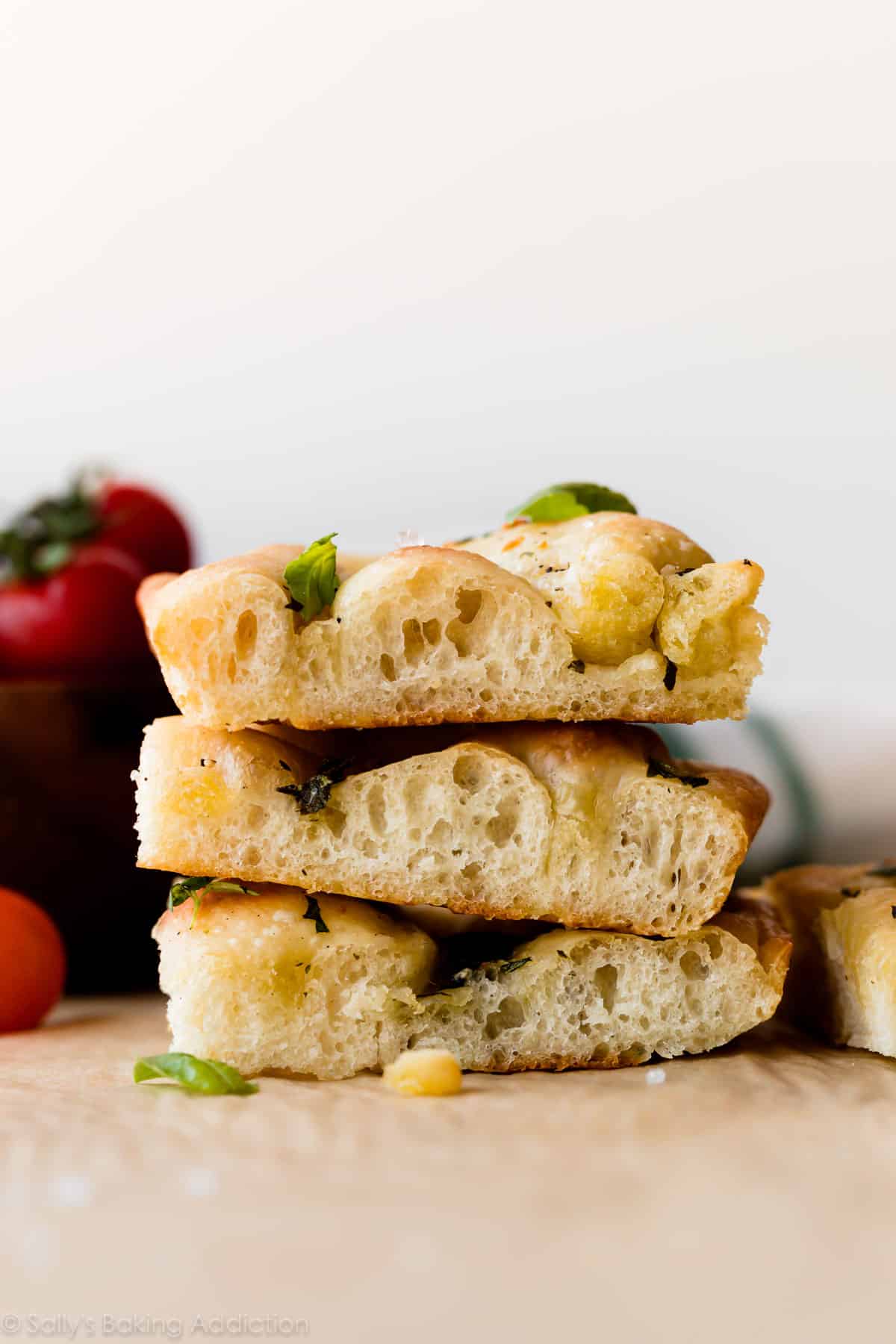
Video Tutorial: Garlic Herb Focaccia
Sit back, relax, and watch as I walk through each step in this garlic rosemary herb focaccia recipe. In fact, most of the “work” is hands-off while the dough rises and rests so you can literally sit back and relax when it’s your turn to make it!
Only 6 Ingredients in Focaccia Dough
Focaccia dough comes together with only 6 basic ingredients. Whether or not you’re a seasoned baker, I bet you have most of these items in your kitchen. This recipe yields a big pan of bread and leftovers freeze wonderfully. (We’ve been snacking on test recipes for weeks now!) If you don’t need that much bread on hand, feel free to halve the recipe.
Let’s quickly discuss the importance of each ingredient.
- Yeast: Yeast raises focaccia bread. If you’re nervous about working with yeast, I encourage you to review my Baking with Yeast guide. You can use active dry or instant yeast. I played around with different amounts and ultimately favored the bread with less yeast than some other recipes call for. The flatter the focaccia, the more the interior is infused with the olive oil and toppings!
- Sugar: 2 teaspoons of sugar feeds the yeast.
- Warm Water: When combined with liquid and sugar, yeast makes dough rise. Use warm water to cut down on rise time, about 100-110°F. Anything over 130ºF kills the yeast.
- Salt: A lot of focaccia’s flavor comes from salt and this dough requires a lot of it. For the best flavor, I strongly recommend using kosher salt.
- Olive Oil: Some recipes only call for olive oil as the topping, but adding olive oil to the dough creates a richer-tasting bread. You’ll also use it to coat the pan and top the dough before baking, just like we do when we make pesto pizza. Use your favorite kind—I prefer extra virgin olive oil.
- Bread Flour or All-Purpose Flour: I tested this focaccia with both and prefer the bread flour variety. Both are great, but bread flour has a higher protein content so it yields a chewier texture. This recipe calls for 4.5–5 cups of flour, and if using bread flour, you’ll need closer to 4.5 cups since it absorbs more water. If using all-purpose flour, you’ll need closer to 5 cups. It all depends on how sticky the dough feels. Adding a bit too much or too little flour won’t ruin the recipe, so don’t be nervous.
Baking with Yeast Guide
Reference this Baking with Yeast Guide whenever you work with baker’s yeast. I include practical answers to all of your common yeast questions!
How to Make Garlic Herb Focaccia
Focaccia is a very simple bread. This recipe requires a rise, plus a considerable amount of “resting” in the refrigerator. Most of the dough’s flavor is developed during this cold resting period, so I don’t recommend rushing it. You can’t rush good bread.
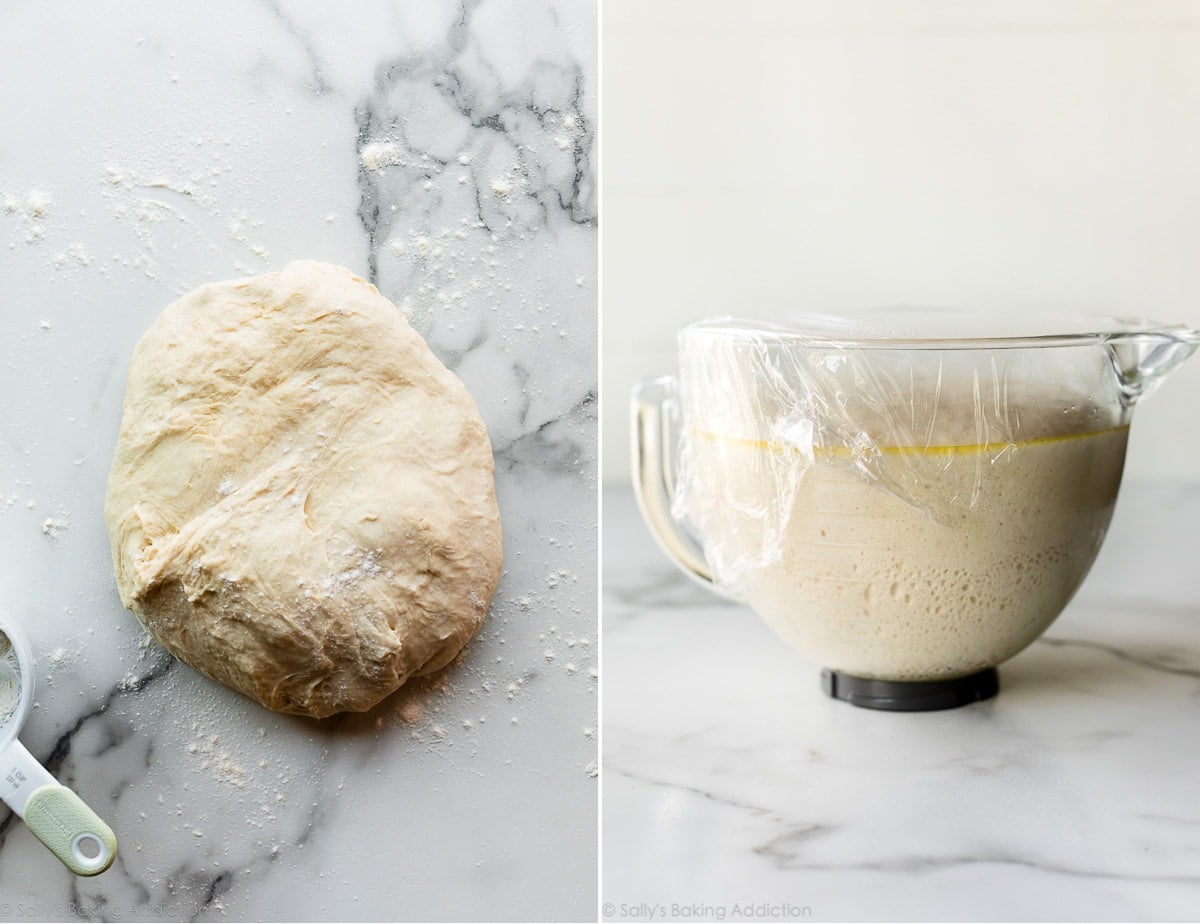
- Make the dough: Mix the ingredients together, and then knead the dough by hand or with your mixer. I like doing this by hand and you can watch me in the video, or in my separate How to Knead Dough tutorial.
- Let the dough rise: Place dough into a greased bowl, cover tightly, then set aside to rise for about 2–3 hours.
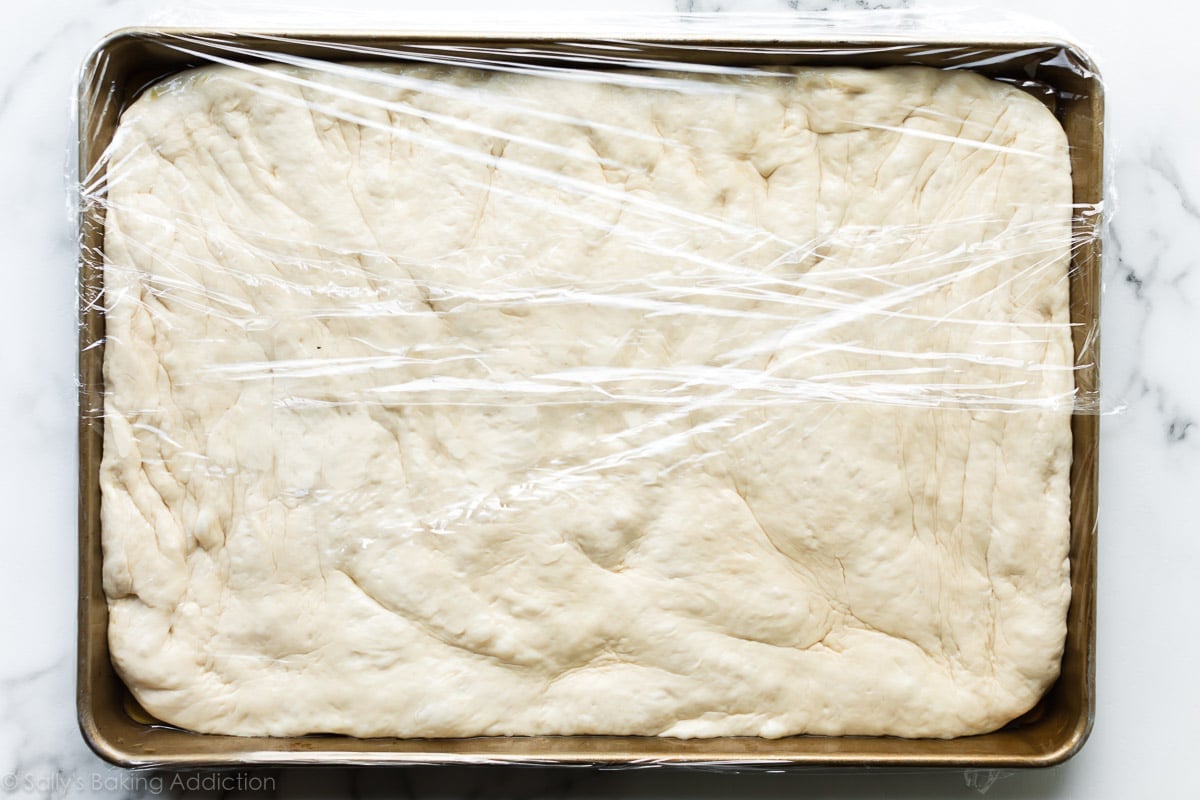
- Flatten dough out onto a baking pan: Punch down the risen dough to release the air, then use your hands to flatten the dough out onto an oiled baking sheet. If the dough keeps shrinking, cover it for 5 minutes to let the gluten settle.
- Let the dough rest in the refrigerator: The cold temperature slows down the rising. In fact, there’s so little yeast that the dough will hardly rise at all during this step. Let it rest in the refrigerator for as little as 1 hour and up to 24 hours. The longer it rests, the better the flavor. I recommend at least 12 hours, just like with my artisan bread and ciabatta bread recipes. You won’t regret it!
- Remove from the refrigerator: Let the dough hang out on the counter as you preheat the oven and prep the toppings. It will rise a little bit, but not much.
- Preheat oven: Focaccia bakes in a very hot 450°F (232°C) oven.
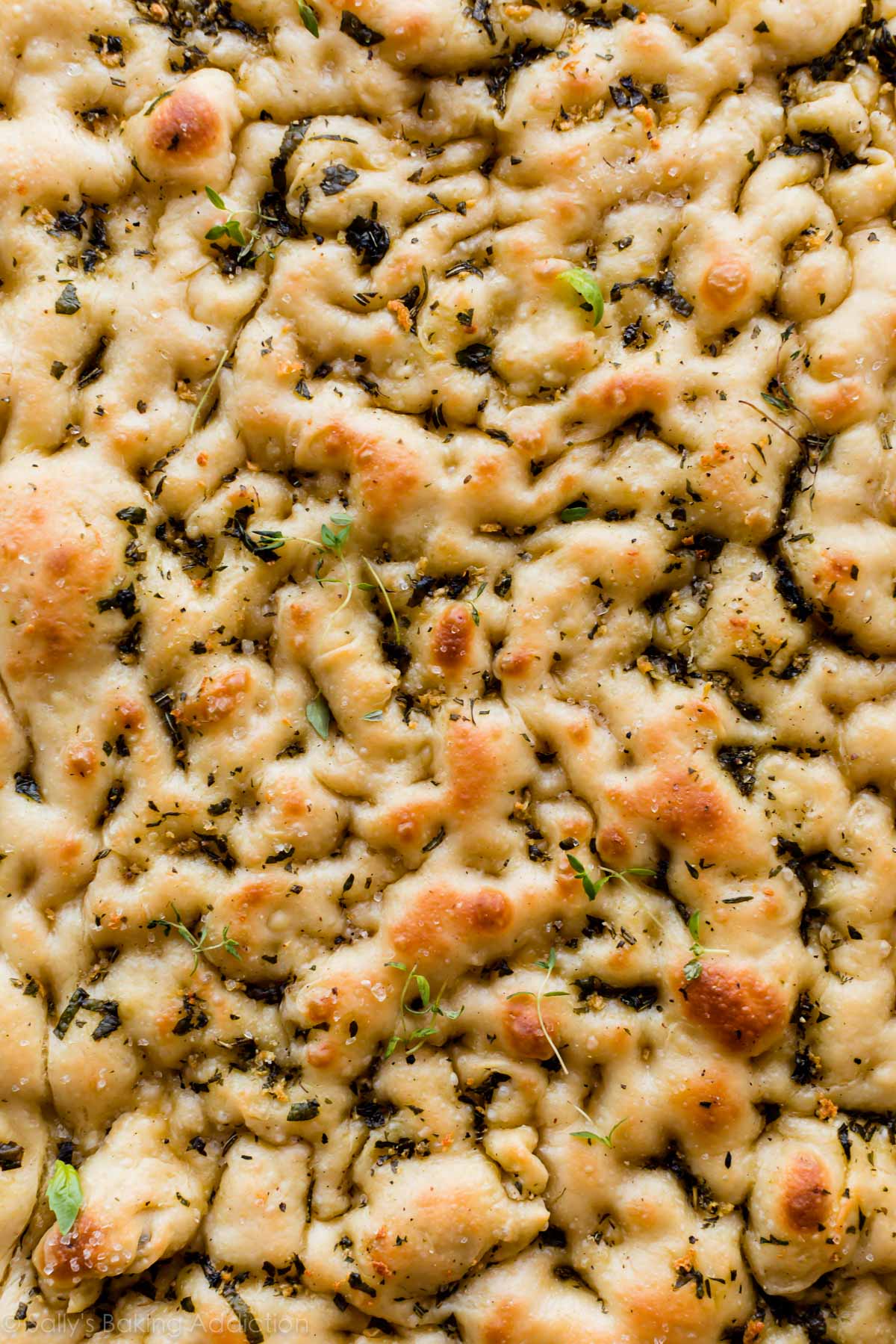
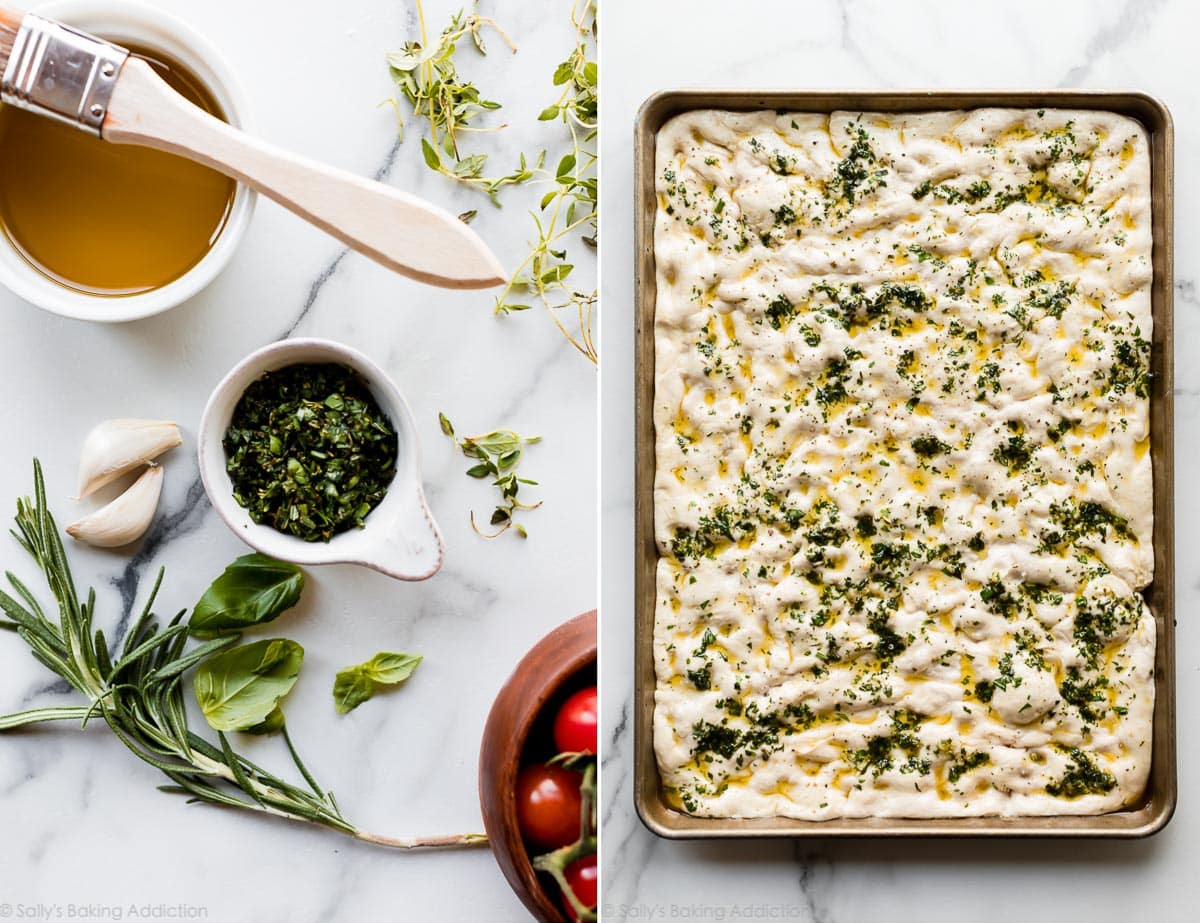
- Dimple the dough: A good stress reliever! Use your fingers to dimple the entire surface of the dough just like we do when making cold veggie pizza. The dimples give the olive oil and toppings “a place to go.” This step is fun!
- Add toppings: A simple blend of fresh garlic, rosemary, thyme, and basil is a favorite, but I have plenty of focaccia topping suggestions listed below. No matter which topping you use, drizzle olive oil all over the surface.
- Bake: Bake until golden brown. I set the oven to broil for the last minute to really crisp up the surface. Highly recommended!
The dough stretches to fit a large baking sheet. You can also divide the dough in half for 2 smaller focaccia loaves. I love that there’s no rolling pin or complicated shaping required.
After the dough rests in the refrigerator, dimple it with your fingers, then add toppings:
Make Ahead Recipe
As mentioned above, the longer the dough rests, the better it tastes. Focaccia is a convenient make-ahead recipe since you can do most of the work the day before serving. The bread tastes AWESOME warm from the oven, but it lasts all day if you want to bake it several hours prior to serving. Leftovers keep well for a few days or even a few months in the freezer, but some of the crispiness is lost over time. However, a few minutes in a preheated oven quickly brings leftover focaccia back to life!
Freezing dough: You can also freeze focaccia dough just as you would freeze pizza dough. After the dough rises in the mixing bowl, punch it down to release the air, coat it with a little olive oil, then cover and freeze for up to 3 months. Thaw in the refrigerator. Once thawed, remove the dough from the refrigerator and allow to rest for 30 minutes on the counter. Finally, shape the dough on the baking sheet and continue with the recipe.
Focaccia Toppings
Garlic & rosemary herb focaccia is a classic favorite, but you can customize it with various toppings. There’s truly no limit and here’s a list to prove it. Leave out the garlic and herbs (or keep them!), drizzle the dough with the olive oil, then add any of these toppings:
- Everything Bagel Seasoning
- Cherry Tomatoes or Sliced Tomatoes
- Parmesan (add before or after baking)
- Pesto (add before or after baking)
- Sliced Zucchini
- Pine Nuts
- Sliced Lemons or Lemon Zest
- Sun-Dried Tomatoes
- Olives
- Mushrooms
- Artichokes
- Raw or Caramelized Onions
I topped a test batch with the garlic & herb olive oil called for in the recipe below, plus some pine nuts and thinly sliced tomatoes. We all DEVOURED it.
More Simple Homemade Bread
- Homemade Pizza Dough
- No Yeast Bread
- Soft Pretzels
- Garlic Knots
- Brown Butter Sage Dinner Rolls
- Artisan Bread
- Homemade Garlic Bread
- Cornbread
- Olive Bread
- Whole Wheat Bread

Garlic Rosemary Herb Focaccia
- Prep Time: 16 hours
- Cook Time: 20 minutes
- Total Time: 16 hours, 20 minutes
- Yield: 2 dozen pieces
- Category: Appetizer
- Method: Baking
- Cuisine: Italian
Description
This simple 6-ingredient focaccia dough is a wonderful starting point for many different flavors, including this garlic rosemary herb focaccia. The homemade bread is chewy and soft in the center with a mega-crisp exterior. For the best flavor and texture, let the dough rest in the refrigerator overnight.
Ingredients
- 2 cups (480ml) warm water (between 100–110°F, 38–43°C)
- 2 teaspoons granulated sugar
- 2 teaspoons instant or active dry yeast (slightly less than 1 standard packet)
- 1/4 cup (60ml) extra virgin olive oil
- 1 Tablespoon kosher salt
- 4 and 1/2–5 cups (563–625g) all-purpose flour or bread flour (spooned & leveled), plus more for hands
Topping & Pan
- 5 Tablespoons (75ml) extra virgin olive oil or more as needed, divided
- 2 garlic cloves, minced
- 3–4 Tablespoons chopped fresh herbs such as basil, thyme, and rosemary (or 2 Tablespoons dried herbs)
- sprinkle of coarse salt and freshly ground black pepper
Instructions
- Prepare the dough: Whisk half of the water (1 cup; 240ml), 2 teaspoons sugar, and 2 teaspoons yeast together in the bowl of your stand mixer fitted with a dough hook or paddle attachment. Cover and allow to rest for 5 minutes.
- Add the remaining water, olive oil, salt, and 1 cup (130g) flour. Beat on low speed for 20 seconds, then add 3 and 1/2 cups (440g) more flour. Beat on low speed for 2 minutes. If the dough is still sticking to the sides of the bowl, add the last 1/2 cup (60g) of flour.
- Knead the dough: Keep the dough in the mixer and beat for an additional 5 full minutes, or knead by hand on a lightly floured surface for 5 full minutes. (If you’re new to bread-baking, my How to Knead Dough video tutorial can help here.) If the dough becomes too sticky during the kneading process, sprinkle 1 teaspoon of flour at a time on the dough or on the work surface/in the bowl to make a soft, slightly tacky dough. Do not add more flour than you need because you do not want a dry dough. After kneading, the dough should still feel a little soft. Poke it with your finger—if it slowly bounces back, your dough is ready to rise. You can also do a “windowpane test” to see if your dough has been kneaded long enough: tear off a small (roughly golfball-size) piece of dough and gently stretch it out until it’s thin enough for light to pass through it. Hold it up to a window or light. Does light pass through the stretched dough without the dough tearing first? If so, your dough has been kneaded long enough and is ready to rise. If not, keep kneading until it passes the windowpane test.
- Let the dough rise: Lightly grease a large bowl with a teaspoon of oil or some nonstick spray—just use the same bowl you used for the dough. Place the dough in the bowl, turning it to coat all sides in the oil. Cover the bowl with aluminum foil, plastic wrap, or a clean kitchen towel. Allow the dough to rise at room temperature for 2–3 hours or until double in size. (Tip: For the warm environment on a particularly cold day, heat your oven to 150°F (66°C). Turn the oven off, place the dough inside, and keep the door slightly ajar. This will be a warm environment for your dough to rise. After about 30 minutes, close the oven door to trap the air inside with the rising dough. When it’s doubled in size, remove from the oven.)
- Prepare the pan: Generously grease a 12×17-inch baking pan (with at least 1-inch-tall sides) with 2 Tablespoons of olive oil. This is the base layer of the bread, so be generous with the oil. A pastry brush is helpful to spread it.
- Flatten the dough: When the dough is ready, punch it down to release any air bubbles. Place on the oiled baking pan, then stretch and flatten the dough to fit the pan. Don’t tear the dough. If it’s shrinking (mine always does), cover it with a clean towel and let it rest for 5–10 minutes before continuing. This lets the gluten settle and it’s much easier to shape after that.
- Let the dough rest: Cover the dough tightly and let it rest in the refrigerator for at least 1 hour and up to 24 hours. The longer it rests, the better the flavor. I recommend at least 12 hours.
- Remove the dough from the refrigerator and let it sit at room temperature as you preheat the oven and prepare the toppings. Keep it covered. It may rise a little during this time, but not much.
- Preheat oven to 450°F (232°C). Allow it to heat for at least 10–15 minutes so every inch of the oven is very hot.
- Prepare the toppings: Whisk the 3 remaining Tablespoons of olive oil with the minced garlic and herbs. Set aside.
- Using your fingers, dimple the dough all over the surface. You can watch me do this in the video above. Drizzle on the olive oil topping and use your hands or a pastry brush to spread it all over the top. Add a little more olive oil if needed so the dough is completely covered. (This creates the crisp crust!) Sprinkle with a little coarse salt and freshly ground black pepper.
- Bake for 20–23 minutes or until lightly browned on top. If desired, broil on high for the last minute to really brown the top.
- Cut and serve hot or let it come to room temperature before slicing and serving. Focaccia tastes wonderful warm or at room temperature. Cover leftover focaccia tightly and store at room temperature for 2 days or in the refrigerator for 1 week. You can also freeze the baked and cooled focaccia for up to 3 months. Thaw in the refrigerator or at room temperature. To reheat the slices, you can use the microwave or bake in a 300°F (149°C) oven for 5 minutes.
Notes
- Freezing Instructions: After the dough rises, punch it down to release the air as instructed in step 5. Freeze the dough or portions of the dough to make at a later time. Lightly coat all sides of the dough ball(s) with olive oil. Place the dough ball(s) into individual zipped-top bag(s) and seal tightly, squeezing out all the air. Freeze for up to 3 months. To thaw, place the frozen dough in the refrigerator overnight. Remove the dough from the refrigerator and allow to rest for 30 minutes on the counter, then continue with shaping the dough to fit the baking pan as instructed in step 5. (Even after thawing, the dough must still rest in the refrigerator as instructed in step 6.)
- Make Ahead Instructions: The is a wonderful recipe to begin the day ahead of time. The dough must rest in the refrigerator for at least 1 hour and up to 24 hours, as instructed in step 6. I’ve let it go for as long as 30 hours and the flavor is incredible. I wouldn’t go past 24-30 hours.
- Special Tools (affiliate links): Stand Mixer | 12×17-inch Baking Pan | Pastry Brush
- Smaller Portions: This recipe yields a big pan of bread. You can divide the dough in half and bake smaller portions on 2 baking sheets or 9×13 inch baking pans. If desired, you can divide the dough in half and freeze half of it. Or you can halve the entire recipe.
- Yeast: You can use instant or active dry yeast instead. The rise time in step 3 may be a little quicker if using instant yeast. No matter which yeast you choose, you only need 2 teaspoons which is a little less than 1 standard 7g packet. Reference my Baking with Yeast Guide for answers to common yeast FAQs.
- Flour: You can use all-purpose flour or bread flour. All-purpose flour is convenient for most, but bread flour produces a chewier bread. No matter which you choose, the focaccia is still soft and rich with a crispy exterior. Either flour is fine and there are no other changes to the recipe if you use one or the other. You may need slightly closer to 5 cups of flour if using all-purpose.
Adapted from Bon Appetit & Pizza Crust








Reader Comments and Reviews
I was super excited to try this but unfortunately didn’t work out for me. I rested the dough for a day in the fridge, but even after some extra cooking time the dough was dense and uncooked with burnt edges. I did put it in a smaller pan as I didn’t have a larger one, could that have been the issue? Or maybe I didn’t let the dough rest enough after I took it out of the fridge? It just seemed like it didn’t want to cook. The night before when i was stretching the dough it seemed really nice and soft, but after keeping it in the fridge it was harder. Looking forward to a solution!
Hi Rebeka! In a smaller pan, the dough will be thicker and not bake through as intended.
I am trying this for the first time tomorrow and want to use dried Italian herbs and grated Parmesan. I see that you list 2 Tablespoons dried herbs but I don’t see how much Parmesan you suggest. I also only have the Parmesan in a can so don’t know if I should skip that because it would make it too dry.
Hi Jane, a few Tablespoons of parmesan would be great. You can add it before or after baking.
Personal preference – I’ll use a smaller pan next time to get a thicker loaf. Great tasting recipe. Overnight fridge proofing really gives better flavor.
Sally, you and your team are GENIUS! I have been making Focaccia for over 20 years and this is the best Focaccia I have ever made! Even my husband commented on it. This recipe has the best dough and the PERFECT ratio of topping ingredients. This is the only recipe I will ever use again. I was only able to rest the flattened dough in the refrigerator for 2 hours but next time I will plan ahead and leave in refrigerator for 12 hours. Sally I love your recipes and yours site is ALWAYS my go to. You and your recipes are to be trusted.
Great recipe! However I did have an issue while kneading/shaping the dough – I feel like I added SO much extra flour and it was still too sticky. I really worked the flour all the way through but after a few rounds of kneading it was sticking so much again. I eventually just gave up and shaped it, it was also hard to dimple for this reason. I guess I could have added even more flour but it really seemed like overkill. Any ideas to what I could have done wrong? Still came out delicious but would love to try again and get it right!
Hi Elyssa, is it especially hot and/or humid where you live? A lot of different factors can go into the consistency of the dough (even the weather on a particular day!), so it’s completely fine to add flour (a tablespoon at a time) to get it to come together into a workable consistency. Thank you so much for giving this one a try–we’re glad you enjoyed it!
This is my first time making this recipe. It’s in the refrigerator right. Ow, will bake it tomorrow morning. I don’t have a 12 x 17 pan so am using a regular 10 x 15 cookie sheet. The bread will be a little thicker, I’m assuming I need to bake it longer? So far, everything has come together perfectly…so just wondering about the bake time.
Hi Gina, the bake time should be only a little bit longer. I like breads to be nice and golden brown, so I’d probably extend it 5 minutes.
Thanks, Sally! I baked for 25 minutes until the top was nicely browned. It just came out of the oven and of course I had to try a piece. Absolutely amazing! I’m taking it to a meeting tomorrow morning, I guarantee I’ll get requests to make it for future meetings.
I’ve made this recipe a few times now and it turns out amazing every time! I’d love to make a sourdough version as well! Do you have a sourdough variation or suggestions on how to substitute? Thanks!
Hi Tabitha, we haven’t tested a sourdough version of this focaccia, but let us know if you do!
Tabitha, I recently found an instant sourdough packet in the baking aisle at my Winco grocery store. It is called Platinum by Red Star. You use it like regular yeast, teaspoon for teaspoon. I used it once in bread sticks and it didn’t taste very sour sour to me but Sourdough is never sour enough for me.
My first try at this recipe came out very good, although a tad too salty for my taste. I’m thinking now of something sweet instead of savory. Say, a cinnamon roll type topping and basting the bread with melted butter instead of olive oil. Also reducing the salt in the base dough by half to 1/2 Tbs. Then add a light glaze drizzle. Your thoughts or suggestions?
Hi Dave, we haven’t tested a sweet variation of this bread, but don’t see why that wouldn’t work! Have fun experimenting, and let us know how it turns out!
I made this and really enjoyed the flavor of the bread. Although it was great bread, it didn’t have the classic “focaccia” bubbles inside that I was hoping to achieve. I followed the recipe but I did let it prove for a little longer. Is that my problem? Or not enough time in the fridge?
Hi Grace, did it seem overly dense? It could be that the dough was over proofed and/or over handled, causing it to lose some of the air pockets/bubbles. We recommend at least 12 hours in the refrigerator for best taste. Hope this helps and we’re so glad you enjoyed the bread! You may find it helpful to review our Baking with Yeast Guide, too.
I wanted to make flatbread focaccia for sandwiches, turns out I pressed 2 doughs on cookie pans and it was like a cracker. Great flavor and really crunchy.
Can this be made in a bread machine? You are my favorite creator of all things baked. Simple clear and delicious recipes – everyone I have tried (I have tried many) is exceptional.
Hi Sasha, We don’t own a bread machine and haven’t tried this method, but let us know if you do give it a try!
Can I add cherry tomatoes into the bread before baking? And would
I need to adjust the baking time?
Hi Andrea! Yes, you can absolutely add cherry tomatoes. Bake time will be very similar.
I cannot wait to make this recipe. What flour do you advise if flutes free is needed? Thanks!
Hi Martha, we don’t have much experience baking with gluten free flour. Although some readers report using an all-purpose 1:1 gluten-free flour in many of our recipes with success, you should expect slightly different results anytime you substitute ingredients. Let us know what you try.
Quick question! I want to make this recipe into Focaccia Rolls in a muffin tin with paper liners, is there an amount of minutes to bake that can be adapted?
Hi Christine, we haven’t tried it before so we’re unsure of the best bake time, but it should be a bit less. Keep a close eye on it, and please do let us know how it goes!
How do I make this recipe if I do not have a stand free mixer with dough hook? Can I use a hand held mixer?
Hi Deb, the dough can tend to get stuck in the beaters of a handheld mixer, but you could use a mixing bowl and wooden spoon/spatula instead.
If I wanted to add olives should they be mixed into the dough or put on top before baking?
Hi Shannon, we recommend adding the to the top before baking. Enjoy!
You cannot even imagine how good this recipe is! My Italian friend even claims it as good as anything he’s had in Italy and better than anything he’s had outside the country! It’s super easy and super reliable. When I had some health issues recently my husband jokingly said “you can’t let anything bad happen to you until you tell me how to find the focaccia recipe!” Yes – it’s that good!!!
I’ve made this focaccia twice now and I love it!! I replaced some of the flour with whole wheat flour, but I just wanted to know how you would go about making it 100 percent whole wheat? Thanks!!
I would love to know if you ever tried it 100% whole wheat? Ive done 50/50 and the texture is great but have you ever tried to only use whole wheat flour?
I have made this a few times & it always turns out great, but I must say, using 00 flour turned out the best. After all, focaccia is a pizza bread.
I followed this recipe but it didn’t turn out like I had hoped. It was more dry and chewy. I’m looking forward to making it again with better results.
Hi Sally,
I’ve made this focaccia a few times and it’s genuinely one of the best things I’ve ever made, it’s delicious and always a hit!! I want to make one for my friend who is gluten free, and was wondering whether its possible to just switch out the type of flour or would I have to try something else??
Thank youu
Hi Cris, I really wish I could help but I have very little experience baking gluten free yeast breads. For best success, I would search for a recipe that has been formulated around using GF flour. I’m glad you enjoy this recipe, and thank you for asking!
Just made this today. Had to do a “quick” rise, 4 hrs. Yep I also had to add a bit more flour, but it was soooo soo yummy!! I brushed the top with olive oil and sprinked Savory Spices Pesto Parmesan on top. Wonderful!!
This is just delicious!
I have made this recipe a couple of times. It is so delicious!! The texture is perfect.
Like others reviewed, this dough was unworkably wet. Had to add what seemed like 1-2 more cups of bread flour. It is rising now… hopefully it turns out right!
The first time I made this my dough where I live in Florida, it was extremely wet, so I added (a lot) more flour (didn’t measure, just went by the feel of the dough and the consistency of what I thought it should be). It turned out FANTASTIC! I made this dough again yesterday while visiting my daughter in Arizona. I used the exact amount of flour and the dough was perfect. I think humidity has a big factor in the “wetness” of the dough. This batch is in the fridge and waiting to get in the oven, yet but I’m still excited to see the results. Best focaccia recipe ever, and a forgivable recipe too. Just trust your feel for the dough!
This ended up being a delicious focaccia, which I made with fresh rosemary, garlic and sea salt as a topping. It seems to be a very forgiving bread recipe too – the dough as written was FAR too wet for me, and I had to add significantly more flour. I also made a couple of rookie mistakes – had to use a regular cookie sheet whose sides weren’t tall enough, and didn’t cover tight enough overnight because I didn’t have cling film. But it still ended up super tasty with a great texture, chewy inside and q crispy crust.
Can I use 00 flour instead?
That substitution shouldn’t be a problem here.
YES!!! Way better finished product.
Thank you. I think I used it last time I made it & it turned out amazing. I couldn’t remember for sure if I did or not. I appreciate your response because yes, it was better than when I used bread flour.
This is the highest hydration dough I’ve ever worked with. I had to use a bit of extra flour and there was minor stickiness in spots when I finally just deemed it good enough. I let in rise in the fridge about 18 hours. I used 1/2 tbsp dried rosemary, 1/2 tbsp dried basil, 1 tbsp dried oregano plus coarse sea salt and pepper. I needed a little extra oil as the dried spices absorbed a fair amount. It turned out very well.
I’m not much of a reviewer, but I just had to say something because this recipe delivered some seriously delicious bread. I have always been terrified of bread making, but I followed these steps and was super successful! I used a 10” cast iron skillet and the full recipe and it came out perfect, about 1” in height. Thank you so much!
Hi Sally and Crew! This recipe turned out to taste AMAZING!! We topped it with the herb oil, salt, olives, and about 5 minutes before baking was done, a healthy sprinkling of Parm. So delicious next to our Italian sausage, tortellini, and veggie soup! Truly a perfect pairing.
So, why four stars? Well, because I have been an accomplished home baker for 15 years and am someone who buys premium yeast by the pound. I have made so, SO many loaves over the years so I knew there was a problem just as the mixing/kneading started. I added all the flour called for in the recipe, using KA bread flour.. as well as an additional half cup of flour. I weighed my ingredients carefully, as always, yet the dough was VERY wet and completely unmanageable by hand. In the end, I literally poured the dough into two heavily oiled zipper bags and threw it in the freezer. A few days later, having defrosted in the fridge, I poured one portion into a heavily oiled 9 x 13 and hoped for the best.
It didn’t rise much during the 24-hour cold rise but did puff up nicely as it sat on the counter during the 40-minute oven preheat. Still, it did not entirely reach the corners/edges of my pan, but I forged ahead and am very glad I did because the bread was SO tasty! And, the final oven proof filled my pan perfectly. 🙂
I would like to make this again in the future but honestly, dealing with the very wet dough was a real pain and a real mess. I am sure that I measured correctly and I see the gorgeous pictures and great reviews here.. so I am at a loss as to what caused the sticky mess? I cannot blame environmental conditions, as I know they can affect flour and hydration, but again.. been baking in the same environment for so very long that I know that this cannot be the cause of the problems I experienced.
Help?
Thanks so much for all the great recipes guys! I TRULY appreciate all the work you do testing recipes, which in turn, helps novices (as I once was) gain the confidence needed to become great home bakers themselves.
Melissa, I had exactly the same problem. The dough shown in the video is much less wet.
My dough was amazing, not wet at all and look just like her in the video
i had to add probably an extra cup of flour before it was workable (didn’t measure, just went by feel). had too the first time i made it too. turned out great!