
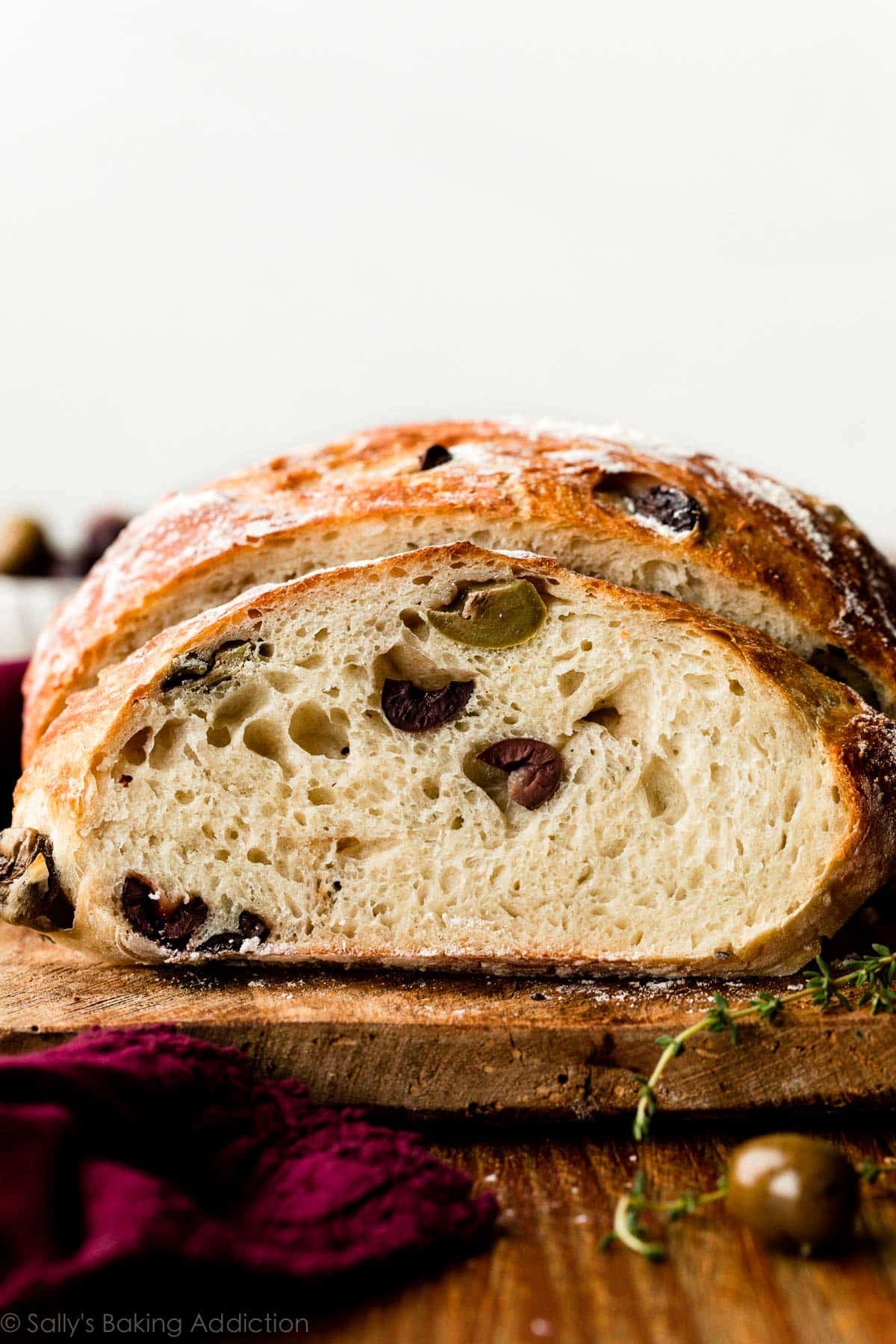
This crusty olive bread is perfect for serving at your next dinner party, or alongside a cheese and charcuterie board. It’s sure to impress your guests, and they won’t have any idea how easy it actually is! There’s no kneading or complicated shaping involved, and the vast majority of time is hands-off. This loaf is soft inside with a crispy chewy crust, and includes garlic, oregano, and plenty of salty olives.
One reader, Shannon, commented: “Another phenomenal recipe. Had this last night with the Baked Chicken Meatballs—was so delicious. So much flavor and with minimal effort, especially for a bread. Did a mix of kalamata and green olives. Wonderful. ★★★★★“
Another homemade yeast bread to love!
Don’t let your eyes fool you… the dark speckles in today’s bread are not chocolate chips and raisins. They’re olives! This recipe is based off of my homemade artisan bread, a wonderfully easy and widely popular no-knead bread that’s fit for both beginners and experts. (Note that I bake this bread at a slightly lower oven temperature because the olives can burn.)
A Flavorful Bread Recipe for Beginners
Today’s olive bread basically makes itself, so if you’re nervous to try homemade bread, this recipe is a great introduction. Even though the recipe is easy, the bread does NOT skimp on flavor. It’s just a simple way of baking homemade bread inspired by the no-knead technique originating from bread expert Jim Lahey. Here’s why it’s so simple:
- Only 7 ingredients
- Absolutely no kneading (just like homemade English muffins!)
- Zero complicated shaping
- No mixer required
- 90% of the time is totally hands off
- Can bake in a dutch oven or on a baking sheet
Plus, you can make it in 4 hours or let the dough rest in the refrigerator for up to 3 days (great make-ahead recipe!). Once you realize how easy it is to prepare salty, herby, garlicky olive bread, you’ll find any excuse to bake it.
Key Ingredients You Need & Why
Today’s Mediterranean-inspired bread is an egg free baking recipe and dairy free recipe. Here are the ingredients you need:
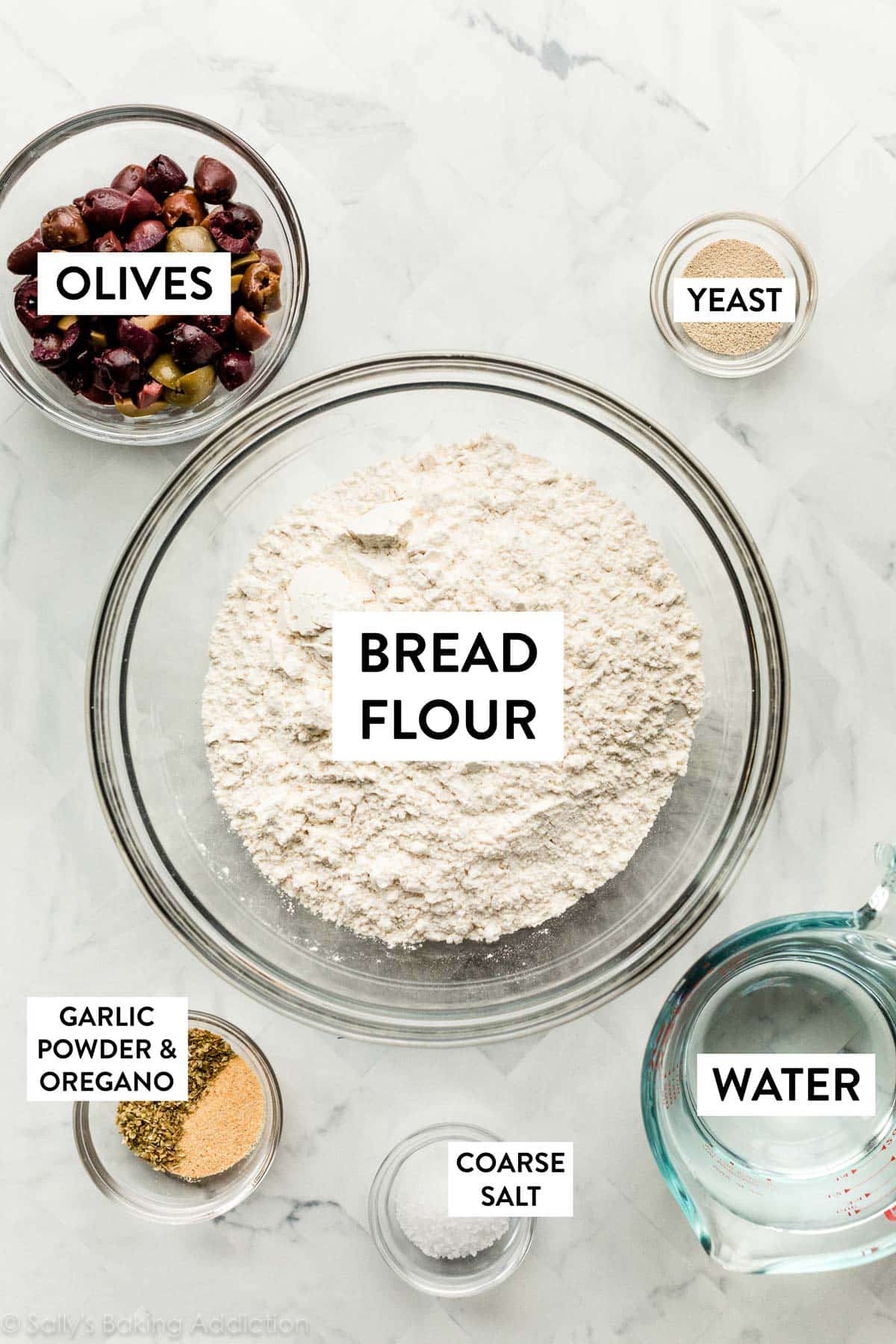
- Bread Flour: While you could use all-purpose flour in this recipe, I strongly recommend using bread flour. Bread flour produces a stronger, chewier bread and that makes a big difference in an artisan-style loaf like this olive bread or this homemade ciabatta bread.
- Instant Yeast: While you can use active dry yeast if that’s all you have, any quick-rise or instant yeast will produce flavorful results in less time. I use more yeast in this recipe compared to my cranberry nut no-knead bread and no-knead jalapeño cheddar bread. Why? Those doughs rest and rise at room temperature. However, for more flavor and just as much rise, I use more yeast and let this dough rest in the refrigerator. (Cool air slows the fermentation process and helps develop better flavor.)
- Salt: Just like with asiago-crusted skillet bread and no-knead pizza bread, I recommend using coarse salt because I find the bread’s flavor lacking with regular table salt.
- Garlic + Herbs: Dried oregano and garlic powder add flavor to the dough. You could also try some chopped fresh herbs or roasted garlic cloves, or simply leave them out. The recipe is pretty adaptable, just like the toppings for focaccia!
- Olives: See below for my recommendations.
- Water: I normally encourage you to use warm liquid with yeast, like we do in no knead seeded oat bread, because warm liquid helps the yeast work faster. However, use cool or room-temperature water here. Not freezing cold, not super warm… just cool to the touch. 70°F (21°C) is great, but the exact temperature doesn’t matter as long as it’s not warm. We use the same cool water method for no-knead honey oat bread.
- Optional Cornmeal: If you’re using a baking sheet, dust the pan with cornmeal for a pop of flavor and a little crunch. This is completely optional. If you have it, use it. If you don’t have it, dust the pan with flour.
Best Olives to Use
Kalamata olives are excellent in this bread, but you can use a medley of olives. I’ve made it both ways. Whatever you use, give the olives a rough chop.
Let Me Show You How to Make This Olive Bread
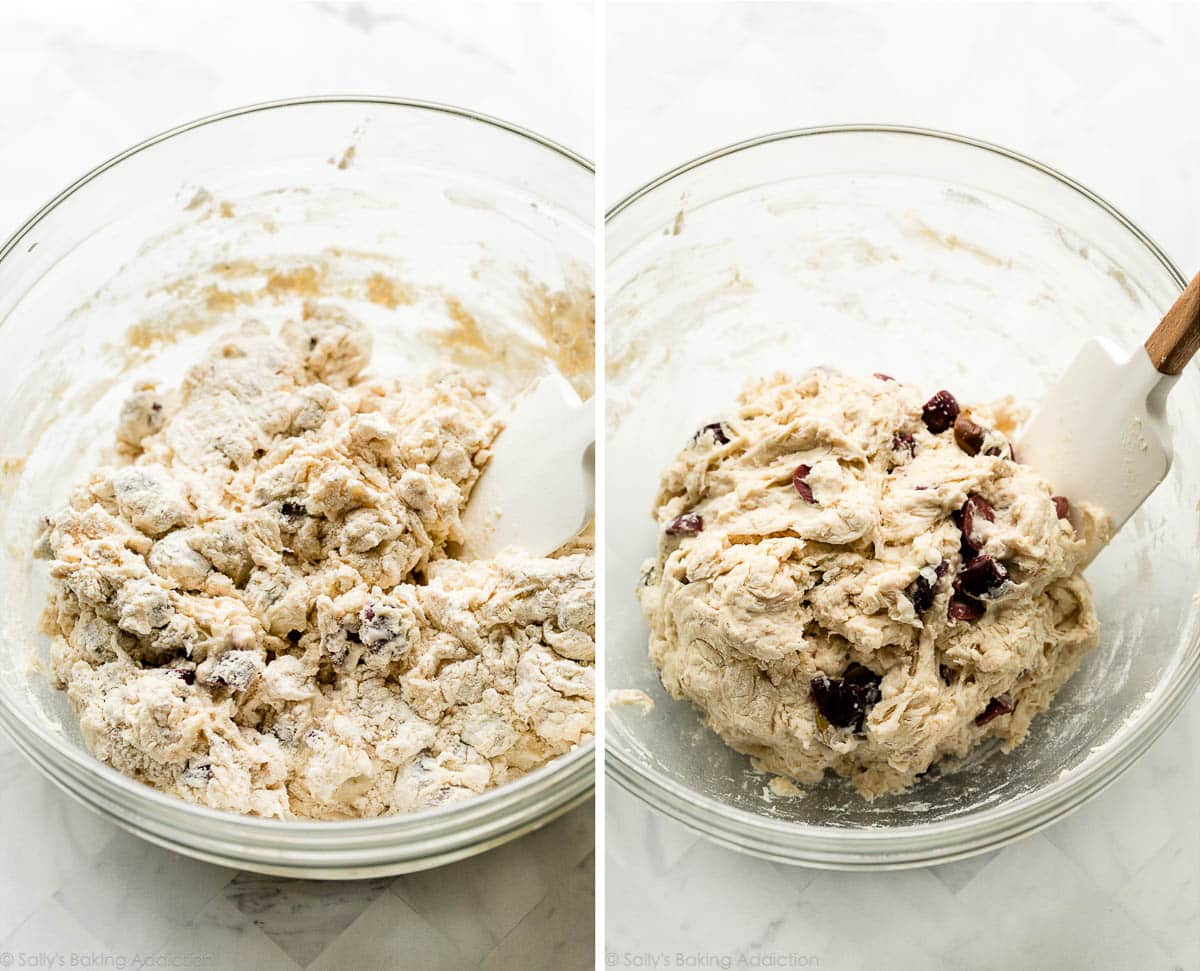
Mix the dry ingredients together and then mix in the chopped olives and water. At first the dough will seem very dry and shaggy and you’ll question if it will even come together. (See above!) Use a spatula at first and then switch to your hands to ensure all of the flour is moistened. The dough is a little sticky after it’s thoroughly mixed.
Let it rise. Cover the dough and let it rise at room temperature for about 2–3 hours.
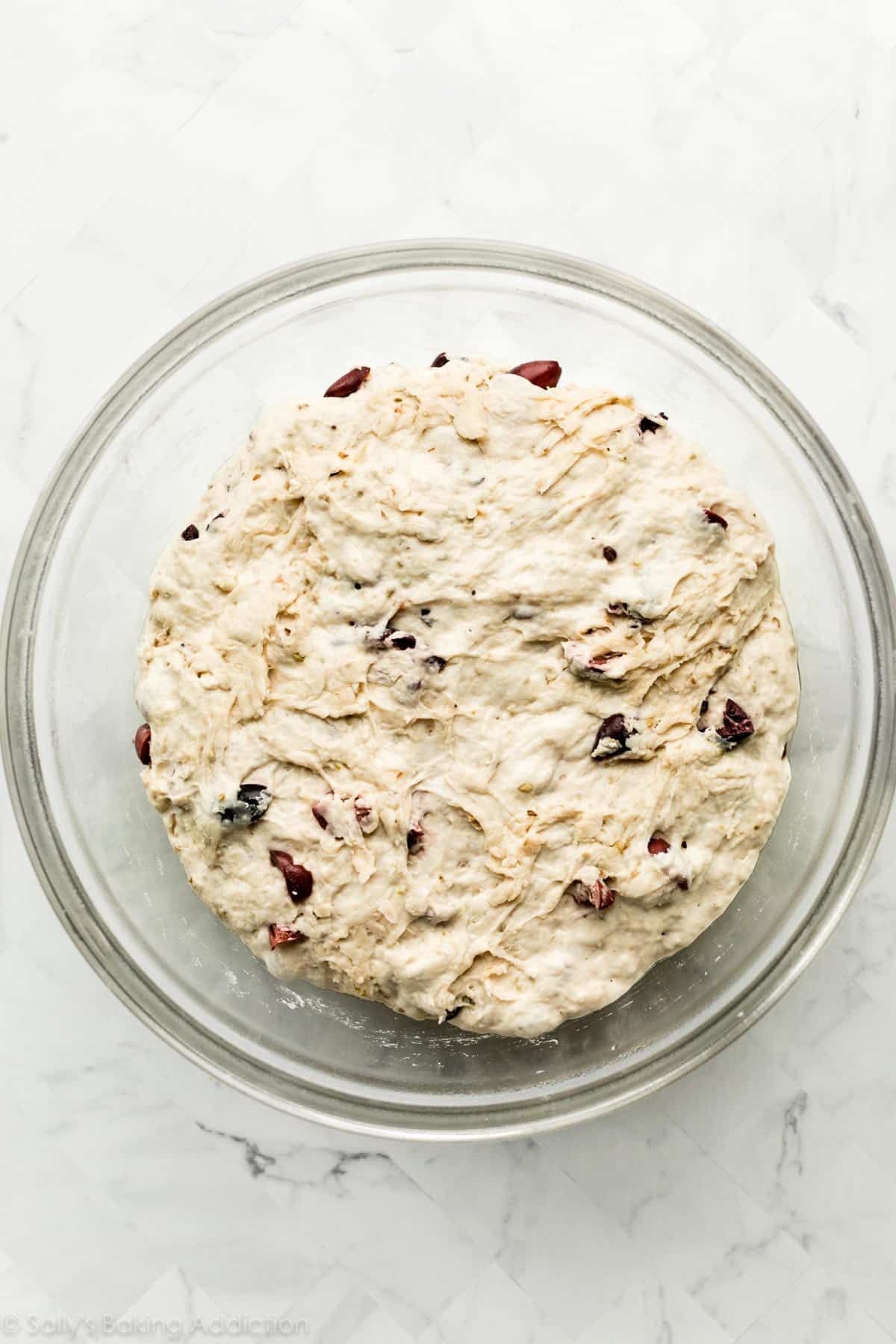
You can immediately continue with step 4 below (gently shaping before baking) or refrigerate the dough for up to 3 days. For best flavor, I strongly recommend refrigerating the risen dough even if it’s just for a couple hours.
After the dough rises and rests in the refrigerator, use generously floured hands to shape the dough into a round boule or ball-like shape:
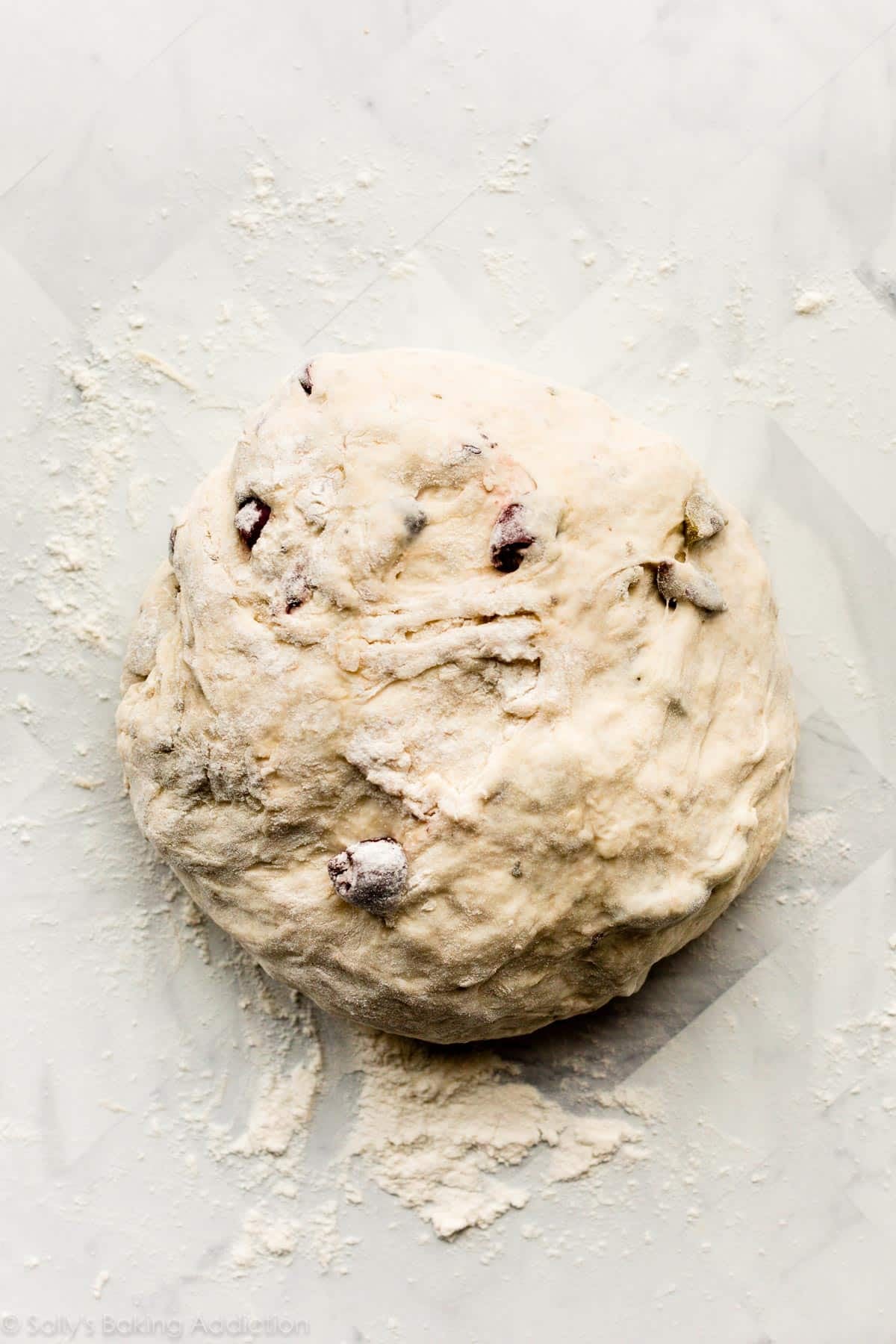
Now it’s time to choose between a dutch oven or baking sheet. This bread isn’t picky!
Use a Baking Sheet or Dutch Oven
You can use either. Baking the olive bread in a covered dutch oven traps steam inside the pot, creating that perfect crust. If you plan to bake a lot of bread in the future, you won’t regret picking up a dutch oven. If you don’t have a dutch oven, a nonstick large baking sheet is best. Let me explain both ways:
- Baking Sheet: Lightly dust it with flour and/or cornmeal. Place the dough on top, cover it, and let it rest as the oven preheats. You will find these detailed instructions in the recipe below, along with my crispy crust optional trick in step 7!
- Dutch Oven: Place the empty dutch oven with lid in the oven as it preheats. Place the dough on high heat resistant parchment paper (I use this parchment paper) and then fit inside a bowl. Cover and let the dough rest as the oven preheats, then place it (with the parchment) in the hot dutch oven before baking. You will find these detailed instructions in the recipe Note below.
Whichever you use, don’t forget to score the dough with a bread lame or sharp knife. Scoring allows the wet, airy dough to “breathe” as it rises and bakes.
Dutch oven method:
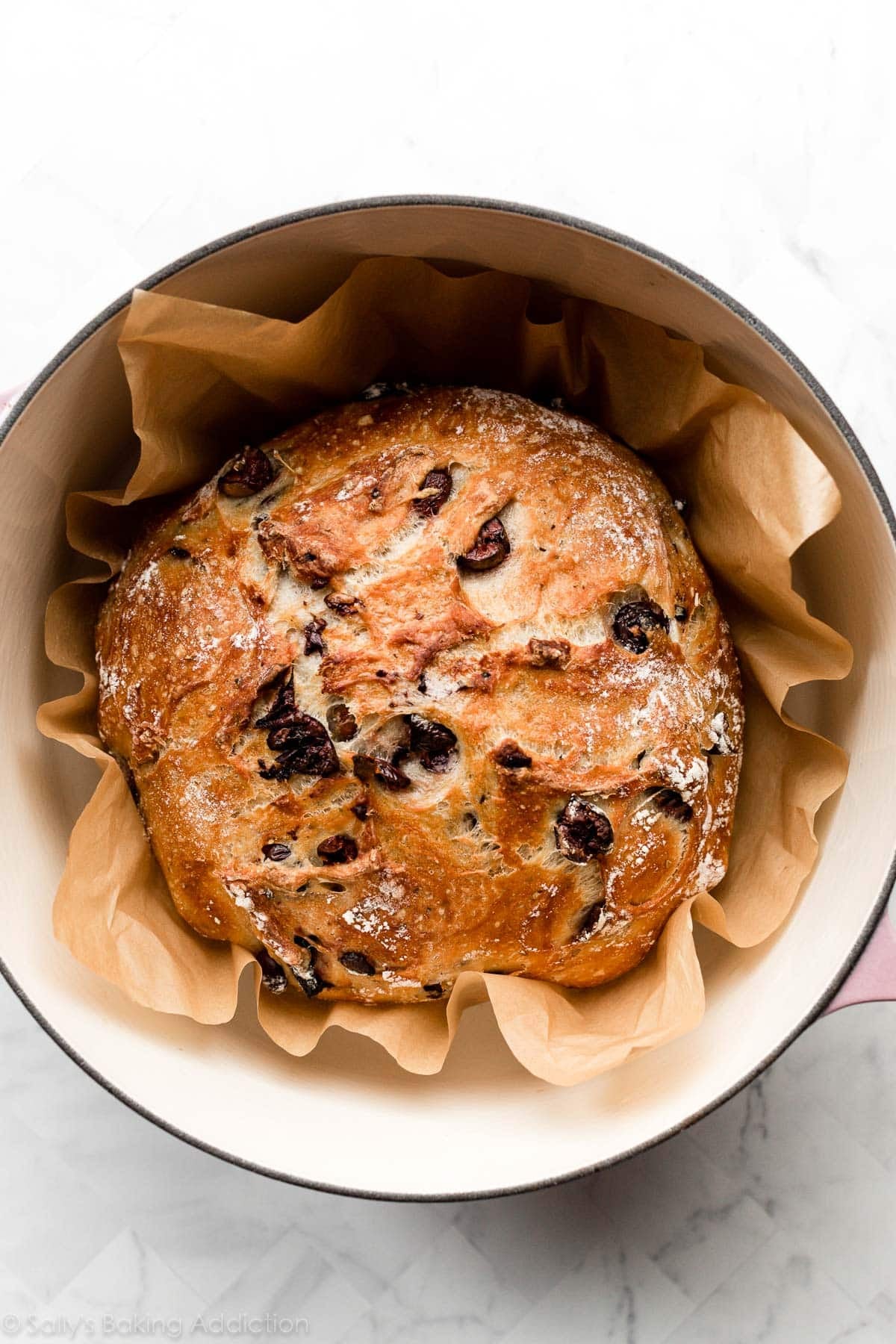
Baking sheet method:
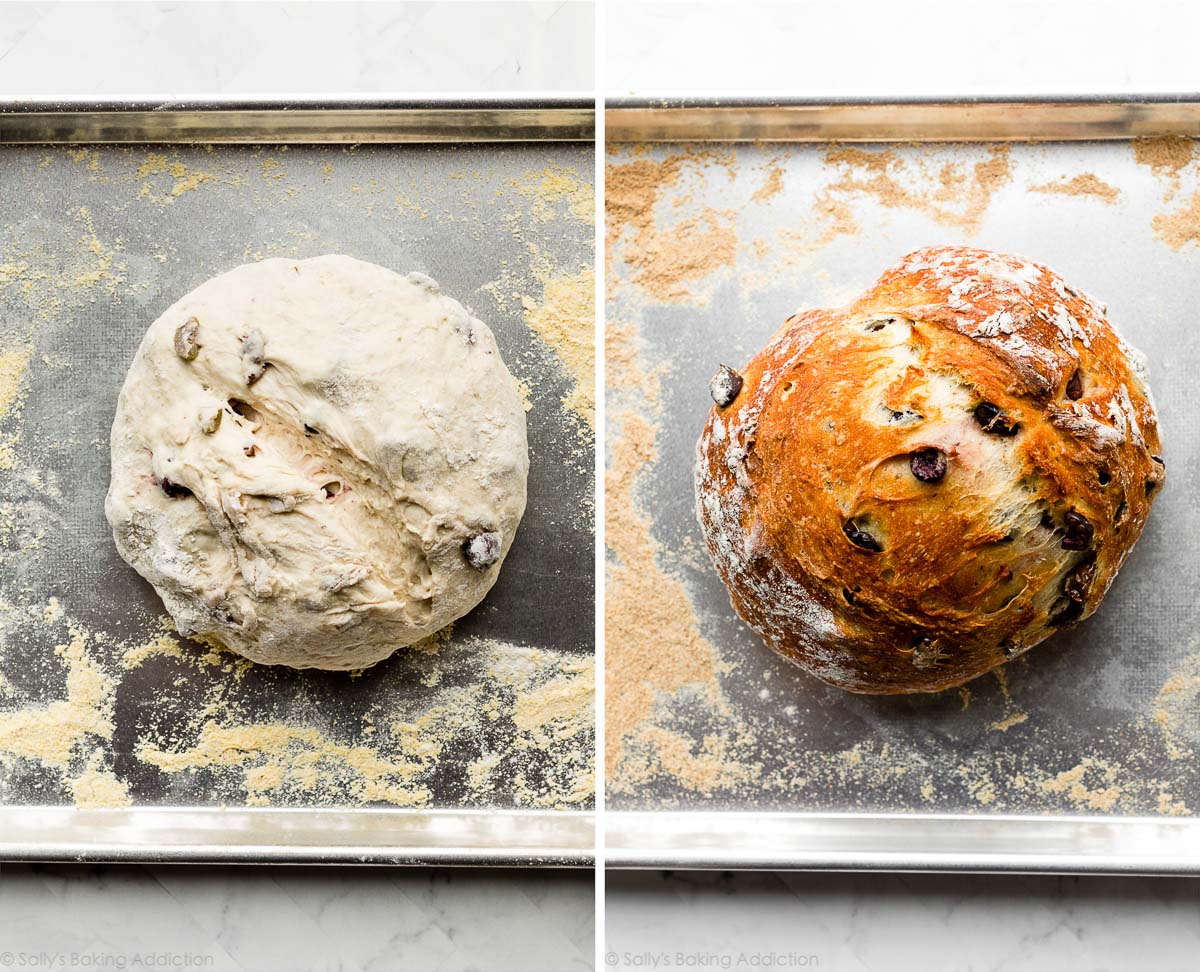
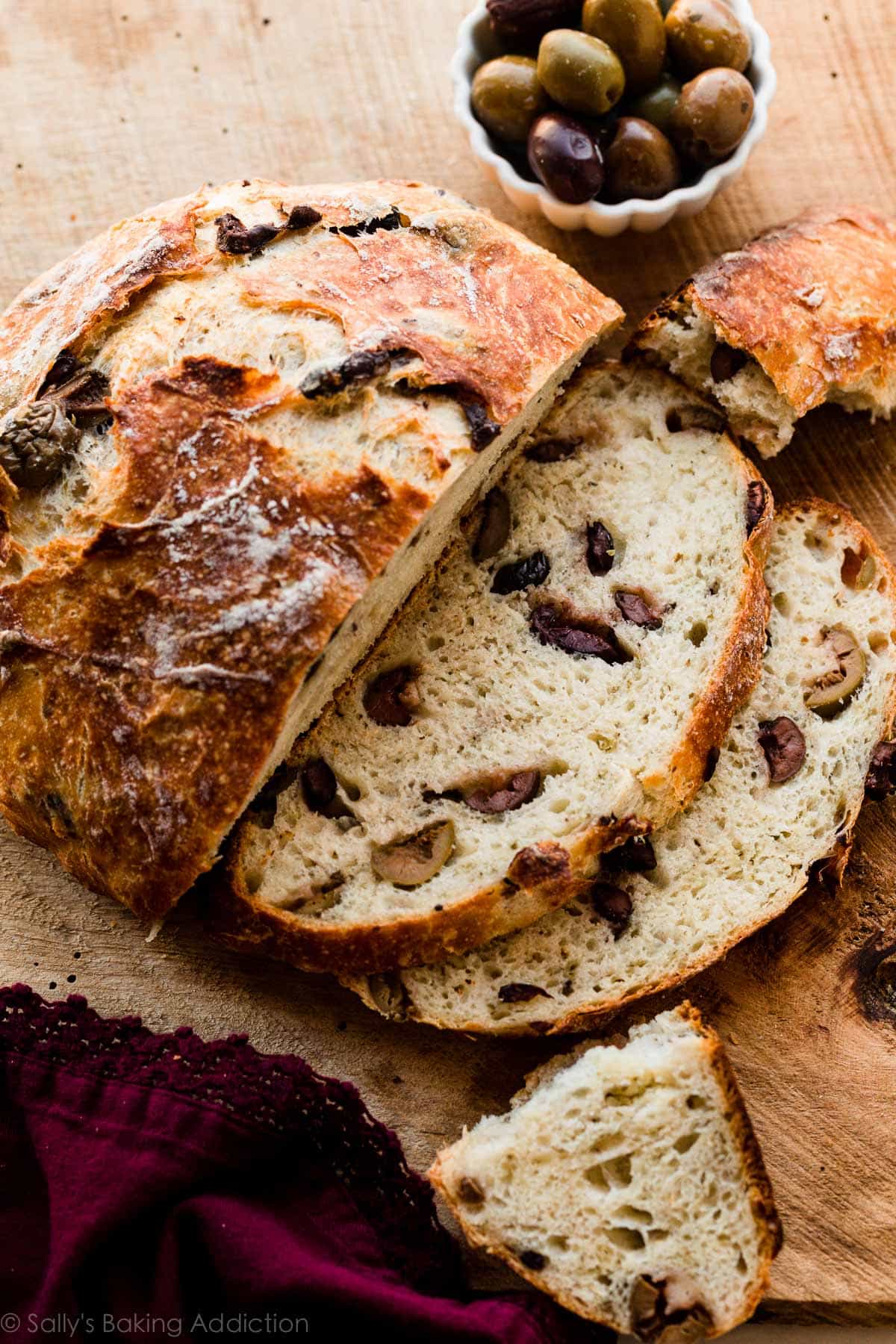
The bread is unbelievable when it’s fresh from the oven—warm, crispy, crusty, and soft inside!
What Can I Serve With This Olive Bread?
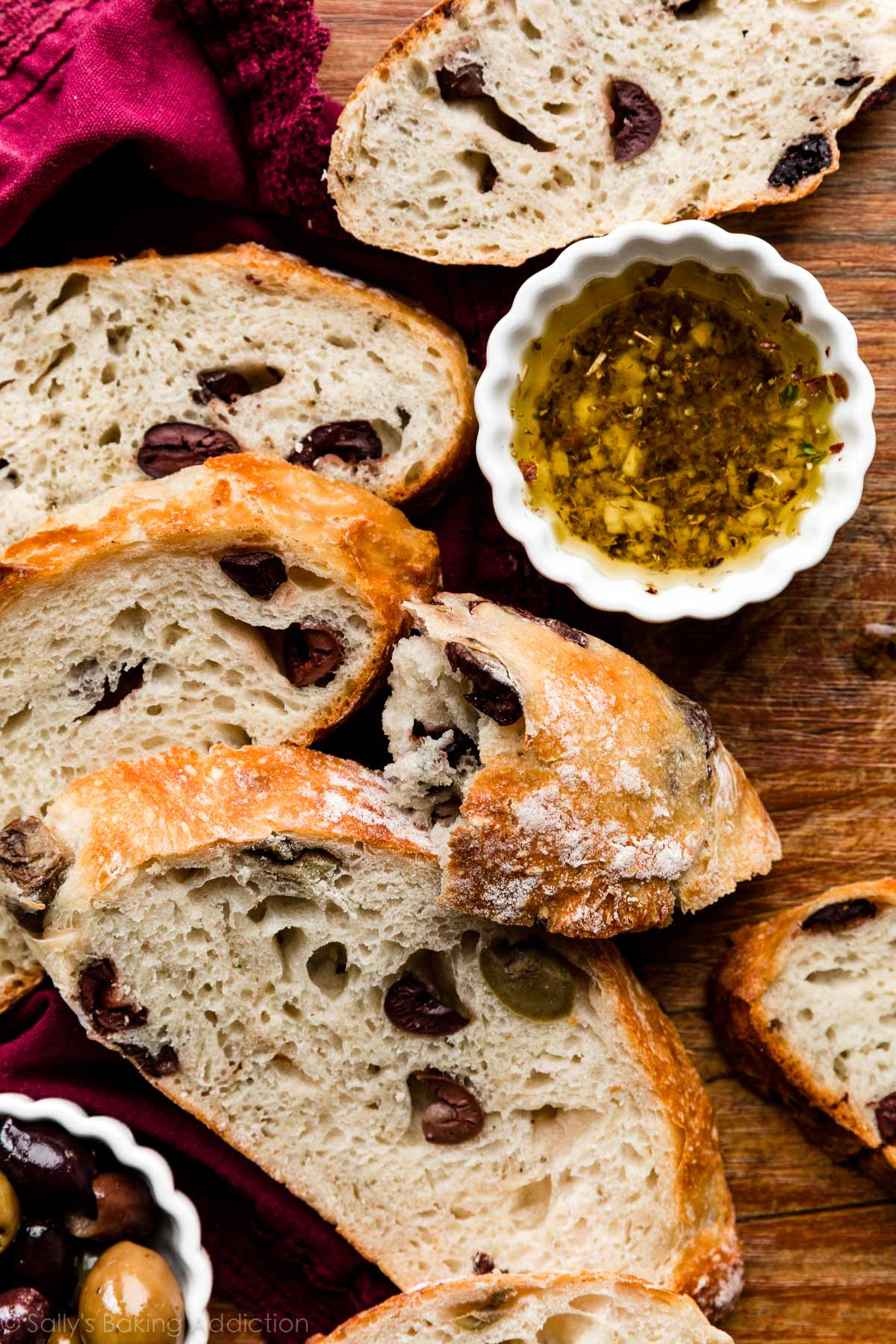
Honestly, it’s fantastic plain. But I usually mix together a super easy + flavorful dipping oil: 3 Tablespoons (45ml) extra virgin olive oil and 2 minced cloves of garlic plus a sprinkle each of red pepper flakes, fresh or dried thyme, dried oregano, salt, and pepper. The bread would also be delicious paired with homemade pesto.
Serve your olive bread alongside a charcuterie or cheese platter, or with any Mediterranean-style fare. I love it with a big Greek salad and have even served it with minestrone soup, pesto shrimp, chicken meatballs, and lemon thyme chicken.
Print
Easy No-Knead Olive Bread
- Prep Time: 4 hours
- Cook Time: 35 minutes
- Total Time: 4 hours, 35 minutes
- Yield: 1 loaf; 10-12 servings
- Category: Bread
- Method: Baking
- Cuisine: American
Description
Follow this recipe and enjoy homemade olive bread that’s altogether crisp, soft, garlicky, herby, and salty. Review Notes before beginning. If you’re new to working with yeast, reference my Baking with Yeast Guide for answers to common yeast FAQs.
Ingredients
- 3 and 1/4 cups (about 430g) bread flour (spooned & leveled), plus more as needed for shaping and pan
- 2 teaspoons instant or active dry yeast
- 2 teaspoons coarse salt (see note)
- 2 teaspoons dried oregano
- 1 and 1/2 teaspoons garlic powder
- 1 heaping cup (about 135g) roughly chopped olives
- 1 and 1/2 cups (360ml) water, close to room temperature at about 70°F (21°C)
- optional: cornmeal for dusting pan
Instructions
- In a large un-greased mixing bowl, whisk the flour, yeast, salt, oregano, and garlic powder together. Using a silicone spatula or wooden spoon, mix in the olives. Pour in the water and gently mix together. The dough will seem dry and shaggy, but keep working it until all the flour is moistened. If needed, use your hands to work the dough ingredients together. The dough will be sticky. Shape into a ball in the bowl as best you can. (Tip: Stir dough by hand. Dough is too sticky for a mixer.)
- Keeping the dough in the bowl, cover the dough tightly with plastic wrap or aluminum foil and set on the counter at room temperature (honestly any normal room temperature is fine). Allow to rise for 2-3 hours. The dough will just about double in size, stick to the sides of the bowl, and have a lot of air bubbles.
- You can continue with step 4 immediately, but for absolute best flavor and texture, I strongly recommend letting this risen dough rest in the refrigerator for at least 12 hours and up to 3 days. (Even just a couple hours is good!) Place covered dough in the refrigerator for up to 3 days. The dough will puff up during this time, but may begin to deflate after 2 days. That’s normal and nothing to worry about.
- Lightly dust a large nonstick baking sheet (with or without rims and make sure it’s nonstick) with flour and/or cornmeal. Turn the dough out onto a floured work surface. Using generously floured hands, shape into a ball as best you can. Dough is very sticky. Transfer to prepared baking sheet. Loosely cover and allow dough to rest for 45 minutes. You will bake the dough on this prepared baking sheet. See recipe note if you want to use a pizza stone or dutch oven.
- During this 45 minutes, preheat the oven to 425°F (218°C).
- When ready to bake, using a very sharp knife or bread lame (some even use kitchen shears), score the dough with a slash or an X, about 1/2 inch deep. (“Score” = shallow cut.) If the shaped loaf flattened out during the 45 minutes, use floured hands to reshape into a ball.
- Optional for a slightly crispier crust: After the oven is preheated and bread is scored, place a shallow metal or cast iron baking pan or skillet (I usually use a metal 9×13-inch baking pan) on the bottom oven rack. Carefully and quickly pour 3-4 cups of boiling water into it. Place the scored dough/baking pan on a higher rack and quickly shut the oven, trapping the steam inside. The steam helps create a crispier crust.
- Place the shaped and scored dough (on the flour/cornmeal dusted pan) in the preheated oven on the center rack. Bake for 35-40 minutes or until the crust is golden brown. How to test for doneness—give the warm loaf a light tap. If it sounds hollow, it’s done. For a more accurate test, the bread is done when an instant-read thermometer reads the center of the loaf as 195°F (90°C).
- Remove the bread from the oven and allow to cool for at least 10-20 minutes before slicing and serving. Store leftovers loosely covered at room temperature for up to 3 days or in the refrigerator for up to 1 week.
Notes
- Make Ahead & Freezing Instructions: The dough can sit in the refrigerator for up to 3 days, so this is a wonderful recipe to begin ahead of time. You can also bake the bread, allow it to cool, and freeze for up to 3 months. Thaw in the refrigerator and allow to come to room temperature before serving. You can also freeze the dough. Complete the recipe through step 3. Wrap in plastic wrap and place in a freezer-friendly container. Freeze up to 3 months. To bake, allow dough to thaw overnight in the refrigerator, or for 2–3 hours at room temperature. Continue with step 4 and the rest of the recipe instructions.
- Special Tools (affiliate links): Glass Mixing Bowls | Wooden Spoon or Silicone Spatula | Baking Sheet or Dutch Oven | 2-Cup Measuring Cup | Bread Lame | Instant-Read Thermometer | Coarse Sea Salt
- Flour: For absolute best flavor and chewy texture, I strongly recommend using bread flour. You can use a 1:1 substitution of all-purpose flour in a pinch with no other changes to the recipe. I recommend avoiding whole wheat flour in this dough, however if necessary, you can replace up to 1 cup (about 130g) of the bread flour with whole wheat flour.
- Yeast: You can use instant or active dry yeast, but I highly recommend an instant (aka “rapid rise” or “quick rise” yeast). The bread will rise faster. 2 teaspoons is a little less than 1 standard packet. If using active dry yeast, there are no changes needed to the recipe. The rise time in step 2 may take longer. Reference my Baking with Yeast Guide for answers to common yeast FAQs.
- Salt: Use a coarse salt, such as coarse sea salt, in this bread. I find the flavor slightly lacking when using regular table fine salt. If you only have fine salt, reduce to 1 and 1/2 teaspoons.
- Dried Oregano & Garlic Powder: Feel free to use 2-3 teaspoons chopped fresh oregano or substitute 2 teaspoons of another dried herb you love. Instead of garlic powder, you can use 2 teaspoons minced fresh garlic or roasted garlic.
- Using a Dutch Oven: The process is similar to Cranberry Nut No-Knead Bread. You need a 6-quart or larger dutch oven or any large oven-safe pot with a lid (lid is crucial—see cranberry nut no-knead bread for more information). Prepare dough recipe above through step 3. Turn the dough out onto a lightly floured work surface and, using lightly floured hands, shape into a ball as best you can. Doesn’t have to be perfect. Transfer dough to a large piece of parchment paper. (Large enough to fit inside your pot and one that is safe under such high heat. I use this parchment and it’s never been an issue.) Lift the parchment paper and dough up and place it all into a large mixing bowl. Using a very sharp knife or bread lame, gently score an X into the top. Cover dough lightly with plastic wrap and leave alone for 30 minutes. During this 30 minutes, preheat the oven to 425°F (218°C). Place your dutch oven (with the lid) inside for 30 minutes so that it’s extremely hot before the dough is placed inside. After 30 minutes, remove the dutch oven from the oven and carefully place the dough inside by lifting it up with the parchment paper and sticking it all—the parchment paper included—inside the pot. Cover with the lid. Bake for 30 minutes with the lid on. Carefully remove the lid and continue baking for 10 more minutes or until the bread is golden brown. You can test for doneness exactly how you would in step 8 above. Remove pot from the oven, carefully remove the bread from the pot, and allow to cool on a wire rack for 10-20 minutes before slicing/serving.
- Using a Pizza Stone: If you want to bake your bread on a pizza stone, place pizza stone in the preheating oven. Remove hot pizza stone, dust with cornmeal or a little flour, and then transfer shaped and scored dough to hot pizza stone and bake as directed.
- No Nonstick Pan?: If you don’t have a nonstick baking sheet, line it with parchment paper instead. Coat with a dusting of flour and/or cornmeal before placing the dough on top. Parchment paper can burn, so it’s best to check the box to see how much heat yours can tolerate. Lower your oven heat if necessary, and bake the bread for longer until it’s golden brown and sounds hollow when tapped.









Reader Comments and Reviews
I make this bread at least once a month following the recipe. Since this is similar to the Artisan bread recipe, do you think I can shape this into two loafs similar to the Artisan recipe?
Hi Michael, that should work just fine! Bake time may be a bit shorter for the smaller loaves.
This recipe was the bomb and so easy to make – added more olives and due to the saltiness of Kalamata olives, would just decrease the salt. Otherwise perfecr
Hi Sally
I just dont seem to get the brown crust like your breads. Feels so disappointed, though the taste is really good!
Thanks for these recipes.
You’re welcome! Try keeping the bread in the oven for longer, or raising the oven rack. Are you baking in a dutch oven or just on a baking sheet?
I enjoyed making this recipe. And the multigrain oats bread. But somehow, my breads dont brown well within the time mentioned. I dont want to overbake, though I do add another 10 mins. Pls advise
Hi M, every oven can be a bit different, so it’s okay if yours takes a a bit longer to finish baking through. We’re so glad you enjoy the bread!
Never made bread before and this recipe was so easy. I did, however, notice that the bread, after baked, was quite heavy. Any tips? It was tasty though:)
Hi Kim! There’s no kneading involved here AND there’s a heavy wet add-in (olives) so the bread is going to be denser than, say, a slice of sandwich bread. Try using a little more yeast (2 and 1/4 teaspoons) and kneading the dough as best as you can (it’s sticky) for about 5 minutes at the end of step 1. Try not to add any more flour than you need. A sticky dough is OK. This will help the texture lighten up a bit. Thank you for giving this one a try!
Hi can you use a bread machine for this recipe
This no-knead dough is not suitable for a bread machine.
Thank you for this recipe…it was well received by my other half. In fact, he ate the whole loaf in just two days!!
My boule didn’t brown as I had hoped. I notice that other recipes say to remove cover at some point. Do you have any suggestions?
Hi Sara, did you bake for 30 minutes with the lid on and then for another 10 minutes with the lid off? That should help the crust get nice and brown, but you can also try removing the lid even earlier. Hope this helps for the next batch!
Can I bake your Easy No-Knead Olive Bread recipe in a bread pan – if so, what size? oil bottom and sides of pan?, and how long to bake and at what temperature?
Hi Judy, There is a little too much dough for a standard size (9×5 inches) loaf pan, but you could try dividing the dough in half and using 2 loaf pans. The edges should still crisp up and the bake time may vary.
Great recipe! I used the Dutch oven method. And it took about 50 minutes to get it somewhat golden brown. But not as much as yours in the photo. Is there something I could do differently to help it to brown sooner? I was afraid that I might burn it.
Hi Laura, did you take the lid off after 30 minutes of baking and finish baking the bread uncovered? You can simply try taking the lid off a little sooner next time. Hope the bread tastes great!
I think I may be missing something despite searching through the info on this page and the recipe. My apologies if you’ve already addressed the answer to my question elsewhere. I am using the Dutch oven method and letting mine sit in the fridge to develop flavor.
Can you please clarify for me, after letting the dough sit in the fridge, what do we do next? Do we let it fully come back to room temp before baking? Or do we only shape and let sit for 30 min in a covered bowl and then bake even if the dough still feels cool?
Hi there, you don’t have to allow the dough to come up to room temp after refrigerating. You can go ahead and bake the bread while it’s still cool. Hope it turns out great!
Great!
Oh dear. I must have done something wrong. I measured out the flour using the scoop and level, I double checked everything. I let it rise on the counter and then in the fridge. It deflated some in the fridge, but that was expected. Then I brought it out to shape and it was SO wet. It was ultra sticky in a way that could not be conquered by flour and it just kind of spread out in a gooey mass. I left it to rise, covered on the counter for 40 min and didn’t notice much difference except that there were LOTS of air bubbles. The plastic wrap stuck completely to the wet wet dough. If this happens again (ultra-wet, unshapable, ultra-sticky), is there a way to save it, or should I just start over?
Hi Elizabeth! Did you dough look anything like the step by step photos and video tutorial above? Use those visuals as a guide. There are a lot of variables that go into the consistency of dough, even down to the weather and humidity in the air. There’s nothing wrong with adding just a little more flour to bring the dough into a less sticky consistency.
Awesome recipe! This was my first time making bread and it turned out great! Starting another loaf right now. I was very pleased with the amount of olives.
I made this recipe ALL THE TIME!!!! Easy to do and DELICIOUS every time!!
Such nice texture and flavor. Thanks for the easy recipe.
My second loaf is waiting for the oven to preheat right now and then i will enjoy some for breakfast. The first loaf vanished in mere minutes. The taste and texture of the bread was spot on and it’s hard to imagine it being any better. We shall see…this time I let it rest overnight in the fridge. I had to supplement the kalamata olives with green ones because I didn’t have enough, but I love all olives! I may have to experiment and try to make a larger loaf. Or I could just make two…
This recipe was fantastic! I live at over 5,000 ft in elevation and didn’t make a single alteration and it still turned out fabulous. I am doing a pantry clean out and had several jars of olives that were only a quarter full, so this recipe was a great use for them. I also only had about half the amount of bread flour needed left, so I used all-purpose flour for the rest. I let it rise on my counter for 3.5 hours and then put it in my fridge overnight. I followed the dutch oven instructions using my Lodge enameled dutch oven. Will definitely make this again! I might try using sundried tomatoes next time.
Can this be made with whole wheat bread flour? Or ordinary whole wheat flour?
Hi Ellen! We wouldn’t replace more than 1 cup (about 130g) of flour with whole wheat flour (see recipe Notes).
Hi I love your recipe
I followed it word for word and let the dough rise for 3 to 4 hours but my bread was very dense it was not light and fluffy. CBA you please advise why and how can I make it better?
Hi Gurleen, there’s no kneading involved here AND there’s a heavy wet add-in (olives) so the bread is going to be denser than, say, a slice of sandwich bread. Try using a little more yeast (2 and 1/4 teaspoons) and kneading the dough as best as you can (it’s sticky) for about 5 minutes at the end of step 1. Try not to add any more flour than you need. A sticky dough is OK. This will help the texture lighten up a bit.
Hi! I’m so excited to try this recipe. I don’t have a Dutch oven, so could I use a big cast iron pan instead? Thank you!!
Hi Alysia, If you don’t have a traditional Dutch oven, we recommend skipping that method and following the baking instructions as written. The optional pan with boiling water trick (step 7) in the oven will yield a nice, crispy crust without a Dutch oven. Happy baking!
I have two questions. If I use my sourdough recipe do I need to do anything different? Also, what kind of olives? Reguar or calamata olives? Thank You
Hi Larry, we haven’t tested this recipe using sourdough starter. Kalamata olives are excellent in this bread, but you can use a medley of olives if you prefer.
Could this recipe be used to make dinner rolls instead of one loaf? Would the baking time/temperature need to be adjusted?
Hi Kevin, this is a very slick and sticky dough (most no knead doughs like this are) and it would be very difficult to shape into smaller rolls. You absolutely can, just know that you will need a lot of flour on hand to make the dough workable. Instead, you could try adding chopped olives to these herb skillet rolls instead.
Could I make this recipe with garlic cloves instead of olives?
Hi Alice, you can omit the olives and add 4 cloves of minced garlic. Or, follow our recipe for artisan bread and add 4 cloves of minced garlic there. Enjoy!
Suggestion: the perfect utensil to mix the dough is a Dutch whisk.
Made this recipe sooo many times! I never get tired of it. Do you have a cookbook?
Hi Lynn! Yes, Sally has three cookbooks and is currently working on her fourth.
While preparing the dough smelled amazing! But it never. Doubled. Baking it anyway – hope it turns out.
Hi Jeanne, is your yeast expired by chance? Be sure your water is room temperature, too–if it’s too hot, it can kill the yeast and prevent the dough from rising properly.
Can I add small pieces of deli ham to this recipe
That should work to replace some of the add-ins with chopped ham. Give the ham a few pats with a paper towel before adding to take out any excess moisture. Hope you enjoy the bread!
Can I double or triple this batch
We recommend making two or three loaves rather than doubling or tripling.
I am making this recipe again tonight!
Delicious! Soft and chewy. I put it in a loaf pan because I love crust. Instead of greasing the pan I lined it with nonstick foil. Definitely will make this again!
Thanks!