
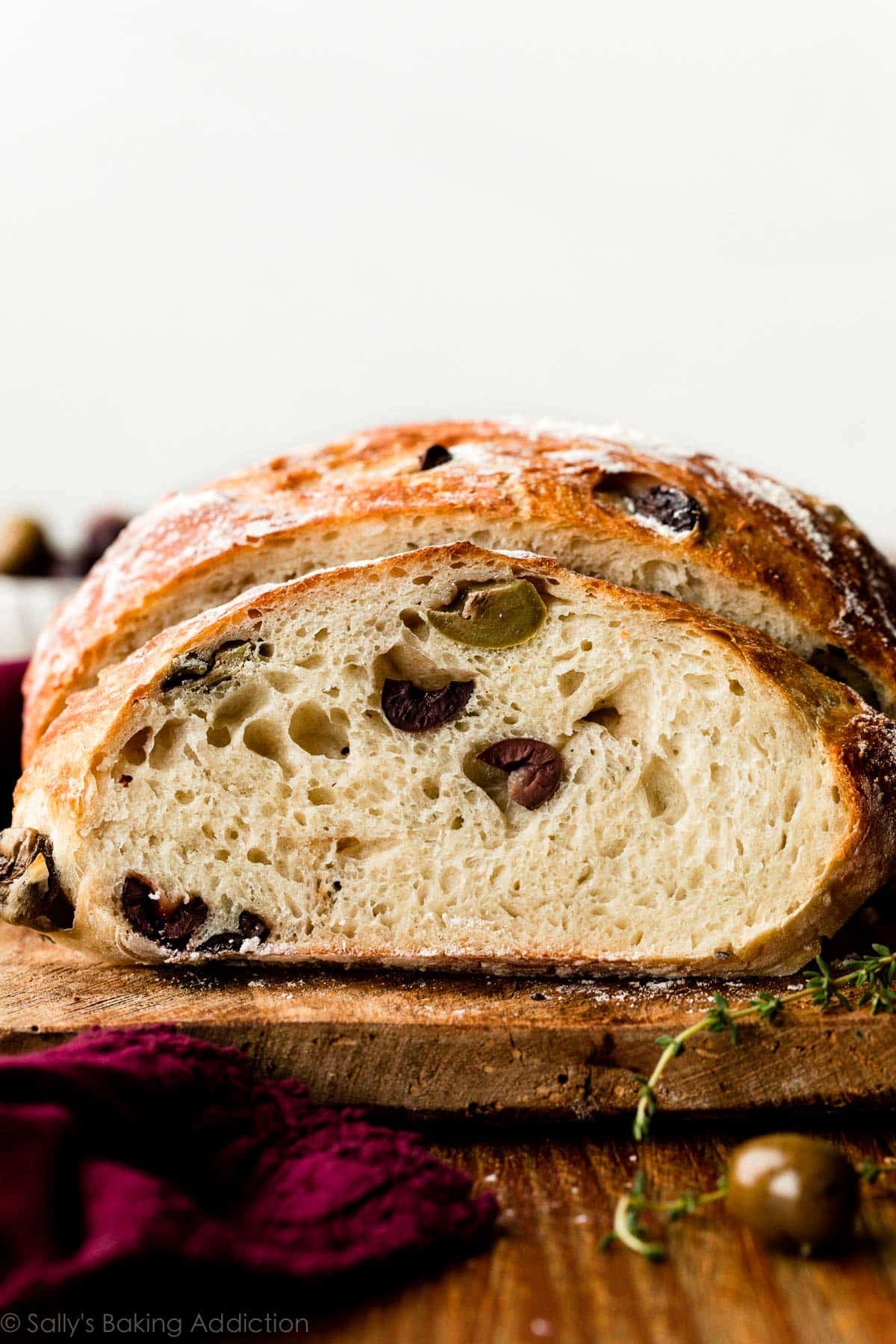
This crusty olive bread is perfect for serving at your next dinner party, or alongside a cheese and charcuterie board. It’s sure to impress your guests, and they won’t have any idea how easy it actually is! There’s no kneading or complicated shaping involved, and the vast majority of time is hands-off. This loaf is soft inside with a crispy chewy crust, and includes garlic, oregano, and plenty of salty olives.
One reader, Shannon, commented: “Another phenomenal recipe. Had this last night with the Baked Chicken Meatballs—was so delicious. So much flavor and with minimal effort, especially for a bread. Did a mix of kalamata and green olives. Wonderful. ★★★★★“
Another homemade yeast bread to love!
Don’t let your eyes fool you… the dark speckles in today’s bread are not chocolate chips and raisins. They’re olives! This recipe is based off of my homemade artisan bread, a wonderfully easy and widely popular no-knead bread that’s fit for both beginners and experts. (Note that I bake this bread at a slightly lower oven temperature because the olives can burn.)
A Flavorful Bread Recipe for Beginners
Today’s olive bread basically makes itself, so if you’re nervous to try homemade bread, this recipe is a great introduction. Even though the recipe is easy, the bread does NOT skimp on flavor. It’s just a simple way of baking homemade bread inspired by the no-knead technique originating from bread expert Jim Lahey. Here’s why it’s so simple:
- Only 7 ingredients
- Absolutely no kneading (just like homemade English muffins!)
- Zero complicated shaping
- No mixer required
- 90% of the time is totally hands off
- Can bake in a dutch oven or on a baking sheet
Plus, you can make it in 4 hours or let the dough rest in the refrigerator for up to 3 days (great make-ahead recipe!). Once you realize how easy it is to prepare salty, herby, garlicky olive bread, you’ll find any excuse to bake it.
Key Ingredients You Need & Why
Today’s Mediterranean-inspired bread is an egg free baking recipe and dairy free recipe. Here are the ingredients you need:
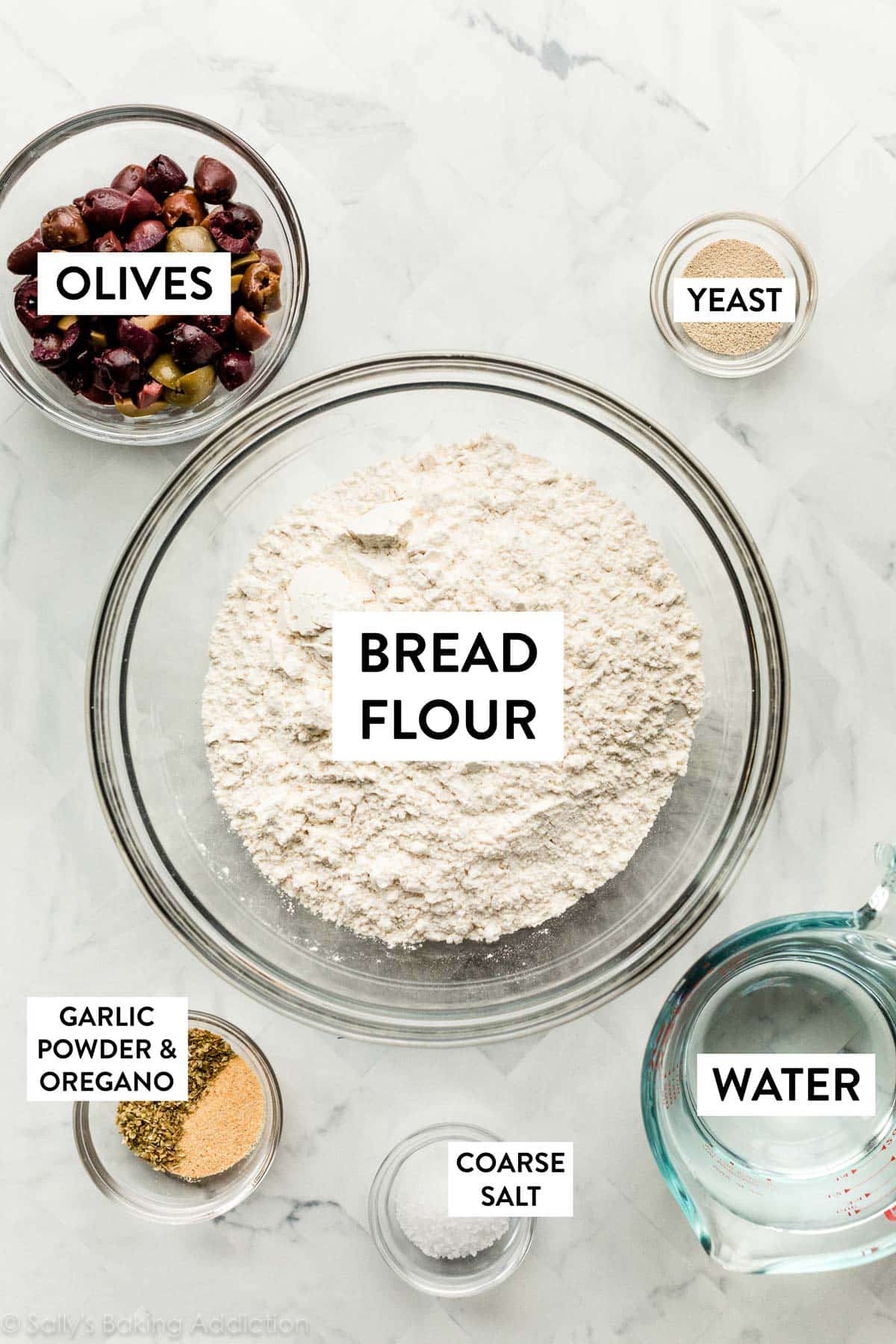
- Bread Flour: While you could use all-purpose flour in this recipe, I strongly recommend using bread flour. Bread flour produces a stronger, chewier bread and that makes a big difference in an artisan-style loaf like this olive bread or this homemade ciabatta bread.
- Instant Yeast: While you can use active dry yeast if that’s all you have, any quick-rise or instant yeast will produce flavorful results in less time. I use more yeast in this recipe compared to my cranberry nut no-knead bread and no-knead jalapeño cheddar bread. Why? Those doughs rest and rise at room temperature. However, for more flavor and just as much rise, I use more yeast and let this dough rest in the refrigerator. (Cool air slows the fermentation process and helps develop better flavor.)
- Salt: Just like with asiago-crusted skillet bread and no-knead pizza bread, I recommend using coarse salt because I find the bread’s flavor lacking with regular table salt.
- Garlic + Herbs: Dried oregano and garlic powder add flavor to the dough. You could also try some chopped fresh herbs or roasted garlic cloves, or simply leave them out. The recipe is pretty adaptable, just like the toppings for focaccia!
- Olives: See below for my recommendations.
- Water: I normally encourage you to use warm liquid with yeast, like we do in no knead seeded oat bread, because warm liquid helps the yeast work faster. However, use cool or room-temperature water here. Not freezing cold, not super warm… just cool to the touch. 70°F (21°C) is great, but the exact temperature doesn’t matter as long as it’s not warm. We use the same cool water method for no-knead honey oat bread.
- Optional Cornmeal: If you’re using a baking sheet, dust the pan with cornmeal for a pop of flavor and a little crunch. This is completely optional. If you have it, use it. If you don’t have it, dust the pan with flour.
Best Olives to Use
Kalamata olives are excellent in this bread, but you can use a medley of olives. I’ve made it both ways. Whatever you use, give the olives a rough chop.
Let Me Show You How to Make This Olive Bread
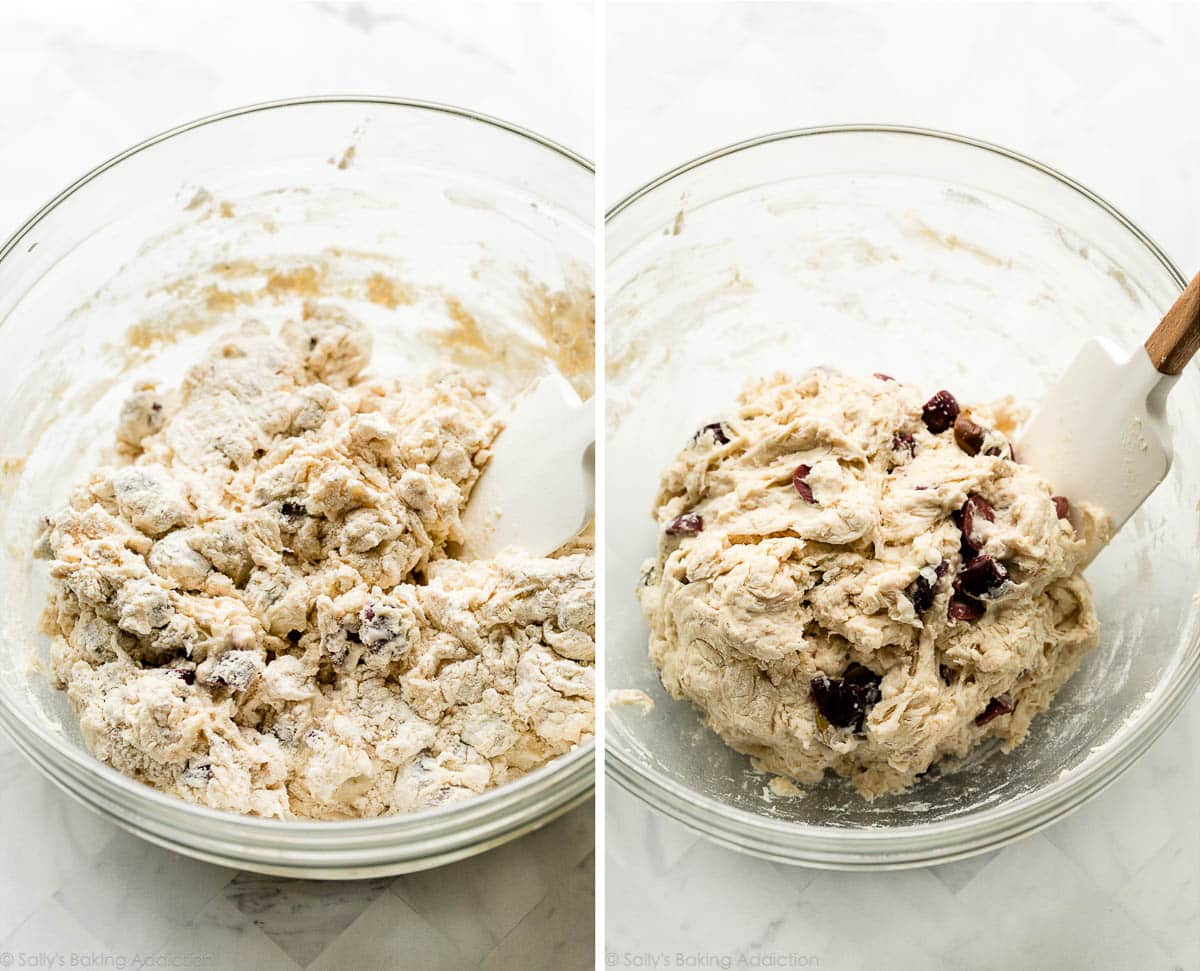
Mix the dry ingredients together and then mix in the chopped olives and water. At first the dough will seem very dry and shaggy and you’ll question if it will even come together. (See above!) Use a spatula at first and then switch to your hands to ensure all of the flour is moistened. The dough is a little sticky after it’s thoroughly mixed.
Let it rise. Cover the dough and let it rise at room temperature for about 2–3 hours.
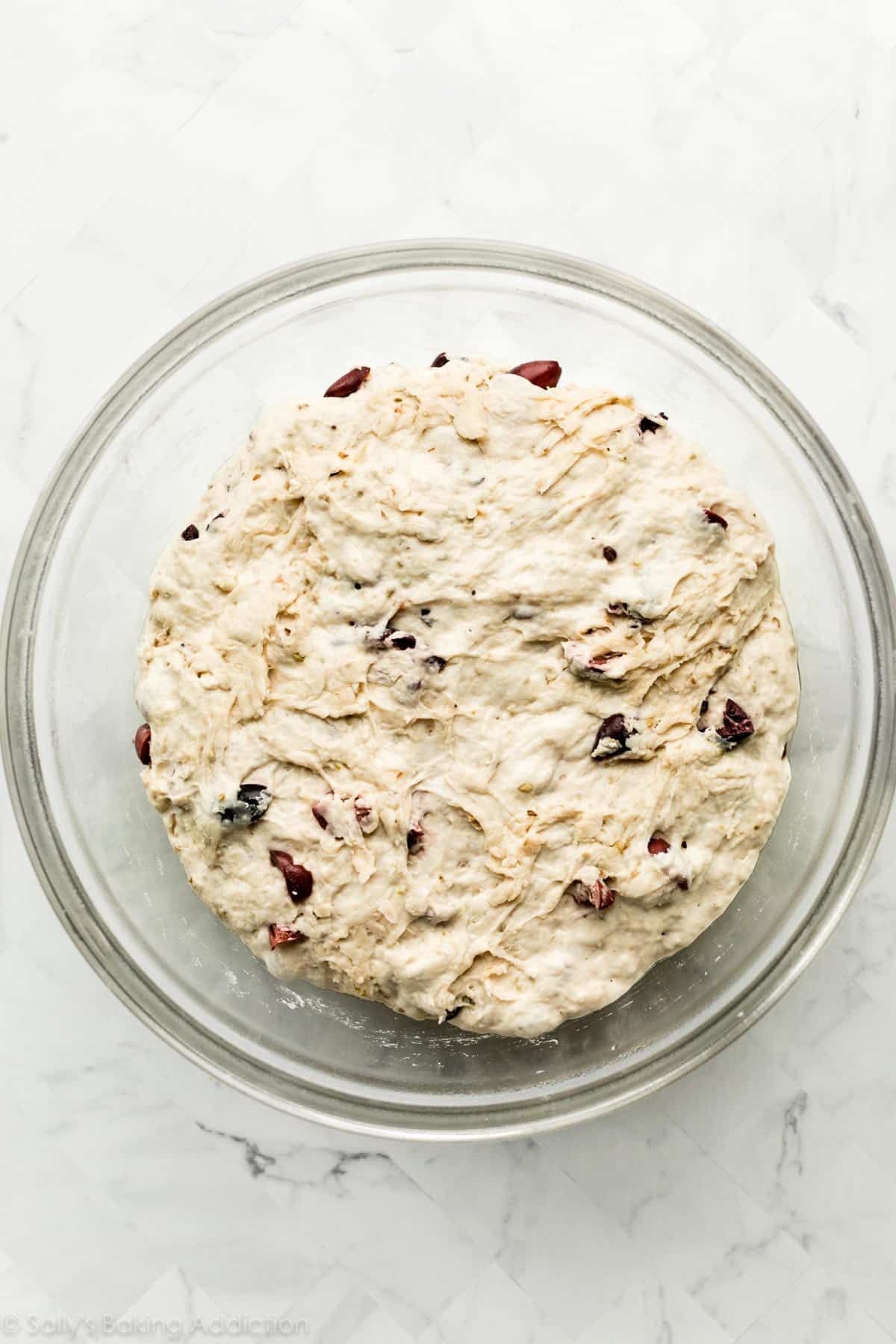
You can immediately continue with step 4 below (gently shaping before baking) or refrigerate the dough for up to 3 days. For best flavor, I strongly recommend refrigerating the risen dough even if it’s just for a couple hours.
After the dough rises and rests in the refrigerator, use generously floured hands to shape the dough into a round boule or ball-like shape:
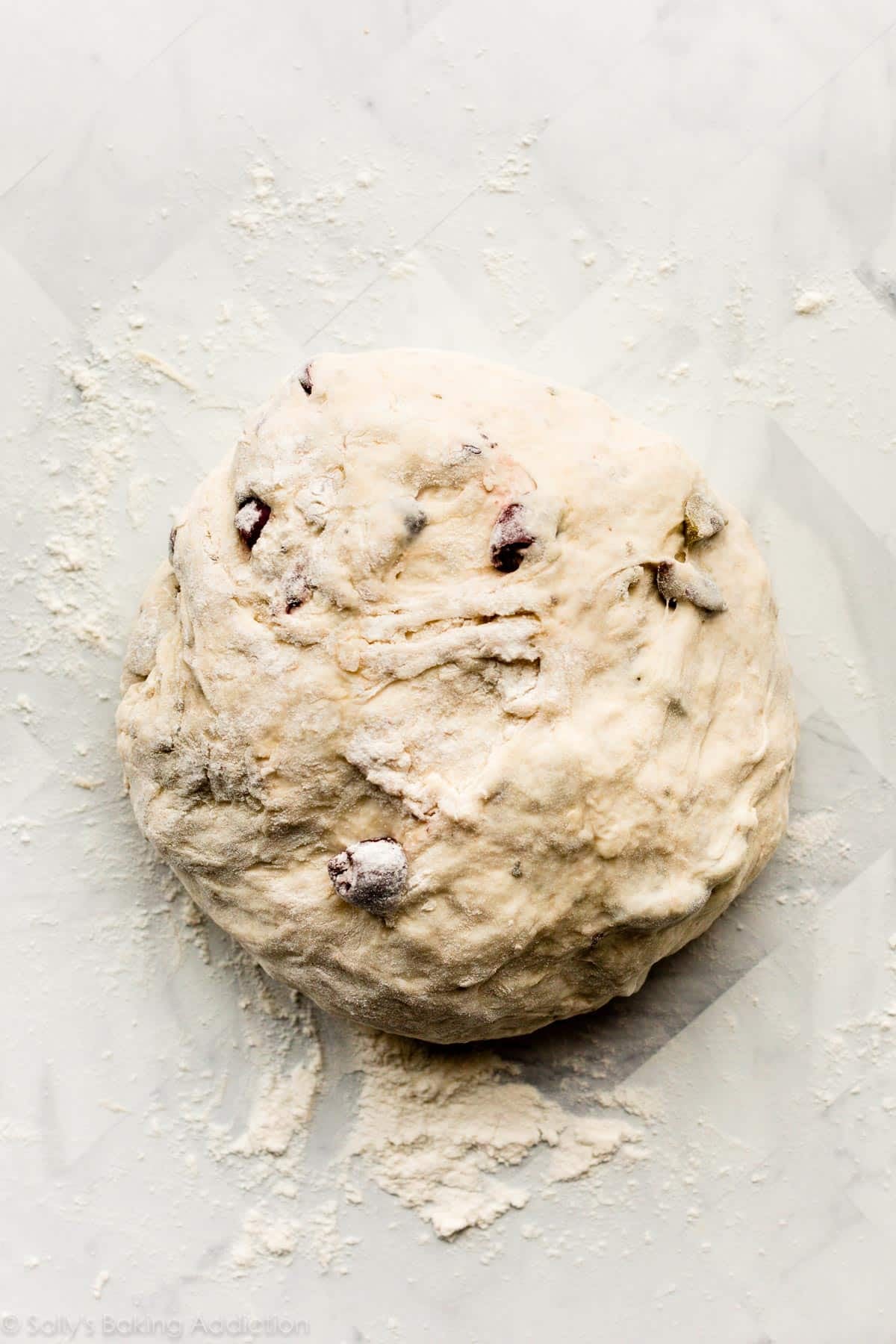
Now it’s time to choose between a dutch oven or baking sheet. This bread isn’t picky!
Use a Baking Sheet or Dutch Oven
You can use either. Baking the olive bread in a covered dutch oven traps steam inside the pot, creating that perfect crust. If you plan to bake a lot of bread in the future, you won’t regret picking up a dutch oven. If you don’t have a dutch oven, a nonstick large baking sheet is best. Let me explain both ways:
- Baking Sheet: Lightly dust it with flour and/or cornmeal. Place the dough on top, cover it, and let it rest as the oven preheats. You will find these detailed instructions in the recipe below, along with my crispy crust optional trick in step 7!
- Dutch Oven: Place the empty dutch oven with lid in the oven as it preheats. Place the dough on high heat resistant parchment paper (I use this parchment paper) and then fit inside a bowl. Cover and let the dough rest as the oven preheats, then place it (with the parchment) in the hot dutch oven before baking. You will find these detailed instructions in the recipe Note below.
Whichever you use, don’t forget to score the dough with a bread lame or sharp knife. Scoring allows the wet, airy dough to “breathe” as it rises and bakes.
Dutch oven method:
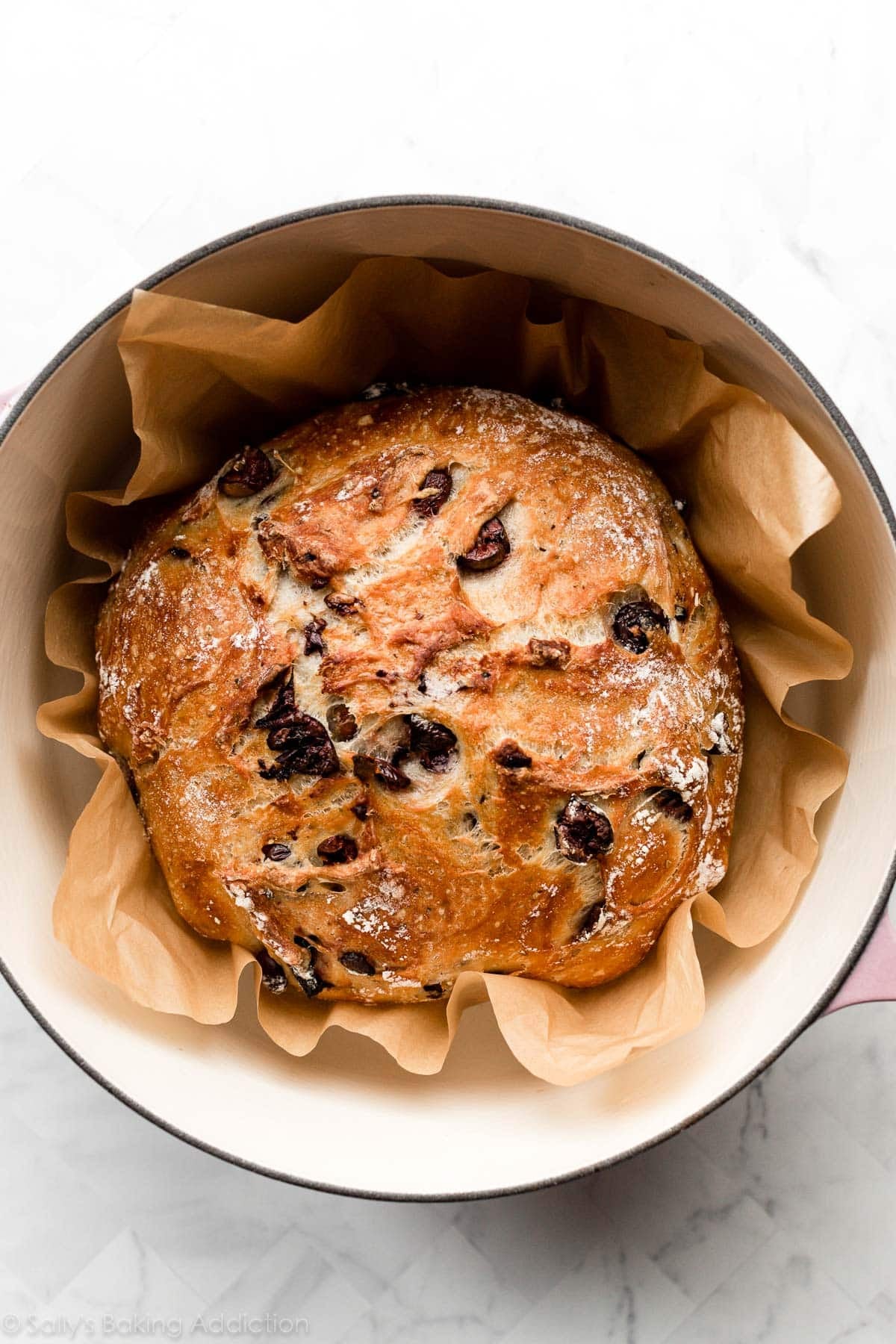
Baking sheet method:
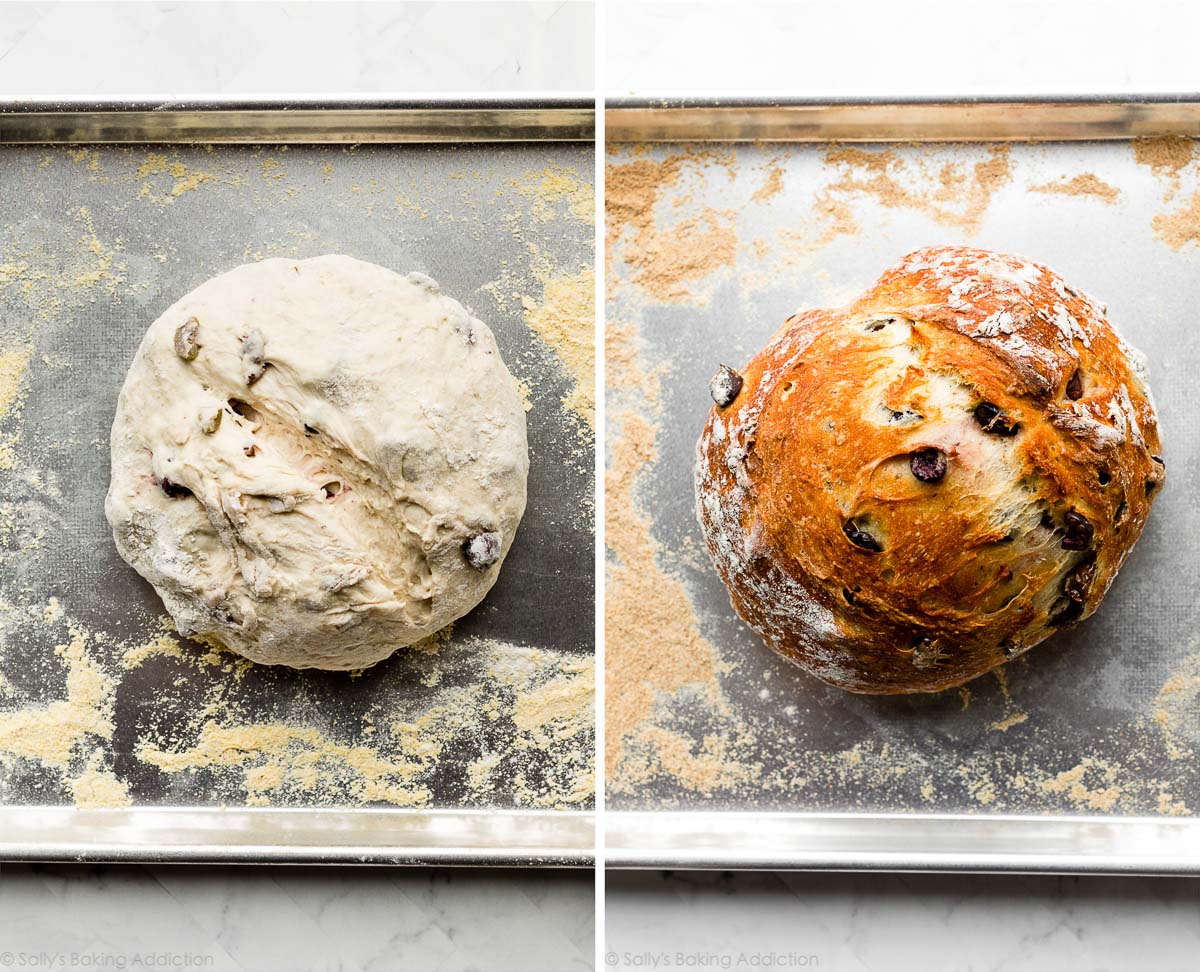
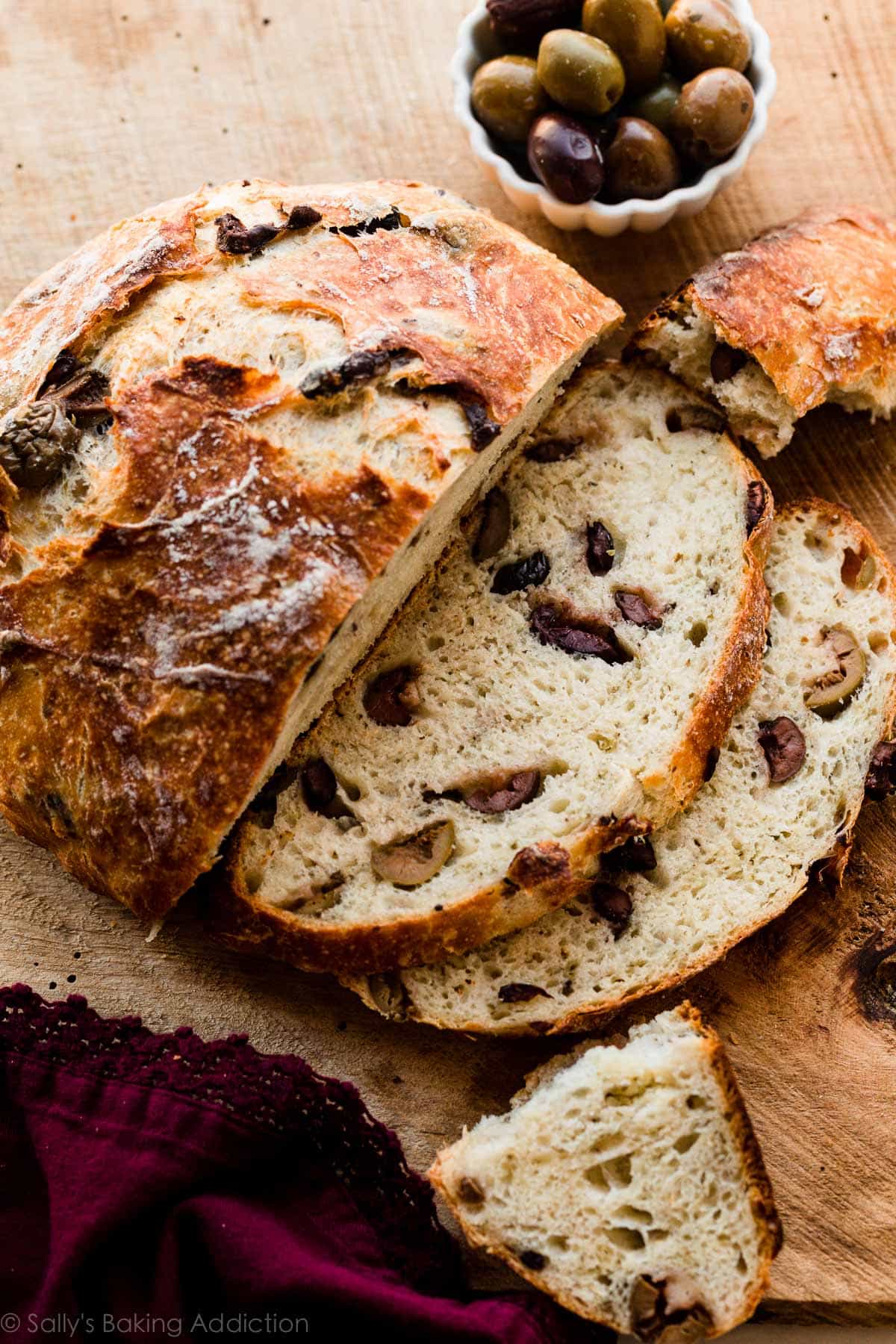
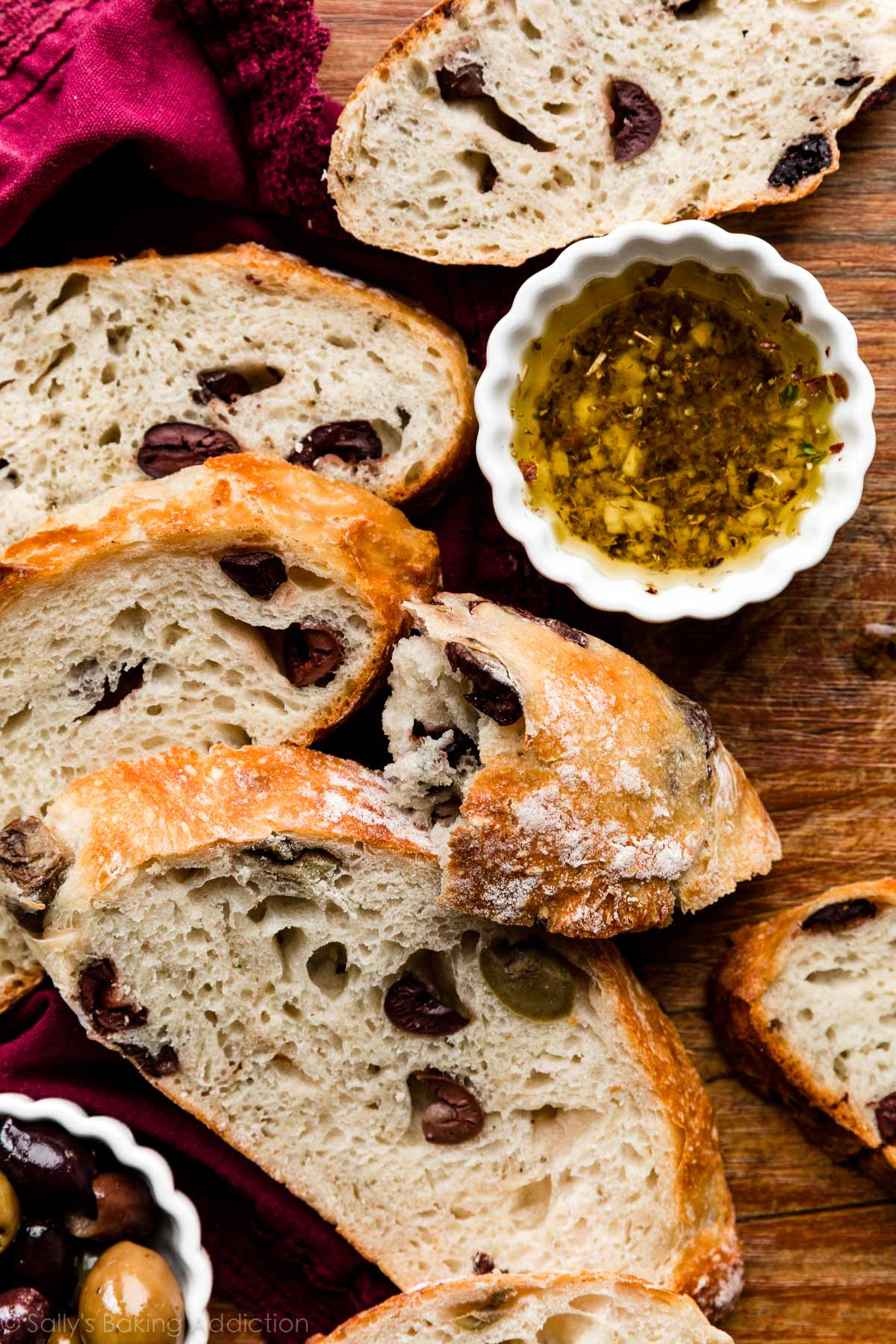
The bread is unbelievable when it’s fresh from the oven—warm, crispy, crusty, and soft inside!
What Can I Serve With This Olive Bread?
Honestly, it’s fantastic plain. But I usually mix together a super easy + flavorful dipping oil: 3 Tablespoons (45ml) extra virgin olive oil and 2 minced cloves of garlic plus a sprinkle each of red pepper flakes, fresh or dried thyme, dried oregano, salt, and pepper. The bread would also be delicious paired with homemade pesto.
Serve your olive bread alongside a charcuterie or cheese platter, or with any Mediterranean-style fare. I love it with a big Greek salad and have even served it with minestrone soup, pesto shrimp, chicken meatballs, and lemon thyme chicken.
Print
Easy No-Knead Olive Bread
- Prep Time: 4 hours
- Cook Time: 35 minutes
- Total Time: 4 hours, 35 minutes
- Yield: 1 loaf; 10-12 servings
- Category: Bread
- Method: Baking
- Cuisine: American
Description
Follow this recipe and enjoy homemade olive bread that’s altogether crisp, soft, garlicky, herby, and salty. Review Notes before beginning. If you’re new to working with yeast, reference my Baking with Yeast Guide for answers to common yeast FAQs.
Ingredients
- 3 and 1/4 cups (about 430g) bread flour (spooned & leveled), plus more as needed for shaping and pan
- 2 teaspoons instant or active dry yeast
- 2 teaspoons coarse salt (see note)
- 2 teaspoons dried oregano
- 1 and 1/2 teaspoons garlic powder
- 1 heaping cup (about 135g) roughly chopped olives
- 1 and 1/2 cups (360ml) water, close to room temperature at about 70°F (21°C)
- optional: cornmeal for dusting pan
Instructions
- In a large un-greased mixing bowl, whisk the flour, yeast, salt, oregano, and garlic powder together. Using a silicone spatula or wooden spoon, mix in the olives. Pour in the water and gently mix together. The dough will seem dry and shaggy, but keep working it until all the flour is moistened. If needed, use your hands to work the dough ingredients together. The dough will be sticky. Shape into a ball in the bowl as best you can. (Tip: Stir dough by hand. Dough is too sticky for a mixer.)
- Keeping the dough in the bowl, cover the dough tightly with plastic wrap or aluminum foil and set on the counter at room temperature (honestly any normal room temperature is fine). Allow to rise for 2-3 hours. The dough will just about double in size, stick to the sides of the bowl, and have a lot of air bubbles.
- You can continue with step 4 immediately, but for absolute best flavor and texture, I strongly recommend letting this risen dough rest in the refrigerator for at least 12 hours and up to 3 days. (Even just a couple hours is good!) Place covered dough in the refrigerator for up to 3 days. The dough will puff up during this time, but may begin to deflate after 2 days. That’s normal and nothing to worry about.
- Lightly dust a large nonstick baking sheet (with or without rims and make sure it’s nonstick) with flour and/or cornmeal. Turn the dough out onto a floured work surface. Using generously floured hands, shape into a ball as best you can. Dough is very sticky. Transfer to prepared baking sheet. Loosely cover and allow dough to rest for 45 minutes. You will bake the dough on this prepared baking sheet. See recipe note if you want to use a pizza stone or dutch oven.
- During this 45 minutes, preheat the oven to 425°F (218°C).
- When ready to bake, using a very sharp knife or bread lame (some even use kitchen shears), score the dough with a slash or an X, about 1/2 inch deep. (“Score” = shallow cut.) If the shaped loaf flattened out during the 45 minutes, use floured hands to reshape into a ball.
- Optional for a slightly crispier crust: After the oven is preheated and bread is scored, place a shallow metal or cast iron baking pan or skillet (I usually use a metal 9×13-inch baking pan) on the bottom oven rack. Carefully and quickly pour 3-4 cups of boiling water into it. Place the scored dough/baking pan on a higher rack and quickly shut the oven, trapping the steam inside. The steam helps create a crispier crust.
- Place the shaped and scored dough (on the flour/cornmeal dusted pan) in the preheated oven on the center rack. Bake for 35-40 minutes or until the crust is golden brown. How to test for doneness—give the warm loaf a light tap. If it sounds hollow, it’s done. For a more accurate test, the bread is done when an instant-read thermometer reads the center of the loaf as 195°F (90°C).
- Remove the bread from the oven and allow to cool for at least 10-20 minutes before slicing and serving. Store leftovers loosely covered at room temperature for up to 3 days or in the refrigerator for up to 1 week.
Notes
- Make Ahead & Freezing Instructions: The dough can sit in the refrigerator for up to 3 days, so this is a wonderful recipe to begin ahead of time. You can also bake the bread, allow it to cool, and freeze for up to 3 months. Thaw in the refrigerator and allow to come to room temperature before serving. You can also freeze the dough. Complete the recipe through step 3. Wrap in plastic wrap and place in a freezer-friendly container. Freeze up to 3 months. To bake, allow dough to thaw overnight in the refrigerator, or for 2–3 hours at room temperature. Continue with step 4 and the rest of the recipe instructions.
- Special Tools (affiliate links): Glass Mixing Bowls | Wooden Spoon or Silicone Spatula | Baking Sheet or Dutch Oven | 2-Cup Measuring Cup | Bread Lame | Instant-Read Thermometer | Coarse Sea Salt
- Flour: For absolute best flavor and chewy texture, I strongly recommend using bread flour. You can use a 1:1 substitution of all-purpose flour in a pinch with no other changes to the recipe. I recommend avoiding whole wheat flour in this dough, however if necessary, you can replace up to 1 cup (about 130g) of the bread flour with whole wheat flour.
- Yeast: You can use instant or active dry yeast, but I highly recommend an instant (aka “rapid rise” or “quick rise” yeast). The bread will rise faster. 2 teaspoons is a little less than 1 standard packet. If using active dry yeast, there are no changes needed to the recipe. The rise time in step 2 may take longer. Reference my Baking with Yeast Guide for answers to common yeast FAQs.
- Salt: Use a coarse salt, such as coarse sea salt, in this bread. I find the flavor slightly lacking when using regular table fine salt. If you only have fine salt, reduce to 1 and 1/2 teaspoons.
- Dried Oregano & Garlic Powder: Feel free to use 2-3 teaspoons chopped fresh oregano or substitute 2 teaspoons of another dried herb you love. Instead of garlic powder, you can use 2 teaspoons minced fresh garlic or roasted garlic.
- Using a Dutch Oven: The process is similar to Cranberry Nut No-Knead Bread. You need a 6-quart or larger dutch oven or any large oven-safe pot with a lid (lid is crucial—see cranberry nut no-knead bread for more information). Prepare dough recipe above through step 3. Turn the dough out onto a lightly floured work surface and, using lightly floured hands, shape into a ball as best you can. Doesn’t have to be perfect. Transfer dough to a large piece of parchment paper. (Large enough to fit inside your pot and one that is safe under such high heat. I use this parchment and it’s never been an issue.) Lift the parchment paper and dough up and place it all into a large mixing bowl. Using a very sharp knife or bread lame, gently score an X into the top. Cover dough lightly with plastic wrap and leave alone for 30 minutes. During this 30 minutes, preheat the oven to 425°F (218°C). Place your dutch oven (with the lid) inside for 30 minutes so that it’s extremely hot before the dough is placed inside. After 30 minutes, remove the dutch oven from the oven and carefully place the dough inside by lifting it up with the parchment paper and sticking it all—the parchment paper included—inside the pot. Cover with the lid. Bake for 30 minutes with the lid on. Carefully remove the lid and continue baking for 10 more minutes or until the bread is golden brown. You can test for doneness exactly how you would in step 8 above. Remove pot from the oven, carefully remove the bread from the pot, and allow to cool on a wire rack for 10-20 minutes before slicing/serving.
- Using a Pizza Stone: If you want to bake your bread on a pizza stone, place pizza stone in the preheating oven. Remove hot pizza stone, dust with cornmeal or a little flour, and then transfer shaped and scored dough to hot pizza stone and bake as directed.
- No Nonstick Pan?: If you don’t have a nonstick baking sheet, line it with parchment paper instead. Coat with a dusting of flour and/or cornmeal before placing the dough on top. Parchment paper can burn, so it’s best to check the box to see how much heat yours can tolerate. Lower your oven heat if necessary, and bake the bread for longer until it’s golden brown and sounds hollow when tapped.









Reader Comments and Reviews
I loved this recipe. Bread comes out amazing
Sally, I LOVE your recipes and this is no exception. They are so accurate and easy to follow. I am a novice bread maker but experienced cook. This olive bread is absolutely scrumptious. I made it AS
WRITTEN for a party along with your dipping sauce and it was gone in a flash. I have also made the cranberry No Knead bread and it is so delicious. So glad I found your site.
I just sliced my loaf. It is amazing. The seasonings are perfect as is the texture. I let my dough refrigerate for two days. The directions are easy to follow. I used a combination of Kalamata and pimento stuffed green olives. As always, a Sally recipe is a winner! Thank you so much!
Can I use the 18 hour rise on the counter with this bread? Cannot wait to make it
Hi Cindy! It is best to do an initial 2-3 hour rise at room temp, then let the dough rest in the fridge for 12 hours to 3 days for this recipe.
Ty Trina for your quick reply. Cannot wait.
This produced a fantastic loaf – artisan in appearance and with a great texture! No kneading ! Can’t quite believe it. I used thyme from the garden. Will make this loaf again for lunch with my friend, who has requested an olive loaf. I think she’ll be amazed by this bread, Thanks so much!
I just finished step 1 and my dough looks much wetter than the dough in the video. It was not really possible to knead/shape it. Did I do something wrong? I used all-purpose flour and measured both with cups and with a scale to check if the amount was correct.
Hi Lise, the dough will still be quite wet and sticky at that point, but if needed, you can add an additional tablespoon or two of flour to help bring it together a bit more. This can be quite common, especially if you live in a particularly humid climate. Hope you enjoy the bread!
I’m a retired cancer patient and needed something to do to keep me busy. I’ve been baking loaves for the whole family and they all love it (with my 90 year old Mom, I’ve created a monster…lol). Thanks for posting this recipe!
I’m so glad to read that you enjoy it! Thank you!
This recipe takes about 15 minutes to make, which includes tracking down the ingredients and measuring them. I questioned the recipe initially, because I couldn’t find where instructions were for proofing the yeast. Turns out, you don’t have to do that! This bread is incredible! I substituted rosemary for the oregano as a matter of preference, but that’s the only change I made. I made the dough in 15 minutes, and that evening I refrigerated it. I baked it the next day. Mine wouldn’t hold a ball shape as well as I’d hoped, but it just didn’t matter. This is amazing! It was far easier to make than Hamburger Helper! I can’t claim to understand the magic, but don’t doubt it. Just trust the recipe, and be thrilled with the results! I’ll probably need to make this every other day to keep up with demand.
Can I half the olive bread recipe and if so, what size Dutch oven should I use?
Hi Beth, a 3.5-quart Dutch oven (or something around that size) should work well for half this recipe. Or, feel free to use the baking sheet method instead. Enjoy!
I think I’ll love this, but I wanted to mention that the recipe never mentions adding the yeast to the water, and then to the dough. Seasoned cooks will do fine, but a novice might make a mistake.
She adds the yeast to the dry ingredients, then mixes in the olives, and lastly adds the water.
I’ve made this bread three times, mixing the yeast in with the flour, salt, oregano, and garlic powder, then adding the olives, and then the water, just as the recipe states, and it’s been perfect and delicious each time. I don’t believe that mixing the yeast with the other dry ingredients and then adding water is a mistake. It may be different than many other bread recipes, but that doesn’t mean it’s incorrect.
This turned out amazing! I’m wondering if you have any advice on how to heat it in the oven after it has been in the fridge.
Hi Jamie, you could toast individual slices in the oven or in a toaster after it’s been baked. So glad you enjoyed it!
I’m going to try this recipe today in the oven and I can’t wait but just want to k ow if it can be done in a bread maker too?
Hi Lauren, we’re sure it’s possible, but we haven’t tested it. Let us know if you try anything!
I make this bread so often now! Also the Cranberry Walnut! My husband loves the olive bread best of all. I make it for friends as it’s such an easy process. I use 3-4 different types of olives including stuffed green — so yummy. I also add a bit of onion powder. It’s perfect either way. So much flavor. Makes an amazing grilled cheese sandwich too!
I make this bread so often now! Also the Cranberry Walnut! My husband loves the olive bread best of all. I make it for friends as it’s such an easy process. I use 3-4 different types of olives including stuffed green — so yummy. I also add a bit of onion powder. It’s perfect either way. So much flavor. Makes an amazing grilled cheese sandwich too! Oh and I definitely always let it sit in the refrigerator as recommended— really love the flavors.
Can I add more olives, like a cup more provided they are really dry? I plan to use the olive bar olives at my local. I think they are piled a bit, so I’d certainly remove all the moisture. I really like a lot of olives in olive bread. Thank you.
Hi Lucy, we fear that many extra olives may add too much weight and moisture to the bread but let us know if you give it a try!
What kind of olives should I use?
Kalamata olives are excellent in this bread, but you can use a medley of olives. I’ve made it both ways. Whatever you use, give the olives a rough chop.
Hi!
I had a question about oven temperatures when using a Dutch oven! For the cranberry-nut bread recipe referenced in the directions when using a Dutch oven, that recipe uses an oven temperature of 475 degrees, while this recipe when using a Dutch oven calls for a temperature of 425. I wasn’t sure which temperature I should use since this recipe says to use the cranberry-nut bread recipe as a guide. Thank you, and sorry for the weird wording. Hopefully that makes sense.
Hi Kristyn, I completely understand your question. Olives can quickly burn, so that is why the temperature is reduced. Follow the Recipe Note in this olive bread recipe. Note #7.
Everyone I make this for loves it! I still think I’m doing something wrong because the bread is too dense. Maybe it’s because I can never tell whether I’ve overproofed or underproofed. (For any bread recipe not just this one) Any hints on how I can make it less dense or is an olive bread always going to be dense by nature of the olives
Hi Deirdre, there’s no kneading involved here AND there’s a heavy wet add-in (olives) so the bread is going to be denser than, say, a slice of sandwich bread. Try using a little more yeast (2 and 1/4 teaspoons) and kneading the dough as best as you can (it’s sticky) for about 5 minutes at the end of step 1. Try not to add any more flour than you need. A sticky dough is OK. This will help the texture lighten up a bit.
Hi Sally! Wondering if you have to do the pan with water when using a Dutch oven? If so, at what part do you do it?
Hi Bea, you don’t because you are baking the bread inside the pan with the lid on, which traps the steam inside.
Confidence restored! I’ve tried to make bread several times now and felt like a failure every single time. I follow your pizza dough recipe and it’s immaculate every time, so I’m very glad I decided to try your olive bread recipe. It turned out perfectly. I had some doubts because the dough was suuuuper sticky and not firm but I just trusted the process and have no regrets! Making bread seems a little less daunting now ☺️
This is scrumptious bread, and so easy! I made it with 1/2 kalamata, 1/2 green olives and used fresh garlic. I also used 330g of organic white bread flour and 100g of wheat bread flour. I did not refrigerate it – let it rise at room temperature for 3hrs, then another 45 min while oven preheated and baked it in a dutch oven. It is outstanding!! Thank you for demystifying bread making- it is so easy, so satisfying— I can’t stop making bread!
Thinking of adding feta cheese to this recipe. Would you recommend any modifications with the addition of cheese? Or would it be fine to just mix it in with the olives? Thanks!
Hi Ashley! We haven’t tested it, but don’t see why mixing crumbled feta in with the olives would be an issue. Let us know if you give it a try!
This recipe is amazing!
Can this be made into buns? If so, how do I cook this and for how long?
So glad you tried and loved this homemade bread! Careful shaping into rolls or buns– this is a sticky dough, so use floured hands. The bake time will be only a few minutes shorter. Bake until golden brown and when lightly tapped, they sound hollow.
I have been merrily working my way through Sally’s bread recipes. This one may be the best yet. I followed the directions using all-purpose flour and place the dough in the refrigerator for 24 hours. The final product is delicious. My guess is this loaf will not last the day.
This was amazing. I was looking for something similar to a bakery, and this did not disappoint. Lots of olives! Made it in my Dutch oven and had a perfect texture, crispy outside. Thank you!
We loved this recipe, one of the best loaves I’ve ever made! I’d like to try the jalapeno and olive one next, but am wondering why the recipes are so different? I’d like to use bread flour, rest the dough overnight in the fridge, and bake longer at a slightly lower temperature (as in this recipe). Any reason I can’t do that and use the jalapenos/cheese instead? Thank you!
Hi Kayla! The recipes use slightly different methods (longer and shorter rising times). You can use the overnight method with other flavors – using our artisan bread as a base. Happy bread baking!
This is the best bread I’ve ever eaten
OMG THIS IS THE BEST OLIVE BREAD I’VE EVER EATEN! I’m not normally a good baker but this recipe was so simple and easy to follow.
I stumbled across this recipe and made the Olive bread. It was absolutely beautiful and very tasty. The only “ad on” where some chopped Sundried tomatoes. Otherwise, I followed the recipe exactly and as I was in a hurry, baked it prior to using the overnight method. The bread was enjoyed by many. Thank you for such a simple, quick and delicious recipe!
So I have made your seeded bread, cranberry walnut bread and olive bread we loved them all! Very easy and your i nstruction are spot on! Thank you! My question is can I use your recipie for the olive bread and add roasted Garlic and Rosemary in stead of the olive and oregano? Husband request thank you love your site!
Hi Amy, that sounds delicious! Give it a try and let us know how it turns out!