
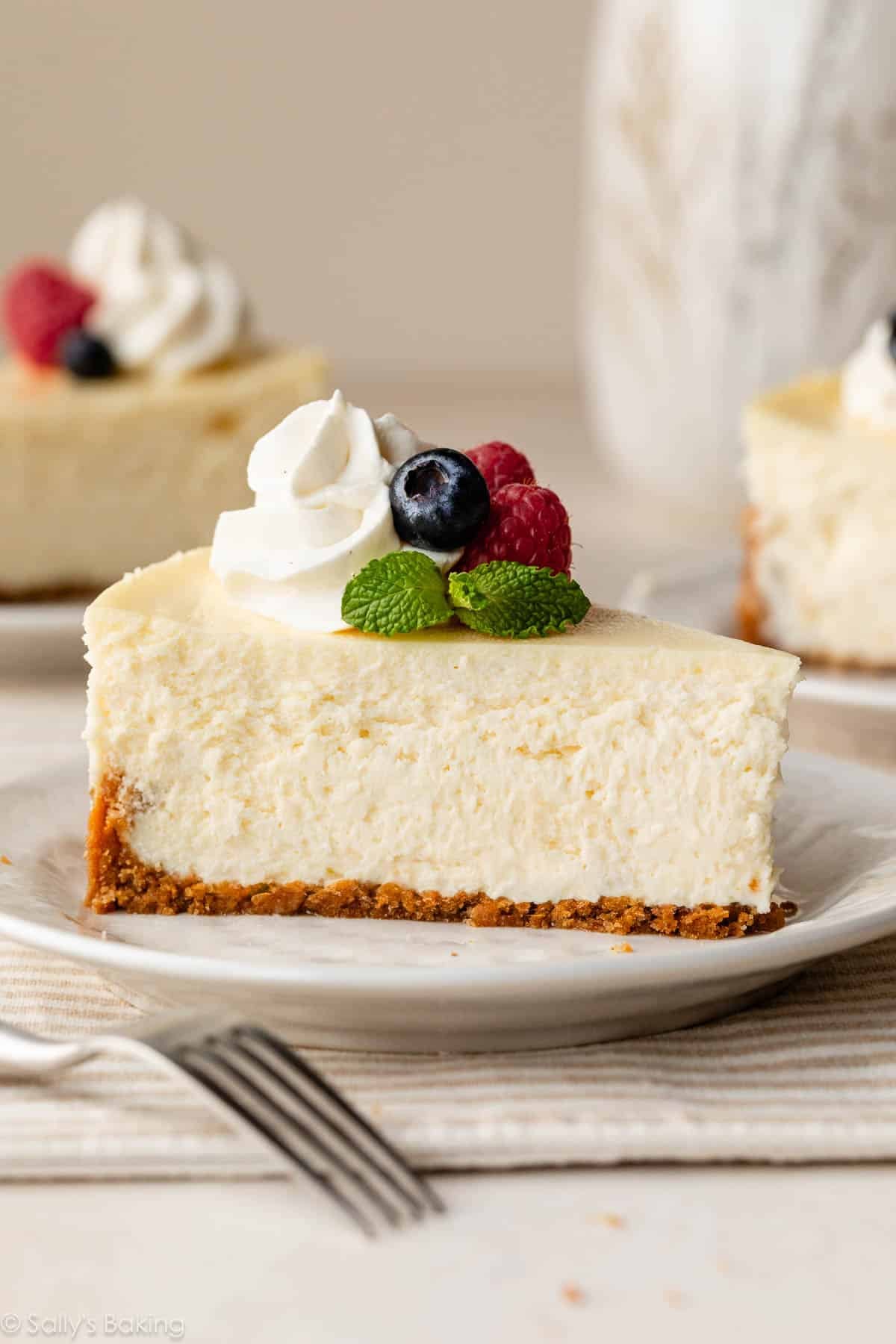
Look no further for a creamy and ultra-smooth classic cheesecake recipe! Paired with a buttery graham cracker crust, no one can deny its simple decadence. For the best results, bake in a water bath.
I originally published this recipe in 2018 and have since added new photos and a few more success tips. This recipe is such a fan favorite, that it deserved a spot in print! You’ll also find this recipe in my New York Times best-selling cookbook, Sally’s Baking 101. The one in the book also includes a recipe for an optional cherry sauce topping!
This is a classic baked cheesecake made with a graham cracker crust and a creamy, tangy filling. By following the recipe below and the success tips my team and I have included, you will be rewarded with a perfect cheesecake: no cracks, no water leaks, and no guesswork!!!
One reader, Randy, commented: “This is the best cheesecake I have ever had! I’m from New York and nothing there beats this—even in the fanciest of restaurants. The only problem is that everyone I’ve shared it with wants me to make more and more. They rave about it being the best ever. ★★★★★”
Not a Plain Cheesecake Recipe
I have shared many, many cheesecake recipes over the years.
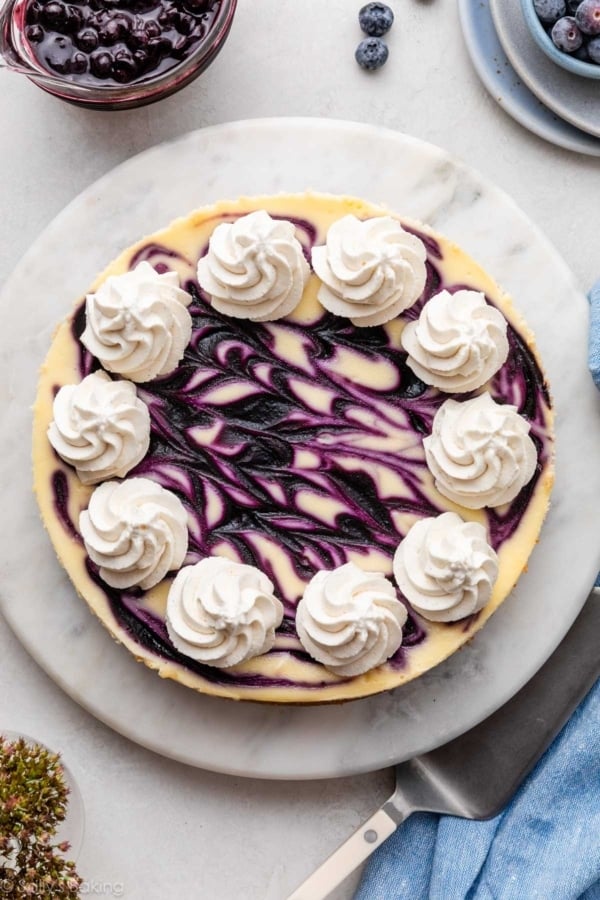
There’s been peanut butter cheesecake, blueberry swirl cheesecake, Snickers cheesecake, pumpkin swirl cheesecake, lemon cheesecake, and Amaretto cheesecake. Plus more cheesecake in my published cookbooks. That’s a lot of cheesecake recipes without a single nod to where it all originates: classic cheesecake.
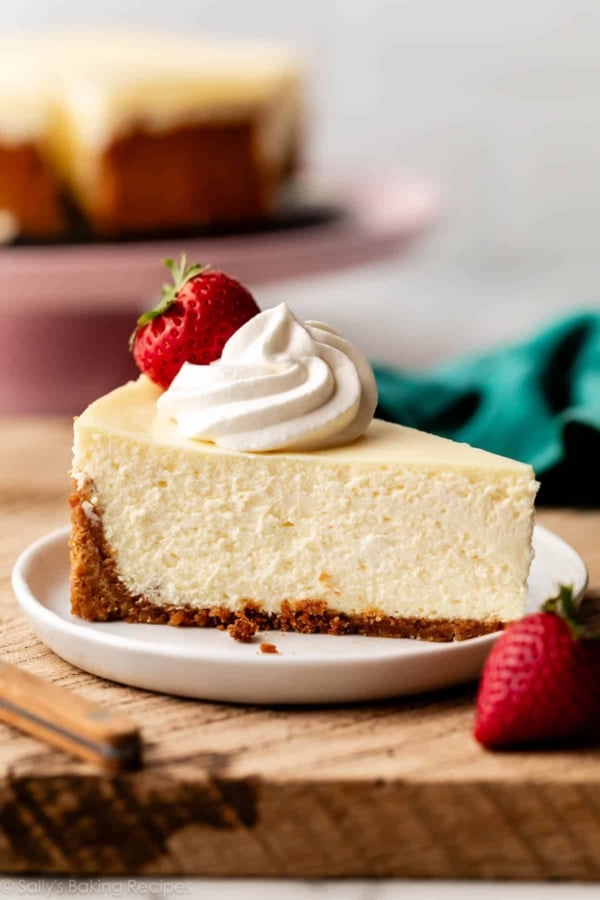
To me, classic cheesecake is creamy, rich, and smooth. My cheesecake recipe is not as dense as New York cheesecake, but it’s just as special. It’s thick, it’s velvety, and there’s no denying its decadence. When I imagine what Chandler and Rachel’s stolen cheesecake tastes like, it’s this!
While there’s a glaring absence of chunks, swirls, and sprinkles in this ivory crowned jewel, there’s nothing plain about this simply stunning dessert.
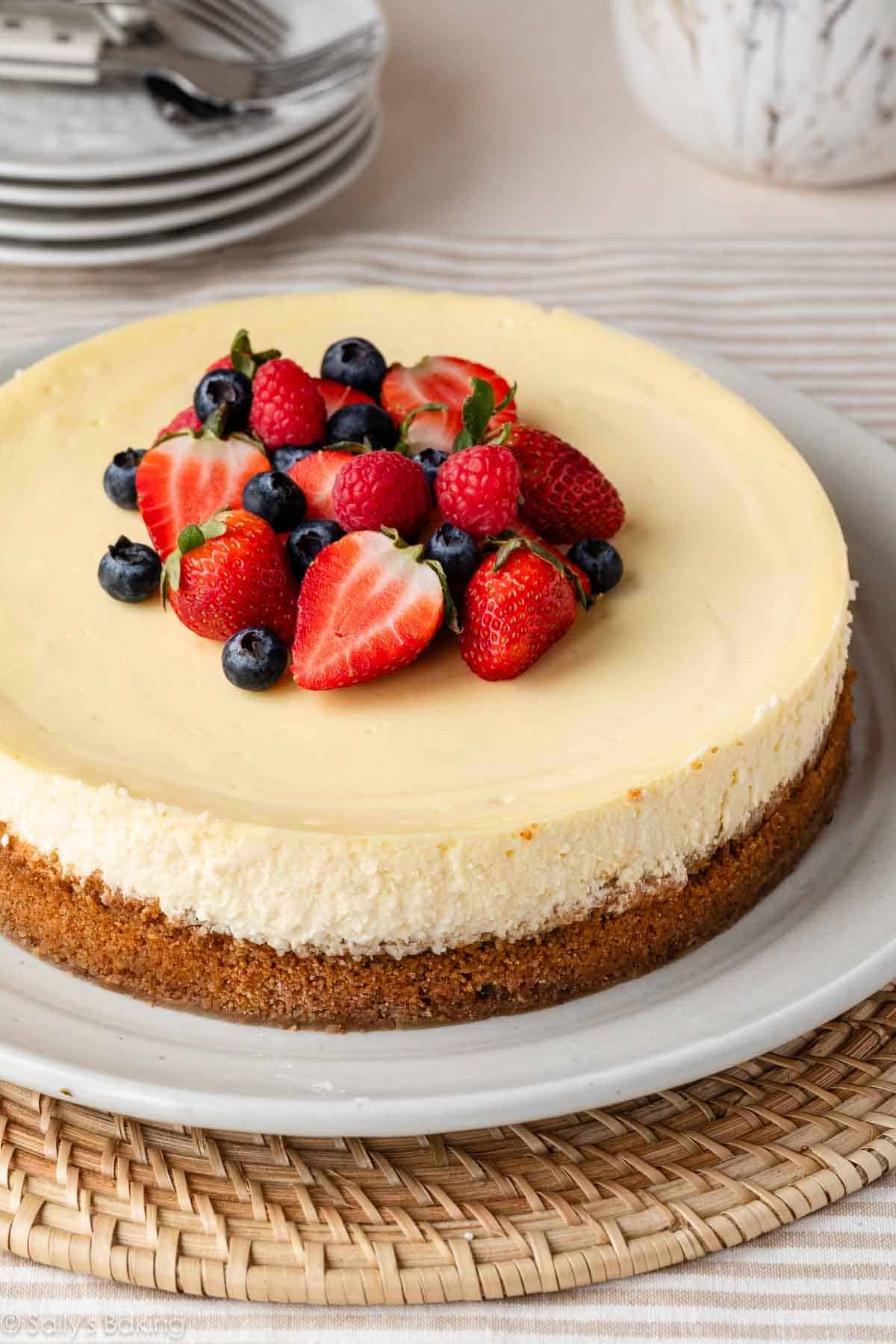
Preparing this cheesecake recipe is simple—it’s baking it that can make or break the results. Many factors are at play like the springform pan leaking, the surface of the cheesecake cracking, under-baking, over-baking, etc. I have plenty of tricks that will help guarantee classic cheesecake perfection, including determining when the cheesecake is done and everything you need to know about a cheesecake water bath.
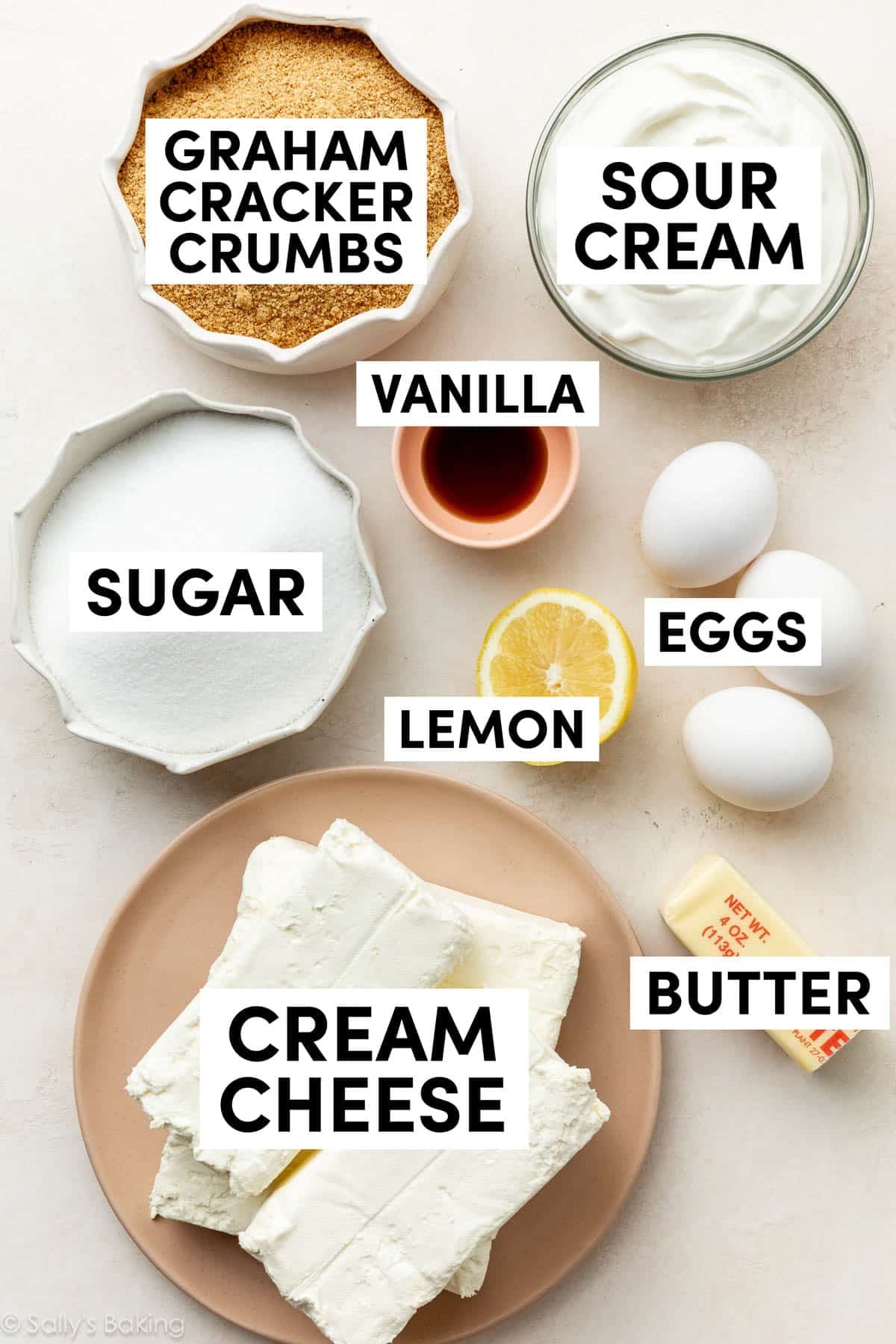
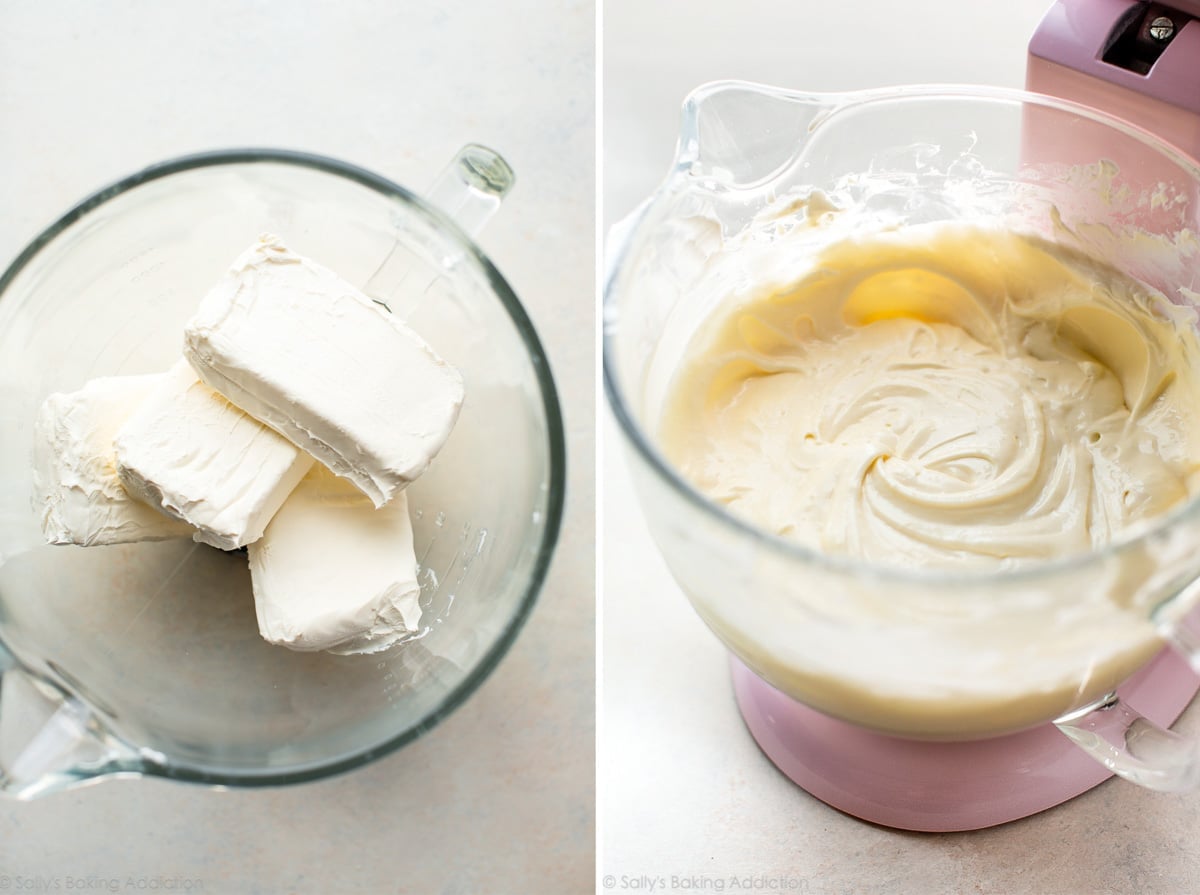
Ingredients You Need & Why
You only need a few basic staple ingredients for this cheesecake recipe.
- Brick cream cheese: Four 8-ounce bricks of full-fat cream cheese are the base of this cheesecake. That’s 2 pounds. Make sure you’re buying the bricks of cream cheese and not cream cheese spread. There are no diets allowed in cheesecake, so don’t pick up the reduced-fat variety!
- Sugar: 1 cup. Not that much considering how many mouths you can feed with this dessert. Over-sweetened cheesecake is hardly cheesecake anymore. Using only 1 cup of sugar gives this cheesecake the opportunity to balance tangy and sweet, just as classic cheesecake should taste.
- Sour cream: 1 cup. I recently tested a cheesecake recipe with 1 cup of heavy cream instead, but ended up sticking with my original (which can be found here with blueberry swirl cheesecake!). I was curious about the heavy cream addition and figured it would yield a softer cheesecake bite. The cheesecake was soft, but lacked the stability and richness I wanted. It was almost too creamy. Sour cream is most definitely the right choice.
- A little flavor: 1 teaspoon of pure vanilla extract and 2 of lemon juice. The lemon juice brightens up the cheesecake’s overall flavor and vanilla is always a good idea. Vanilla bean paste is wonderful too!
- Eggs: 3 eggs are the final ingredient. You’ll beat the eggs in last, one at a time, until they are *just* incorporated. Do not over-mix the batter once the eggs are added. This will whip air into the cheesecake batter, resulting in cheesecake cracking and deflating.
And as always, make sure all of the cheesecake batter ingredients are at room temperature so the batter remains smooth, even, and combines quickly. Beating cold ingredients together will result in a chunky, over-beaten cheesecake batter, hardly the way we want to start!
How to Make a Graham Cracker Crust
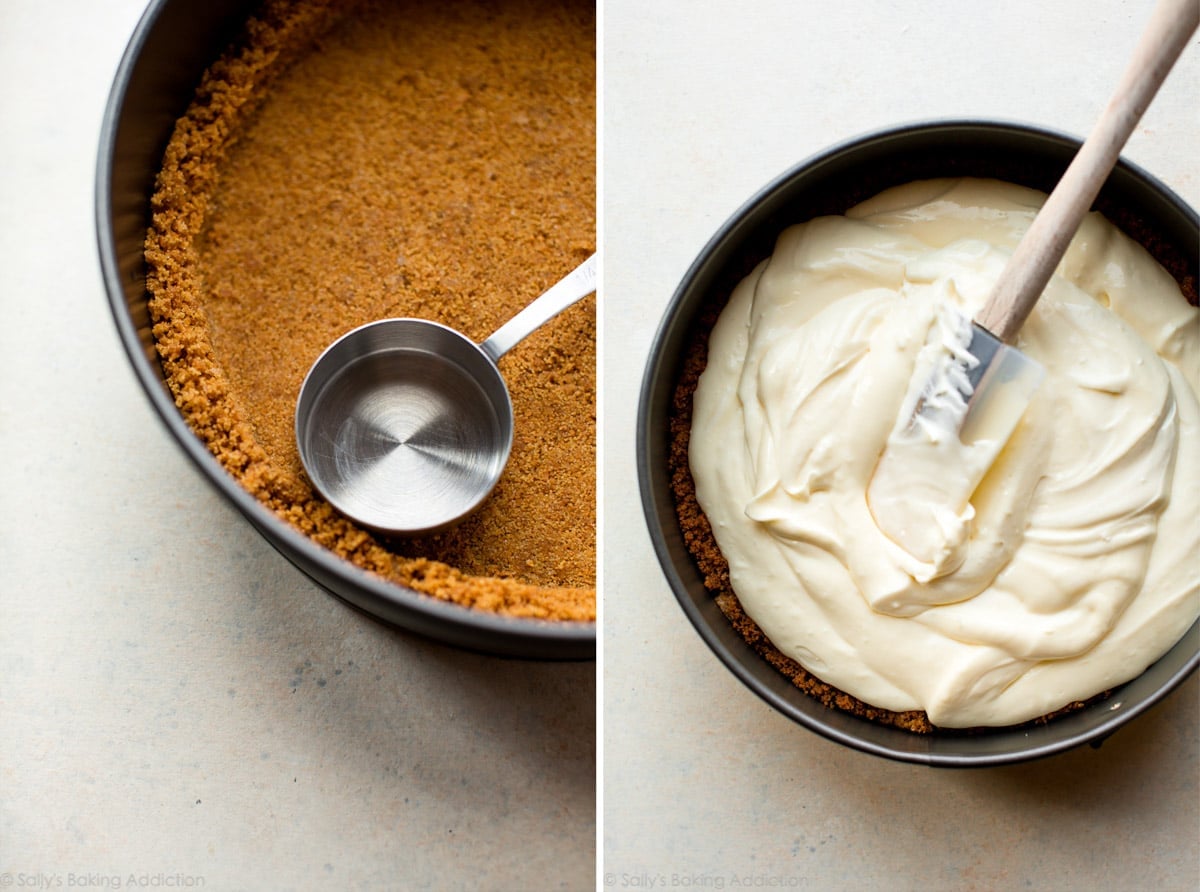
Since classic is the keyword of the day, we’re sticking with cheesecake’s main squeeze: a graham cracker crust. I reduced the butter from my original graham cracker crust recipe by 1 Tablespoon. I find this crust remains a little more crunchy. Make sure you pack the crust in tightly and pre-bake it to help prevent any sogginess.
You could use this Oreo cookie crust instead. No big changes necessary to the recipe below, but I do encourage you to lightly grease the bottom of the springform pan because Oreo crusts tend to stick. (You could also use a Biscoff pie crust instead if you’d like!)
I like to use the bottom of a small measuring cup to smooth the crust mixture into the springform pan. Speaking of, you’ll need a 9-inch or 10-inch springform pan. A springform pan has removable sides so you can safely release the cheesecake without having to flip the pan over or struggle to cut the cheesecake inside the pan. Springform pans can leak if you’re baking the cheesecake in a water bath (more on that below!), but this particular pan is reliable. I haven’t had any leaking issues.
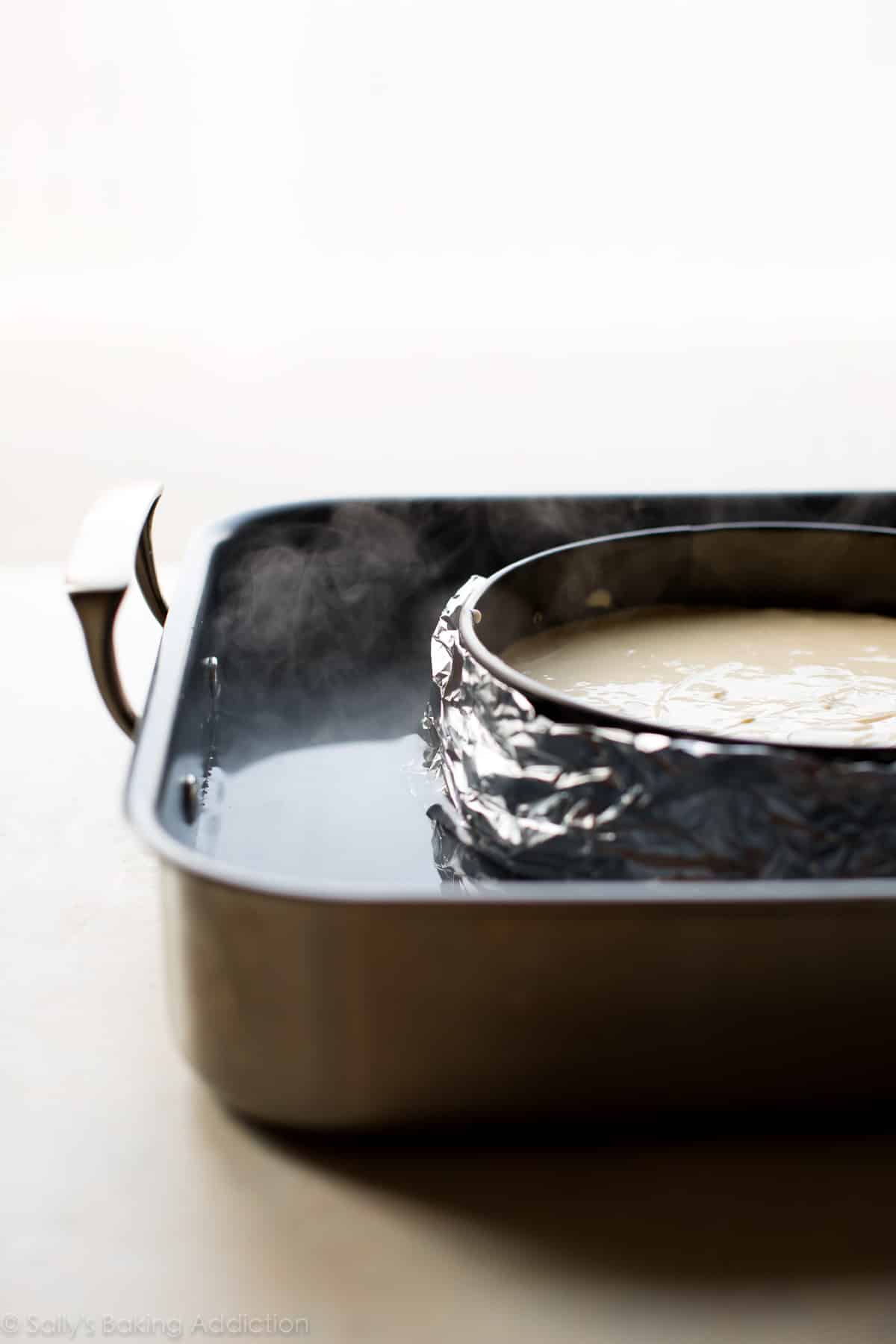
Cheesecake Water Bath
I promise a water bath is nothing complicated. All you’re doing is placing the springform pan in a roasting pan, filling it with hot water, and baking. What’s the point, you ask?
- I actually have an entire post and video tutorial for How to Make a Cheesecake Water Bath.
Cheesecake loves a humid environment. The steam from the hot water will lift the cheesecake up slowly and evenly, reducing the risk of cracks on the surface. Additionally, this slow and even baking method helps prevent the cheesecake from sinking back down as it cools. Taking a few extra minutes to prepare a water bath for this cheesecake recipe is well worth it.
Yes, but I don’t recommend it. A water bath creates a humid environment that helps the cheesecake bake gently and evenly. If you skip it, expect a slightly drier texture, browned surface, and there’s a higher chance it will crack.
Cheesecake is done when the edges are set and the center still has a slight wobble. All ovens are different, so this can take anywhere from 55 to 70 minutes.
Yes! Cheesecake is a wonderful make-ahead dessert because it needs to chill in the refrigerator for several hours and up to 2 days. You can also freeze it; see detailed instructions below.
Cooling & Chilling Cheesecake
In addition to using a cheesecake water bath, another way to help prevent cheesecake cracks is to let it cool slowly, starting inside the oven. When the cheesecake is done baking, turn the oven off, crack open the oven door, and leave the cheesecake inside for 1 hour. A drastic and sudden change of temperature isn’t ideal for cheesecake—from hot oven to cool counter—so do your best to control the environment by leaving the cheesecake inside. Does this make sense?
After the cheesecake cools in the oven for 1 hour, place it on the counter to cool completely to room temperature. After it’s cool, chill it in the refrigerator for at least 4 hours or even overnight. There’s no greater test to your willpower than those hours you’re forced to wait as the cheesecake cools down and then chills in the refrigerator. But when you take that first bite, every minute you waited will be completely worth it!
For a quicker, easier alternative to making a classic cheesecake, try this cheesecake pie or pumpkin cheesecake pie. Or if you want to completely skip the baking and cooling process, try my no-bake cheesecake instead.
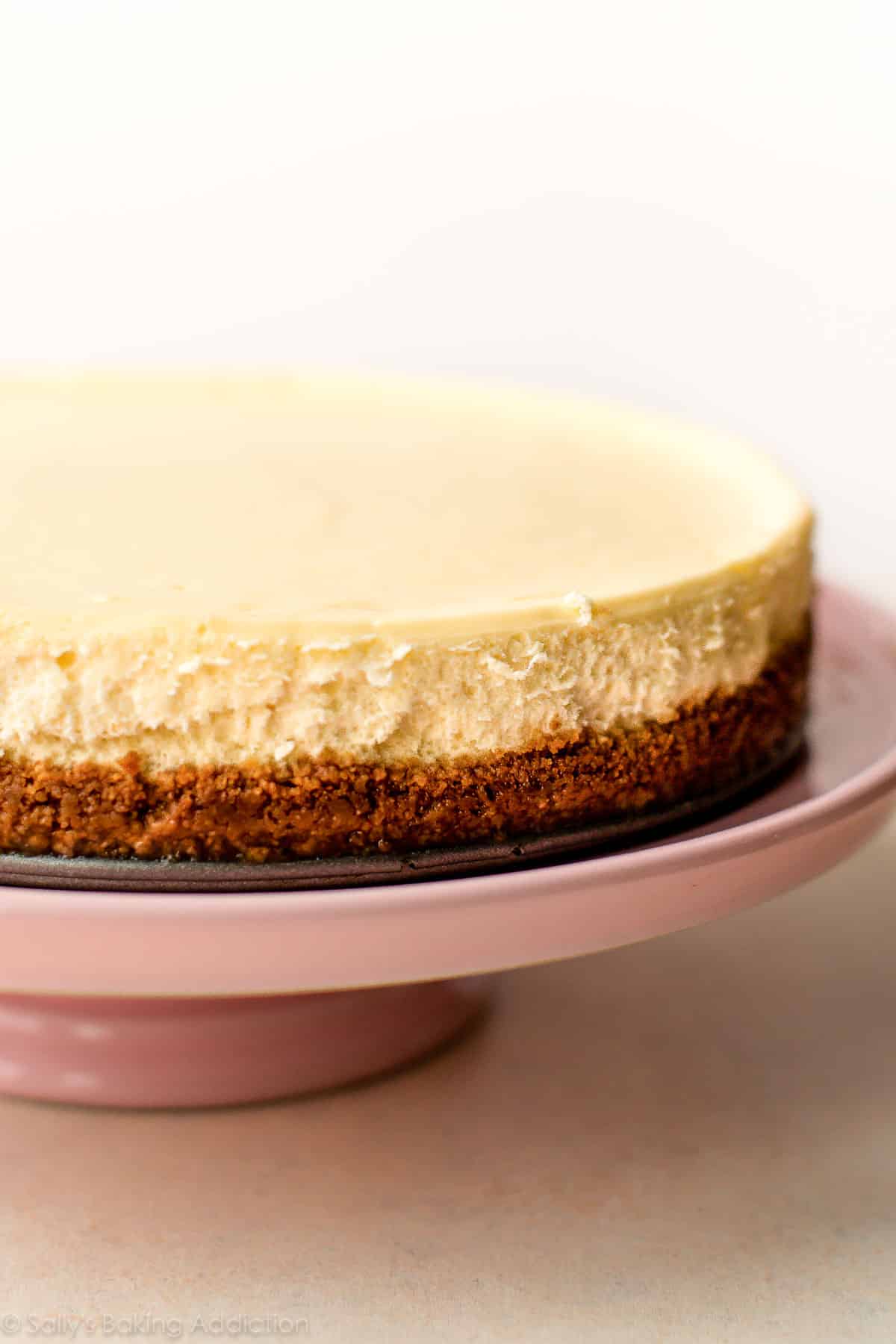
4 Success Tips for This Cheesecake Recipe
To summarize the above, here are the key tips:
- Start with room-temperature ingredients.
- Do not over-mix the cheesecake batter.
- Bake in a water bath.
- Leave cheesecake in the cooling oven for 1 hour, then cool completely at room temperature.
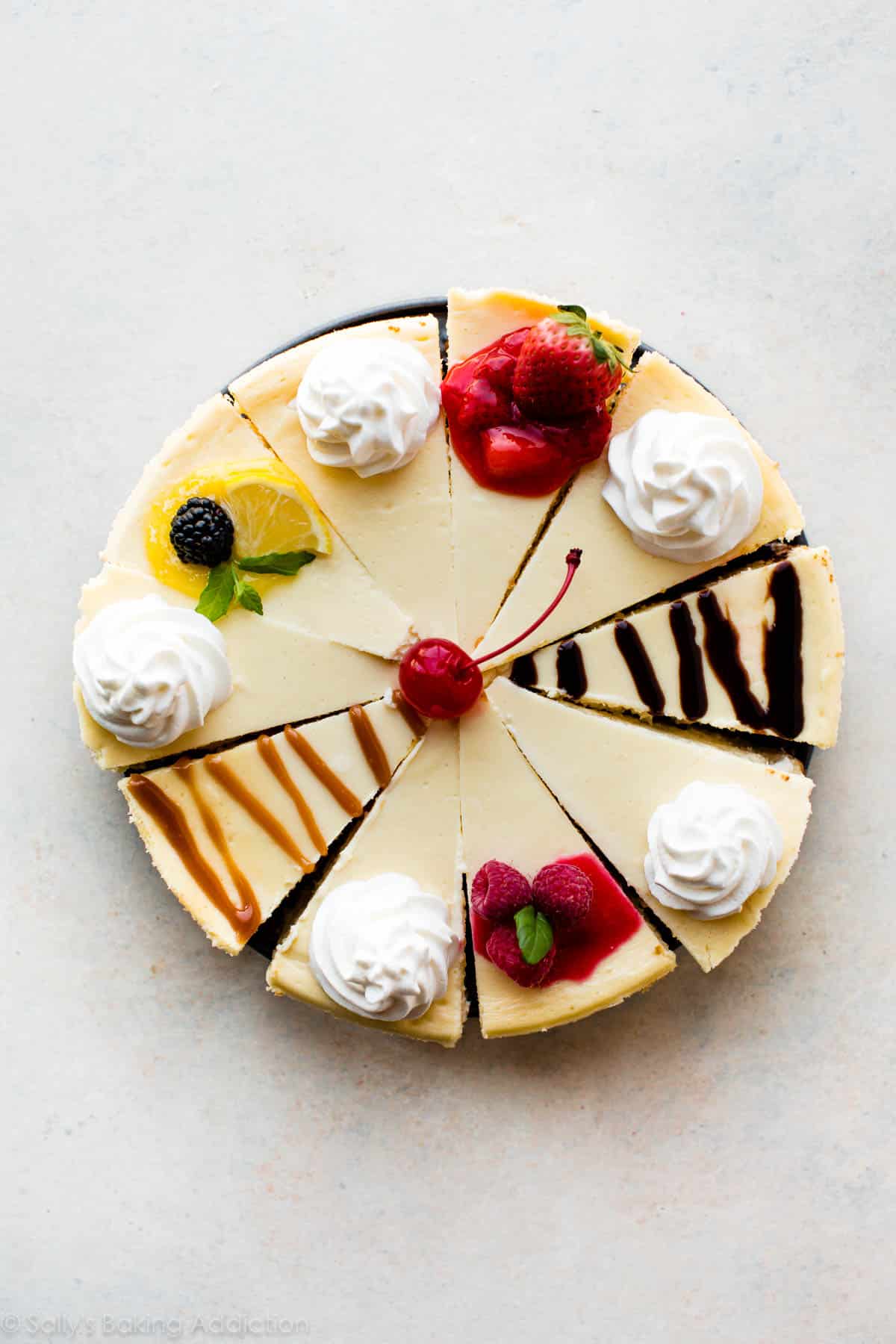
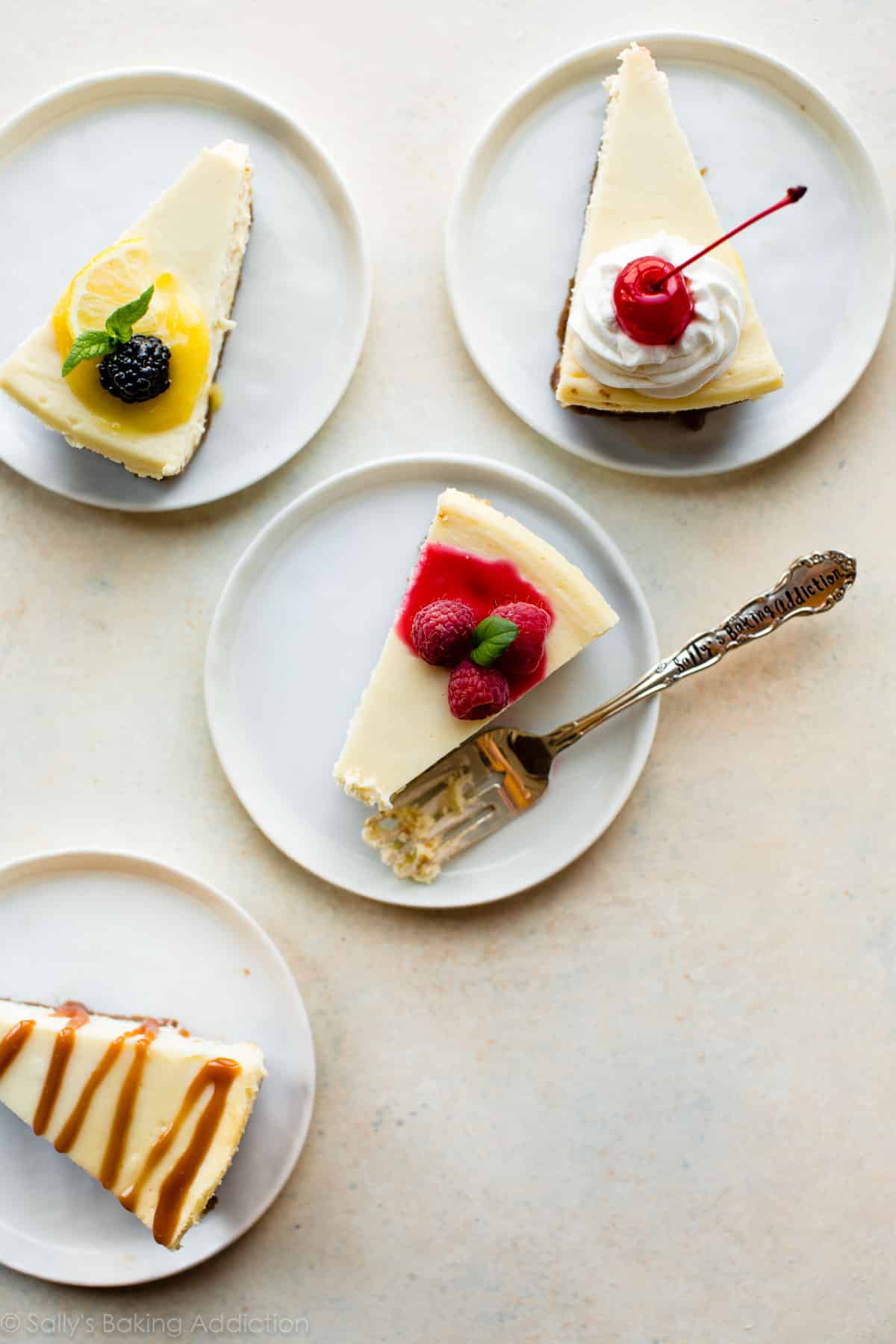
Cheesecake Toppings
Enjoy your velvet-rich cheesecake as is, or get a little fancy with a selection of toppings. Here are some recommendations:
Get creative or keep it simple. Either way, it’s going to impress.
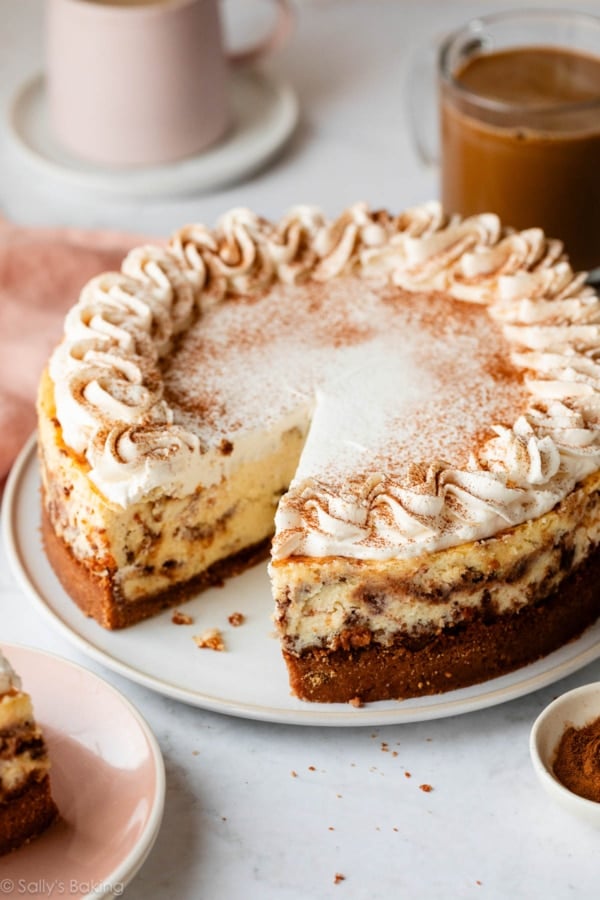
And if you’re really looking to take your cheesecake to the next level, check out my pecan pie cheesecake, cinnamon swirl cheesecake, or caramel apple cheesecake pie.
How to Freeze Cheesecake
- Cool the cheesecake on the counter before freezing. No need to chill it in the refrigerator.
- How to freeze cheesecake on the springform pan: Remove the outer rim from the springform pan. Wrap the cheesecake with the bottom of the pan with a few layers of plastic wrap, then a final layer of aluminum foil.
- How to freeze cheesecake without the springform pan: After the cheesecake has completely cooled, run a sharp knife underneath the crust to release it from the bottom of the pan. Carefully slide it onto a parchment paper–lined piece of cardboard or use a freezer-safe plate. Wrap it all in a few layers of plastic wrap, then a final layer of aluminum foil.
- Freeze cheesecake for up to 3 months, then thaw overnight in the refrigerator before serving.
- Do not freeze cheesecake with any toppings. Add toppings just before serving the thawed cheesecake.
Classic Cheesecake Recipe
- Prep Time: 45 minutes
- Cook Time: 1 hour
- Total Time: 7 hours, 45 minutes (includes chilling)
- Yield: serves 12-16
- Category: Dessert
- Method: Baking
- Cuisine: American
Description
Look no further for a creamy and ultra smooth classic cheesecake recipe! Paired with a buttery graham cracker crust, no one can deny its simple decadence. For the best results, bake in a water bath. This recipe is also in my cookbook, Sally’s Baking 101.
Ingredients
Graham Cracker Crust
- 1 and 1/2 cups (180g) graham cracker crumbs (about 12 full-sheet graham crackers)
- 1/4 cup (50g) granulated sugar
- 5 Tablespoons (71g) unsalted butter, melted
Cheesecake
- 32 ounces (904g) full-fat brick cream cheese, softened to room temperature
- 1 cup (200g) granulated sugar
- 1 cup (240g) full-fat sour cream, at room temperature
- 1 teaspoon pure vanilla extract
- 2 teaspoons fresh lemon juice (optional, but recommended)
- 3 large eggs, at room temperature
Instructions
- Adjust the oven rack to the lower-middle position and preheat oven to 350°F (177°C).
- Make the crust: If you’re starting out with full graham crackers, use a food processor or blender to grind them into fine crumbs. Pour into a medium bowl and stir in the sugar until combined, and then stir in the melted butter. Mixture will be sandy. Try to smash/break up any large chunks. Pour into an ungreased 9-inch or 10-inch springform pan. With medium pressure using your hand, pat the crumbs down into the bottom and partly up the sides to make a compact crust. Do not pack down with heavy force because that makes the crust too hard. Simply pat down until the mixture is no longer crumby/crumbly (you can use the flat bottom of a small measuring cup to help smooth it out if needed). Bake for 10 minutes. Remove from the oven and set aside while you prepare the filling.
- Make the filling: In a large bowl using a handheld or stand mixer fitted with a paddle attachment, beat the cream cheese and granulated sugar together on medium-high speed until the mixture is smooth and creamy, about 2 minutes. Add the sour cream, vanilla extract, and lemon juice and beat until fully combined. With the mixer on medium speed, add the eggs one at a time, beating after each addition until just combined. Stop the mixer as soon as the final egg is fully incorporated into the batter; over-mixing can cause the cheesecake to deflate. You will have nearly 6 cups of batter.
- Prepare the simple water bath (see Note): (If needed for extra visuals, see How to Make a Cheesecake Water Bath; the visual guide and video will assist you in this step.) Boil a kettle/pot of water. You need 1 inch of water in your roasting pan for the water bath, so make sure you boil enough. I use an entire kettle of hot water. As the water is heating up, wrap 1 or 2 sheets of heavy-duty aluminum foil around the springform pan—be careful if it’s still warm from baking the crust! Place the wrapped springform pan inside of a large roasting pan. Pour the cheesecake batter on top of the crust. Use a spatula to smooth it into an even layer. Carefully pour the hot water inside of the pan and place in the oven. (Or you can place the roasting pan in the oven first, then pour the hot water in—whichever is easier for you.)
- Bake the cheesecake for 55–70 minutes or until the center is almost set. If you notice the cheesecake browning on top, tent it with aluminum foil halfway through baking. When it’s done, the center of the cheesecake should still slightly wobble if you gently tap or shake the pan. Turn the oven off and open the oven door slightly. With the door ajar, let the cheesecake sit in the oven in the water bath as it cools down for 1 hour. After 1 hour, remove from the oven and water bath, discard the foil, and place the springform pan on a cooling rack to cool completely at room temperature. When it has cooled, cover and refrigerate the cheesecake for at least 4 hours or up to 2 days.
- Run a knife around the edges of the springform pan to help loosen the cheesecake, then remove the outer rim. Using a sharp knife, cut into slices for serving. For neat slices, wipe the knife clean and dip it into warm water between each slice.
- Serve cheesecake with desired toppings (see Note). Cover and store leftover cheesecake in the refrigerator for up to 4 days.
Notes
- Make-Ahead Instructions: This cheesecake can be made the day before. It has to chill for quite some time before serving. See step 5. Another way to make this cheesecake ahead of time is to freeze it. Cheesecake can be frozen for up to 3 months. See instructions in blog post above.
- Special Tools (affiliate links): Food Processor | Glass Mixing Bowl | 9-inch Springform Pan or 10-inch Springform Pan | Electric Mixer (Handheld or Stand) | Roasting Pan | Silicone Spatula
- Oreo Cookie Crust: Feel free to replace the graham cracker crust with this Oreo cookie crust. Spray bottom of springform pan with nonstick spray, as Oreo cookie crusts tend to stick. Pre-bake the crust, just as you do with the graham cracker crust in step 2 above.
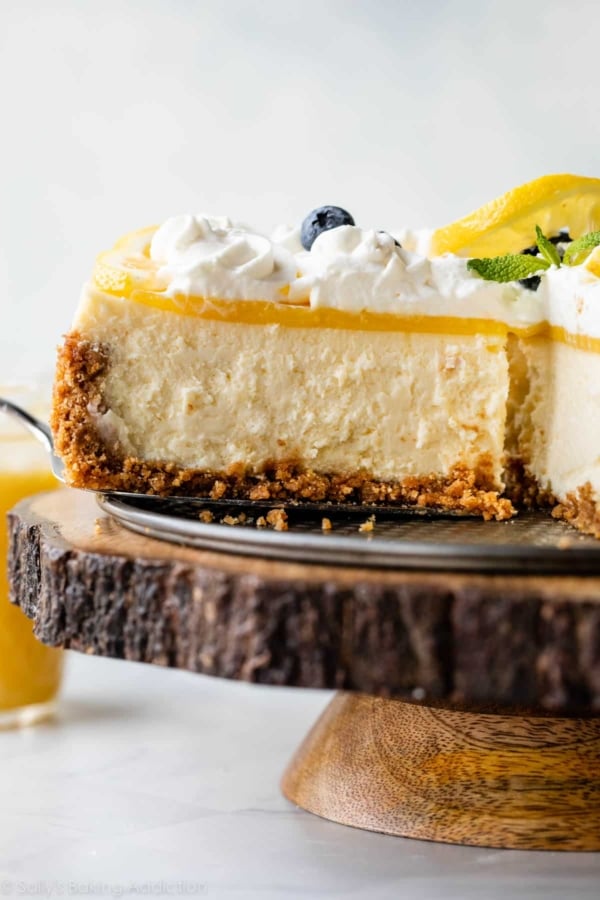
- Toppings: One of my favorite toppings for this cheesecake is raspberry sauce. Or you could top the baked and cooled cheesecake with salted caramel, lemon curd, strawberry topping, chocolate ganache, red wine chocolate ganache, fresh fruit, or whipped cream. The topping from my pecan pie cheesecake is also an option!
- Alternate Water Bath Method: This method works as well, and you don’t have to bake the cheesecake IN water. Boil a kettle or pot of water. You need 1 inch of hot water in your roasting pan for the water bath, so make sure you boil enough. Place the cheesecake on the center oven rack of the preheated oven. Place a large metal baking or roasting pan (do not use glass—I usually use a 9×13-inch baking pan or an extra-large cast iron skillet) on the bottom rack. Pour boiling water into the empty pan, about 1 inch deep. Immediately close the oven door to trap the steam inside. This unique water bath adds steam to the oven without having the cheesecake sit inside the water itself. No need to wrap the springform pan in foil. See How to Make a Cheesecake Water Bath for more information.
- Room-Temperature Ingredients: Bring all cold ingredients to room temperature before beginning. Room-temperature ingredients combine quickly and evenly, so you won’t risk over-mixing. Also, beating cold ingredients together will result in a chunky cheesecake batter, hardly the way you want to begin!
- Non-US Readers: Don’t have graham crackers where you live? Use 200g ground digestive biscuit crumbs (about 2 cups; 13–14 biscuits), 1/3 cup (67g) granulated sugar, and 6 Tablespoons (85g) melted butter. Pre-bake the crust for a bit longer, about 12–14 minutes. And from what I understand, spreadable cream cheese sold in a tub in countries outside of the US is a little different from the spreadable cream cheese in the US. It’s thicker, sturdier, and more solid and should be OK for this recipe. I have no experience with it, but this is what I’ve heard from other non-US readers. If you try it, let us know how it turns out!







Reader Comments and Reviews
I used a blender to make the batter which obviously then turned out too runny. I didnt have exact measurements because i live in the UK. Everything here tastes different. i decided to bake it anyway. Took three hours. I had to refill the waterbath a million times. It rose super high and cracked when the batter rose and stuck to the tented foil. Stressful. I followed as much of the recipe and tips as i could and that resulted in a saved cake that didnt sink. LET ME TELL YOU: this is the easiest recipe to follow im just a terrible baker andEVEN THEN this tasted like HEAVEN!! I imagine rachel and chandler fighting for the last bite of this cake off the floor of their newyork apartment hallway!! SO SO GOOD!
Literally the best cheesecake! I will never make a different recipe! Which is why I was wondering if there is a way to adapt this recipe to include cookie butter? I really want to try cookie butter cheesecake but don’t want to try anyone elses recipes!
Hi Ann, so glad you enjoyed this cheesecake. It’s certainly a favorite. I haven’t tested this exact batter with the addition of cookie butter. However, you could try this peanut butter cheesecake recipe and replace the peanut butter with cookie butter. Leave out the butterfinger candies, of course.
Thank you!!! So excited to try it!
This recipe is absolutely amazing! The first time I made it my brother was begging me to make more, and now it’s a weekly thing that is usually gone in one day! Favourite cheesecake recipe xx
Hi sally! I want to make an Oreo cheesecake..would you suggest using this recipe and using an Oreo crust..and then somehow incorporating crushed Oreos in the filling? Do you think that would work or would the filling need any adjustments?!
Hi Ariel! That should work, though we haven’t tested it. You may also love our cookies & cream pie!
The taste was beyond delicious and a huge hit with our friends! I drizzled a strawberry coulis which was a perfect marriage. My fail was with the crust which stuck to the bottom and I could only scrape off some of it. I used parchment paper on the bottom of the springform pan but I did not spray it with Pam. The cheesecake sat in the fridge overnight, but the crust was wet and stuck to the bottom. Please help me understand what I did wrong as I am going to make this again and again…..
Good morning Sally,
I wanted to know if I use lactose free cream cheese bricks will I still get the proper texture/result?
Hi Jessica, we haven’t tried this recipe with lactose free cream cheese so we’re unsure of the results. If you do try them, let us know how it turns out!
Just made this and it looks fantastic! Fluffy and perfectly cooked. However, I did use the water bath and wrapped well with foil. Mine too leaked. So bummed. I will definitely use the alternative next time. Also first time I have ever used a springform pan.
I love this recipe! I follow all of the directions but have found that the bottom of the graham cracker crust is a little bit soggy & I assume that’s from the water bath? But I wrap the spring form pan 2x in aluminum foil. Is there anyway to avoid this?
Hi Abby, so glad you love it! For next time, you can try a tighter or extra layer of foil, or even the alternate water bath described in the post which eliminates putting the cheesecake directly in water. Thank you for giving this recipe a try!
I have a 7-8 inch springform pan could I half the recipe to bake in smaller pan?
Hi Ash, We haven’t tested it and are unsure exactly how much batter you would need. For reference, this recipe makes about 5 3/4 cups of batter. We are unsure of the exact bake time you would need for a smaller cheesecake but keep your eye on it and bake until the center is almost set. When it’s done, the center of the cheesecake will slightly wobble if you gently shake the pan.
I’ve made this cake for the second time now and I use slow cooker bags to put my pan in for a water bath. No leaks that way. Don’t have to worry about the foil having a tear or small hole in it. The cheesecake is wonderful.
Hello Trina,
How much sour cream should I put in?
Would a 3/4 cup be enough instead of putting in the full cup in order to add 4oz melted baking chocolate?
Hi Jessica, we haven’t tested a chocolate version of this cheesecake so can’t say for sure – but let us know what you try!
Just made this and it looks so good!
But I just took it out of the fridge and when I removed the foil I realized she water has seeped in and made the crust a bit soggy along the edges.
How do I fix this?
Hi Batool! Unfortunately, there’s not much you can do after the water has come through the aluminum foil. The crust may be a bit soft, but the cheesecake should still be delicious nonetheless. For next time, you can try a tighter or extra layer of foil, or even the alternate water bath described in the post which eliminates putting the cheesecake directly in water. Thank you for giving this recipe a try!
Hello Sally,
If I wanted to turn this original cheesecake into a chocolate cheesecake instead would I only have to melt chocolate baking bars and incorporate it into the mix?
If so how many 4oz bars would you recommend?
Would I need to reduce or increase any of the other ingredients in this recipe in order to add the melted chocolate baking bars (ie granulated sugar)?
Hi Jessica, We haven’t tested a chocolate version, but you can try to slightly reduce the sour cream and add 3 or 4 ounces of melted (and slightly cooled) unsweetened chocolate. Another option would be to add in chocolate chips like we do with our Amaretto Cheesecake or simply top the baked cheesecake with chocolate ganache. Let us know what you try!
Hello Trina,
How much sour cream should I put in?
Would a 3/4 cup be enough instead of putting in the full cup in order to add 4oz melted baking chocolate?
Hello Sally! I tried the recipe and it was amazing! But it was a bit sour. Is there a way I can substitute the sour cream with something else? To remove the sour taste
Hi Riad, Full fat plain or Greek yogurt works in the place of sour cream. It may taste a bit heavier, but not much.
Hi sally. I want to swirl in coke chocolate. Would you recommend just melting a few tablespoons of bittersweet chocolate and swirling it in after pouring the mixture into the pan?
Hi Mo, we haven’t tested a chocolate version (or one with swirls), but you can try to slightly reduce the sour cream and add 3 or 4 ounces of melted (and slightly cooled) unsweetened chocolate. Another option would be to add in chocolate chips like we do with our Amaretto Cheesecake or simply top the baked cheesecake with chocolate ganache. Let us know what you try!
This is great, thank you! Any suggestions for what to do with left over batter?
Hi James, you could use leftover batter to make additional mini cheesecakes on the side.
I made this once before and it was PERFECT. Thank you!! 5 stars all around. I placed the boiling water in a pan below the cake because I was worried about leakage, and it worked just right.
My partner has asked for this with a chocolate base for Valentine’s Day. Can I just replace the regular graham crackers with chocolate? or any other recommendations?
Hi Lauren, you could definitely try that for a chocolate base. Enjoy!
Crushed Oreos make a great substitute! We use 1.5 cups crushed Oreos (about 20 Oreos) and 3 tablespoons of melted butter. You can omit the sugar since the Oreos are already sweetened!
Hi sally! May i know how to improve crust, it breaks when i slice it or transfer it to the cake board.
Hi Sean, the crust may be over-baked. See if skipping the crust pre-bake helps for next time.
PERFECT
we had that big storm this weekend on Long Island so I decided to make this cake.
My advice – don’t change a thing, do exactly as Sally says to do and you’ll have a perfect
cake.
Thank you Sally!
Hi Sally,
I love your recipes and again this one didn’t disappoint!. I follow the instructions as listed and it was perfection; Especially when I’m not a cheesecake fan but, definitely keeping this one.
I’m so disappointed! I followed the directions exactly, placing the water underneath the rack with the cheesecake. When I went to check on it at 60 min there was a huge crack around the top. Did I overfill it? Not enough water? Not sure what I did wrong. I was going to use for a baby shower tomorrow but it’s not pretty.
Hi Bri, Overbaking is definitely the most common culprit of cracks in cheesecakes! If you would like more tips you can check out the post How to Prevent Cracks in Cheesecake.
How deep is the cheesecake?
Hi Crystal, we haven’t measured this cheesecake, but would guess it’s about 2 inches deep.
Thank you so much for replying so quickly. I found another recipe from someone else and it didn’t even messure an inch and a half so it looked so little. Im using your recipe now! Can’t wait to try it!
I love this recipe! I’ve made it numerous times, always requested by guests and always a hit! Today, for the second time in the past year, I got leakage into the foil and I can see the base of the crust gotten soggy 🙁 I am hyper-vigilant with the foil wrapping, and I use a great quality pan … all the instructions followed to a T!! I checked the foil wrap – not a single tear anywhere (double layer too!). Are there theories as to how water seeps in? Could it simply be that the level of condensation on the foil wrap can cause it? Im ready to explore the non-traditional bain marie method. Any tips or thoughts? Thank you in advance.
Hi Faye! Those water baths can be so tricky – we understand your frustration. We highly recommend the alternate method detailed in the recipe notes – it takes away the headache and worry of the water bath 🙂
Hi Sally! I’m a cheesecake fan!
I just bought a new electric oven .Should I Bake the cake in the conventional función? Or in convection Bake function?
Thank you !!!
Hi Silvia, All of the recipes on this site are written for conventional settings. Convection ovens are fantastic for cooking and roasting. If you have the choice, we recommend conventional settings when baking cakes, breads, etc. The flow of air from convection heat can cause baked goods to rise and bake unevenly and it also pulls moisture out of the oven.
I’ll get the tinfoil extra long from the dollar store. It covered my whole pan
I may have missed it, but what do I need to preheat the oven too when I cook the cheesecake??
Hi Abby, In step one of the directions you will preheat oven to 350°F (177°C).
The cake came out perfect.
I had an issue separating the graham cracker crust from the bottom of the pan.
Any suggestions?
We’re thinking of using parchment paper next time.
Hi Chris, So glad you liked the cheesecake! Make sure it’s cooled completely and slide a knife or flat edged spatula under the bottom to loosen it. Then you can carefully slide it onto your serving dish (or attempt to lift it with large spatulas but that method is a little risky). Other bakers have reported using a parchment paper round on the bottom of their pan as well. Hope this helps!
Hello! I love your recipes! I noticed the filling curdled when I was mixing in the eggs in. I know the cream cheese was cold or mabe I used to much? Just wondered if you knew why that would happen? Thanks!
Hi Lynn! The filling with curdle if the ingredients are different temperatures – make sure to use room temperature (not cold) cream cheese and eggs. An easy fix for next time!
Can this be baked without a springform pan?
Hi Crystal, a springform pan is definitely ideal for cheesecake, but you can try a pie dish instead – you will have enough filling for 2 since most pie dishes aren’t as deep as springform pans – or cut the filling recipe in half for one. It may be more difficult to remove from a regular pie dish. Or try our small-batch cheesecake that’s made in a loaf pan. Enjoy!
I love this recipe! I’ve been looking so long for the perfect cheesecake and finally found it. I am baking it for the fourth time now already in my “best recipes” collection. Thank you!
Okay …I am a big fan of Sally! Love your recipes. Just hoping there might be some way to reduce the cream cheese in this recipe?
Hi Marcia! Cream cheese is a very important ingredient in this classic cheesecake recipe and we don’t recommend reducing it. For a smaller recipe that uses less cream cheese you may enjoy this small batch cheesecake!
Perfect! Thank you Sally!
Hi!
If I opt for the method of placing the water on the rack below the cake, do I still need to wrap the pan with foil?
Hi Courtney, no you do not have to wrap the pan in aluminum foil if you aren’t placing it directly in water.
Hi Sally I just want to know that can we use our homemade cream cheese for this recipe, I just want to know that will it still give us the texture like a perfect cheesecake
Hi Fatima! We haven’t tried it, so can’t say for certain. Let us know if you do!