
Learn how to make a perfectly buttery, flaky pie crust from scratch using this in-depth tutorial and video. This page includes all of my best success tips, lots of step-by-step photos, and a thoroughly detailed recipe. Millions of readers have been using this helpful guide since it was first published. Become a pro with this crust recipe and the rest will be as easy as… eating salted caramel apple pie!
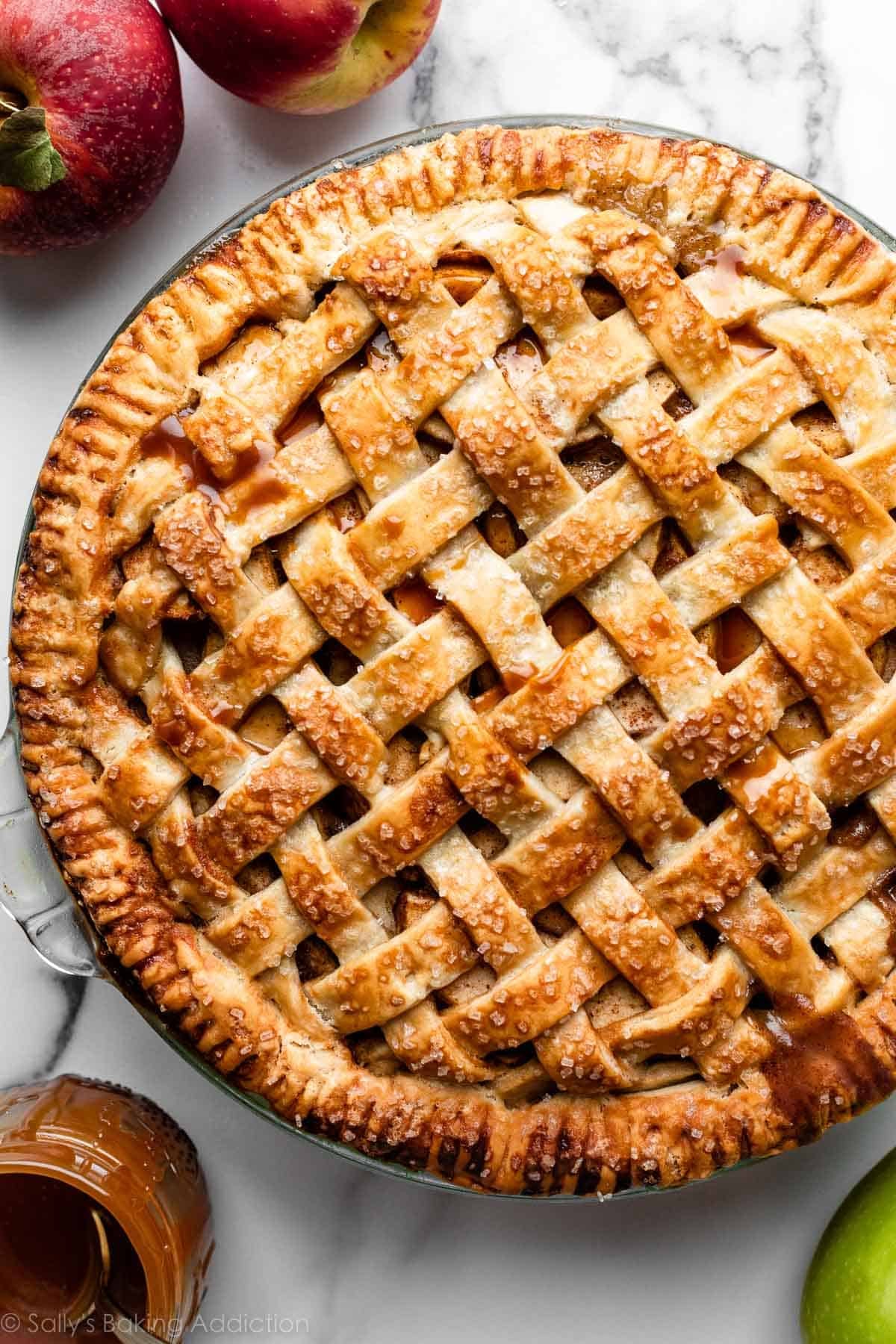
I originally published this recipe in 2015 and have since added new photos, a video tutorial, and more success tips.
For a baker, there’s nothing more satisfying than making a pie completely from scratch. Pies are often made for special occasions, and there’s a good reason for that: they’re time consuming. This shouldn’t scare you! It should intrigue you. If you’ve ever felt intimidated about making homemade pie crust, I’m here to walk you through it and cheer you on. If I can do this, you can do this.
Pie crust is the foundation for so many delicious desserts (plus savory pies and quiche), so once you build up your confidence in making a crust, you’re opening a door to an entire baking category. And that’s exciting! Whether your favorite pie filling is apple pie or creamy banana cream pie, or even eggs & cheese, the success of the overall pie can really hinge on the quality of the crust.
You wouldn’t hang a beautiful piece of art or favorite photo in a terrible frame, right?
Today I’m teaching you everything about making a buttery, flaky pie crust. This is my absolute favorite pie crust recipe and one of the most popular recipes on this website.
With all the recipe testing that goes into publishing the many pie recipes on this website and in my cookbooks, plus my annual Pie Week, it’s not an understatement to say that I have made a LOT of pies. Along the way, I’ve learned what works and what doesn’t, and I’m happy to share it all with you.
One reader, Laurie, commented: “Wow! I made a batch of my old favorite all-butter dough and a batch of this dough so I could have a ‘bake off’ to see which was better. This crust was fantastic: tender and very flaky. It will be my new standard crust! ★★★★★“
Another reader, Leo, commented: “This recipe was great! The dough was easy to make with the simple and detailed instructions from this recipe. I used it for my peach pie and it’s delicious! I also followed the braid and lattice tutorial and my pie looks great! ★★★★★“
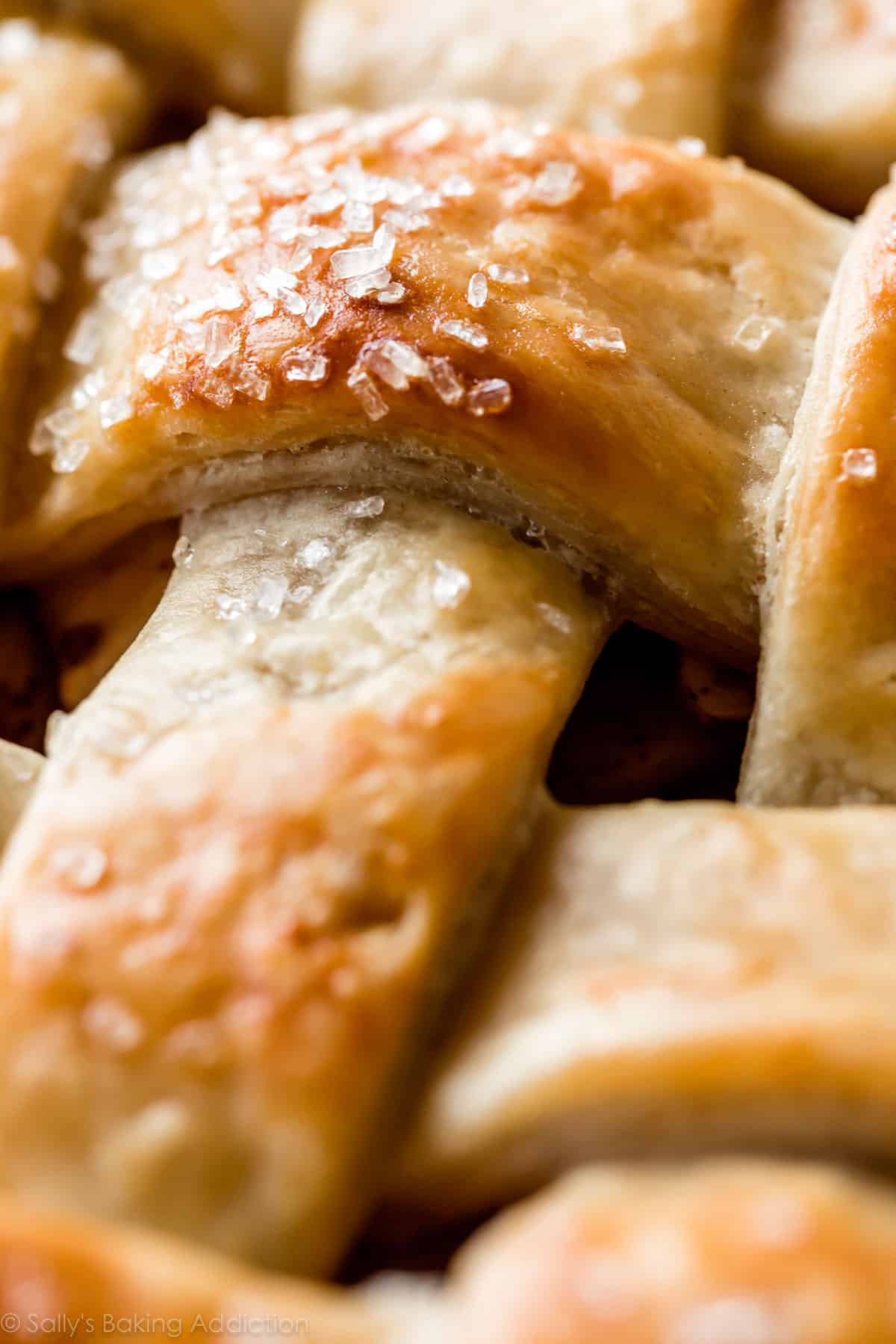
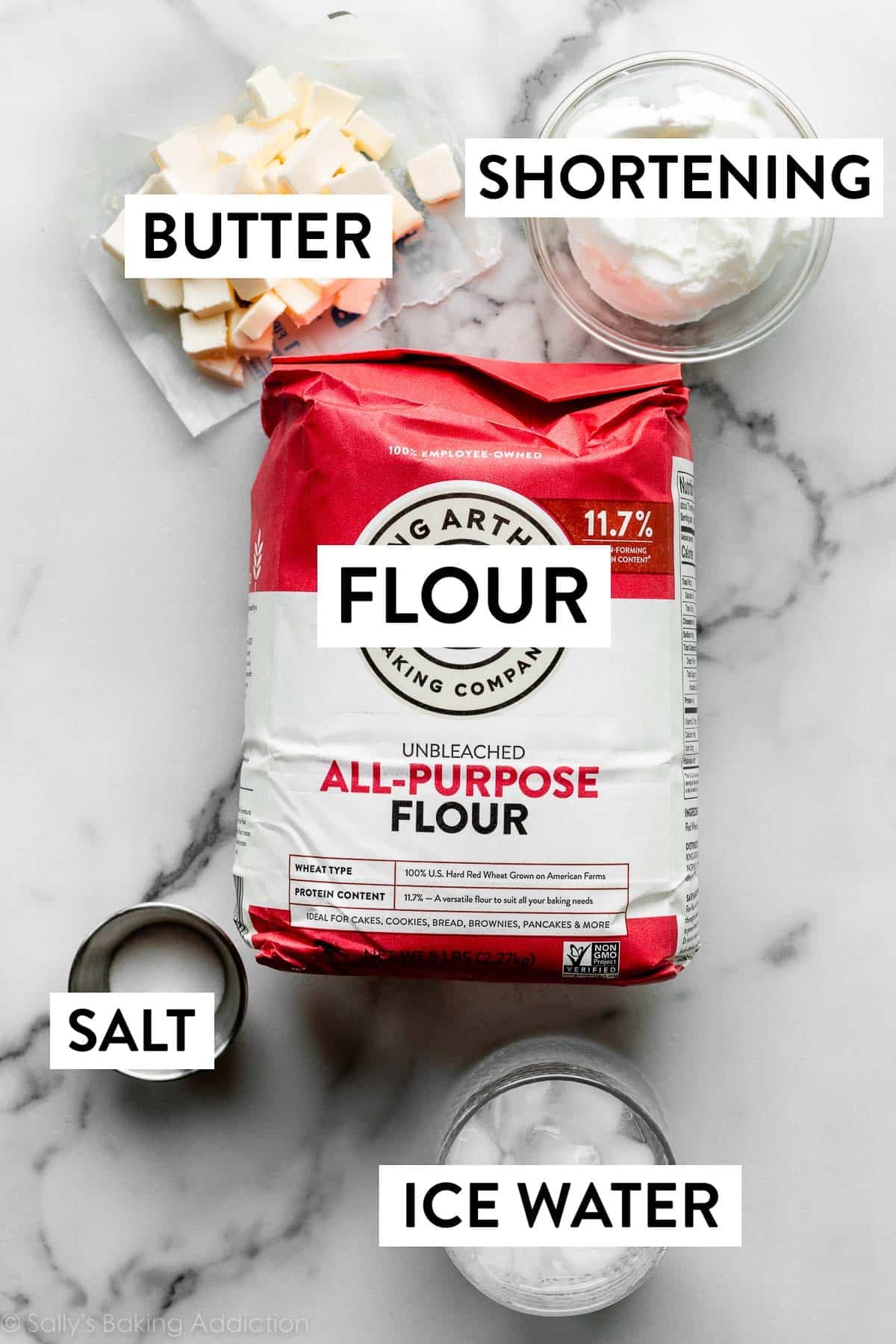
Start With These 5 Ingredients
The ingredient list for pie crust is short & simple:
- Flour: Start with quality flour. Did you know that not all all-purpose flours are equal? King Arthur Unbleached All-Purpose Flour is my go-to for not only pie crust, but for everything. (Not working with the brand, just a true fan!) Why? Its high protein level: “At 11.7% protein, it tops ordinary American all-purpose flours by nearly 2 percentage points.” What does this mean? Baked goods rise higher and stay fresh longer.
- Salt: Enhances the flavor.
- Butter: For that unparalleled buttery flavor and flaky layers.
- Vegetable Shortening: For structure and stability. More on this below.
- Ice water: Liquid brings the dough together. Some recipes call for half water and half vodka, because alcohol doesn’t promote gluten formation, which helps the crust stay flaky and tender. Basically, it’s a gift to anyone who accidentally overworks dough. If you want to try using vodka, use 1/4 cup (60ml) each cold vodka and cold water in this recipe.
You can use this pie dough for so many recipes beyond a traditional pie, too, such as mini pecan pies, mini fruit galettes, apple hand pies, and homemade brown sugar cinnamon pop tarts.
Is Pie Crust Better With Butter or Shortening?
I use BOTH shortening and butter in this pie crust because they work together to make the BEST crust. Buttery, flaky, and tender: the pie-fect trifecta.
- What does butter do? Butter adds flavor and flakiness.
- What does shortening do? Shortening helps the dough stay pliable, which is helpful when you’re rolling and shaping it. Plus, shortening’s high melting point helps the crust stay tender and maintain its shape as it bakes. Have you ever had a butter pie crust lose its shape completely? Shortening is “shape insurance.” 😉
If you don’t want to use shortening, try this all-butter pie crust instead. Let’s compare:
- Using all butter creates a lighter-textured crust and this is due to the butter’s water content. As the crust bakes, the butter’s water converts to steam, lifting up the dough and creating flaky layers. But because of all this butter, the crust doesn’t usually have a perfectly neat-edge/shape compared to the shortening and butter combination.
Both crusts taste buttery and flaky. But overall, this butter-and-shortening crust wins in terms of texture and flavor; AND, if you follow the pie crust recipe carefully, it holds shape too.
The Secret to Perfect Pie Crust: COLD
The refrigerator is as important as the oven when you’re making a homemade pie.
Why the emphasis on temperature? Keeping your pie dough as cold as possible helps prevent the fats from melting before the crust hits the hot oven. If the butter melts inside the dough before baking, you lose the flakiness. When the lumps of fat melt in the oven as the pie bakes, their steam helps to separate the crust into multiple flaky layers, as explained above. Warm fats will yield a hard, crunchy, greasy crust instead of a tender, flaky crust.
The colder the ingredients, the easier your pie crust is to work with, and the better it will turn out.
Two Tricks to Start as Cold as Possible:
- I keep some of my butter in the freezer and transfer it to the refrigerator a few hours before beginning the crust. This way it is still a little bit frozen and very, very cold. Simply keep the shortening in the refrigerator.
- Mix the dry ingredients together in a large bowl (the flour and salt). Place the bowl in the refrigerator or freezer while you get the rest of the ingredients ready.
These Step-By-Step Photos Will Help
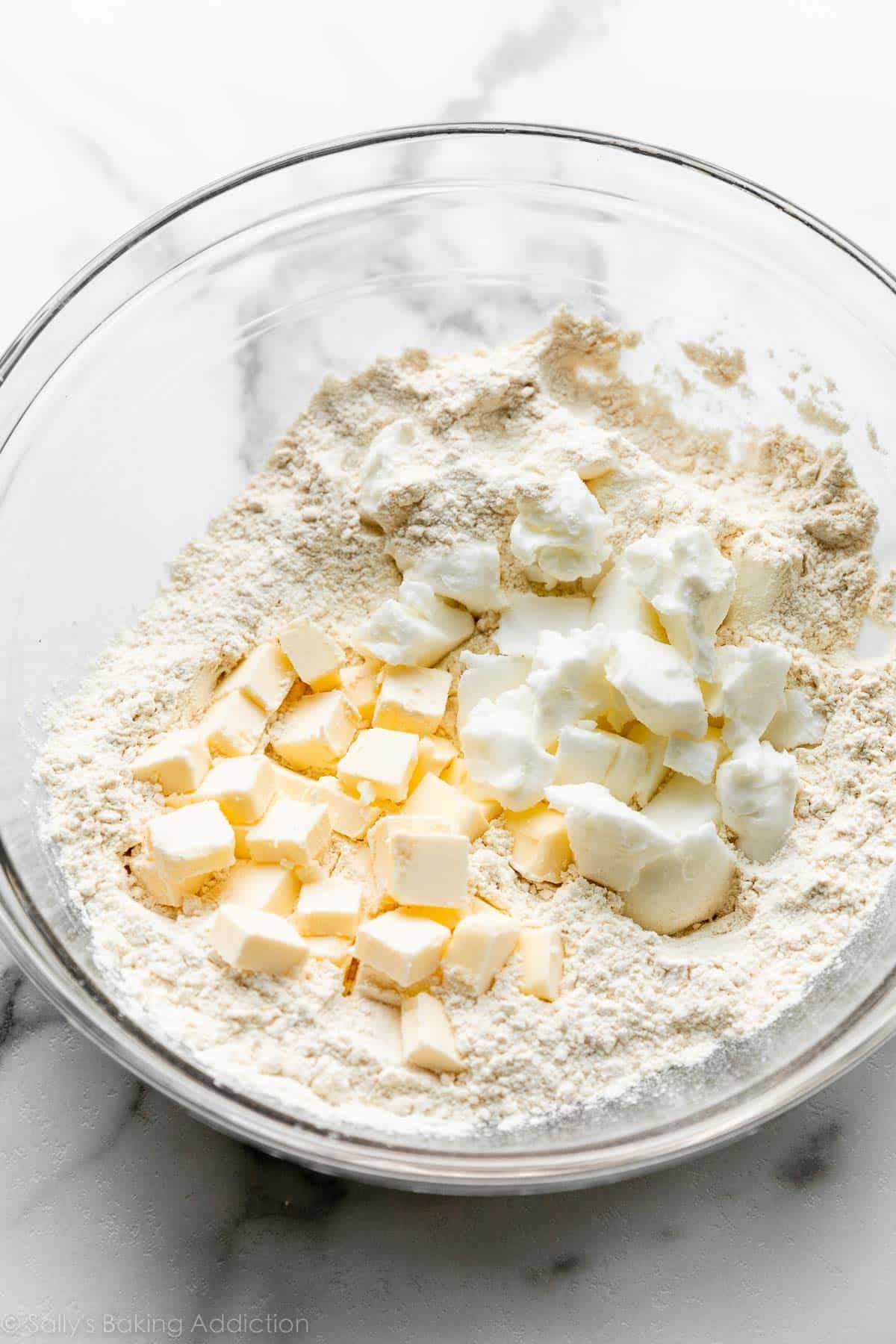
Take the butter and shortening out of the refrigerator. Cube the cold butter and measure out the cold shortening. Give the shortening a little chop—this is actually optional because, truly, the shortening is quite soft even when cold so it’s easy to mix in.
Now it’s time to combine everything. Add the butter and shortening to the dry ingredients, and use a pastry cutter (or 2 forks) to cut in the fats. Some pie crust recipes use a food processor for this, but I don’t recommend it, because it can lead to overworking the fats into the dough, cutting them up too small—which means you’ll need less water and your dough will fall apart. In this step, you’re only breaking up the cold fat into tiny little flour-coated pieces; you’re not completely incorporating it:
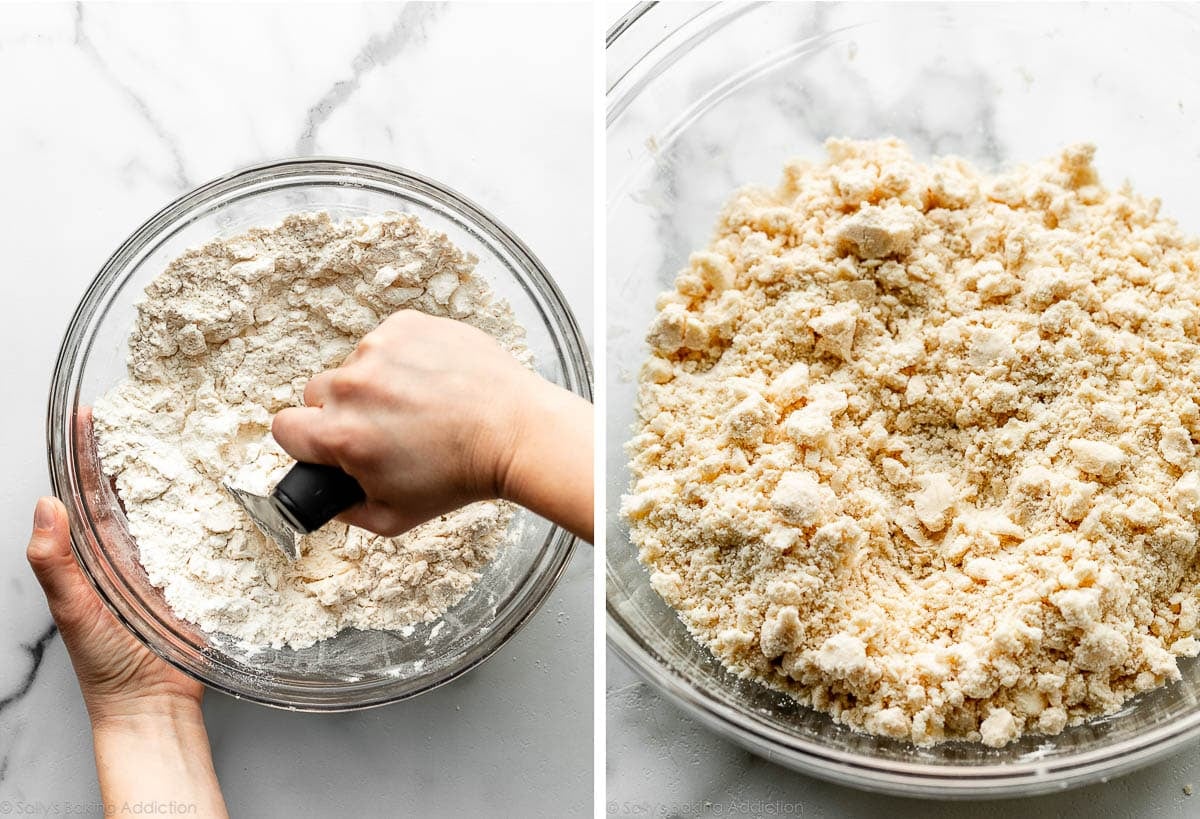
Cut in the fats until the mixture resembles coarse meal—crumbly with lots of lumps, as you see above. You should still have some larger pieces of butter and shortening when you’re done.
From a cup of ice water, measure out 1/2 cup (120ml), since the ice has melted a bit. Drizzle the cold water into the dough 1 Tablespoon (15ml) at a time, stirring after every Tablespoon has been added.
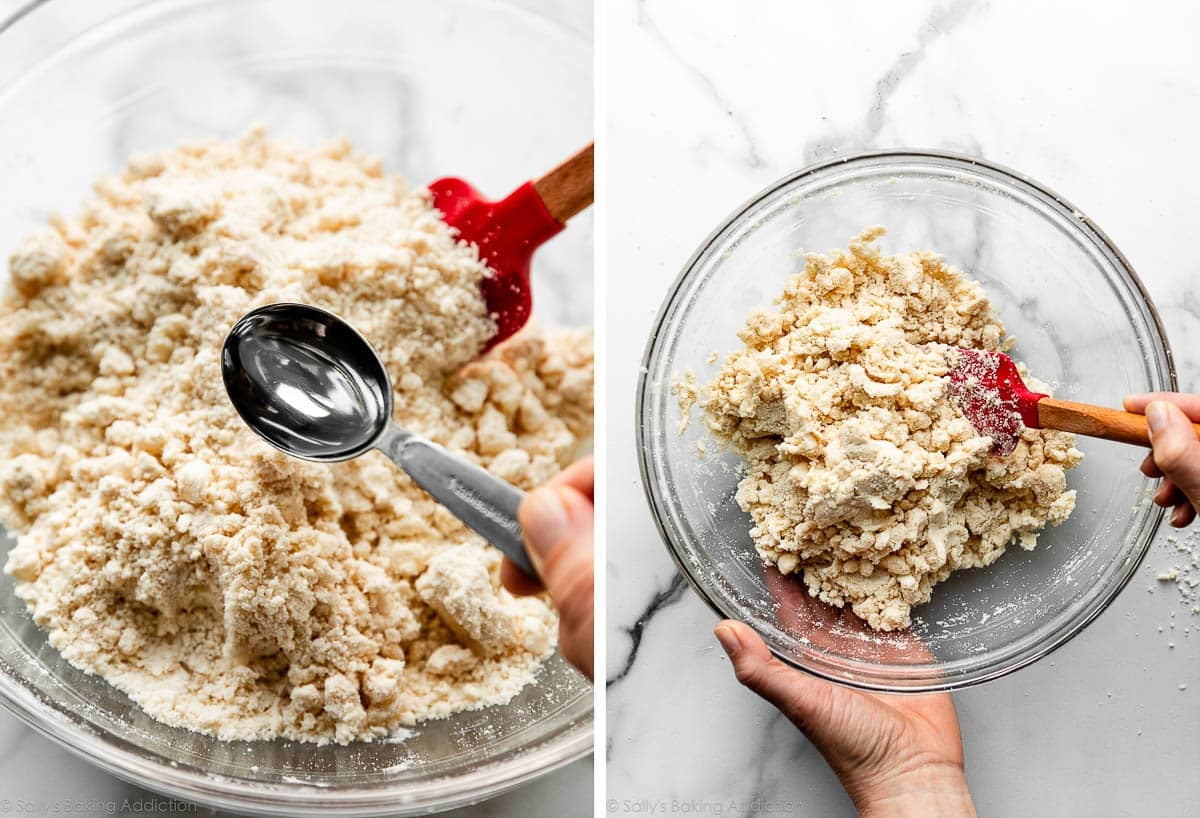
You’ll add just a little water at a time so that you don’t accidentally add too much. Stop adding water when the dough begins to form large clumps. I usually use 1/2 cup (120ml) of water, but if the weather is humid, you may not need as much, and if the weather is really dry, you may need a little more.
If too much water is added, the pie dough will require more flour and become tough.
If too little water is added, you’ll notice the dough is dry and crumbly when you try to roll it out and handle it.
You want the dough to clump together, but not feel overly sticky. Once the dough is clumping together, transfer the dough to a floured work surface.
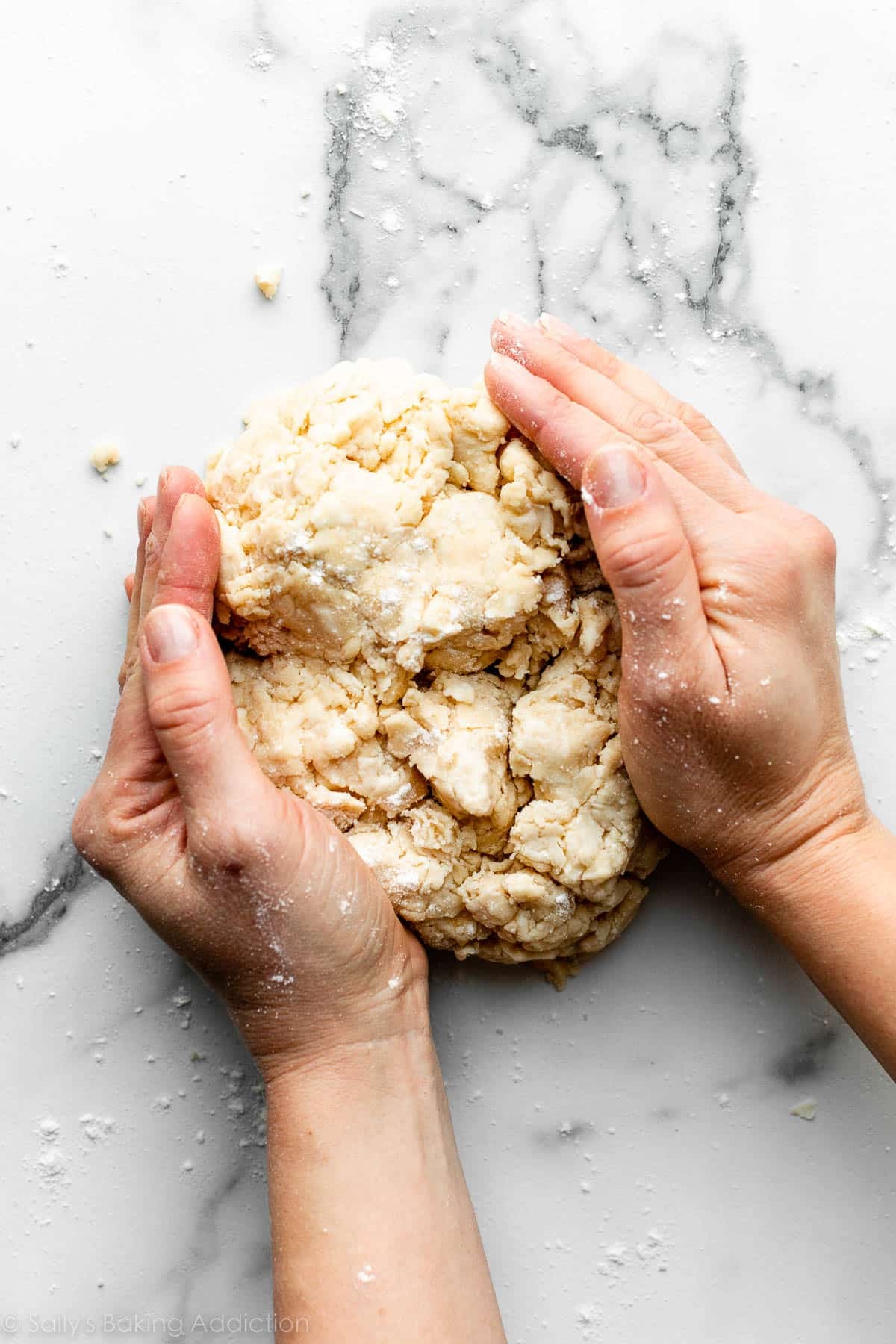
Using floured hands, fold and smush (yes, that’s the technical term) the dough into itself, forming the dough into a ball. Your hands are your best tool, just like when making homemade puff pastry.
The ball of dough should come together easily. If it feels a bit too dry or crumbly, dip your fingers in the ice water and then continue forming the dough with your hands. If it feels too sticky, sprinkle on more flour and then continue forming the dough with your hands.
Once your ball of pie dough has come together, use a sharp knife to cut it in half:
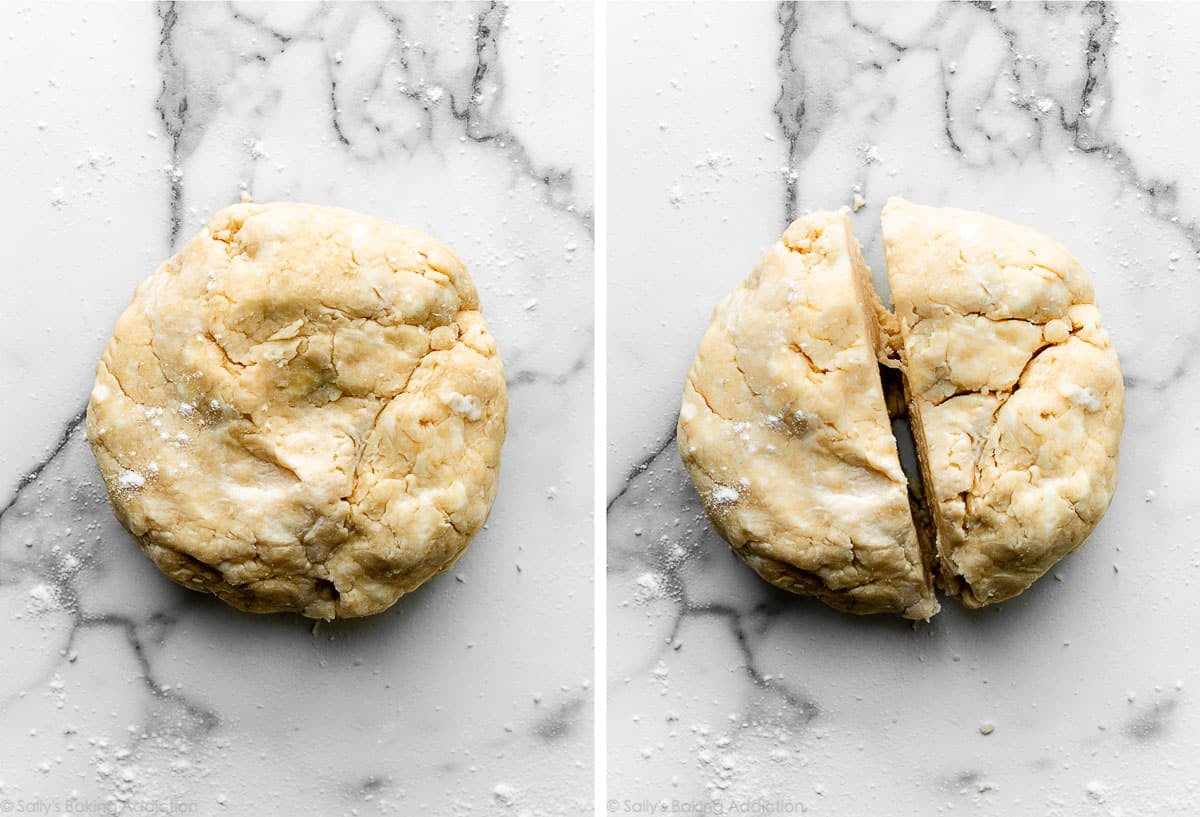
This is enough dough for 2 pie crusts. You can use both crusts for a double-crust pie, like chicken pot pie and strawberry rhubarb pie; or, if your pie doesn’t require a top crust, like coconut cream pie, brownie pie, and lemon meringue pie, save the second pie crust for another pie. You can also roll out the second dough and use cookie cutters to make an easy pie design, like on this pumpkin pie.
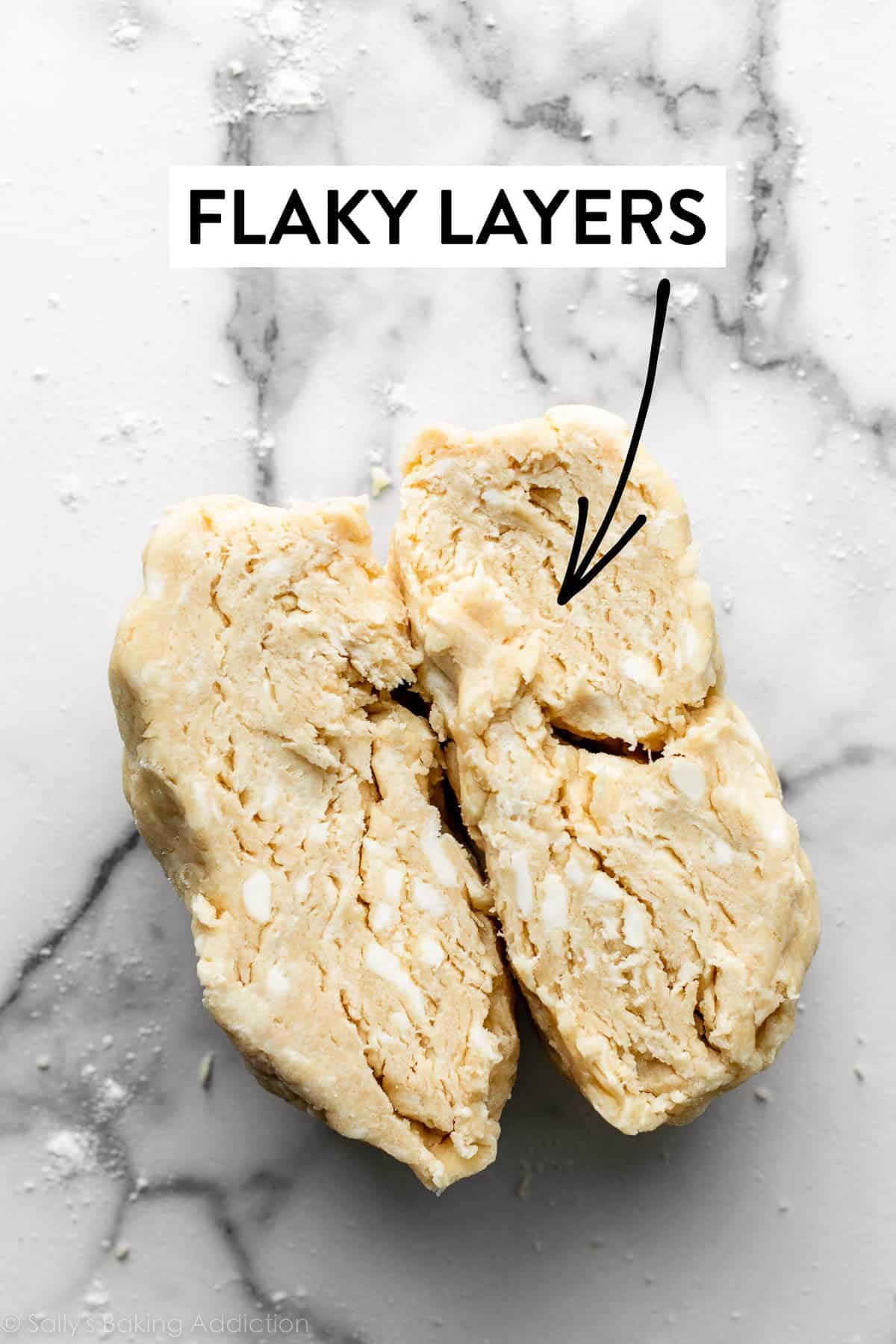
Success Tip: Visible Specks and Swirls of Fat in Pie Dough
Take a look at the inside of the dough where you just sliced it. You want to see pieces of butter and flaky layers throughout the pie dough. These specks and swirls of butter and shortening will help ensure a flaky pie dough. They are a GOOD thing!
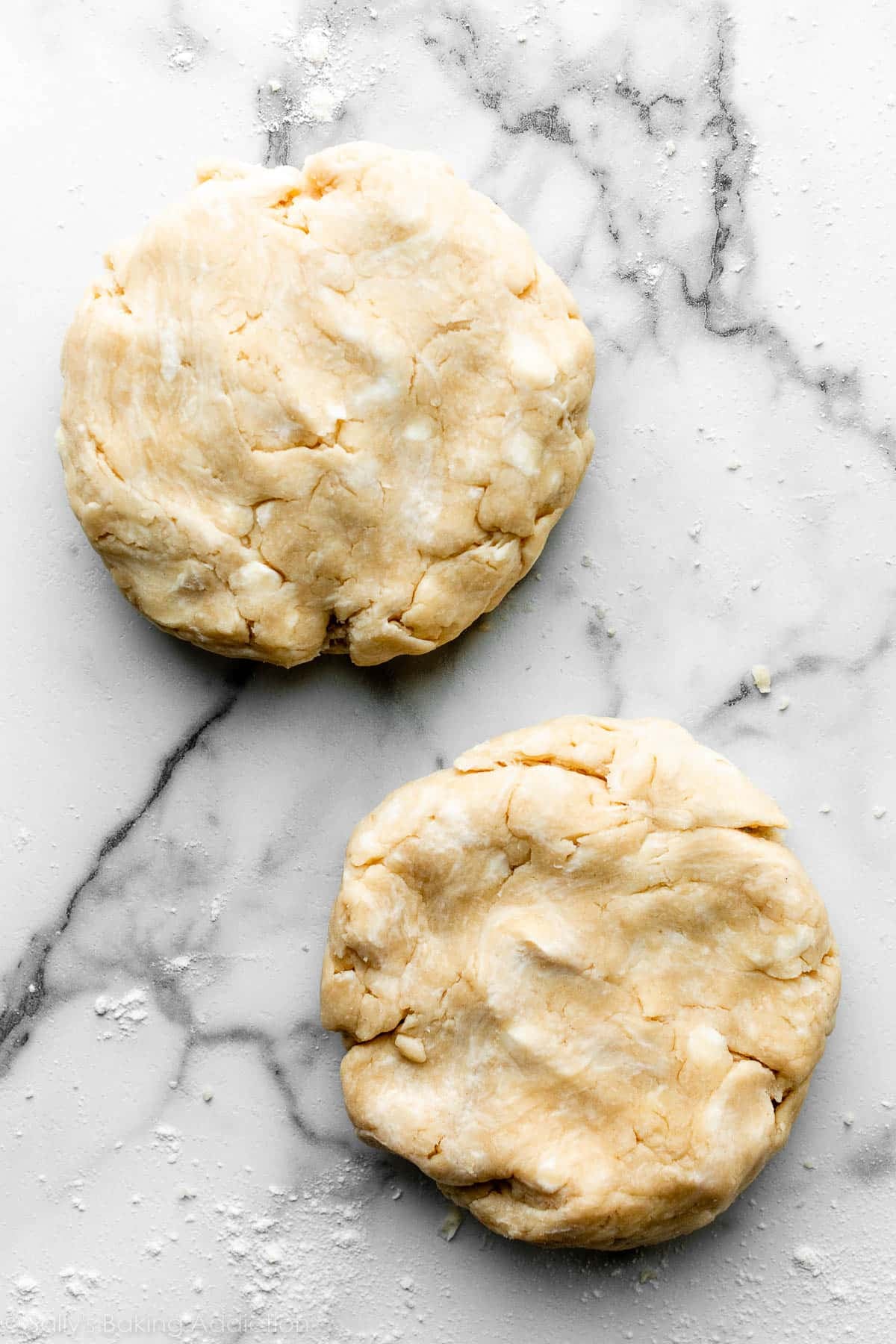
Now your pie dough is ready for a rest in the refrigerator. Flatten each half into 1-inch-thick discs using your hands. The disc shape makes it easier to roll out. Wrap each disc tightly in plastic wrap.
Refrigerate for at least 2 hours or up to 5 days.
Can I Freeze Pie Dough?
Yes, absolutely, and I encourage it! Pie crust freezes beautifully, so it’s a great thing to make ahead of time. Store the tightly wrapped discs of pie dough in the freezer for up to 3 months.
If you know you’re going to want several pies around the holidays, or when your favorite fruit will be in season (cherry pie, anyone?), you can cut down on the amount of time it takes to make pies from scratch the day you want them by making several pie crusts in advance and freezing them.
Thaw the pie crust dough overnight in the refrigerator before rolling it out. It will be extra cold, which is a great starting point.
How to Roll Out Pie Crust
After the dough has chilled for at least 2 hours, you can roll it out. Work with one crust at a time, keeping the other in the refrigerator until you’re ready to roll it out. You’ll need a clean work surface, a rolling pin, and some flour. Lightly flour the work surface, rolling pin, and your hands, and sprinkle a little flour on top of the dough. Use gentle-medium force with your rolling pin on the dough—don’t press down too hard on the dough; you’re not mad at it!
When rolling dough out, start from the center and work your way out in all directions, turning the dough with your hands as you go:
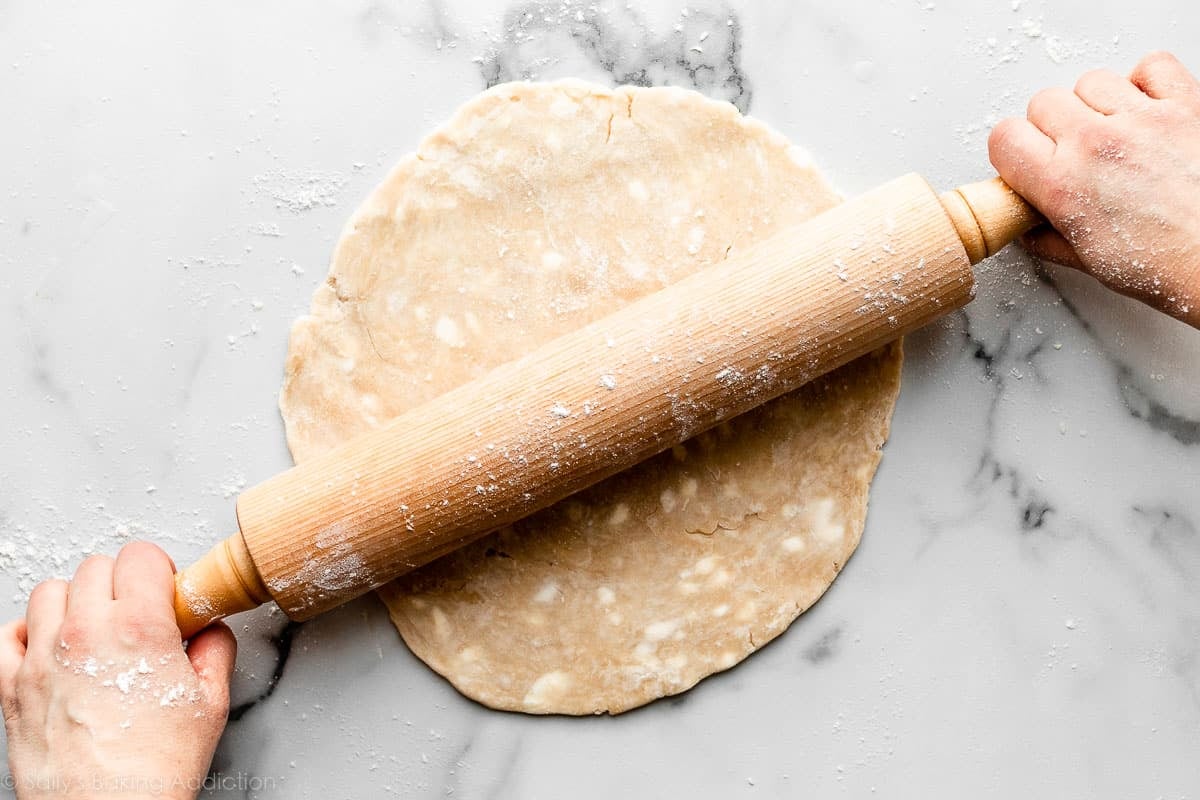
Between passes of the rolling pin, rotate the pie crust and even flip it, to make sure it’s not sticking to your work surface. Sprinkle on a little more flour if it’s sticking. Roll, turn. Roll, turn.
Do you see that beautiful marbling of the butter and shortening throughout the dough? Flaky layers, here you come!
Success Tip: If you notice the dough becoming a lopsided circle as you’re rolling it out, put down the rolling pin and use your hands to help mold the dough back into an even circle:
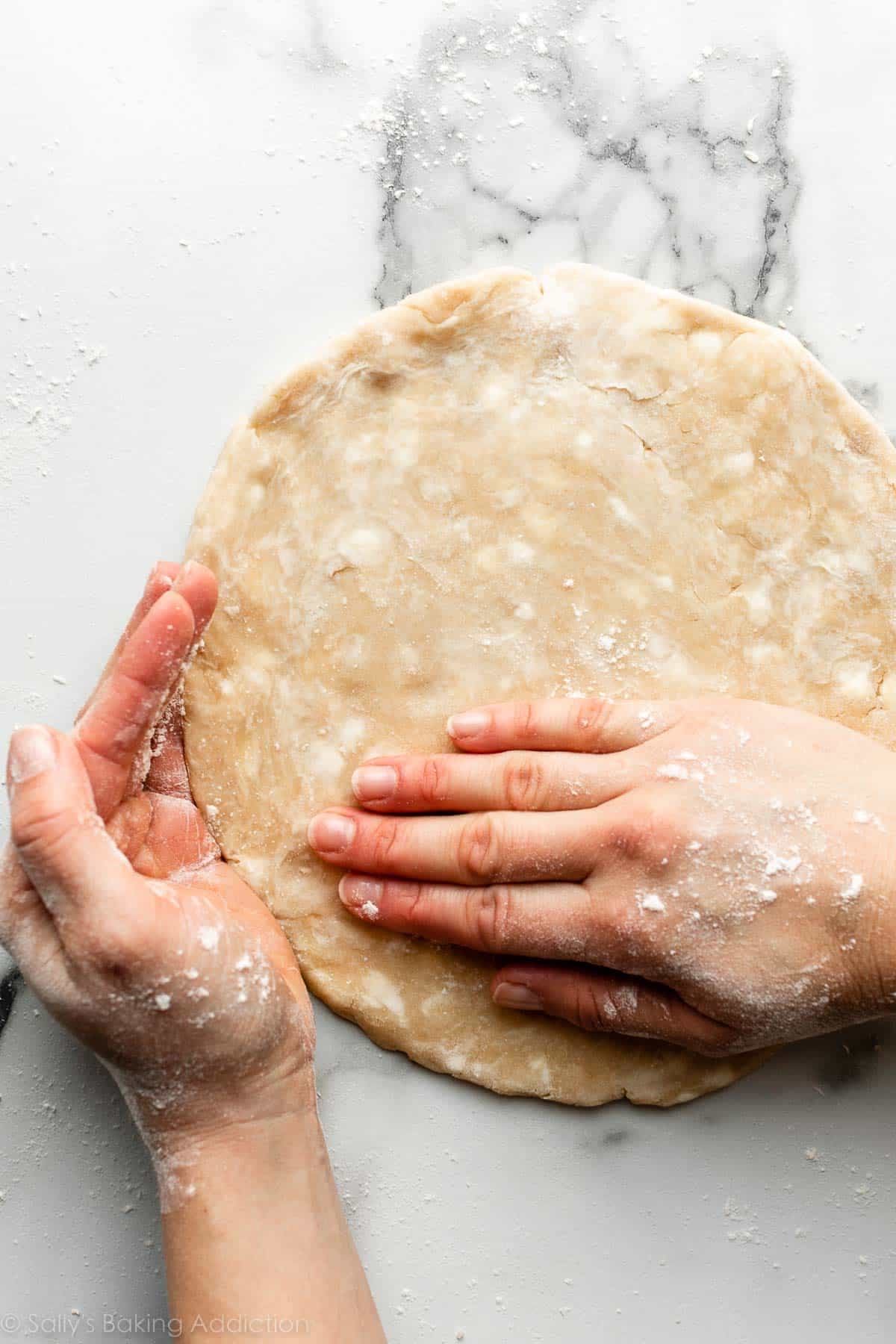
Roll the dough into a thin 12-inch circle, which is the perfect size to fit a 9-inch pie dish. You want enough crust to have some overhang so you can make a decorative edge for your pie.
Your pie dough will be about 1/8-inch thick, which is quite thin.
Success Tip: Since your dough is so thin, use your rolling pin to help transfer the pie crust to the pie dish. Carefully roll one end of the circle of dough gently onto the rolling pin, rolling it back towards you, slowly peeling it off the work surface as you go. Pick it up, and carefully roll it back out over the top of the pie dish. It’s helpful to watch how I do it in the video below.
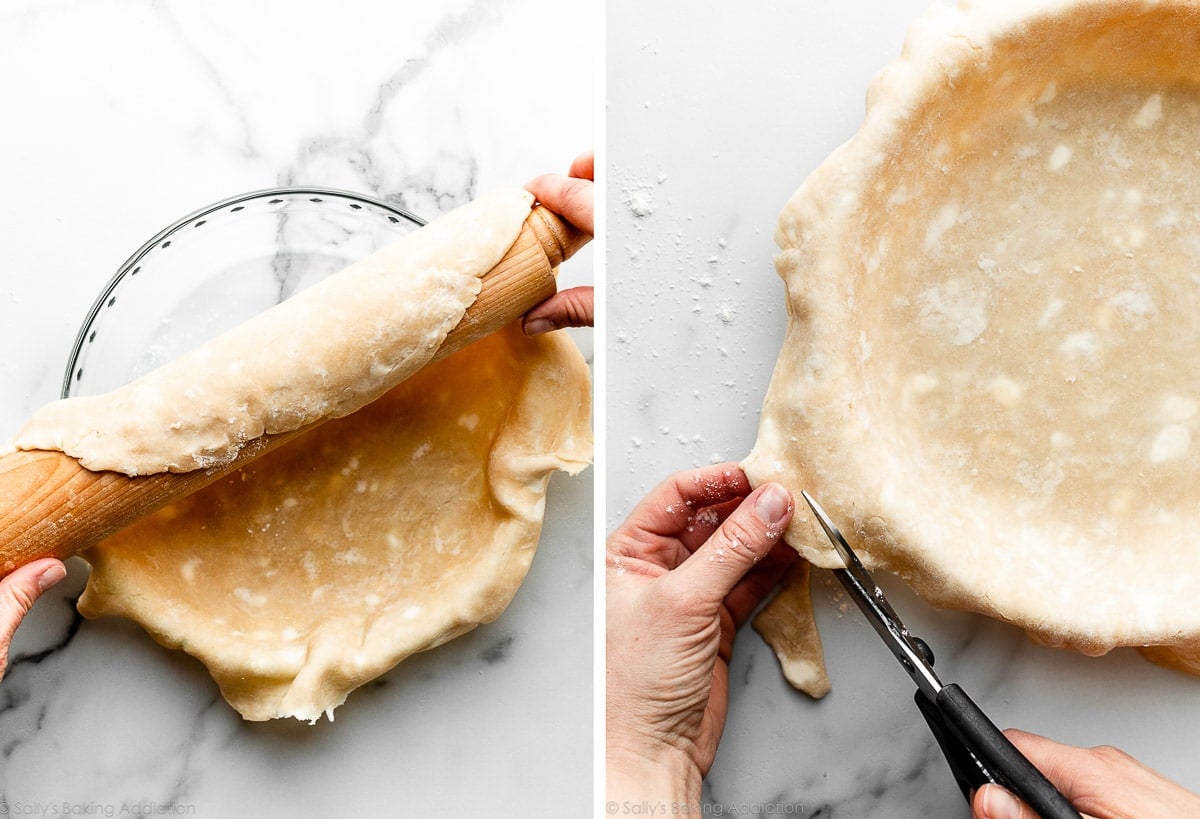
Make sure the pie crust is pretty well centered in the dish, with some overhang all around the sides. Tuck the crust into the pie dish, gently pressing it to the interior all the way around—no air bubbles.
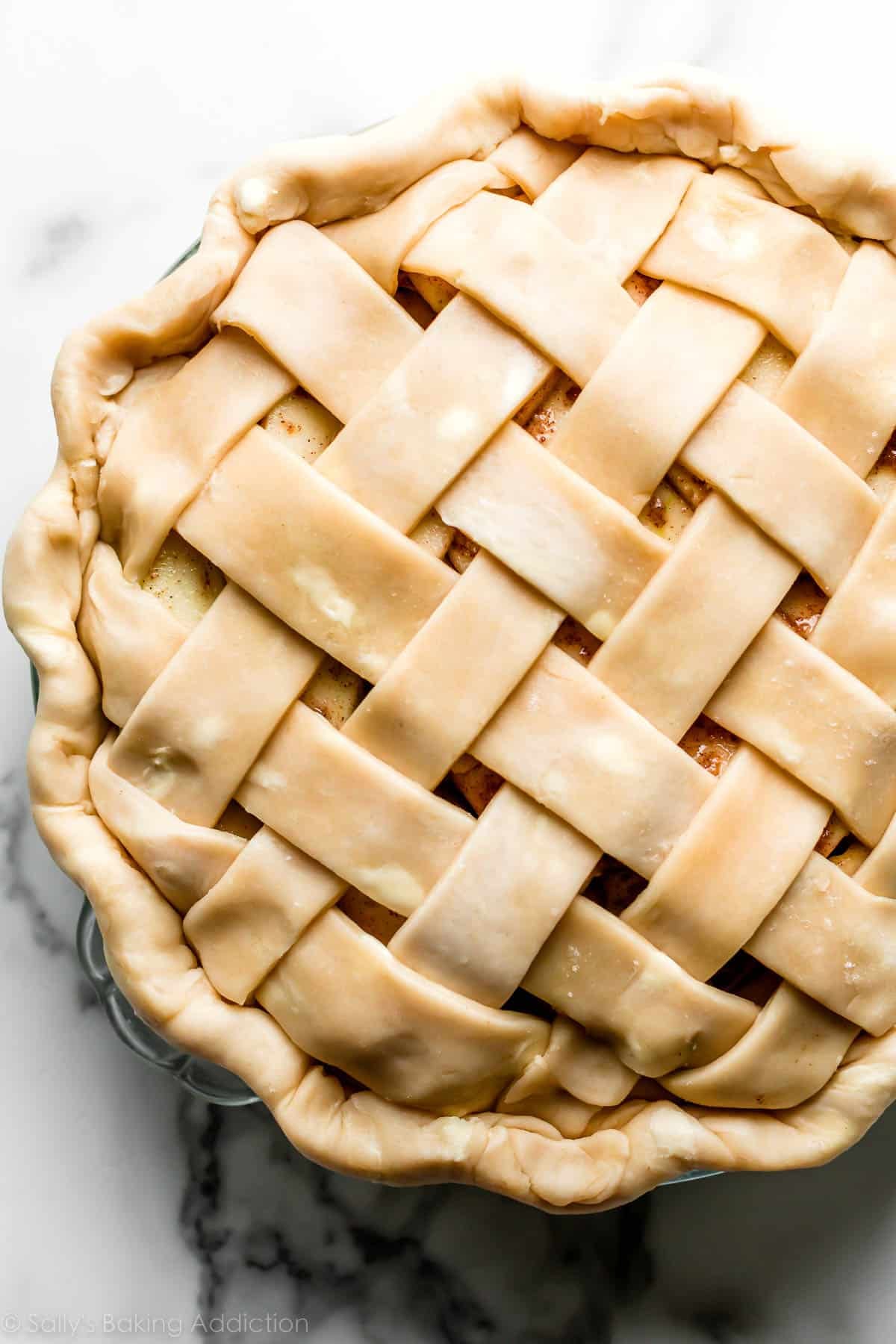
Trim dough around the edges if there’s excess dough in some spots—you want about 1-inch overhang. After you add your pie filling and top crust (such as a lattice pie crust), fold overhang back over and pinch the top and bottom crusts together. Now you can create a pretty edge, such as fluting or crimping. I have a full tutorial on how to crimp and flute pie crust, but here’s a quick overview:
Fluting with fingers: To flute the edges, use a knuckle and 2 fingers to press around the edges of the pie crust, to give it a beautiful and classic scalloped look, like this apple pie.
Crimping with fork: You can also use a fork to crimp the edges, like I do with this peach pie.
Again, review my how to crimp and flute pie crust page and video if you need a little extra help with this step.
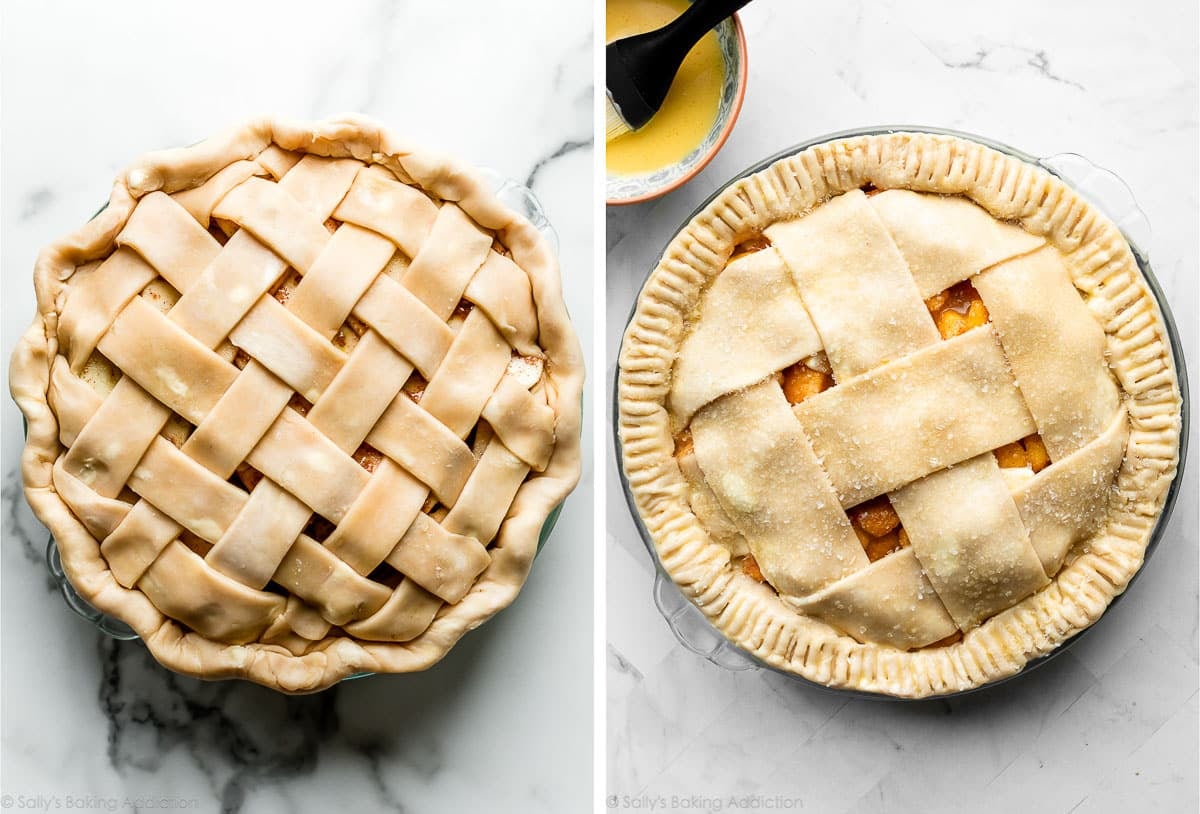
Your pie crust is ready to bake! Follow your pie recipe’s instructions from here; some recipes may call for a fully baked crust, and some may call for a partially baked (par-baked or blind baked) crust. You can read a tutorial on that here in this How to Par-Bake Pie Crust post. And some recipes, like this blueberry pie or triple berry pie, don’t require baking the crust at all before adding the filling, because the pie bakes for so long; just spoon/pour the filling right in.
Your pie recipe might call for an egg wash on the dough and for that, use a pastry brush. And if you bake a lot of pies, this list of 10 best pie baking tools will be helpful for you.
Troubleshooting Pie Crust
- Pie crust is tough: Tough crusts are the result of not enough fat in the crust, as well as overworking the dough. Use the recipe below (plenty of fat) and avoid handling the dough more than you need.
- Don’t have enough pie dough: This recipe yields 2 pie crusts. To ensure you have enough pie dough for overhang and a pretty topping, roll your dough out to a 12-inch circle, about 1/8 inch thick.
- Pie crust shrinks down the sides of the dish when baking: This can happen when par-baking a pie crust. See section below.
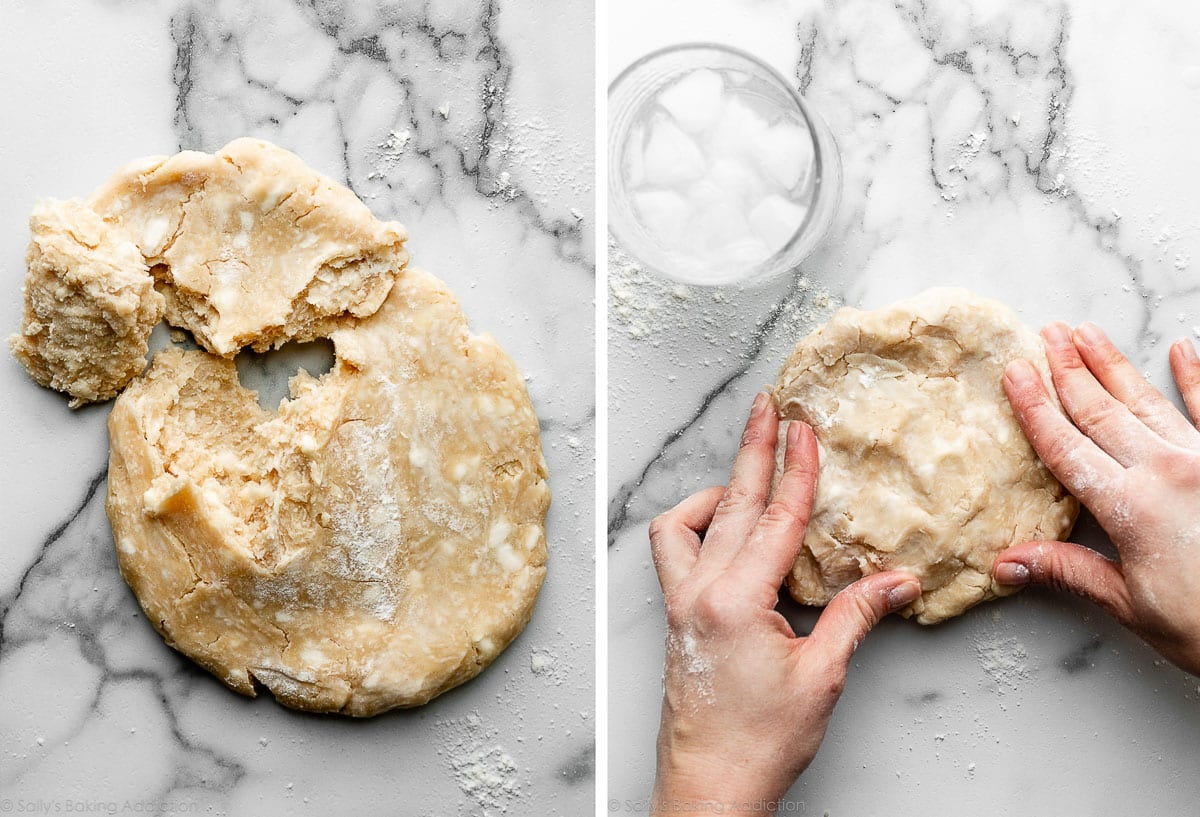
- Pie dough is dry & cracking around edges when rolling: Use enough ice water when preparing the pie dough. If you work the fats into the dry ingredients too much, the dough will feel too wet before you can add enough water. (And the dough will be dry and thirsty.) Do not overwork the fats in the dry ingredients—you still want those nice crumbles. If it’s too late and you notice the edges of your pie crust are cracking as you roll it out, dip your fingers in ice-cold water and meld the edges back together. Wait a minute, and then try rolling out again.
- Pie dough is falling apart & crumbling when rolling: The dough is likely crumbling because there’s too much fat, and not enough flour and water. Again, this is usually a result of fat being worked in too much, which can easily happen if the ingredients weren’t cold enough. (Refrigerate those dry ingredients before you start!) If it’s too late and the pie dough is crumbling as you roll it out, try adding more water AND more flour. Sprinkle a tiny bit of ice water and flour onto the cracks and crumbled pieces, and gently work it all in with your fingers. Wait a minute, and then try rolling out again.
Gently work ice water drops and flour into your crumbly pie dough to bring it back together:
Blind Baking Pie Crust
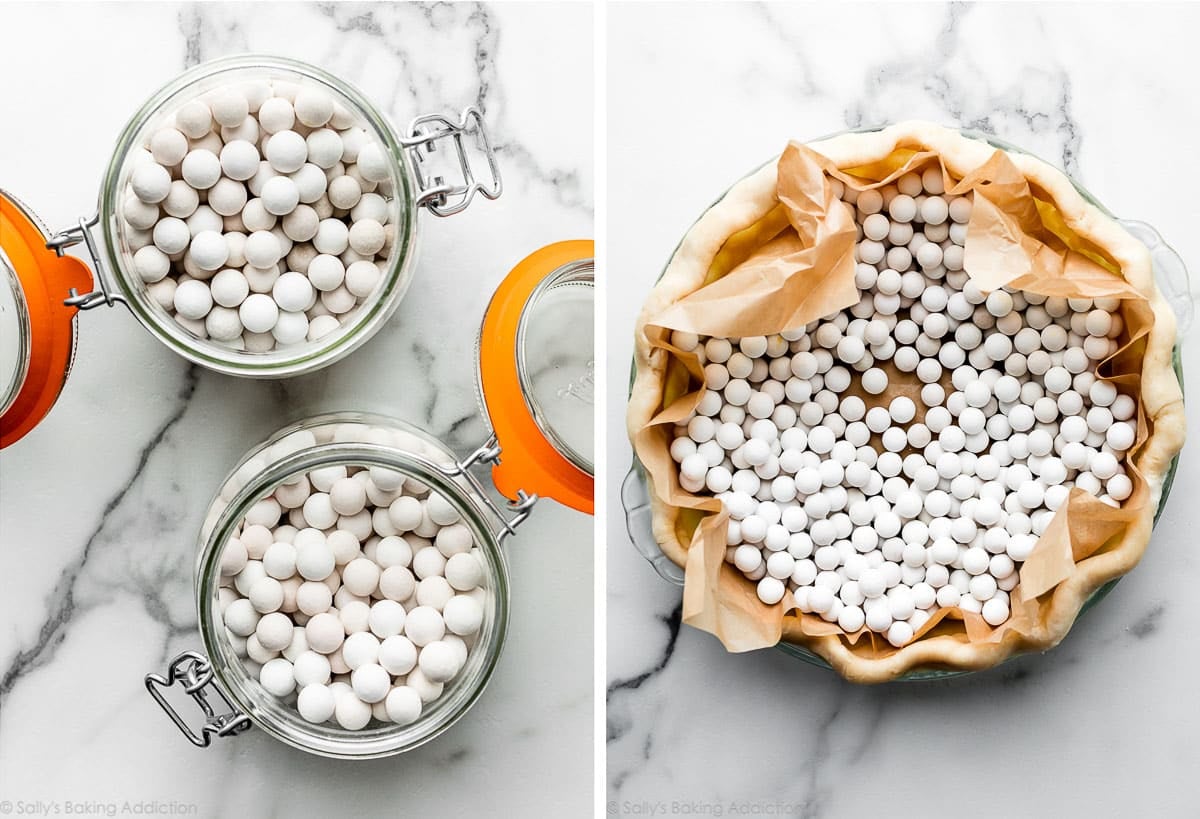
If your pie recipe requires a fully baked or par-baked pie crust before adding the filling, follow the directions and success tips in this How to Par-Bake Pie Crust guide. You need 2 packs of pie weights, which are metal or ceramic beads that serve to weigh down the crust to prevent the puffing/shrinking. You could use dried beans instead. Whichever you choose, be sure to line the crust with parchment paper, then fill the empty pie crust shell with the weights prior to baking. Without pie weights, the dough will puff up, and then shrink down the sides.
Pie Crust Success Tips
- Use a glass pie dish. I prefer using a glass pie dish when I make pie. Why? Glass dishes conduct heat evenly, which allows the bottom of the crust to bake thoroughly. Also, you’ll be able to see when the sides and bottom of the crust have browned.
- The refrigerator is pie dough’s best friend. Keep everything cold every step of the way: ingredients, the bowl, and the dough before rolling. When taking the pie crust out of the refrigerator to roll out and fill, make sure your pie filling is ready to go. If not, keep the pie crust in the refrigerator until it is.
- Keep dough cold when rolling out: Warm pie dough is unworkable. If the dough becomes too warm when you’re rolling it out, stop what you’re doing, pick it up as gently as you can, put it on a plate or small baking sheet, and then cover and refrigerate it for 10–20 minutes.
- Protect the crust edges from burning: Use a pie crust shield to prevent the edges from burning. A shield keeps the crust edge covered, but the center of the pie exposed, protecting the edges. I usually just make a pie shield out of a piece of aluminum foil. Take a piece of aluminum foil and fold it in half. Cut out a half circle. When you open it back up, you’ll have a square of foil with a circle cut out of the center. If you notice the edges of your pie crust are browning before the pie has fully baked, carefully and gently place the foil over the top of the pie, centering the cut-out hole over the pie. Carefully (obviously it’s very hot!) and lightly tuck the sides of the foil around the pie crust edges, then let the pie finish baking.
- Create a beautiful topping: For designing the top crust, see How to Lattice Pie Crust, How to Braid Pie Crust, or these Pie Crust Designs. And here is my tutorial on How to Crimp and Flute Pie Crust, too.
For more pie crust inspiration, see my graham cracker crust and homemade chocolate pop tarts (with a chocolate crust!).
Print
Homemade Buttery Flaky Pie Crust Recipe
- Prep Time: 15 minutes
- Cook Time: 0 minutes
- Total Time: 2 hours, 15 minutes
- Yield: 2 pie crusts (1 lb, 8 ounces dough total)
- Category: Pie
- Method: Baking
- Cuisine: American
Description
This recipe is enough for a double crust pie. If you only need 1 crust for your pie, freeze the other half per the Freezing Instructions below. Is your pie dough tearing, cracking, or crumbling as you try to roll it out? See recipe Notes.
Ingredients
- 2 and 1/2 cups (315g) all-purpose flour (spooned & leveled), plus more for shaping and rolling
- 1 teaspoon salt
- 6 Tablespoons (85g) unsalted butter, chilled and cubed
- 2/3 cup (130g) vegetable shortening, chilled
- 1/2 cup (120ml) ice cold water
Instructions
- Whisk the flour and salt together in a large bowl.
- Add the butter and shortening. Using a pastry cutter or two forks, cut the butter and shortening into the mixture until it resembles coarse meal (pea-sized bits with a few larger bits of fat is OK). In this step, you’re only breaking up the cold fat into tiny little flour-coated pieces; you’re not completely incorporating it. Do not overwork the ingredients.
- Measure 1/2 cup (120ml) of water in a cup. Add ice. Stir it around. From that, measure 1/2 cup (120ml) of water, since the ice has melted a bit. Drizzle the cold water in, 1 Tablespoon (15ml) at a time, and stir with a rubber spatula or wooden spoon after every Tablespoon has been added. Stop adding water when the dough begins to form large clumps. I always use about 1/2 cup of water, and need a little more in dry winter months. Do not add any more water than you need.
- Transfer the pie dough to a floured work surface. Using floured hands, fold the dough into itself until the flour is fully incorporated into the fats. The dough should come together easily and should not feel overly sticky. Avoid overworking the dough. If it feels a bit too dry or crumbly, dip your fingers in the ice water and then continue bringing dough together with your hands. If it feels too sticky, sprinkle on more flour and then continue bringing dough together with your hands. Form it into a ball. Use a sharp knife to cut it in half. If it’s helpful, you should have about 1 lb, 8 ounces dough total (about 680g). Gently flatten each half into 1-inch-thick discs using your hands.
- Wrap each tightly in plastic wrap. Refrigerate for at least 2 hours and up to 5 days.
- After the dough has chilled for at least 2 hours, you can roll it out. Work with one crust at a time, keeping the other in the refrigerator until you’re ready to roll it out. Lightly flour the work surface, rolling pin, and your hands, and sprinkle a little flour on top of the dough. Use gentle-medium force with your rolling pin on the dough—don’t press down too hard on the dough; you’re not mad at it! When rolling dough out, start from the center and work your way out in all directions, turning the dough with your hands as you go. Between passes of the rolling pin, rotate the pie crust and even flip it, to make sure it’s not sticking to your work surface. Sprinkle on a little more flour if it’s sticking; don’t be afraid to use a little more flour. If you notice the dough becoming a lopsided circle as you’re rolling it out, put down the rolling pin and use your hands to help mold the dough back into an even circle. Roll the dough into a very thin 12-inch circle, which is the perfect size to fit a 9-inch pie dish. Your pie dough will be about 1/8 inch thick, which is quite thin. Visible specks of butter and fat in the dough are perfectly normal and expected.
- Because your dough is so thin, use your rolling pin to help transfer the pie crust to the pie dish. Carefully roll one end of the circle of dough gently onto the rolling pin, rolling it back towards you, slowly peeling it off the work surface as you go. Pick it up, and carefully roll it back out over the top of the pie dish. It’s helpful to watch how I do it in the video below.
- Proceed with the pie per your recipe’s instructions. If your dough requires par-baking, see helpful How to Par-Bake Pie Crust tutorial.
Notes
- Make Ahead & Freezing Instructions: Prepare the pie dough through step 5 and freeze the discs for up to 3 months. Thaw overnight in the refrigerator before using in your pie recipe.
- Special Tools (affiliate links): Large Glass Mixing Bowl | Pastry Cutter | Rolling Pin | 9-inch Pie Dish | For more tools you may need to completely assemble and bake your pie, see my 10 Best Pie Baking Tools list.
- Salt: Use regular table salt. If using kosher salt, use 1 and 1/4 teaspoons.
- Shortening: This recipe uses a butter and shortening combination. Butter for flakiness and flavor, and shortening for its high melting point and ability to help the crust hold shape. You can use butter-flavor shortening if desired. If you want to skip the shortening, feel free to try this all-butter pie crust instead. Some readers have substituted lard for shortening in this recipe with success.
- Can I use a food processor? You can use a food processor to bring the dough ingredients together in step 1, but I find it quickly overworks the dough. For best results and a light, flaky crust, I recommend a pastry cutter.
- Pie dough is dry & cracking around edges when rolling: Use enough ice water when preparing the pie dough. If you work the fats into the dry ingredients too much, the dough will feel too wet before you can add enough water. (And the dough will be dry and thirsty.) Do not overwork the fats in the dry ingredients—you still want those nice crumbles. If it’s too late and you notice the edges of your pie crust are cracking as you roll it out, dip your fingers in ice-cold water and meld the edges back together. Wait a minute, and then try rolling out again.
- Pie dough is falling apart & crumbling when rolling: The dough is likely crumbling because there’s too much fat, and not enough flour and water. Again, this is usually a result of fat being worked in too much, which can easily happen if the ingredients weren’t cold enough. (Refrigerate those dry ingredients before you start!) If it’s too late and the pie dough is crumbling as you roll it out, try adding more water AND more flour. Sprinkle a tiny bit of ice water and flour onto the cracks and crumbled pieces, and gently work it all in with your fingers. Wait a minute, and then try rolling out again.
- More Crusts: If you need more than 2 pie crusts, make another separate batch of dough. Doubling or tripling the recipe leads to over- or under-working the dough, which ruins all of your efforts.








Reader Comments and Reviews
Hello Sally,
I was wondering if your pie crust recipe would hold shape if I use a cookie cutter to make different shapes to place on top of my pie? Thank you! Love your recipes!
Yes it will Adriana! There are several different ways to do this and we give all of our best tips and tricks in this post on Pie Crust Designs.
So if I do want to use lard what are the measurements for that? And do you use butter as well as the lard?
Hi Tammy, lard should work in place of the shortening without any other changes. Keep the butter. Enjoy!
I’ve found it’s hard to keep butter as cold as it needs to be when making pie crust because it softens so quickly. Do you recommend against using *frozen* butter and grating it into the mixing bowl instead of cutting up the refridgerated cubes?
Hi Ethan! You can use frozen butter and grate it for this pie dough. However, you’ll still need to cut it in. You can use a fork and mix very well.
Hi Mary! Cold shortening is vegetable shortening that has been chilled in the refrigerator. Cold fats are imperative for best results when making pie dough.
I am going to be baking 2 pumpkin pies for Thanksgiving this year. When separating the dough into the two discs, will each dough be enough for both pies? Also, because the pie filling is wet (pumpkin) do I need to pre-bake the crust? I usually use store bought dough and I have not made pie in a long while. Any help and/or tips would be greatly appreciated. Thanks!!
Hi Tabitha, the two discs will be enough for two bottom crusts of two pies, or one bottom and one top crust of two pies. We do par-bake our crust for pumpkin pie. Hope this helps!
Hello. Do you complete bake the pie crust when pre baking or just partially? Thank you- can’t wait to try this recipe!
Would you recommend blind baking the crust for a pecan pie? Also, would this bake well in a disposable metal pie pan?
Hi Christine, we don’t blind bake the crust in our pecan pie recipe. This crust will work in a disposable pan, but we prefer to bake with glass pie dishes for the most even baking (and so we can see when the crust is golden brown on the bottom).
Do you recommend sifting the flour for this ?
Also, if you wanted to sweeten your dough, would adding 1 TBSP of sugar mess up the ratios ? Thanks!
Hi Maria, it’s not necessary to sift the flour for this dough but you certainly can after you measure it. 1 Tablespoon of sugar would not mess up anything in the dough. Use regular white granulated sugar, not brown. Mix it in with the salt + flour.
Hi Sally, I just made this pie crust recipe for the first time and it was delicious. I’m an experienced home cook and had been using a famous chef’s french pastry dough for years, but recently it hasn’t turned out quite as well in times past. At any rate, I followed your directions to the letter (something I’m not known for doing), but I found the dough to be very fragile. I had a hard time rolling out and getting into the pie plate. It wanted to tear and really just fall apart. And, everything was cold. Could it be the high shortening content? I love all of your recipes and really want this to be my go-to pie crust. Any ideas about what I could have done wrong?
Hi Elizabeth, was the dough sticky? When dough is too fragile and sticky, there’s always a fix– add more flour. Keep adding flour to your work surface, rolling pin, and hands. If it’s cracking because it’s flaking apart, a spritz of water helps bring it back together. Or moisten your fingertips to help bring the dough back together. Hope this helps!
Can I substitute KA Bread Flour instead of all-purpose?
Hi Sally, We don’t recommend bread flour for pie crust. It would yield a very chewy texture, which is perfect for bread, bagels, etc. but not for a tender, flaky crust. It’s best to stick to all-purpose flour here.
Can’t wait to try this. I’ve been struggling with crusts for years. Everyone I make gets worse and worse, but this looks like one I can do. I’ll let you know. In the meantime, I have a pie I’d like to make that I used to buy in a restaurant. No body knows where they got it, maybe with your expertise you could figure it out. It was called “Bourbon Pecan”. It’s had a cake crust, not pie crust. The filling was Not gooey, and it was about 1 1/2″ high. It had pecans on tops – but not smothered. The Bourbon flavor was not overpowering. I’ve looked everywhere – but everyone seems stuck on the tradition sickening sweet Pecan Pie. I bet you could figure it out! I hope you try.
Hi Sandra, we hope you love this pie crust! That bourbon pecan pie sounds absolutely incredible, but we’ve never heard of anything like it with a cake crust. So sorry we can’t help more but let us know if you find it!
I would love to use butter – but I can’t . I the the pie to be non-dairy. Do you think the recipe will work with Earth’s Balance margarine? Thank you!
Hello! We haven’t tested Earth Balance margarine in this recipe, but let us know if you give it a try! You can also make a pie crust with lard if you can find it.
What depth of pie plate do you use? A regular depth or deep dish? I have regular depth Pyrex & deep dish Emile Henri.
Hi Lynn! Unless otherwise stated (like with our deep dish apple pie recipe), we’re using a standard 9 inch pie dish, 1.75 inches deep.
I was a bit nervous making this the first time but hubby and I absolutely love it. Thank you for your well written instruction and inspiration!!!
I was wondering if I could use King Arthur Measure for Measure GF flour?
Hi Katherine! We haven’t tested this pie crust recipe with GF flour but let us know if you do.
Thanks, best pie crust ever and I used 1/4 cup of Vodka, great idea! And I’ve always wanted to know how to do a lattice pie crust. Your video was perfect for teaching me, Thanks again. I’ll be using more of your recipes
Thank you so much for giving this pie crust recipe a try, Diana – so glad you enjoyed it!
Thank you! I made the crust using lard in place of the shortening and it turned out great. Definitely the flakiest most tender pie crust I have ever made 🙂
Hi, I was wondering if I need to blind bake the crust for a pumpkin pie? I am new to baking and don’t know when to blind bake or not.
Hi there, this may not be the case for every pumpkin pie recipe, but we do recommend par-baking the crust in our pumpkin pie recipe.
this crust was amazing! this was my first time using shortening in a crust and it made all the difference in making it easier to handle. thank you!
question — my sister is lactose-intolerant so I want to make a dairy free crust for her. I am able to get some high quality lard from our local grocery store — how would i adapt this recipe using lard? 100% lard for the fat, or a mix of lard and shortening?
Hi Kaedan, you can try replacing the shortening with lard or using all lard, but the pie crust may not be as flakey. Let us know what you try!
I thought at first that if using kosher salt, you were recommending using more of it because table salt contains fillers like dextrose and silica (so less salty) but that doesn’t make sense because then one would use less kosher salt, not more.
Could you please elaborate on this?
Absolutely. Kosher salt is actually less salty measure for measure because it weighs less than regular table salt.
A few years ago I discovered an all butter recipe and it was amazing! But the last two times I’ve tried it the crust was tough and terrible and I heard that the problem is the butter – that they are feeding cows differently which is changing the butter. Your thoughts and wondering if there is a better brand of butter?
Hi Jennifer! Overworking or over-handling pie dough can create a tough textured crust. I usually like using a mix of shortening and butter because shortening has a higher melting point so the crust holds onto flaky layers and shape better. (I also find it makes the dough a bit more pliable.) I don’t have a specific brand of butter I use all the time– usually store brand or what’s on sale.
Hi Sally. Made this crust last night. Rolled it out today and made a chicken potpie. It was delicious! The crust was so light and flakey! I think the trick is just make sure everything is really cold. I actually had my cubed butter in the freezer, while waiting for my shortening to chill. It was frozen. Next time I’ll put it in the freezer for 5 minutes or so before using it. Anyways thank you for this recipe! Best pie crust I ever made!
thank you! I don’t have shortening so this is helpful.
Ummmm…This is the best pie crust I’ve ever made. What did you think you were making?
I just made this crust and it’s the first one ever that came out really well (except I forgot the salt!!). I sprinkled it onto the dough before rolling it out. I only used a slight amount since it wasn’t mixed in. It could have used more. I watched your video and you say you use 1 1/14 tsp but the recipe only calls for 1? I’m going to use this recipe going forward and want to make sure I use the right amount. I also made your salted caramel apple pie recipe. So good! Thanks for sharing your recipes and tidbits.
I’ve been making my own pie crust for years and made this one last year for Thanksgiving. I used a 1/4 cup vodka and a 1/4 cup water like mentioned and it was truly incredible!! I had never gotten flakes like I did with this recipe. I already have vodka in the freezer to get ready for this year.
I have never frozen a pie crust before but am thinking of doing that this year to save with time. When this thaws, will it get soggy or release any liquids from being frozen? Since I’ve never done this before, I’m apprehensive to do this.
Thank you for your recipes!! I never made one that I didn’t enjoy!!
Thank you for your kind note, Kim! We’re so glad to hear this pie crust recipe was a success for you. You can definitely freeze it (see recipe notes for details) and it won’t be soggy upon thawing. We do it all the time and it works wonderfully. Happy baking to you!
Hey, I made this dough tonight and I’m not sure if 1 disc is for one pie or I use both discs at the same time?
Hi Avril, one disc is for one pie crust. You can use the other to top the pie if you wanted/if the recipe calls for it, or save it for another pie in the future.
I measured everything on my digital scale. With 138 g of shortening, my dough turned out too soft even with less than 1/2 cup ice water. I had to add more flour in order to shape them into discs. I have 2 discs in the fridge and will use them in 2 hours.
I love this recipe. I made beef pot pies with it .
Hi Sally!! My hands are becoming more arthritic and I’m having a hard time getting my crust done. Can I use the food processor or will that make the dough tough? Thanks!!
Hi Y, We find it’s very easy to overwork the dough when using a food processor, so if you want to try it just use the pulse function as few times as it takes.
Thanks!! Going to attempt it later!
Can I increase butter and decrease lard? If so what would the measurements be that make a more flaky crust. Thanks
Hi Rob, You can actually use all butter if you wish. Here is our post on an all butter pie crust.